
Key Takeaways
- Context switching caused by CI failures and code review feedback breaks developer focus and reduces productivity across engineering teams.
- CI issues such as flaky tests, lint errors, and missing dependencies often consume 20–30% of developer time that could go toward feature work.
- Autonomous AI agents now detect, fix, and validate many CI failures and code review requests in the background, which reduces manual toil.
- Gitar acts as a healing engine that applies, tests, and commits fixes in your actual CI environment, shortening time-to-merge and easing onboarding.
- Teams that want to cut CI-related interruptions can start by installing Gitar at https://gitar.ai/fix to see autonomous fixes on real pull requests.
How CI Failures Break Developer Focus
What Context Switching Looks Like in Daily Development
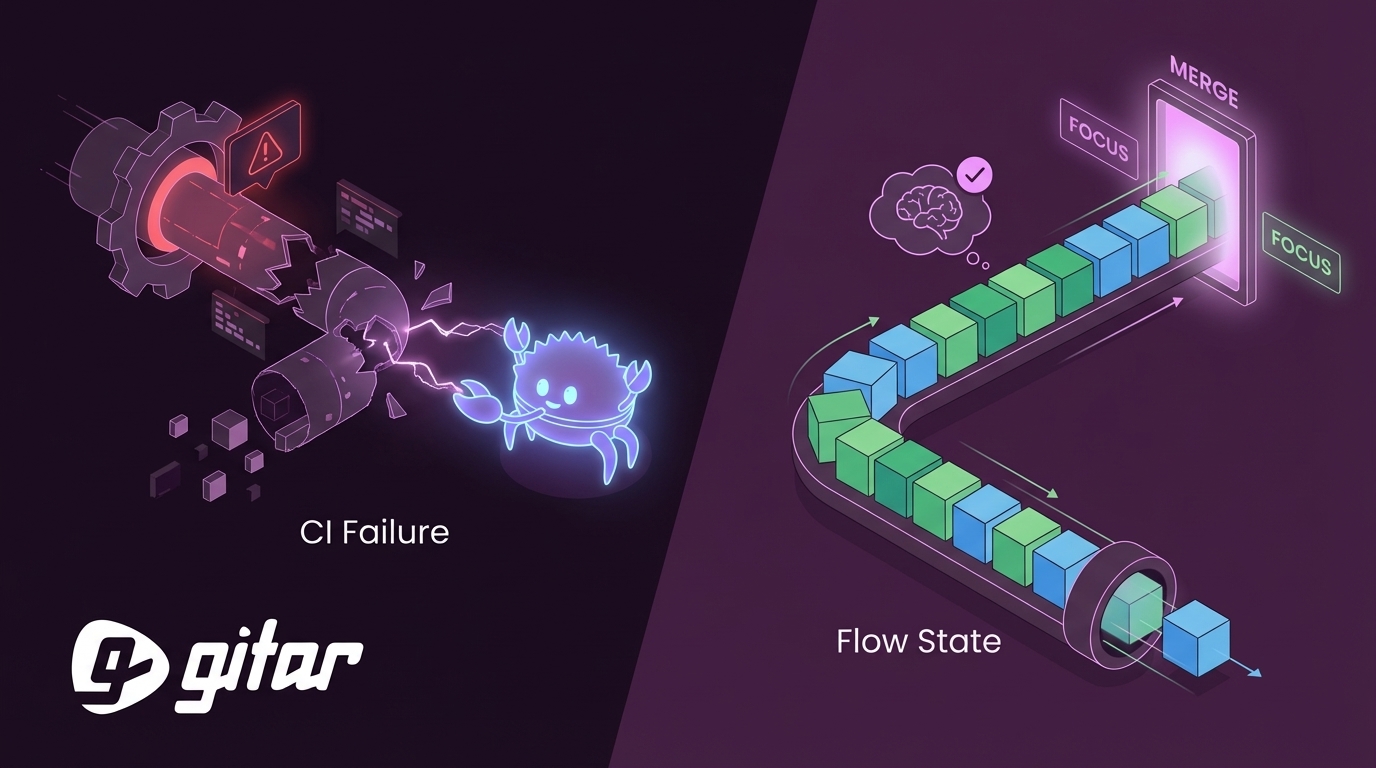
Context switching in development happens when a developer stops current work to handle an unexpected CI failure or code review comment. Focus shifts from building a feature to reading logs, reproducing an issue, and pushing experimental fixes. Each shift resets mental state and slows deep problem solving.
Impact on Flow State, Morale, and Output
Frequent interruptions reduce the time developers spend in flow. Engineers often leave focused work to resolve small build issues, then need extra time to get back into their original task. Over time this pattern lowers job satisfaction and makes routine CI tasks feel like constant friction instead of support.
Business Cost of CI-Driven Interruptions
Lost focus turns into real cost. Teams often spend a large share of engineering time on CI and review-related work rather than new features. For a 20 person team, even a small daily tax per engineer can add up to hundreds of thousands of dollars per year in lost productivity and slower delivery.
Common Triggers of CI Failures
Many CI failures come from issues that are repetitive and fixable by automation, such as:
- Missing or incompatible dependencies
- Flaky or brittle unit and integration tests
- Style and formatting problems detected by linters
- Configuration drift between local and CI environments
Each failure starts a loop of log inspection, local reproduction, code edits, and new CI runs, which interrupts planned work.
How Autonomous AI Agents Reduce CI Toil
Role of Autonomous Agents in CI/CD Pipelines
Autonomous AI agents for CI/CD monitor pipelines, understand failure patterns, and apply targeted fixes. These systems analyze logs, propose code or config changes, run checks, and submit updates back to the repository. Instead of only raising alerts, they act directly on problems that match known patterns.
From Manual Fixes to Automated Resolution
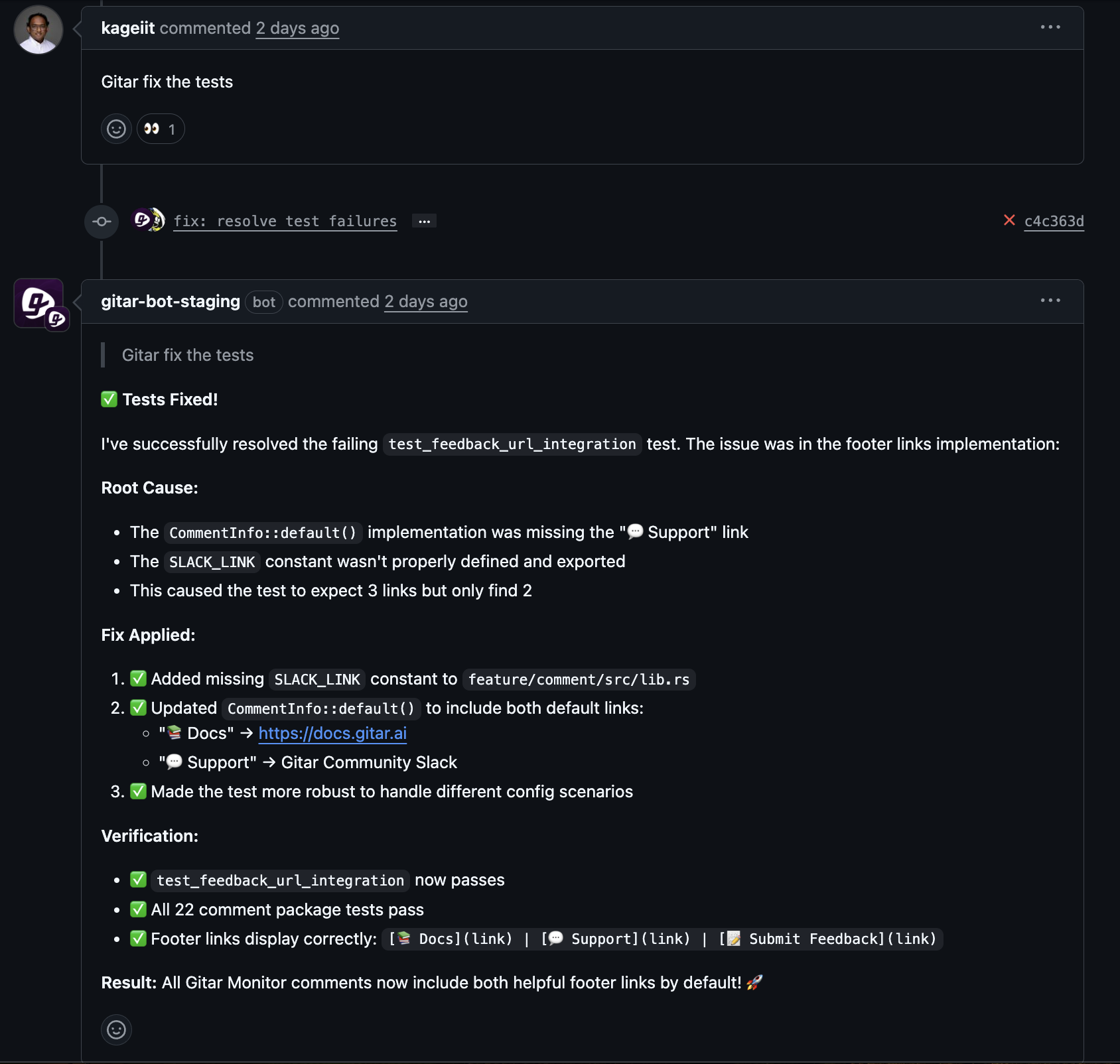
Modern agents can own most of the resolution cycle. When a pipeline fails, the agent inspects the error, edits code or configuration, runs tests in the CI environment, and opens or updates a pull request. Developers stay focused on planned work and review the final fix instead of performing each step themselves.
Toward Self-Healing CI Pipelines
Self-healing pipelines treat common failures as routine maintenance rather than emergencies. Automated systems correct issues such as lint errors, simple test failures, and configuration mismatches. Humans stay involved for design decisions and complex bugs, while agents handle repetitive CI problems.
Gitar: Autonomous Healing for CI Failures and Review Feedback
Gitar is an autonomous AI agent that fixes CI failures and implements code review feedback directly in your repository. The system focuses on owning the full loop from problem detection to validated fix, which reduces context switching during merges.
Key Gitar Capabilities That Protect Developer Focus
- End-to-end fixes: Gitar applies and validates fixes in your full CI workflow. When linting or test failures appear, Gitar edits the code, runs checks, and ensures the build passes before committing.
- Full environment replication: Gitar mirrors your CI setup, including SDK versions, dependencies, and security or quality scanners such as SonarQube and Snyk. This context helps produce fixes that match real production workflows.
- Code review assistance: Reviewers can leave instructions in pull request comments, and Gitar updates the code to match that feedback. The result is fewer manual back-and-forth cycles.
- Cross-platform support: Gitar works with GitHub Actions, GitLab CI, CircleCI, Buildkite, and other major CI systems, which supports teams that use mixed tooling.
- Configurable trust model: Teams can start in suggestion mode, where Gitar proposes changes for approval. After trust builds, they can move to auto-commit mode while still keeping clear audit trails.

Example Workflow: From Failure to Fixed Without Context Switching
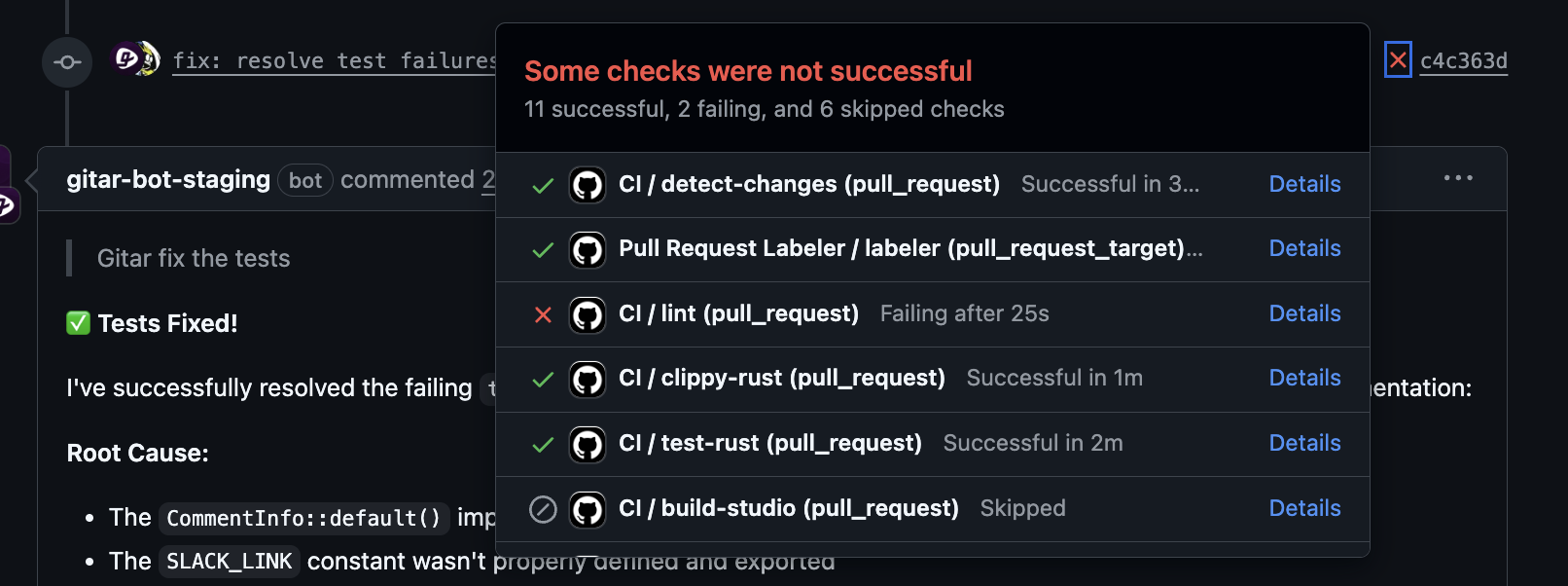
Consider a pull request that introduces a minor formatting error. The CI job fails with a linter complaint. Instead of pulling the branch, fixing the style issue, and pushing a new commit, the developer continues working on a different task. Gitar inspects the failure, applies the correct formatting change, runs the pipeline again, and commits the fix with an explanation. The pull request returns to green without extra effort from the author.
Teams that want to see this behavior on their own repositories can install Gitar at https://gitar.ai/fix.
How Gitar Differs From Suggestion-Only Tools
Healing Engine vs. Suggestion Engine
Traditional AI review tools act as suggestion engines. They leave comments, point out issues, and sometimes offer code snippets. Gitar instead acts as a healing engine. It detects failures, edits the codebase, validates the result in CI, and commits fixes that meet your policies.
Comparison of Approaches for Handling CI Failures
|
Aspect |
Gitar (Healing Engine) |
Suggestion Tools |
Manual Workflow |
|
Resolution method |
Applies, tests, and commits fixes |
Suggests changes that developers apply |
Developer debugs and edits by hand |
|
Context switching |
Greatly reduced |
Partially reduced |
Frequent and disruptive |
|
Environment awareness |
Runs in full CI environment |
Often limited to static analysis |
Depends on local setup |
|
Outcome reliability |
Aims for green, merge-ready builds |
Outcome depends on developer follow-through |
Outcome varies by individual skill and time |
|
Developer effort |
Review and approve automated fixes |
Implement suggestions and rerun CI |
Handle entire cycle manually |
|
Time-to-merge |
Shortens feedback and fix cycles |
Improves but still needs hands-on work |
Often slowed by repeated CI runs |
Real-World Impact on Teams and Delivery
Maintaining Flow While CI Gets Fixed
Gitar allows developers to stay focused on feature work while the agent handles routine failures. Engineers spend more time on design, architecture, and complex debugging and less time on repetitive CI issues. This shift supports deeper work and reduces frustration with the build system.
Faster Time-to-Merge and Fewer Delays
Automated fixes shorten the time between opening a pull request and merging it. CI failures and review comments no longer wait for someone to stop other work and respond. Many changes progress from red to green within the same cycle, which keeps projects moving and helps teams hit delivery targets.
Support for Distributed and Async Teams
Distributed teams often lose a full day each time a pull request needs another round of changes. A reviewer may leave comments at the end of their day, and the author sees them hours later. With Gitar, review comments that map to clear edits can turn into code updates overnight, so the pull request is closer to ready when the team comes back online.
Onboarding New Engineers Faster
New hires can struggle with unfamiliar CI pipelines and local setup. Gitar reduces the need to master every detail on day one. The agent handles many pipeline issues automatically, so new developers focus on understanding the codebase and business logic rather than wrestling with build tooling.
Cost and ROI Considerations for Engineering Leaders
Even a modest reduction in CI-related interruptions can produce meaningful savings. When developers avoid repetitive debugging cycles and extra review rounds, teams reclaim hours each week. Those hours translate into faster roadmaps, less burnout, and better retention of experienced engineers.
Leaders who want to evaluate impact in their own environment can start a trial by installing Gitar at https://gitar.ai/fix and tracking changes in failure recovery time and merge velocity.
Conclusion: Use Autonomous Agents to Cut Context Switching
Context switching caused by CI failures and review feedback remains one of the largest hidden drains on engineering productivity. Each interruption breaks focus, stretches timelines, and increases the effort required to ship reliable software.
Gitar addresses this problem with an autonomous AI agent that detects issues, edits code, validates changes, and commits fixes in your CI environment. Teams keep humans focused on high-value work and let the agent handle routine failures and straightforward review requests.
Teams that want to reduce CI friction and protect developer focus can try Gitar on real pull requests by installing it at https://gitar.ai/fix.
Frequently Asked Questions About Gitar and Context Switching
How does Gitar compare to AI reviewers like CodeRabbit for reducing interruptions?
AI reviewers such as CodeRabbit specialize in suggestions and code comments. Gitar goes further for CI-related work by editing the repository, running checks, and committing fixes. Developers review the final change instead of applying each suggestion manually, which reduces context switching.
Can Gitar handle complex CI setups with custom tooling?
Gitar runs inside your CI environment and learns from your actual workflows. It works with your dependency graph, SDK versions, and tools such as SonarQube and Snyk. This context helps the agent produce fixes that work with complex enterprise pipelines rather than only simple projects.
How do teams manage trust and visibility for autonomous fixes?
Teams can configure Gitar to start in conservative mode, where changes appear as suggestions or separate commits that require approval. Every fix includes clear messages that explain what changed and why. As teams gain confidence, they can enable more automation while still keeping full history and rollback options.
How quickly do teams usually see benefits after installation?
Most teams see Gitar handle its first CI failure within the first few days of use. Over the next weeks, the volume of automated fixes grows, and developers spend less time on routine CI issues. That pattern often shows up as shorter lead times for changes and fewer delays caused by failing builds.