
Key Takeaways
- CI failures and slow code reviews continue to drain developer productivity in 2026, especially as teams ship more code faster.
- Traditional DevOps continuous integration tools surface problems but still require manual debugging, re-runs, and context switching.
- Autonomous CI fixing keeps developers in flow by diagnosing common failures, applying fixes, and validating them directly in the pipeline.
- Teams lower operational costs and shorten PR cycle times when an agent owns repetitive CI fixes and routine code review changes.
- Gitar adds this autonomous layer on top of existing CI, automatically fixing broken builds and review changes so teams can ship with fewer interruptions. Install Gitar to try autonomous CI fixing in your own repos.
The Problem: Why Traditional DevOps Continuous Integration Tools Fall Short
Developer Productivity Drain
Modern teams ship frequent changes, so every red pipeline interrupts focused work. Developers often spend a large share of each day inspecting logs, reproducing failures, and re-running jobs. Common CI pipeline failures include build and test failures, environment issues, dependency problems, resource constraints, configuration errors, test flakiness, integration gaps, code quality issues, and security scanning failures. Each failure forces a context switch away from feature work into reactive debugging.
Frequent culprits include flaky automated tests, deployment breakdowns, mismanaged configuration, and version control oversights. These issues compound as teams add more services, more tests, and more contributors.
High Operational Costs
Lost engineering hours translate into real cost. For a mid-size team, recurring CI firefighting can easily add up to hundreds of thousands of dollars per year in wasted capacity. Project timelines slip, releases bunch up, and managers spend time triaging failures instead of planning improvements. Pipeline challenges such as environment inconsistency, resource-heavy builds, and coordination issues across teams drive much of this overhead.
Engineering Bottlenecks
AI-assisted coding tools now generate code faster than ever. Pull request volume rises, test suites grow, and validation becomes the main constraint. Traditional DevOps continuous integration tools run checks and report failures but stop short of acting on them, so developers still absorb all of the repair work.
Flaky Tests and Environment Discrepancies
Teams still face the classic “it works on my machine” scenario. Differences in operating systems, tool versions, environment variables, file paths, and timezones frequently cause CI-only failures. Flaky tests that depend on timing, shared resources, or external services create additional noise and slow down every merge.
Dependency Management and Resource Constraints
Overloaded servers and networks struggle with concurrent tests and long-running builds, which leads to intermittent failures and timeouts. Dependency conflicts, missing packages, and network outages introduce more instability. Each incident usually requires a human to read logs, search for fixes, and push another commit.
Code Review Delays and Distributed Teams
Code review creates another bottleneck, especially across time zones. A small change can bounce between author and reviewer for days as comments land overnight and fixes wait for the next workday. Manual implementation of review feedback adds more toil and more room for mistakes.
Install Gitar to reduce time spent on broken builds and slow reviews.
The Solution: Introducing Gitar – The Autonomous DevOps Continuous Integration Tool
Gitar extends existing DevOps continuous integration tools with an autonomous agent that not only detects problems but also applies and validates fixes. Instead of treating CI as a read-only signal, Gitar treats it as a closed loop that can heal common failures on its own.
Key Capabilities of Gitar as a DevOps Continuous Integration Tool
Gitar focuses on the repetitive, high-volume work that slows teams down:
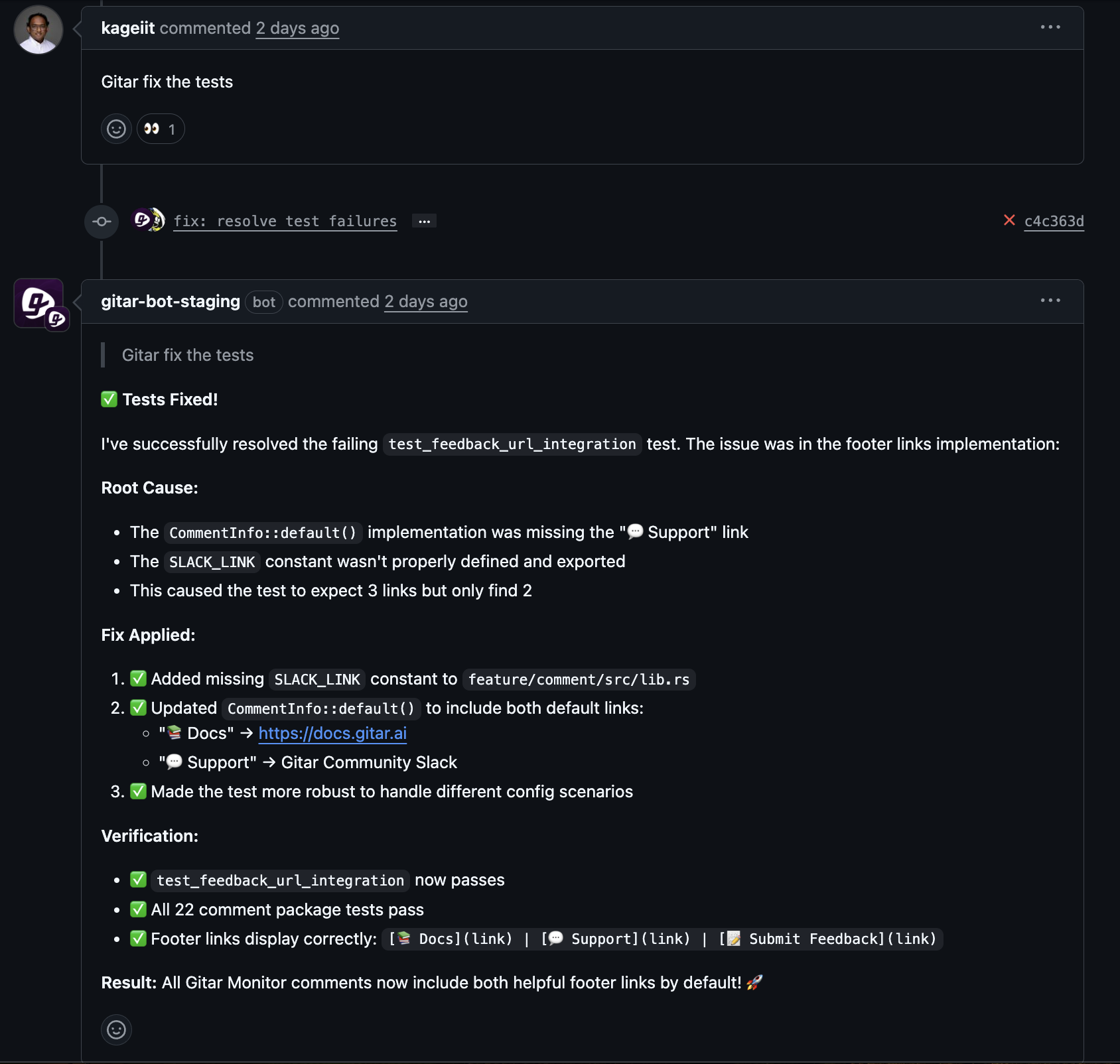
- Autonomous CI fixes: When linting errors, formatting issues, simple test failures, or straightforward build problems occur, Gitar analyzes logs, edits code, and commits fixes directly to the pull request branch.
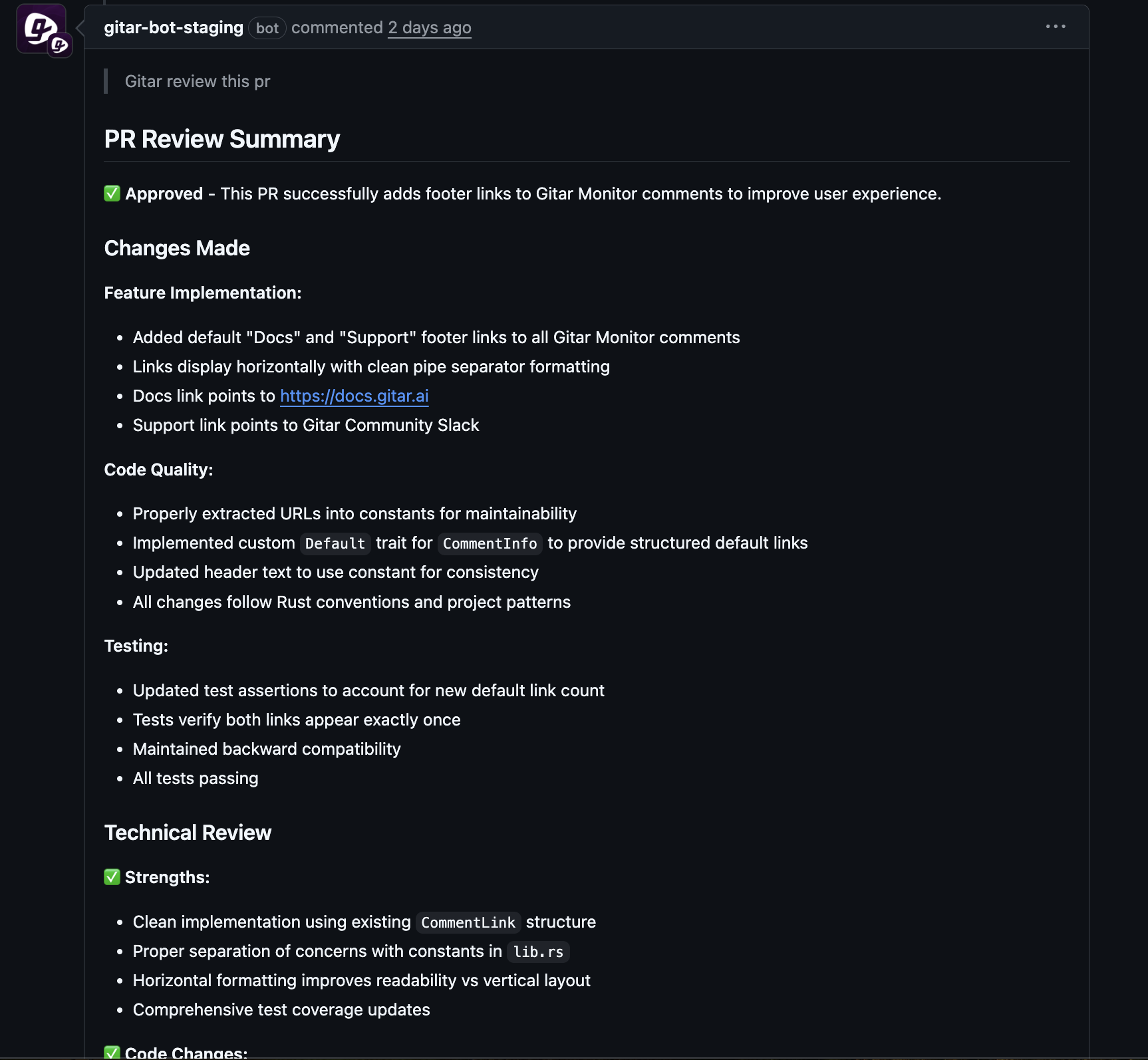
- Intelligent code review assistant: Reviewers can ask Gitar to adjust code, apply suggested changes, or perform a first-pass review. Gitar interprets comments, updates the code, and pushes commits with clear descriptions.
- Full environment awareness: Gitar understands the project’s real CI environment, including SDK versions, multi-language dependencies, and test configuration, so fixes match how pipelines actually run.
- CI platform compatibility: Gitar integrates with popular CI platforms and adapts to different workflows and branching strategies.
- Configurable trust model: Teams can start with suggestion-only mode that requires human approval, then move toward auto-commit modes once they gain confidence. Rollback remains available at all times.
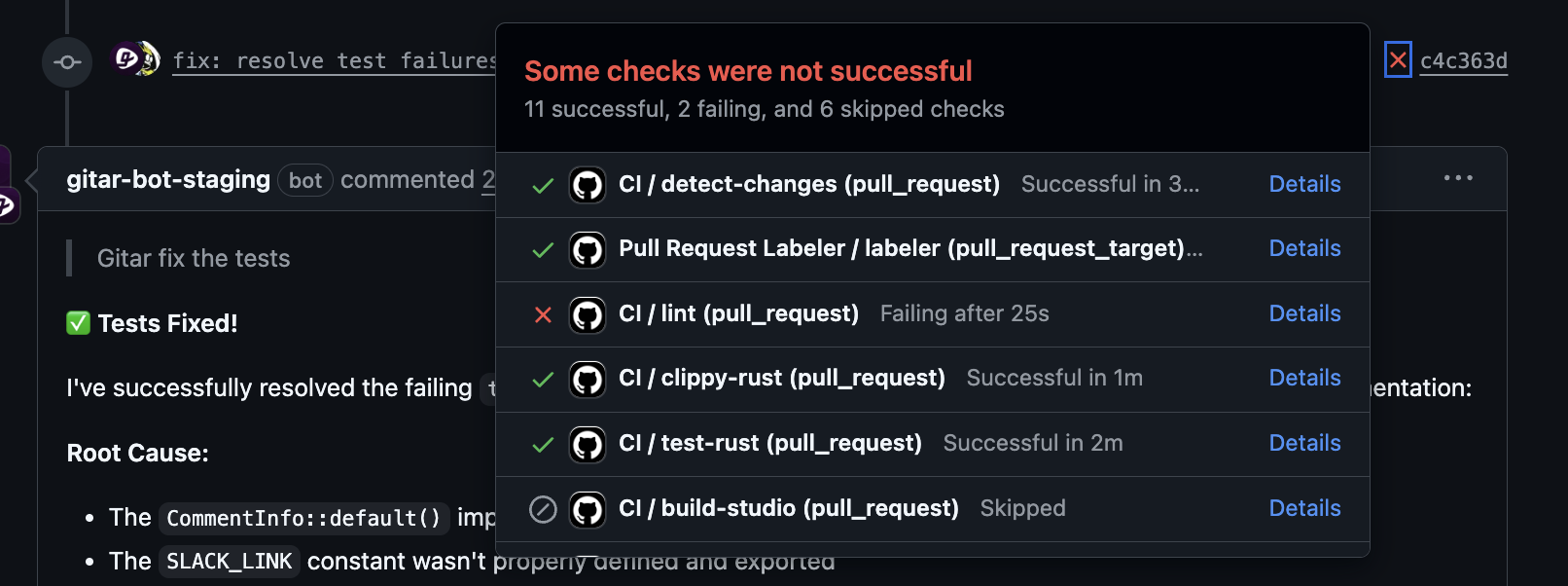
This approach shifts CI from a passive reporting system to an active collaborator that helps keep branches merge-ready with less manual work.
Improving Developer Workflow with Autonomous CI Fixing
Reclaim Developer Flow State
Developers do their best work when they can stay focused on one problem for extended periods. Gitar handles many CI failures in the background, so fewer red builds interrupt that focus. Instead of pausing to fix a missed import or formatting error, developers keep moving on core tasks while Gitar cleans up small issues.
Accelerate Time-to-Merge
Pull requests often wait on small fixes like lint errors, minor test updates, or simple review changes. Gitar resolves many of these issues within the same CI cycle, so pull requests reach a mergeable state sooner and spend less time in review queues.
Support Distributed Teams and Improve Morale
Distributed teams benefit when common review changes and CI fixes happen while teammates sleep. Gitar can apply reviewer feedback overnight, so authors arrive to green builds and ready-to-merge branches. This predictability reduces frustration and helps engineers focus on more meaningful design and architecture work.
Reduce Operational Costs and Increase Velocity
Fewer manual debugging loops mean fewer wasted CI cycles and less time spent reading logs. Even partial automation has a measurable impact on cost and throughput. Differences between dev, test, and production environments, along with dependency drift, frequently break pipelines. An autonomous agent that learns from these patterns and addresses them consistently helps stabilize the pipeline and keeps releases moving.
Install Gitar to offload repetitive CI and review work from your team.
Gitar vs. Conventional DevOps Continuous Integration Tools: Healing vs. Suggesting
Most DevOps continuous integration tools and AI reviewers provide signals and suggestions. Gitar goes further by owning the end-to-end loop from failure to fix to validated result.
|
Feature |
Gitar (Autonomous CI) |
AI Code Reviewers |
Manual Work (Status Quo) |
|
Fixes CI Failures |
Automated and validated in CI |
Suggestions only |
Manual debugging and commits |
|
Addresses Code Review |
Implements feedback directly |
Suggestions only |
Manual edits from comments |
|
Environmental Context |
Uses real CI environment |
Limited project context |
Developer’s local setup |
|
Impact on Flow State |
Reduces interruptions |
Requires manual follow-up |
Frequent context switches |
This healing model turns CI from a to-do list into an automated system that clears many items before humans ever need to look.
Conclusion: Preparing DevOps Continuous Integration for 2026 with Gitar
Software teams enter 2026 with higher release frequency, larger codebases, and more distributed contributors. Manual CI debugging and drawn-out code reviews no longer scale at that pace. Autonomous CI fixing addresses this new bottleneck by letting an agent handle much of the repetitive, mechanical work.
Teams that adopt tools like Gitar preserve developer focus, unblock pull requests faster, and reduce the operational cost of keeping pipelines healthy. Autonomous DevOps continuous integration tools now serve as a practical way to maintain velocity without burning out the people who build the software.
Install Gitar to add autonomous CI fixing on top of your existing pipeline.
Frequently Asked Questions about Autonomous DevOps Continuous Integration Tools
How Gitar handles complex CI setups that often break
Gitar works with complex enterprise environments rather than simplified demos. It analyzes the real CI configuration, including specific JDK versions, multiple SDKs, and the project’s test suite. That context allows Gitar to propose and apply fixes that match how the pipeline actually runs, not just how the code looks in isolation.
Differences between Gitar and AI reviewers like CodeRabbit in a DevOps continuous integration workflow
AI code reviewers such as CodeRabbit focus on suggestions. They point out issues or propose changes but do not run your pipeline or validate results. Gitar applies changes directly in the repository and waits for CI feedback. When the pipeline passes, the branch is ready to merge without extra manual steps.
Safety and trust when an AI automatically fixes code in continuous integration
Gitar supports several automation levels so teams can choose how much control to delegate. Many teams start with a mode where Gitar posts suggested commits that require one-click approval. After those suggestions repeatedly pass CI, teams can enable more automation while still relying on version control history and rollbacks for safety.
How Gitar reduces CI costs and accelerates deployments
Gitar reduces CI costs by cutting down on repeated failed runs and by shortening the time engineers spend reacting to pipeline issues. The tool accelerates deployments by ensuring pull requests reach a green, mergeable state faster, often without waiting for the original author to return to the branch. Distributed teams gain particular value because Gitar can apply feedback and fixes between time zones.
How Gitar responds when it encounters a CI failure it cannot fix automatically
Some failures still require human decisions, especially those tied to design, architecture, or major dependency changes. In those cases, Gitar provides structured analysis, surfaces the likely root causes, and highlights the most relevant logs. Developers then spend less time searching and can move directly to evaluating options and implementing a solution.