
Key Takeaways
- Manual handling of CI failures and review feedback creates frequent context switching, which reduces developer focus and slows delivery.
- Distributed teams and large pull requests increase merge conflicts, review delays, and rework, which extends lead time for changes.
- Standard GitHub flows and traditional AI reviewers often stop at suggestions, so developers still need to debug, implement, and validate fixes.
- Autonomous tools that replicate your CI environment and apply validated fixes can reduce friction across pull requests and onboarding.
- Teams can use Gitar to automatically fix many CI failures and implement review feedback, creating a self-healing pull request workflow.
The Problem: Why Current GitHub Pull Request Workflows Are Failing Your Team
Context Switching And CI Failures Drain Focus
Many engineers experience the same pattern. A pull request looks ready, the pipeline runs, then a missing dependency, flaky test, or linter error blocks the build. The developer must read CI logs, reopen the local environment, patch the issue, push changes, and wait for the pipeline again.
Developers frequently bounce between the GitHub UI, local IDE, and CI dashboards to understand failures or apply review feedback, which slows pull request throughput. A fix that should take five minutes often turns into an hour once task switching and recovery time are included.
Extended review cycles and slow approvals break developer flow, delay deployments, and reduce key DevOps metrics such as deployment frequency and lead time for changes. Each interruption breaks concentration and makes it harder to sustain deep work.
Distributed Teams And Large PRs Increase Cycle Time
Distributed teams feel this friction even more. Long-running pull requests become stale as the main branch moves forward, which increases merge conflicts, repeated CI failures, and rework. A pull request authored in one time zone often waits hours, or days, for feedback and fixes in another.
Large pull requests are harder to review, accumulate more conflicts, and raise risk, which slows time to merge and encourages superficial review. Reviewers face higher cognitive load, often defer decisions, and extend overall cycle time.
As tools like GitHub Copilot make writing code faster, teams create more pull requests and more tests to run. The main constraint shifts from writing code to validating and merging it efficiently.
Manual Intervention And Traditional AI Leave A Gap
The productivity impact of this manual work is significant. Developers can spend up to 30% of their time on CI and code review issues, which can reach roughly $1M per year for a 20-person team when fully loaded costs are included.
Many AI review tools still rely on manual follow-through. They propose changes, but developers must implement, run the pipeline, and debug if the suggestion does not pass CI. This preserves the same loop of broken builds, fixes, and reruns.
The Solution: Gitar For Autonomous DevOps Automation
Gitar shifts from suggestion-only tooling to an automated healing model. The system acts as an autonomous agent that analyzes failures, applies fixes, and validates results in your real CI environment.
- Autonomous CI fixes that generate and apply changes for lint, test, and build failures, then validate against your pipeline.
- Code review assistance that can implement reviewer feedback, push commits, and reduce back-and-forth changes.
- Full environment replication for specific SDK versions, multi-platform builds, containers, and third-party scans.
- A configurable trust model that ranges from suggestion-only mode to fully autonomous commits with rollback options.
- Support for common CI systems including GitHub Actions, GitLab CI, CircleCI, and BuildKite.
Install Gitar to bring self-healing behavior into your GitHub pull request workflow.
Gitar In Action: Creating Self-Healing CI For Pull Requests
CI Failures Fixed In The Background
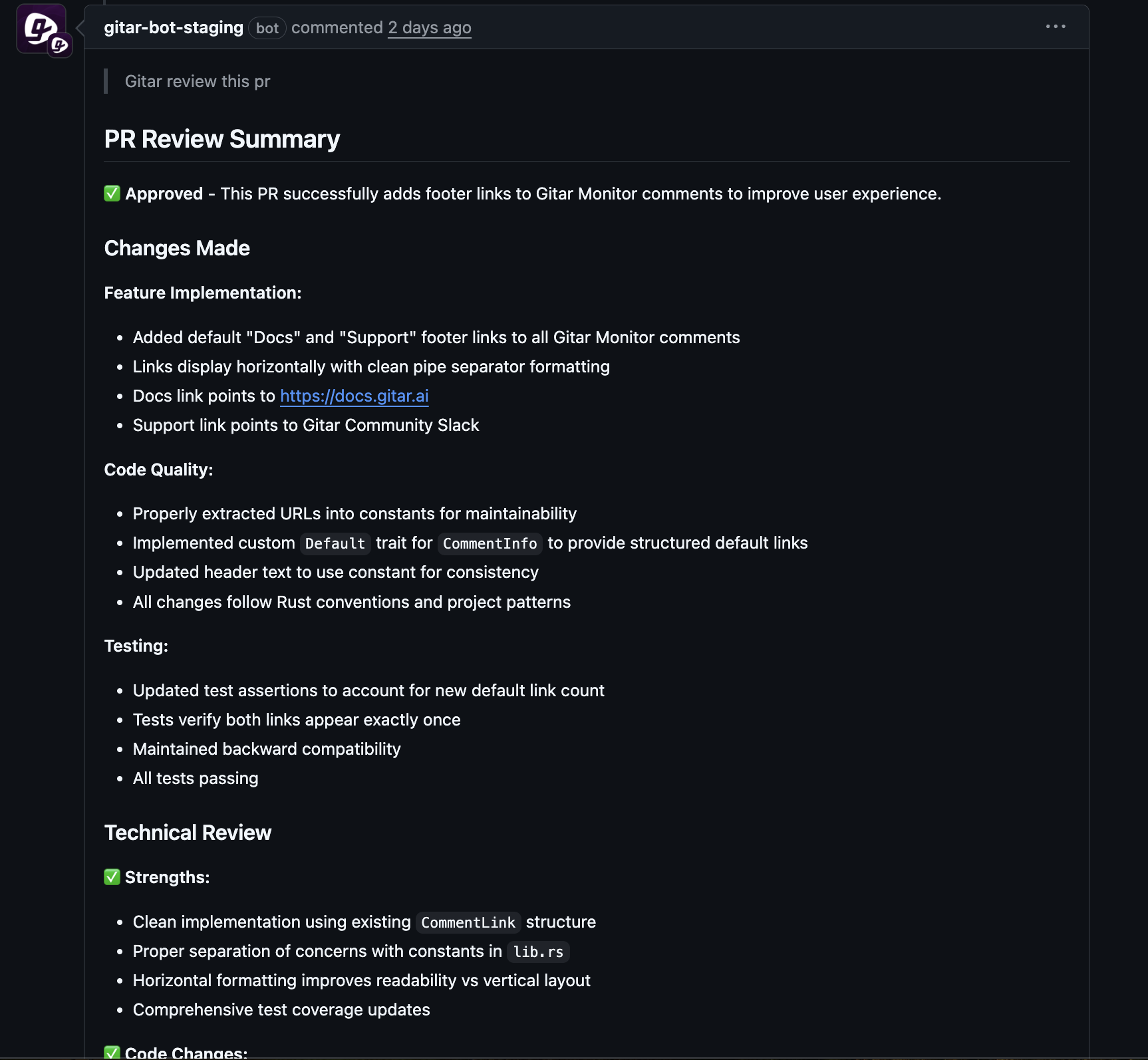
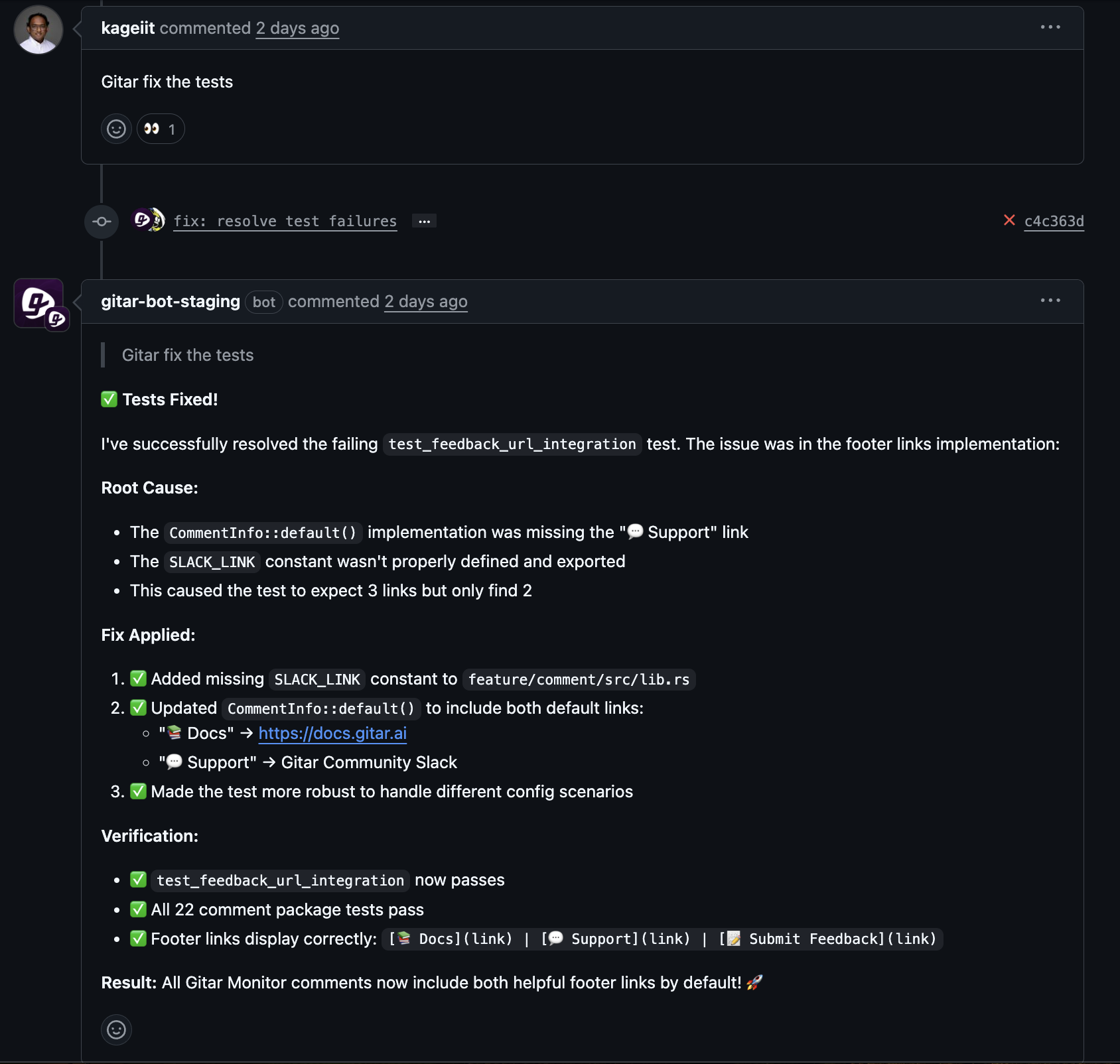
CI checks frequently fail on commands such as npm run lint, pytest, or build scripts. Gitar monitors these runs, inspects logs, identifies the likely root cause, and prepares code changes to address the issue. It then commits the fix to the pull request branch and lets the pipeline run again.
Developers often see the result as a passing build and a new commit that explains the fix, instead of an alert about a failure. Teams can start with a conservative mode where Gitar proposes patches that require one-click approval and later adopt a fully autonomous mode with clear rollback paths.
Code Review Support That Implements Feedback
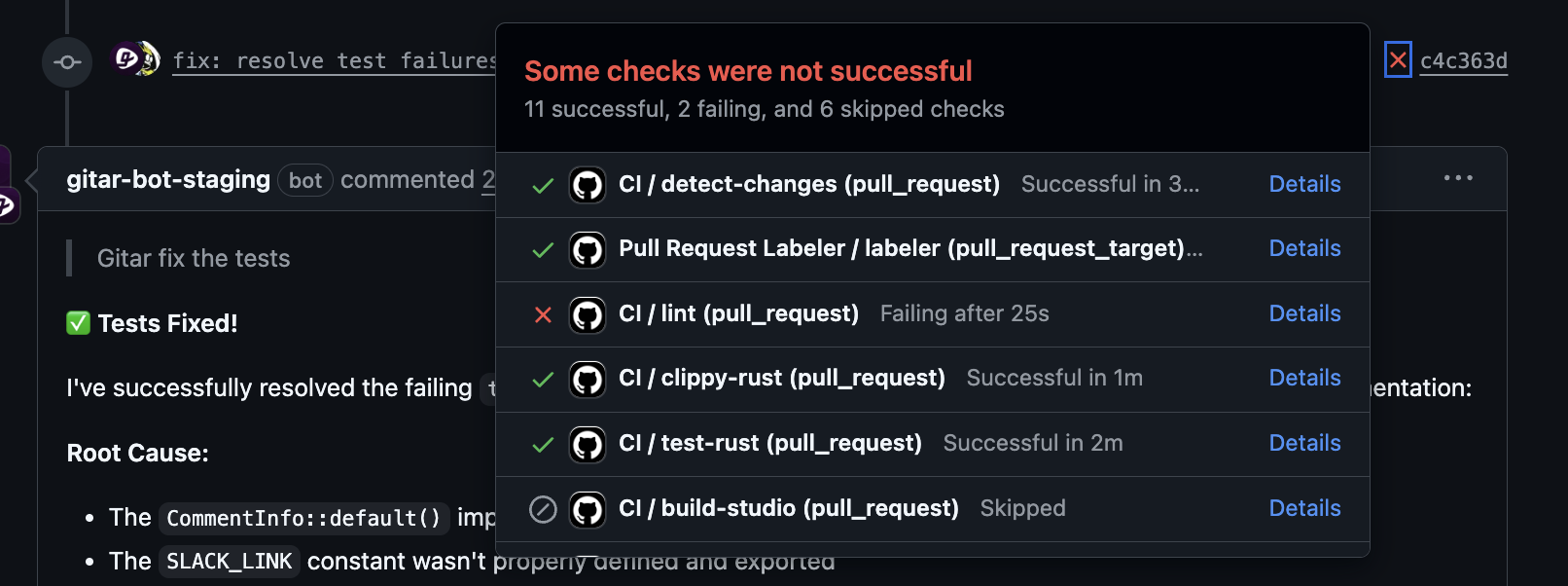
Gitar can perform a first-pass review after a comment such as “Gitar, review this PR.” It summarizes the change set, flags risks, and highlights areas to inspect.
The main benefit appears when reviewers ask for specific changes. For example, a reviewer can request that a feature be removed from the pull request. Gitar updates the code, removes the feature, and commits with a clear description of the changes. Distributed teams can leave feedback at the end of their day and return to updated, passing pull requests instead of a backlog of manual changes.
Complex Environments And Faster Onboarding
Many enterprise teams rely on custom CI environments with particular JDK versions, language runtimes, Docker images, and tools such as SonarQube or Snyk. Gitar runs inside this context, which helps it generate fixes that match project standards and pass all checks.
New engineers can submit pull requests without perfect local configuration. Gitar helps resolve environment-specific issues in CI, which reduces the need for senior engineers to diagnose setup problems.
How Gitar Compares To Other Options For GitHub PRs
|
Feature |
Gitar (Healing Engine) |
AI Code Reviewers |
On-Demand AI Fixers |
Manual Work |
|
Handles CI failures and review feedback |
Applies and validates fixes automatically |
Suggests changes, limited automation |
Runs on request, returns suggestions |
Humans debug and implement |
|
Green build assurance |
Targets passing builds in your CI |
May not run full pipeline |
Developers must validate |
Relies on repeated human attempts |
|
Impact on context switching |
Resolves many issues in background |
Reduces some review effort |
Still requires active interaction |
Creates frequent interruptions |
|
Environment awareness |
Replicates complex CI setups |
Uses project context, not full CI |
Limited view of environment |
Engineers manage local and CI configs |
|
Supported platforms |
GitHub, GitLab, CircleCI, BuildKite |
GitHub, GitLab, some CLI tools |
Varies by product |
Any system, fully manual |
|
Trust controls |
Configurable from suggest to auto-commit |
Primarily suggestion-based |
Manual trigger and review |
Human review and approval only |
Gitar focuses on implementing and validating fixes inside the same CI pipelines that block your pull requests. This emphasis on action and resolution reduces the manual “last mile” work that many AI suggestion tools still leave to developers.
Install Gitar to offload repetitive CI and review tasks to an autonomous agent.
Frequently Asked Questions About GitHub DevOps Automation For Pull Requests
We already use AI reviewers like CodeRabbit. How is Gitar different?
Gitar operates as a healing engine. AI reviewers focus on analysis and suggestions, sometimes with limited automatic edits. Gitar applies fixes, runs them through your full CI pipeline, and updates the pull request so that more builds reach a passing state without manual intervention.
We do not fully trust automated fixes in our pull requests. How does Gitar handle this?
Gitar includes a staged trust model. Teams can begin with a conservative mode where Gitar posts suggested patches that require explicit approval. After the team gains confidence, they can enable more automated modes that commit changes directly, while keeping clear git history and simple rollback options.
Our CI setup is complex with custom dependencies. Can Gitar work in this environment?
Gitar runs inside your CI workflows, which allows it to respect specific language versions, dependencies, Docker images, and security tools such as SonarQube or Snyk. This approach helps ensure that proposed fixes match your environment and pass the same checks your team already relies on.
Conclusion: Make GitHub Pull Requests Easier To Merge In 2026
Engineering teams now face bigger challenges in merging code than in writing it. CI failures, extended review loops, and distributed workflows create context switching and lost time. Traditional AI tools help with analysis but still depend on manual implementation and validation.
Gitar introduces self-healing behavior into GitHub pull requests by automating fixes for many CI failures and reviewer requests within your existing pipelines. This reduces interruptions, shortens feedback loops, and helps teams focus on design and implementation instead of routine repair work.