
Key Takeaways
- Continuous integration failures consume up to 30% of developer time and create costly delays in deployment automation.
- Common CI bottlenecks include flaky tests, dependency issues, misconfiguration, and version drift, which combine to reduce trust in pipelines.
- AI-driven CI failure prevention software shifts work from manual debugging to autonomous analysis, fixing, and validation of failing runs.
- Gitar provides an autonomous CI healing engine that replicates your environment, applies validated fixes, and supports flexible trust and review workflows across major CI platforms.
- Teams that adopt Gitar keep pipelines green, reduce context switching, and ship more reliable code, and they can start today by installing it at Gitar.
Why CI Failures Cripple Your Deployment Automation
The Hidden Cost of Broken Builds and Context Switching
Continuous integration failures create recurring productivity loss, not just brief interruptions. Developers can spend up to 30% of their time dealing with CI and code review issues, which equates to roughly an hour per day that does not move features forward.
Each failure forces a context switch. A simple lint error or minor test failure pulls a developer out of deep work, into log inspection, code tweaks, and reruns of the pipeline. That cycle often repeats several times and disrupts entire sprints, especially when multiple developers wait on the same red build.
Distributed teams feel this even more. A developer in California may wait a full day for a review or fix from a teammate in Bangalore. Without autonomous CI failure prevention, these handoffs stretch simple issues into multi-day delays that slow releases.
Common CI Bottlenecks That Undermine Automation
Most pipelines fail for a small set of recurring reasons. Frequent CI failures include flaky tests, test timeouts, build errors, deployment step issues, configuration mistakes, environment variable problems, and dependency conflicts. These problems show up across languages and platforms.
Flaky tests account for roughly 20–25% of pipeline breakages in large projects, while dependency resolution problems create more than 30% of disruptions in ecosystems such as Maven and npm. Misconfigured YAML files, missing secrets, and subtle environment differences add even more noise.
Version drift also erodes reliability. Nearly 35% of failed runs can trace back to deprecated flags or mismatched dependency versions. When these issues stack together, teams lose confidence that a green build today will remain green tomorrow.
The Right-Shift Bottleneck in a High-Code-Volume World
AI coding assistants such as GitHub Copilot and Cursor increased code output in 2024 and 2025 and continue to do so in 2026. Teams now create more code and more pull requests in less time.
Validation and merging did not speed up at the same rate. The main bottleneck now appears after the code is written, in CI validation, review, and rework. Traditional CI systems, built for slower cycles, struggle with the volume of small changes and failing checks. This right-shifted bottleneck calls for tools that not only detect failures but also fix them and revalidate builds.
Solving CI Failures With AI-Driven Prevention Software
Autonomous Healing for CI and Deployment Automation
AI-driven continuous integration failure prevention software changes CI from a reactive system into an autonomous one. Instead of only flagging errors, this software analyzes logs, identifies root causes, proposes code or configuration changes, and validates those changes through the full pipeline.
This approach supports deployment automation in several ways:
- Less manual log reading and local reproduction of failures
- Faster recovery from broken builds, even outside working hours
- More consistent green pipelines that can safely trigger downstream deployment steps
Why Suggestions Alone Do Not Resolve CI Pain
Many previous AI tools in CI and code review behave like suggestion engines. They add comments on pull requests, draft code snippets, or answer questions when asked. Developers still need to apply edits, push commits, and wait for another CI run, which continues the context switching cycle.
On-demand AI fixers that run inside customer CI also consume CI minutes, and some IDE-based assistants do not see post-commit failures at all. Teams that rely only on suggestions still carry the burden of implementing and validating fixes across complex pipelines.
Continuous integration failure prevention requires autonomous, validated changes that arrive on the pull request ready for review and merge, without extra manual steps.
Install Gitar to start turning broken builds into ready-to-merge pull requests.
Gitar: AI-Powered Continuous Integration Failure Prevention Software
How Gitar’s Autonomous CI Healing Works
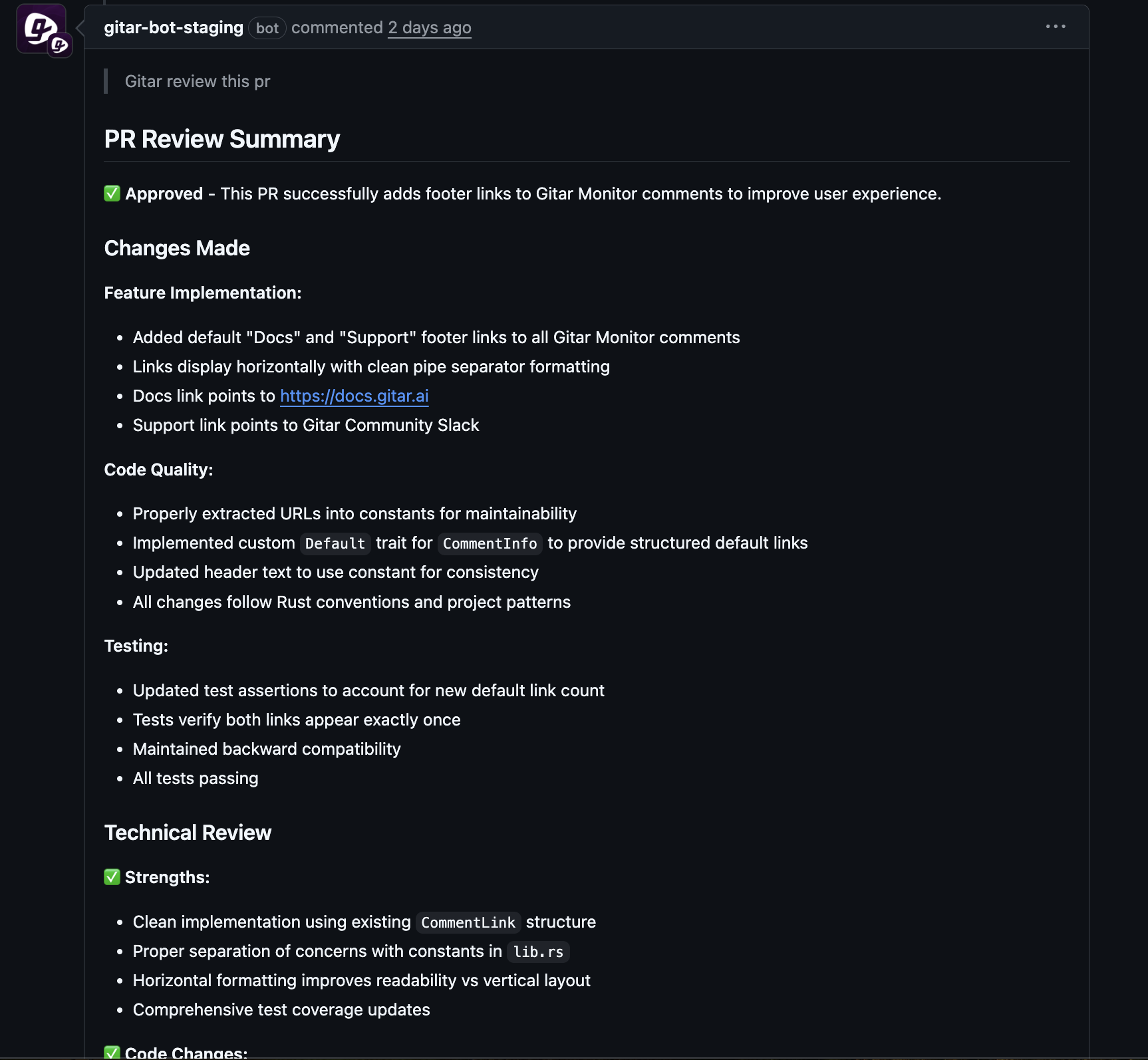
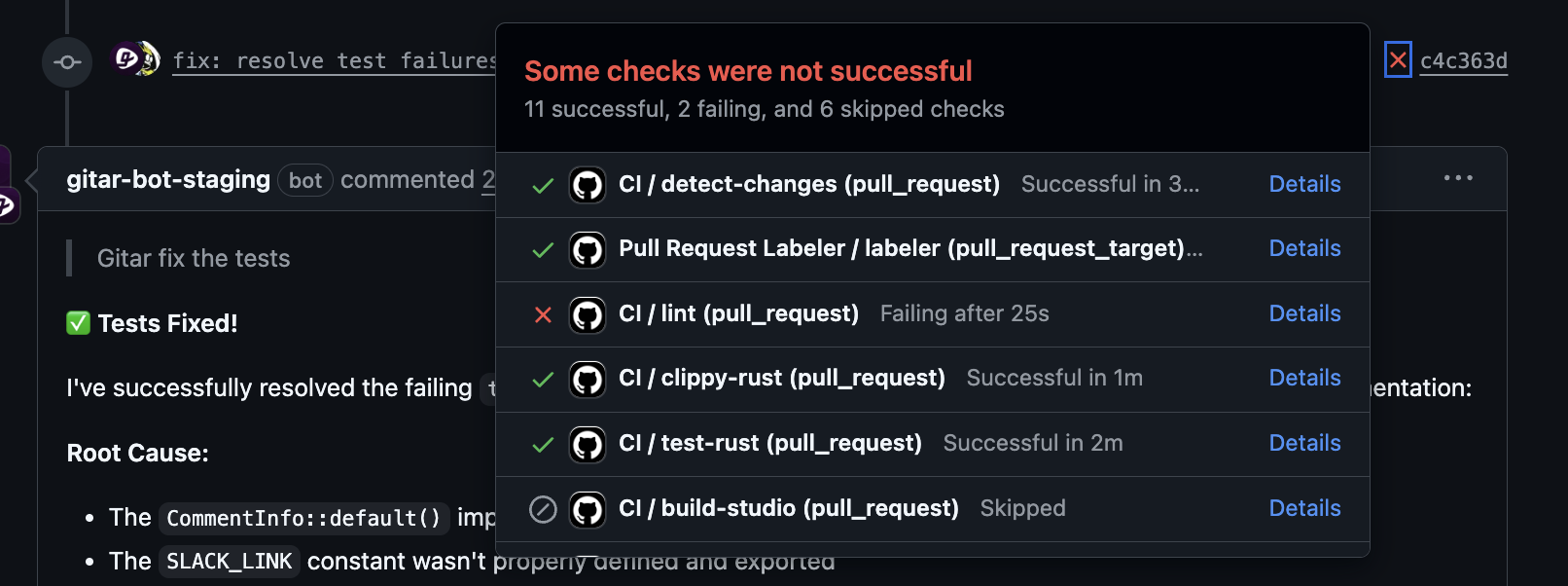
Gitar runs as an AI-powered continuous integration failure prevention engine inside your existing workflow. When a pull or merge request fails CI checks, Gitar automatically inspects the logs, understands the failure, crafts the required change, and updates the branch or pull request.
This self-healing behavior turns many red builds into green ones without human intervention. Developers spend less time on repetitive CI repair work and more time designing features, refactoring, and reviewing important changes.
Key Capabilities That Matter for Your Team
Gitar focuses on reliable CI healing rather than suggestions alone. Core capabilities include:
- End-to-end fixing and validation: Gitar applies code or configuration fixes, reruns the relevant CI checks, and only presents the result when the pipeline passes.
- Full environment replication: The system mirrors complex enterprise setups, including specific JDK or SDK versions, multi-language builds, and tools such as SonarQube and Snyk, so fixes respect real build conditions.
- Integrated code review assistance: Reviewers can ask Gitar to implement requested changes directly through pull request comments, which reduces back-and-forth cycles.
- Configurable trust models: Teams can start with suggestion mode that requires developer approval, then move toward auto-commit with rollback as confidence grows.
- Cross-platform compatibility: Gitar works with GitHub Actions, GitLab CI, CircleCI, Buildkite, and other major CI systems, which avoids lock-in to a single provider.
See how Gitar can fit into your CI/CD pipeline and reduce time spent on broken builds.
Transforming Your Workflow With Gitar’s CI Failure Prevention
Faster Release Cycles and Better Developer Focus
Gitar shortens the time from first commit to merged pull request by removing many manual repair steps between failed and passing builds. Teams that previously stopped feature work to chase CI problems can keep moving while Gitar works in the background.
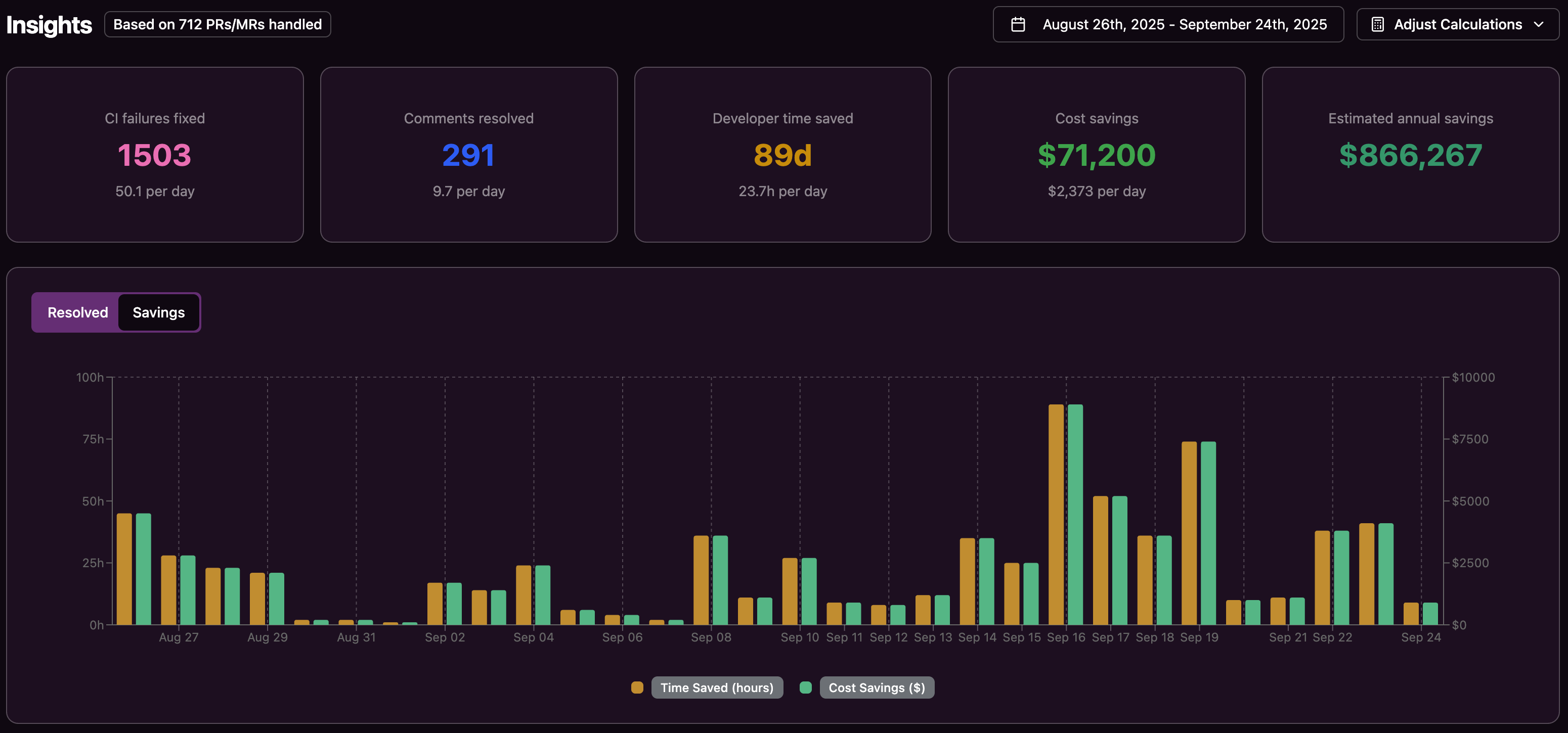
For a 20-developer team that loses about one hour per person per day to CI and review issues, the cost can approach seven figures annually in lost productivity. Gitar helps reclaim a portion of that time by cutting repeated context switches and routine debugging.
More Reliable Pipelines and Lower CI Spend
Gitar creates a self-healing effect on pipelines, which reduces repeated failed runs and extra CI usage. Validated fixes arrive with evidence from your own workflow, which increases trust that a green build is truly ready for deployment.
The comparison below summarizes how Gitar differs from suggestion-only tools and manual work.
|
Area |
Gitar Healing Engine |
AI Code Reviewers |
Manual Work |
|
Action on CI Failure |
Applies fix and revalidates pipeline |
Suggests changes, developer applies |
Developer diagnoses and fixes |
|
Impact on Pipeline |
Moves builds back to green with minimal delay |
Depends on developer time and focus |
Frequent red builds and reruns |
|
Developer Productivity |
Higher, fewer interruptions |
Moderate improvement |
Lower, more context switching |
|
Operational CI Cost |
Fewer repeated failures and reruns |
Unchanged CI usage |
Higher usage from trial and error |
Frequently Asked Questions About Continuous Integration Failure Prevention Software
How Gitar Differs From Other AI Reviewers
Tools such as CodeRabbit or Claude-based reviewers focus mainly on comments and suggestions. Gitar functions as a CI healing engine that takes direct action on failures. It applies fixes, triggers the necessary checks, and updates pull requests only when the pipeline passes, which reduces manual toil around CI repair.
How Gitar Handles Complex CI Environments
Gitar works well in complex enterprise settings that use multiple languages, build tools, and scanners. It recreates your CI environment, including specific dependencies, SDK versions, and services such as SonarQube and Snyk, so that proposed fixes respect the actual conditions of your pipeline.
How Teams Maintain Control Over Automated Fixes
Gitar provides several control levels. Teams can begin with a mode where Gitar proposes changes that require explicit approval. As confidence grows, they can enable automatic commits on certain repositories or branches, backed by rollback options and normal code review practices.
How Gitar Addresses Flaky Tests and Dependency Issues
Gitar inspects logs to distinguish flaky behavior, deterministic failures, and dependency conflicts. It then applies targeted changes, such as improving tests, adjusting timeouts, or updating dependency versions, and validates those changes through CI to keep builds healthy.
How Fast Gitar Fixes CI Failures
Gitar monitors CI continuously and can respond as soon as a pipeline fails. Many issues, including lint errors, straightforward test failures, and common configuration mistakes, can resolve within minutes, often before a developer returns to the pull request.
Conclusion: Move Toward Reliable Deployment With Autonomous CI Healing
Continuous integration failures will always occur, but they no longer need to slow deployment automation or consume large blocks of developer time. AI-driven continuous integration failure prevention software makes it possible to handle many of these failures autonomously.
Gitar brings this capability into everyday workflows by analyzing failing builds, applying environment-aware fixes, and validating those fixes inside your CI system. Teams that adopt this approach gain more stable pipelines, fewer interruptions, and a clearer path to frequent, reliable releases.