
Maintaining consistent coding standards is a challenge in fast-paced engineering workflows. Manual fixes and reviews often slow down productivity. This article dives into how AI-driven tools like Gitar can streamline CI/CD processes by automatically handling code quality issues. You’ll see how moving from suggestion-based systems to autonomous solutions reduces context switching and speeds up the merge process.
Why Manual Enforcement Hurts Productivity and Code Quality
Cutting Down on Context Switching and CI Failure Delays
Context switching is a major drain on developer productivity. Picture this: you push a pull request, only to face a string of CI failures. A test flops, a linter flags formatting, or a dependency issue breaks the build. You’re stuck decoding error logs, switching back to your local setup, making small fixes, and waiting for the pipeline to rerun.
This process doesn’t just take time. It disrupts your focus, turning quick fixes into hours of lost momentum. Developers often spend up to 30% of their day on CI issues and code review feedback, wasting valuable skills on repetitive tasks.
The mental cost of switching tasks is high. After submitting a pull request and moving to another project, a failure or comment pulls you back. That interruption can turn a 30-minute fix into an hour or more as you struggle to regain focus on complex work.
How Inconsistent Standards Slow Teams Down
Inconsistent coding practices create widespread issues. Unenforced code style and formatting reduce readability and hinder collaboration. This leads to friction in reviews and a higher chance of bugs reaching production.
Common problems like dynamic typing errors, unused code, security gaps, poor error handling, and circular dependencies often cause CI failures and lengthy review discussions. These aren’t just delays on single pull requests; they impact entire teams.
Defined guidelines for logging and error handling improve reliability and cut technical debt over time. Without automated enforcement, though, standards vary across developers, leading to rework, merge conflicts, and delayed releases.
The cost adds up fast. For a team of 20 developers, CI failures and review delays can lead to around $1 million yearly in lost productivity, factoring in debugging time and delayed features. This grows as teams and codebases expand.
Why Code Generation Tools Alone Don’t Solve the Issue
AI-powered code generation has sped up writing code, but it shifts the bottleneck to validation and merging. More generated code means more pull requests and tests, often increasing review complexity.
Many AI tools stop at suggestions, leaving developers to manually fix and validate issues. While code gets written faster, the manual steps after creation can erase efficiency gains.
This shift highlights a gap. Speedy code generation is only half the battle if validation and integration still demand significant manual effort, slowing down the overall process.
How Autonomous AI Fixes CI Issues and Boosts Workflow
Moving from Suggestions to Automatic Fixes
AI tools are evolving from merely suggesting fixes to acting as autonomous systems that resolve issues independently. Traditional tools point out problems but leave the work to developers. Newer systems, often called healing engines, detect issues, create fixes, apply them, and verify results through full CI workflows, all without human input.
This approach closes the gap between spotting a problem and solving it. When a CI pipeline fails due to formatting or a test error, these systems analyze the cause, make changes, and confirm the build passes, saving hours of manual effort.
The impact on productivity is clear. Suggestion-based tools still require developers to stop their work and implement fixes. Healing engines handle these tasks in the background, letting developers stay focused on creative problem-solving.
Keeping Focus Intact and Speeding Up Merges
Staying in a focused, productive state is key for developers tackling complex challenges. CI failures and review cycles often break that focus, pulling attention to mundane fixes.
Autonomous systems prevent these disruptions by quietly managing issues. After pushing a pull request, developers can move to the next task while the system resolves problems. Instead of a failure notification, they get an update that the pull request is fixed and ready for review.
This uninterrupted workflow improves team outcomes. Code quality rises, stress drops, and job satisfaction increases as developers tackle meaningful work. Managers also note faster feature delivery and more predictable timelines.
For distributed teams, the benefit is even greater. Feedback from a reviewer in one time zone can be addressed overnight by the system, so the pull request is ready for final approval when the developer logs in, cutting down on delays across global teams.
Gitar: Your AI Partner for Smoother CI/CD Processes
What Sets Gitar Apart in CI/CD Automation
Gitar acts as an independent AI agent that removes the manual burden of CI failures and code review adjustments. Unlike tools that only flag issues, Gitar analyzes problems, applies fixes, and validates solutions automatically.
The process starts when a pull request fails a CI check or gets feedback. Gitar instantly steps in, reviewing logs or comments, identifying root causes, making code changes, and ensuring all CI checks pass before updating the team.
This creates a hands-off experience, turning hours of debugging into an automated task. Developers can push their work and keep moving forward, knowing Gitar handles routine issues without pulling focus.

Ready to simplify your workflow? Install Gitar now to fix broken builds and ship software faster.
Key Features for Enforcing Code Standards Automatically
Gitar offers specific capabilities to maintain code quality and streamline development:
- Complete Issue Resolution: Gitar independently fixes CI failures and applies review feedback, handling everything from linting errors to test and build issues without manual steps.
- Accurate Environment Matching: For complex enterprise setups, Gitar mirrors specific configurations and dependencies, ensuring fixes work in real-world conditions.
- Customizable Automation Levels: Teams can choose conservative mode for suggested fixes to review, or aggressive mode for direct commits with rollback options, fitting different comfort levels with automation.
- Smart Review Support: Beyond CI fixes, Gitar assists with reviews by summarizing pull requests or applying specific feedback, aiding async collaboration across teams.
- Wide Platform Compatibility: Gitar works across GitHub, GitLab, CircleCI, BuildKite, and more, integrating easily into existing toolchains.
Want to see the difference? Request a demo to experience Gitar’s impact.
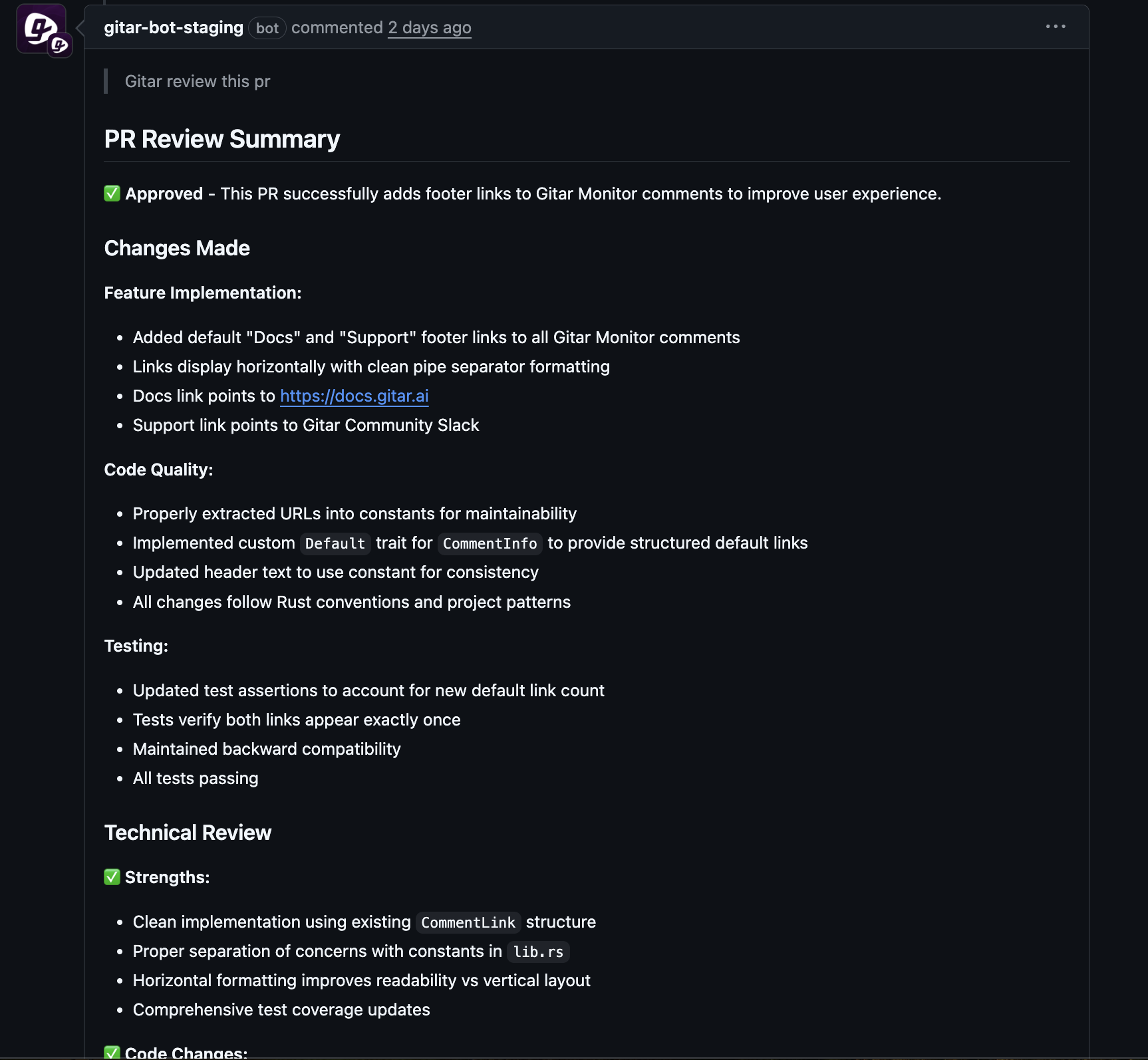
Tackling Common Coding Challenges with Gitar
Fixing Inconsistent Code Style and Formatting
Gitar ensures uniform code quality by automatically correcting linting and formatting errors. When CI checks fail due to style issues, it analyzes the output and applies fixes aligned with team standards.
This saves time on manual adjustments. Tools like Pylint and Flake8 help enforce style and type checking across projects. Gitar builds on this by directly making the needed changes.
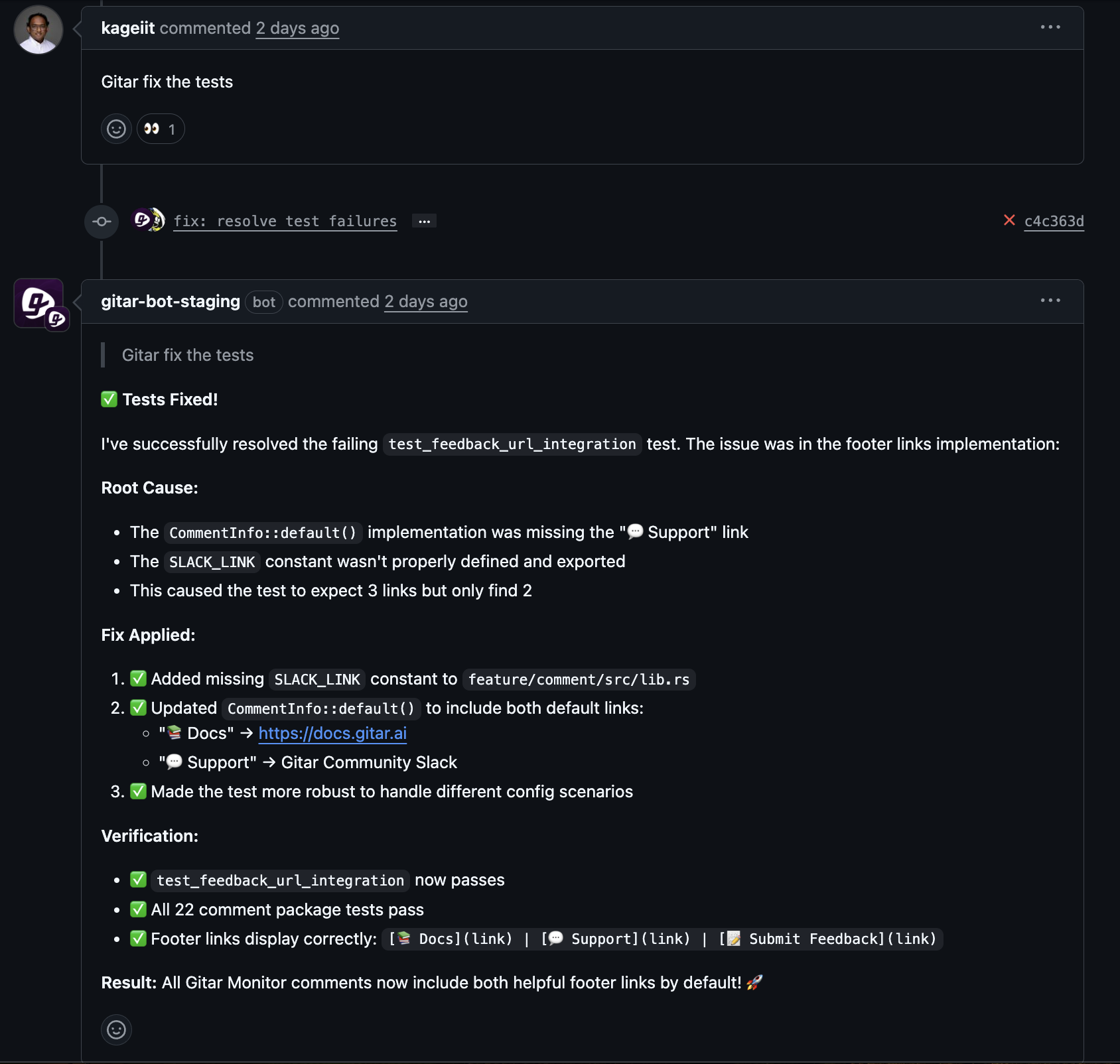
Resolving Recurring CI Failures Efficiently
Gitar quickly diagnoses and fixes common CI issues. For failing tests, it updates snapshots or assertions. For build errors from dependency or config problems, it replicates the environment to deliver working solutions.
Developers can submit pull requests and move on, trusting that routine failures get handled in the background, keeping their focus on the next task.
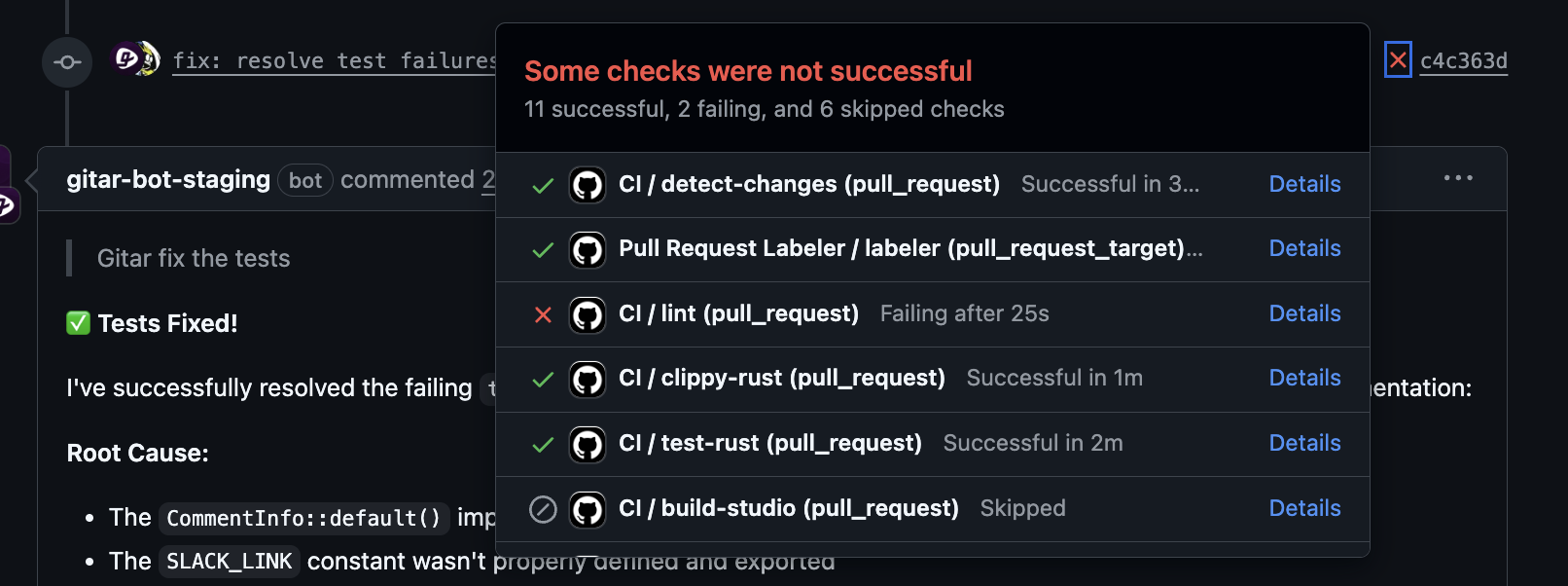
Automating Code Review Feedback Implementation
Gitar simplifies reviews by applying feedback directly, sparing the original developer from context switching. It interprets reviewer comments, makes changes, and commits updates with clear explanations.
This is especially helpful for distributed teams. Feedback from one region can be addressed overnight, so the pull request is ready for approval by the start of the developer’s day elsewhere.
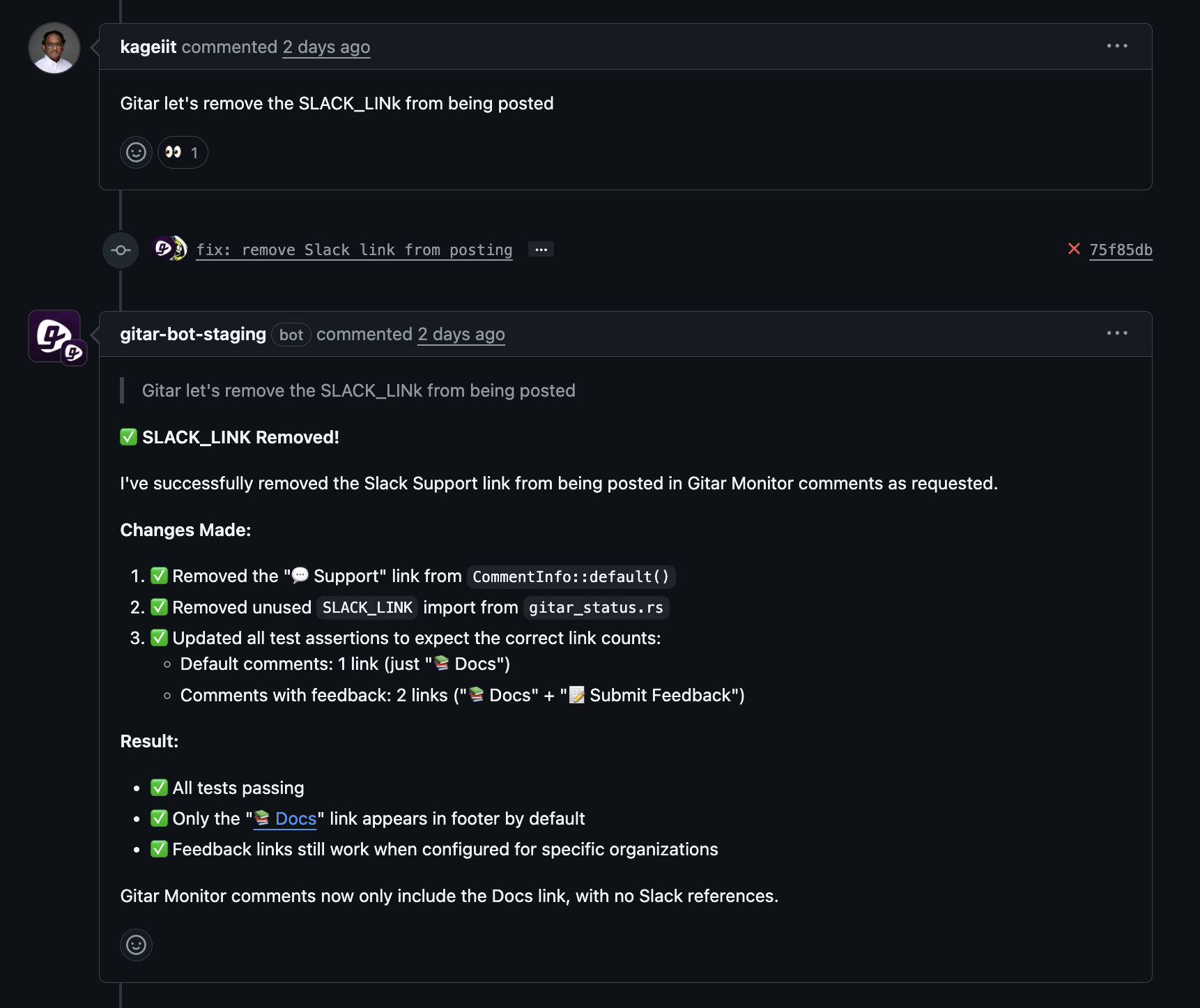
How Gitar’s Healing Engine Outperforms Suggestion Tools
|
Gitar (Healing Engine) |
Suggestion Engines (General Example) |
Manual Work (Status Quo) |
|
|
Problem Resolution |
Automatic fix and validation |
Suggestions needing manual action |
Manual debugging and CI reruns |
|
Developer Focus |
Maintains focus, no interruptions |
Disrupted by manual tasks |
Frequent interruptions, high switching cost |
|
Build Reliability |
Ensures passing builds via full CI checks |
Fix validation not guaranteed |
Relies on human effort and retries |
|
Environment Awareness |
Matches enterprise setups fully |
Context awareness varies |
Limited by human knowledge |
|
Time-to-Merge |
Much faster process |
Slowed by manual steps |
Slowest, often delayed |
The core difference lies in execution. Suggestion tools highlight issues but leave fixes to developers. Gitar, as a healing engine, applies solutions and validates them through CI, removing manual steps entirely.
Install Gitar now to fix builds automatically and ship software faster.
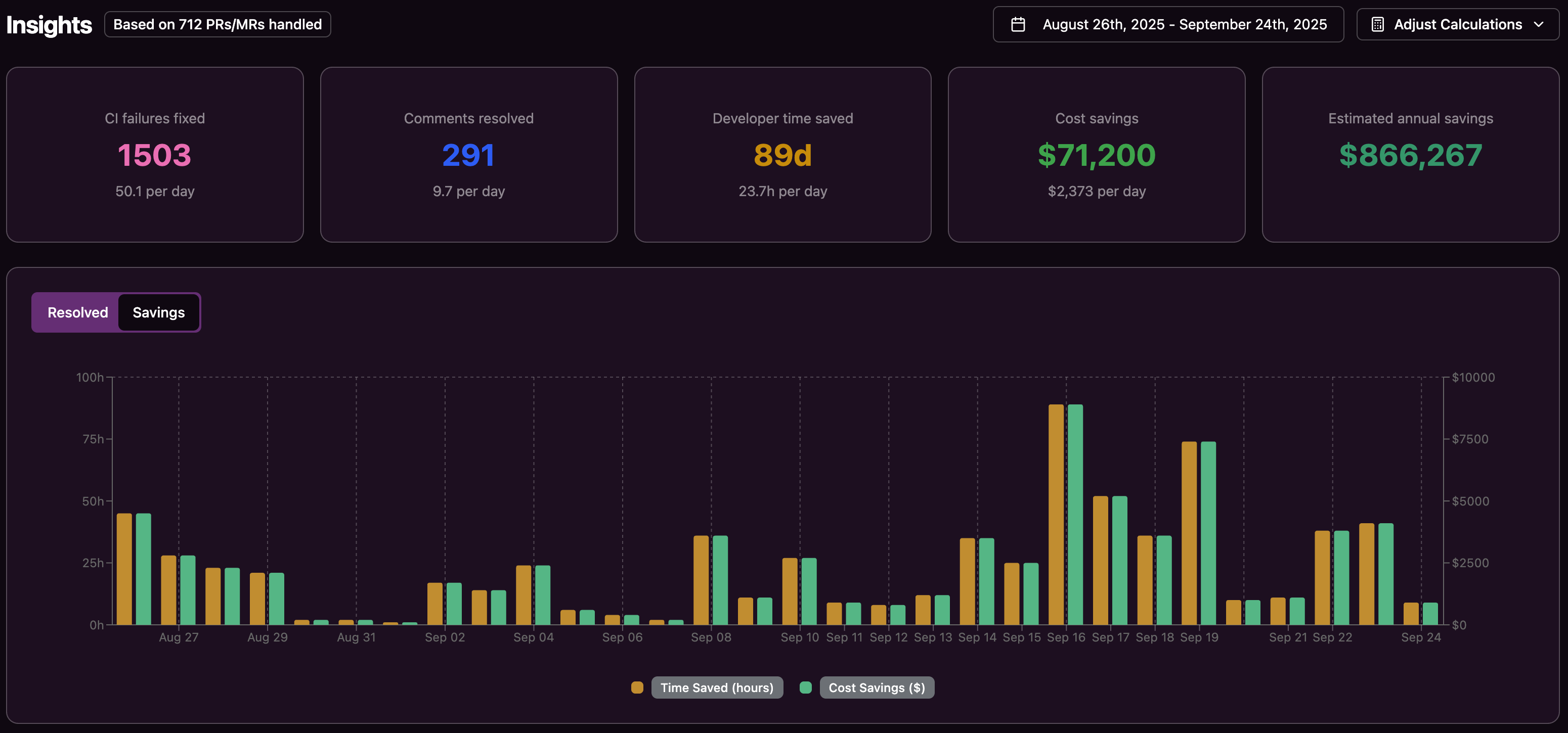
Common Questions About Gitar’s Capabilities
Which CI Failures Can Gitar Handle Automatically?
Gitar addresses many typical CI issues. It fixes linting and formatting errors in languages like Python, JavaScript, Java, Go, and Rust. It resolves test failures by updating snapshots or assertions and handles build issues from dependency or configuration errors, verifying fixes in the full CI environment.
How Does Gitar Manage Complex Enterprise Setups?
Gitar mirrors enterprise environments, supporting specific JDK versions, multi-SDK dependencies, and various tool integrations. This ensures fixes align with an organization’s unique tech stack, even in intricate setups.
What Makes Gitar Different from Other AI Review Tools?
Many AI review tools suggest improvements but require manual implementation. Gitar goes further by autonomously applying fixes, validating them through CI, and ensuring builds pass. This cuts interruptions and speeds up merging.
Wrapping Up: Autonomous Tools Are the Future of Code Standards
Manually enforcing coding standards and fixing CI failures wastes time and resources. Autonomous systems like healing engines mark a shift to automated resolution of issues and feedback.
Gitar removes the manual burden of CI issues, keeps developers focused, and shortens merge times. Teams adopting this approach see lower costs, happier developers, and quicker feature releases.
Don’t let CI failures slow you down. Set up Gitar today to streamline your CI/CD process.