
Written by: Ali-Reza Adl-Tabatabai, Founder and CEO, Gitar
Software development faces ongoing challenges with CI/CD pipeline failures, communication gaps, and delayed code reviews. AI-powered tools, like Gitar, offer a practical way to address these issues by automating fixes and speeding up workflows. This article explains how such solutions help developers save time and deliver code faster.
Why Manual CI/CD Fixes and Review Delays Hurt Your Team
Context Switching Drains Productivity and Morale
Submitting a pull request often leads to frustration when builds fail over small issues, like a missing dependency or a style error. Developers must stop their current task, dig through error logs, apply a fix, and wait for the pipeline to rerun. This process disrupts focus and can turn a quick adjustment into a long delay. Up to 30% of a developer’s time can be spent resolving CI/CD problems, which adds mental strain and breaks concentration.
For a team of 20 developers, even one hour daily on these issues adds up to 5,000 hours a year. At an average cost of $200 per hour, that’s $1 million in lost productivity, not counting delayed projects or turnover from burnout. The constant back-and-forth pulls developers out of their flow, costing more time than the fix itself.
Pipeline Failures Slow Down Your Time-to-Market
CI/CD issues create bottlenecks that delay entire projects. Debugging complex errors often takes hours, especially with intricate systems. Common problems include:
- Inconsistent environments across development, testing, and production.
- Flaky tests that fail unpredictably, undermining trust in the pipeline.
- Dependency mismatches or version conflicts that break builds.
- Infrastructure errors, like Kubernetes misconfigurations.
- Failed security scans or performance issues.
These delays impact delivery schedules and increase costs. Repeated failed CI runs drive up expenses, straining budgets and slowing progress.
Distributed Teams Face Communication Hurdles
Remote work adds complexity to code reviews and collaboration. Misalignment between teams in different time zones often delays feedback and releases. A simple comment on a PR can take days to resolve when team members work across continents. Traditional tools offer suggestions but still require manual effort, leaving developers waiting for the next CI run to confirm a fix.
Siloed workflows mean issues can go unnoticed, while slow feedback loops reduce agility. As AI coding tools speed up code creation, validation and merging often lag behind, creating bottlenecks.
Ready to speed up your process? Install Gitar to automate fixes and ship quality code faster.
Meet Gitar: Your AI Agent for CI/CD and Code Review Efficiency
Gitar tackles the core issues of failing CI builds and slow review cycles. When a pull request faces a CI failure or receives feedback, Gitar’s AI automatically steps in. It identifies the problem, creates a fix, and updates the request, turning a disruptive process into a hands-off solution. This keeps developers focused and cuts down time to merge.

How Gitar Boosts Development Speed
Gitar goes beyond suggestions with automated fixes for CI issues across platforms like GitHub Actions, GitLab CI, and CircleCI. Its capabilities include:
- Fixing linting and formatting errors without manual input.
- Resolving basic test failures, such as broken assertions.
- Handling build issues, like dependency conflicts.
For code reviews, Gitar interprets feedback and applies changes directly, bypassing time zone delays. It also mirrors complex environments, matching specific SDKs and security tools like SonarQube, ensuring fixes align with your setup. Teams can adjust Gitar’s autonomy level, starting with suggestions for approval and moving to direct commits with rollback options as trust grows.
Seeing Gitar at Work: Real Workflow Improvements
Keep Focus with Automated CI Fixes
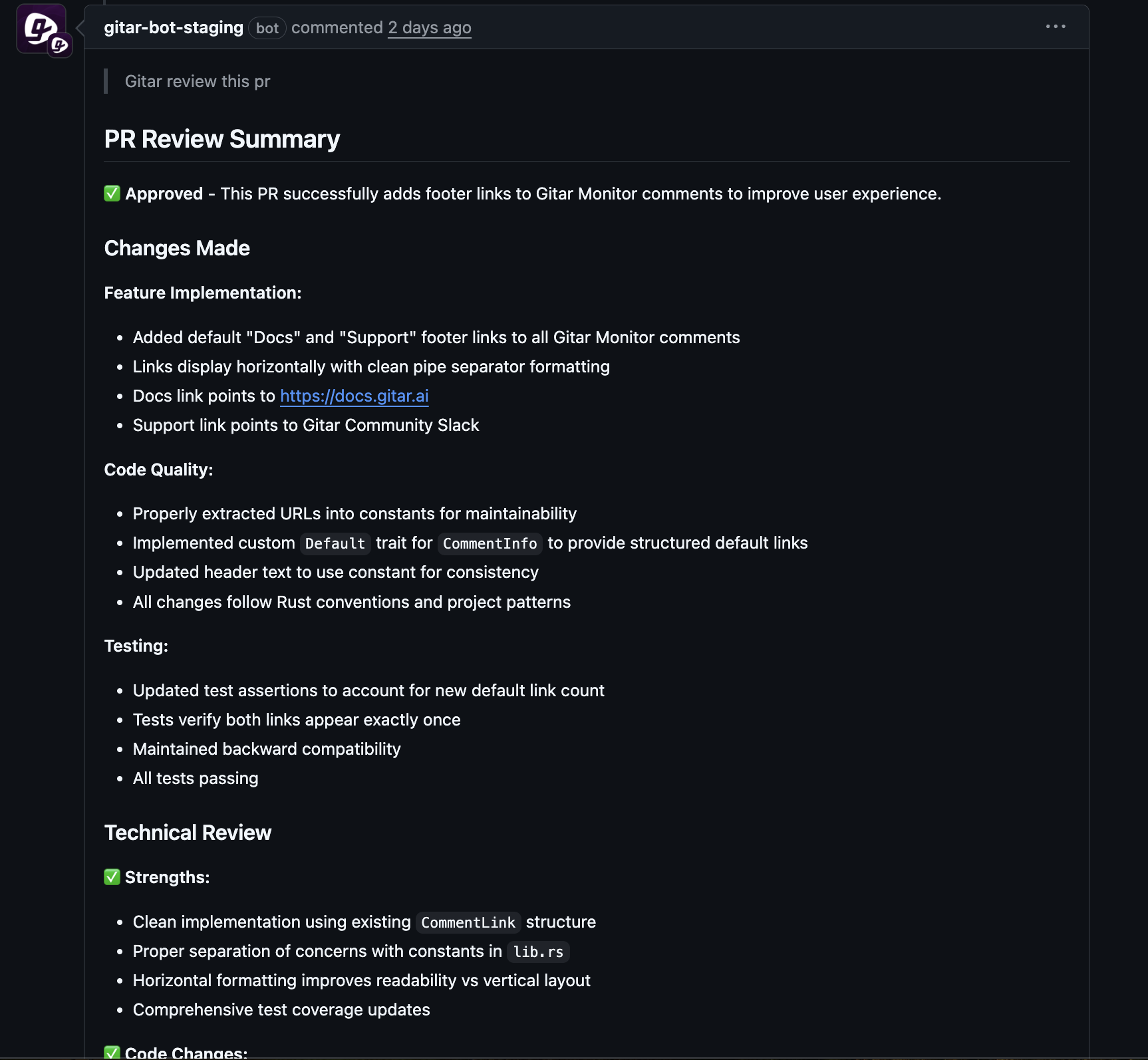
Gitar changes how developers handle CI failures. Often, issues like linting errors are fixed before the developer even notices. A new commit appears in the PR with a clear explanation of the change, avoiding interruptions. This lets developers stay focused on meaningful tasks rather than routine debugging, improving both productivity and satisfaction.
Speed Up Reviews Across Time Zones
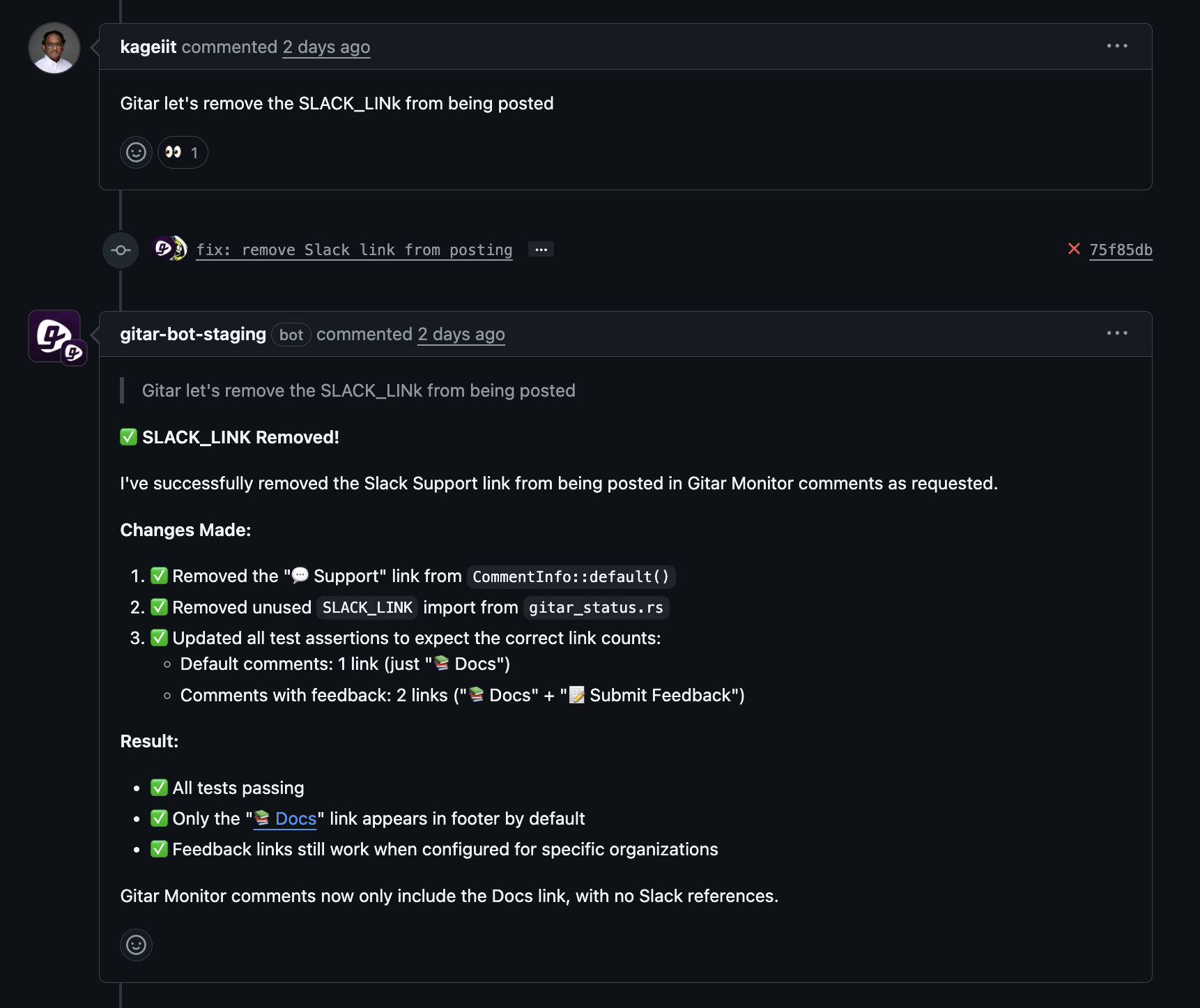
Gitar handles code review feedback instantly, even for distributed teams. If a reviewer requests a change, like removing a feature from a PR, Gitar makes the edit and commits it with an explanation. This cuts a multi-day process into hours, ensuring updates are ready for final review without delay.
Support Enterprise Needs with Reliable Fixes
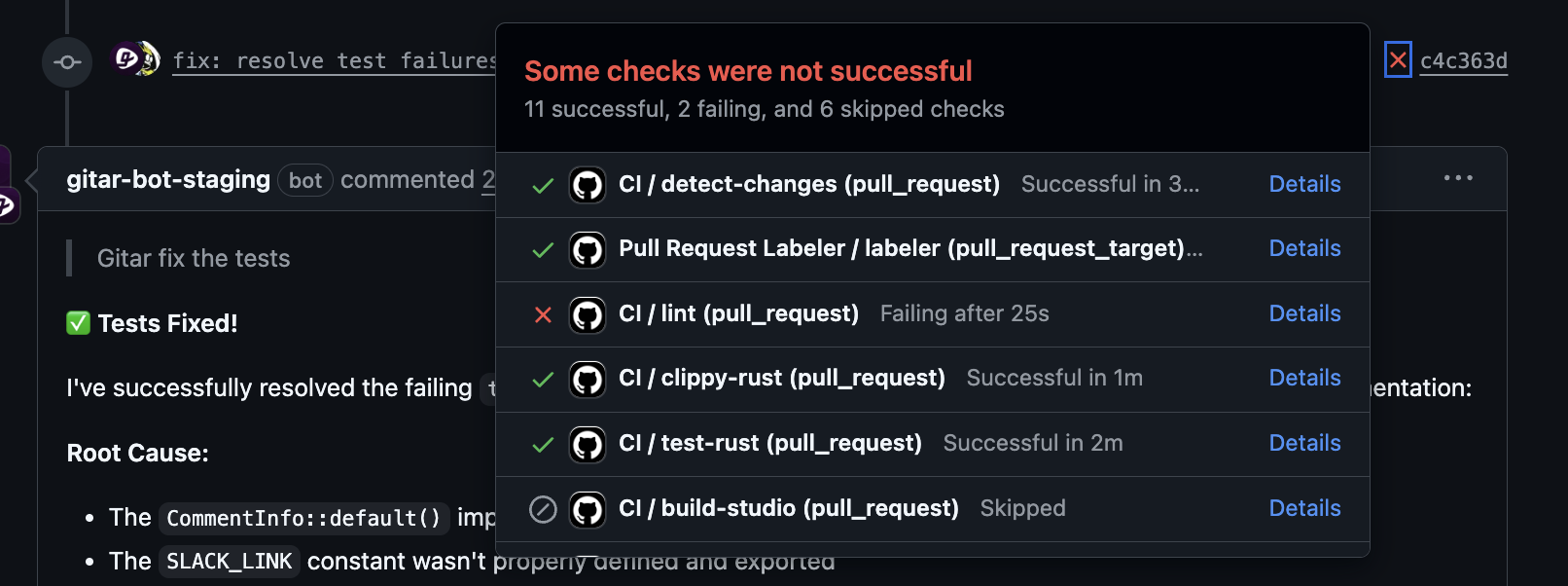
For large organizations, Gitar adapts to intricate setups, including specific dependencies and security scans. It validates fixes against the full CI pipeline to ensure builds pass all checks. This reduces failed runs, cuts infrastructure costs, and maintains stability in complex environments.
Fixes That Go Beyond Suggestions
|
Feature |
Gitar (Healing Engine) |
Traditional AI Tools |
Manual Debugging |
|
Action on Issues |
Fixes and validates code automatically |
Offers suggestions for manual action |
Requires full manual effort |
|
CI Validation |
Ensures builds pass |
No validation guarantee |
Manual testing needed |
|
Context Switching |
Minimizes disruptions |
Still requires intervention |
Frequent interruptions |
|
Time to Fix |
Minutes, often unnoticed |
Hours with manual steps |
Hours to days |
Unlike tools that only suggest fixes, Gitar applies and validates changes in your CI environment, ensuring builds succeed without developer input.
Ease Onboarding for New Developers
New hires often struggle with CI/CD setups, delaying contributions. Gitar handles these complexities, letting them focus on coding. Their changes pass CI checks automatically, speeding up their first merged PR and boosting confidence. This also frees senior developers to focus on mentoring code quality rather than pipeline issues.
Want to streamline your workflow? Install Gitar and start fixing builds automatically.
Measuring the Value: Cost Savings and Faster Delivery
CI/CD inefficiencies cost more than just time. For leaders, the benefits of tools like Gitar are clear when looking at the numbers.
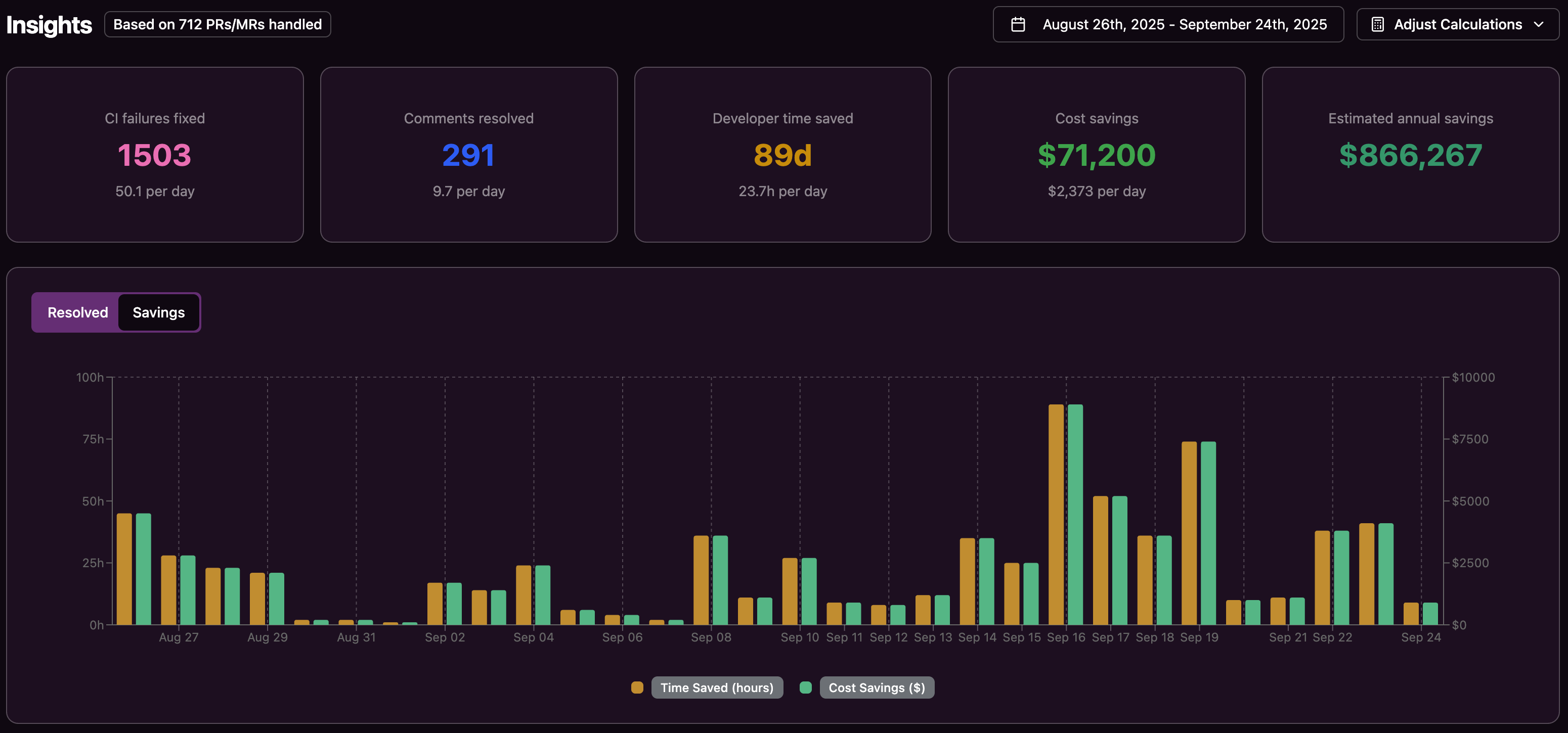
A team of 20 developers spending one hour daily on CI issues loses 5,000 hours yearly. At $200 per hour, that’s $1 million in productivity loss. If Gitar cuts this by half, savings reach $500,000 annually, alongside better team morale. Fewer failed runs also lower infrastructure costs.
Faster merges mean quicker feature releases, giving a market edge. Teams can respond to feedback and ship updates sooner. Beyond numbers, reducing repetitive tasks improves developer satisfaction, helping retention. Leaders gain clearer metrics and can focus on strategy rather than pipeline problems.
Common Questions About AI-Driven Collaboration
How Does Gitar Differ from Other AI Review Tools?
Many AI tools suggest fixes without validating them in CI. Gitar not only applies fixes but also ensures they pass your pipeline checks. It works across platforms like GitHub Actions and Jenkins, with options for on-premise setups to meet security needs.
Is Gitar Safe for Complex Environments?
Gitar matches your exact setup, including SDKs and security tools. Teams can start with a cautious mode for approving fixes and later move to full automation with rollback options. Every change is tested against your CI pipeline to meet compliance standards.
How Is Gitar Different from IDE AI Assistants?
IDE tools help during coding, before commits. Gitar works after code is submitted, fixing CI failures and review feedback in remote repositories. It ensures code meets quality standards for merging, addressing a later stage of the process.
Can Gitar Handle Custom CI/CD Workflows?
Gitar adapts to unique setups by analyzing your specific CI configuration. It replicates dependencies and integrates with enterprise tools to create fixes that fit your environment, ensuring compatibility with custom workflows.
When Will We See Results with Gitar?
Many teams notice benefits within days. Setup is simple: authorize Gitar on your repositories, adjust settings, and connect to CI systems. Start with suggestions for approval, then shift to automated commits as trust builds. Developers quickly experience less context switching, while leaders see faster merges within a month.
Ready to improve your CI/CD process? Install Gitar now to automate fixes and deliver faster.
Moving Forward: Why Autonomous Tools Like Gitar Matter
AI coding tools have sped up code creation, but validation and merging remain bottlenecks. Gitar shifts this balance by automating CI/CD fixes and reviews, letting teams focus on innovation. This move from manual effort to autonomous solutions boosts productivity and positions teams to handle growing complexity.
For leaders, adopting tools like Gitar means faster delivery and a competitive advantage. The savings from reduced CI issues add up quickly, while early adoption builds scalable habits. As distributed teams and complex systems become the norm, autonomous collaboration will be essential.
Software development is evolving toward frictionless workflows. Gitar helps bridge that gap, turning reactive fixes into proactive solutions. Ready to eliminate build failures and slow reviews? Install Gitar today and see the difference in your team’s productivity.