
Key Takeaways
- AI code generation has increased PR review times by 91%, so teams now need tools that auto-fix instead of only suggesting.
- Gitar ranks #1 with validated auto-fixes for CI failures and guarantees green builds across GitHub, GitLab, and CircleCI.
- Propel (#2) leads in accuracy at 64% F-score, while Gitar leads in automation and broad CI coverage.
- CodeRabbit (#3) delivers strong analysis but creates notification overload and still requires developers to apply fixes manually.
- Teams that switch to Gitar cut manual toil by about 75%, with a 14-day trial that proves ROI before purchase.
How We Evaluated 2026 AI Code Review Tools
Our ranking compares tools across six dimensions. These include PR speed and accuracy using F-score metrics from Propel benchmarks, automation level, CI failure resolution, UI clarity, integration breadth, and pricing for teams of 10 to 50 plus developers.
We focus on tools that match the 2026 reality, where 75% of AI-generated PRs contain logic issues and teams need autonomous fixes instead of more comments. Inputs include competitor analysis, developer feedback from Reddit and dev.to, and industry reports on AI coding bottlenecks.
Top 10 AI Code Review Tools Ranked for 2026
#1 Gitar – Healing Engine for Broken Builds
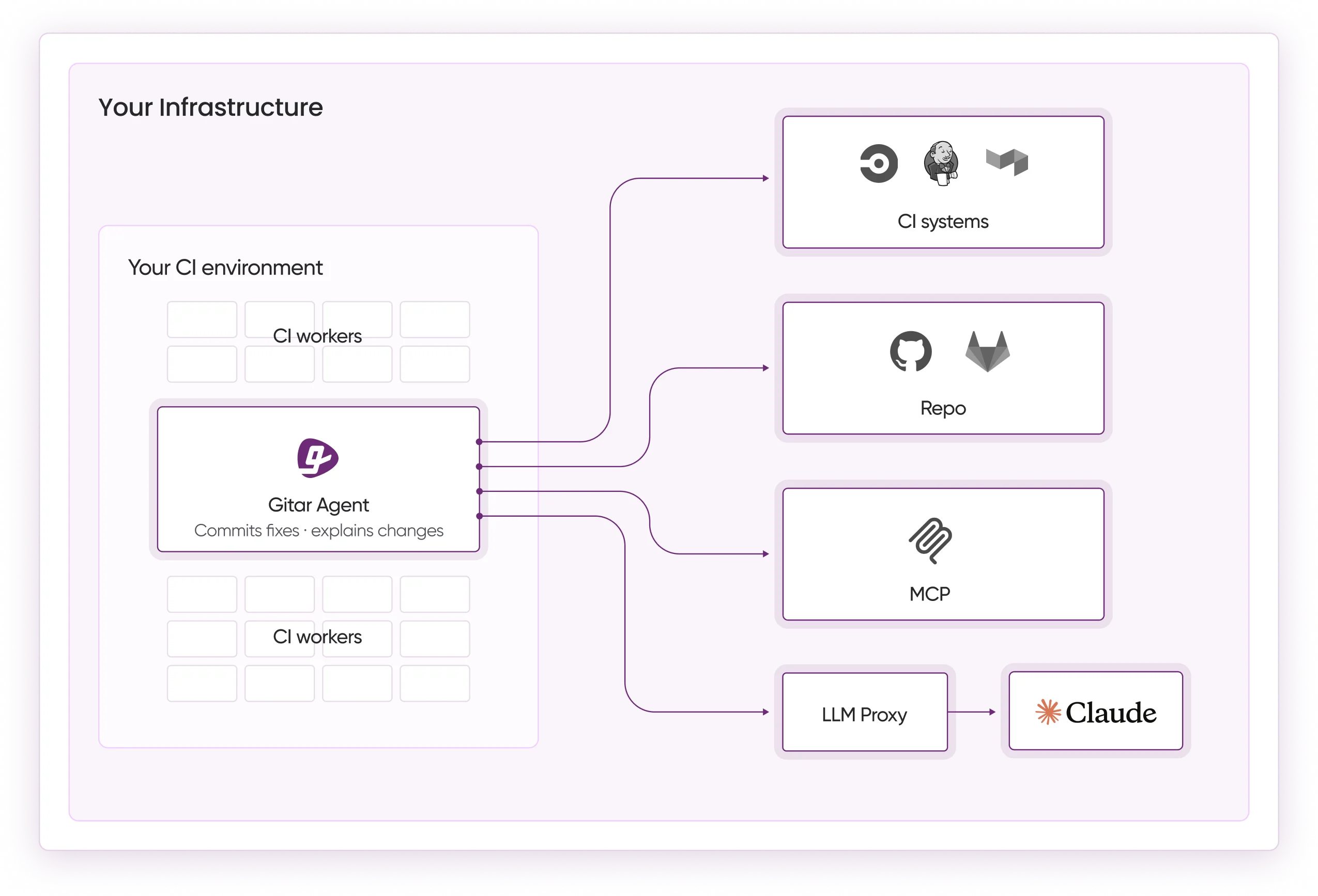
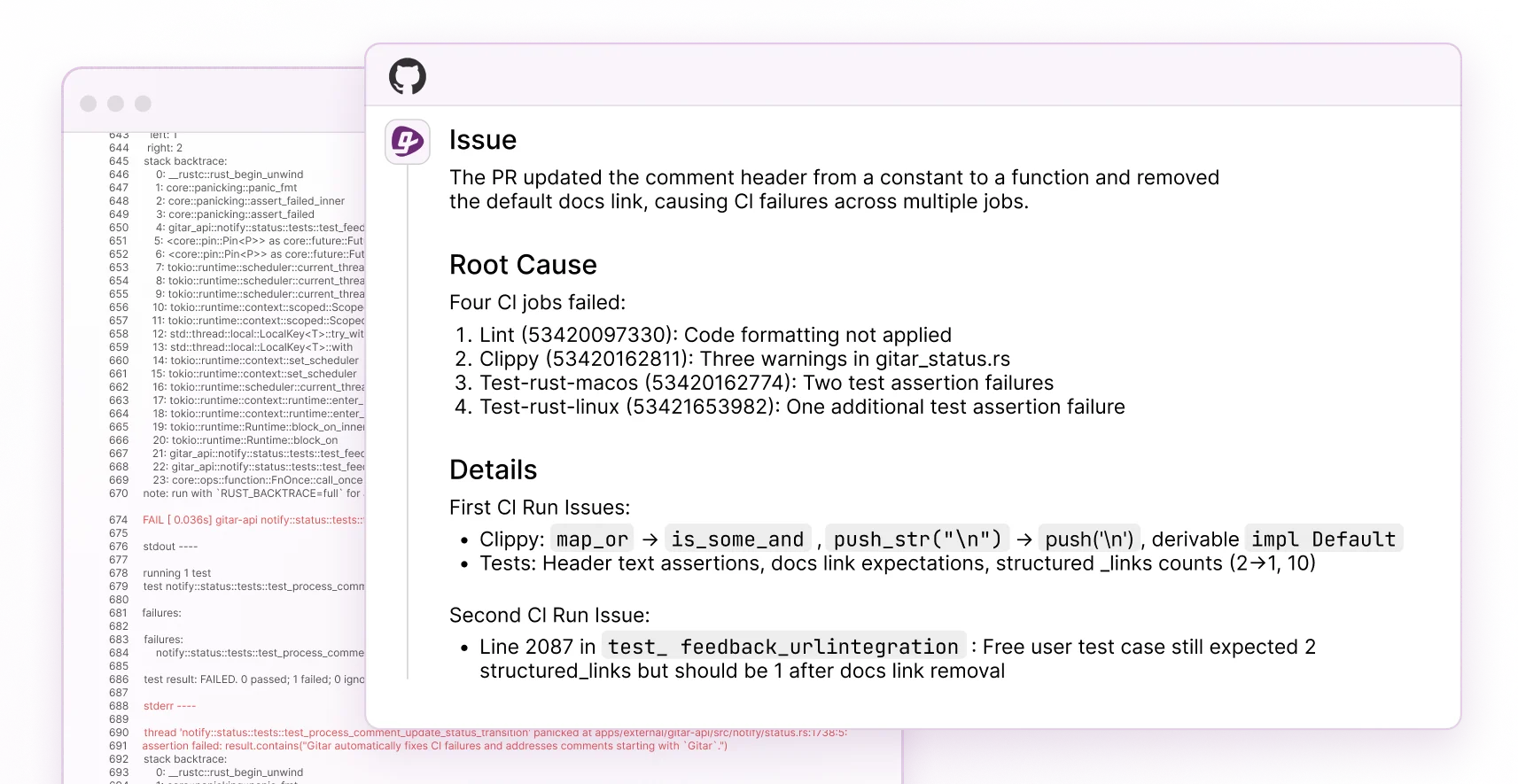
Gitar is the only AI code review tool in this list that fixes code automatically. When CI fails from lint errors, test failures, or build breaks, Gitar reads the logs, generates validated fixes, and commits them directly to your PR.
The platform behaves as a healing engine that guarantees green builds instead of a suggestion engine that hopes fixes work. The 14-day free Team Plan trial includes unlimited auto-fix usage, custom workflow rules, and cross-platform integrations.
Key features include a single-comment UI that consolidates findings, natural language repository rules for workflow automation, and validated CI fixes across GitHub Actions, GitLab CI, CircleCI, and Buildkite. Gitar fits engineering leaders who want measurable ROI from autonomous code fixing instead of more manual suggestion handling.
Install Gitar now, automatically fix broken builds, and ship higher quality software faster.
#2 Propel – Accuracy Champion for Detection
Propel leads 2026 benchmarks with a 64% F-score (68% precision, 61% recall). This makes it the most accurate AI code reviewer in pure detection terms, with solid auto-fix and CI integration features.
Propel works best for teams that treat detection accuracy as the primary goal and still want some automation support.
#3 CodeRabbit – GitHub-Native Reviewer
CodeRabbit delivers deep PR analysis with multi-layered AST, SAST, and AI analysis plus strong security detection. It offers structured feedback on readability, maintainability, and bugs, with 46% accuracy in runtime bug detection.
However, developers report notification spam from many comments cluttering GitHub timelines, especially on large PRs. Pricing starts at $12/user/month and scales to $30/user/month for enterprise features.
Teams must invest time in configuration to cut noise and false positives. CodeRabbit suits GitHub-centric teams that accept manual implementation of suggestions and heavier review workloads.
#4 Cursor Bugbot – Cursor IDE Companion
Cursor Bugbot reaches a 49% F-score and integrates directly with the Cursor IDE. Pricing ranges from a limited free tier to $200/month for Ultra plans.
The tool focuses on suggestions inside the IDE and does not provide CI auto-fixing.
#5 Greptile – Deep Context Explorer
Greptile specializes in codebase context understanding but ranks lower in benchmarks with a 45% F-score (45% precision, 45% recall). Pricing starts at $25/user/month for Team plans and can reach $1,260/user/month for the Ignite tier.
Greptile focuses on suggestion-only workflows and does not apply validated fixes or integrate deeply with CI.
#6 Qodo – Quality and Testing Focus
Qodo emphasizes code quality metrics, testing suggestions, and automated issue resolution features. 2026 reviews describe it as a solid choice for teams that prioritize quality and want some auto-fix support.
#7 Codacy – Compliance and Security First
Codacy targets compliance and security-driven organizations with $21/month pricing. It offers AI-powered scanning, auto-fixes for critical issues, and pipeline-free PR analysis.
#8 Bito – Multi-Platform Helper
Bito supports multiple IDEs and version control systems and provides line-level fix suggestions. It focuses on actionable code improvements that go beyond basic comments but still relies on developers to apply changes.
#9 GitLab Duo – GitLab-Native Assistant
GitLab Duo integrates directly into GitLab workflows at $19/user/month. It works only inside the GitLab ecosystem and offers suggestion-only functionality.
#10 Devlo – Entry-Level Budget Pick
Devlo provides basic AI code review at $19/month, which makes it accessible for smaller teams. It lacks advanced automation and CI integration, so it fits lightweight or early-stage workflows.
Gitar vs CodeRabbit and Peers: 2026 Benchmark Snapshot
|
Feature |
Gitar |
CodeRabbit |
Greptile |
Propel |
|
Auto-Fix CI Failures |
Yes (Validated) |
No |
No |
Yes |
|
Single Comment UI |
Yes |
No (Inline spam) |
No |
Yes |
|
Cross-CI Support |
Yes (All major) |
Limited |
Limited |
Yes (Multiple) |
|
Pricing (30-dev team/mo) |
14-day full trial |
$360-900+ |
$750+ |
Custom |
This benchmark view shows Gitar as the only tool in the group that combines validated auto-fixes with broad CI integration. While Propel leads in detection accuracy with a 64% F-score and offers strong auto-fix features, CodeRabbit still relies on manual implementation of suggestions, which slows teams down.
CodeRabbit Reviews: Common Pain Points and Gitar Alternatives
Developer feedback frequently highlights CodeRabbit notification overload. Users report that CodeRabbit “leaves many comments on each PR, cluttering the GitHub timeline and overwhelming developers”. The detailed analysis creates review fatigue and demands careful configuration to filter noise.
Teams also struggle with trust in AI-generated fixes, since AI PRs show 4x code duplication increases and 75% more logic issues. Gitar responds to these concerns with configurable auto-commit settings, a consolidated single-comment UI, and validated fixes that guarantee CI success instead of untested suggestions.
Pricing and ROI: Auto-Fix vs Suggestion-Only Tools
Suggestion-only tools often appear affordable but create hidden labor costs. CodeRabbit’s $30/user/month enterprise pricing reaches $900 each month for a 30-developer team, while Greptile can reach $1,260/user/month for Ignite plans.
These tools still require engineers to read, evaluate, and apply every suggestion. That manual work erodes ROI over time.
Gitar’s 14-day unlimited trial demonstrates ROI through measurable time savings. For a 20-developer team, time spent on CI and review issues typically drops from 1 hour per day per developer to about 15 minutes.
This shift represents potential annual productivity gains near $750K. Gitar’s healing engine removes manual toil that suggestion-only tools extend, which makes the ROI calculation concrete instead of hypothetical.
Install Gitar now, automatically fix broken builds, and ship higher quality software faster.
Frequently Asked Questions
How does CodeRabbit compare to Gitar for auto-fixes?
CodeRabbit focuses on analysis and suggestions and expects developers to implement every fix. Gitar’s healing engine analyzes CI failures, generates validated fixes, and commits them directly to your PR.
This difference means CodeRabbit users still spend time applying changes, while Gitar users see automatic resolution of build failures, lint errors, and test issues.
Which tool offers the most useful free trial for AI code review?
Gitar offers a 14-day free trial of the full Team Plan with unlimited users, auto-fix capabilities, custom workflow rules, and all integrations. Many competitors restrict free tiers or lock advanced features behind immediate payment.
This structure lets teams measure real productivity gains before committing to a subscription.
Does Gitar integrate with GitLab and CircleCI as well as GitHub?
Gitar supports GitHub, GitLab, CircleCI, Buildkite, and other major CI platforms with the same auto-fix capabilities on each system. Many competitors focus mainly on GitHub, which limits value for teams with mixed toolchains.
Gitar’s cross-platform coverage keeps automation consistent across your stack.
How should teams measure ROI from AI code review tools?
Teams should track PR review time, CI failure resolution speed, and context switching frequency. Gitar customers usually see a 75% reduction in manual toil from automated CI fixes.
Suggestion-only tools can increase work through notification management and manual fix application. The most useful metric is time saved per developer per day, which maps directly to productivity cost savings.
What is a practical path for switching from CodeRabbit to Gitar?
Teams can start with Gitar’s 14-day trial in suggestion mode to build trust. This setup allows comparison of fix quality and UI clarity without immediate auto-commits.
After that, teams can enable auto-commit for specific failure types such as lint errors and build issues. Installation usually takes less than 30 seconds and can run alongside existing tools during evaluation.
Conclusion: Why Gitar Leads 2026 AI Code Review
The 2026 AI code review market splits into suggestion engines that add manual work and automation platforms that remove it. CodeRabbit and similar tools charge premium prices for comments that still need implementation, while Gitar delivers validated fixes that guarantee green builds.
Engineering teams facing a 91% increase in PR review time benefit most from automation that closes the loop. Gitar’s 14-day trial gives teams a low-risk way to confirm that impact in their own pipelines.
Install Gitar now, automatically fix broken builds, and ship higher quality software faster.