
Key Takeaways
- AI-generated code produces 1.7x more issues than human code, which drives frequent CI build failures and over $1M in annual productivity loss for many teams.
- CodeRabbit has seven major gaps, including no root-cause CI log analysis, suggestion-only fixes without validation, and weak monorepo support.
- Complex failures involve dependency cascades, environment mismatches, and logic errors that overwhelm CodeRabbit’s GitHub-centric, manual workflow.
- Gitar automatically analyzes CI logs, generates and validates fixes, commits working solutions, and delivers green builds across GitHub, GitLab, CircleCI, and other platforms.
- Teams that switch to Gitar get free core CI healing that removes manual debugging and helps them ship higher quality software faster.
How AI-Driven Complexity Exposes CodeRabbit’s Weaknesses
AI coding tools increased code output by 3 to 5 times, but CI pipelines now struggle with the volume and complexity of those changes. PR review time jumped 91% as CI systems absorb more AI-generated code with higher defect rates and more subtle logic issues.
AI co-authored code shows 75% more logic errors, including incorrect dependencies and misconfigurations that directly trigger CI failures. These issues compound across services and environments, which stretches traditional review tools beyond their design.
Evidence confirms that AI-generated code carries more risk. CodeRabbit’s 2025 analysis of 470 GitHub PRs found AI-written code has 1.7x more issues, with up to 2x more security vulnerabilities and 8x more performance inefficiencies.
These elevated defect rates overwhelm tools that lack CI context and automated fixing. In complex environments, dependency conflicts ripple across services, environment variables differ between development and production, and logic errors break downstream systems. CodeRabbit’s recommendation-only model leaves developers to implement and validate fixes by hand, which creates repeated push, test, and fail cycles.
Seven Ways CodeRabbit Falls Short on Complex CI Failures
1. No Root-Cause CI Log Analysis
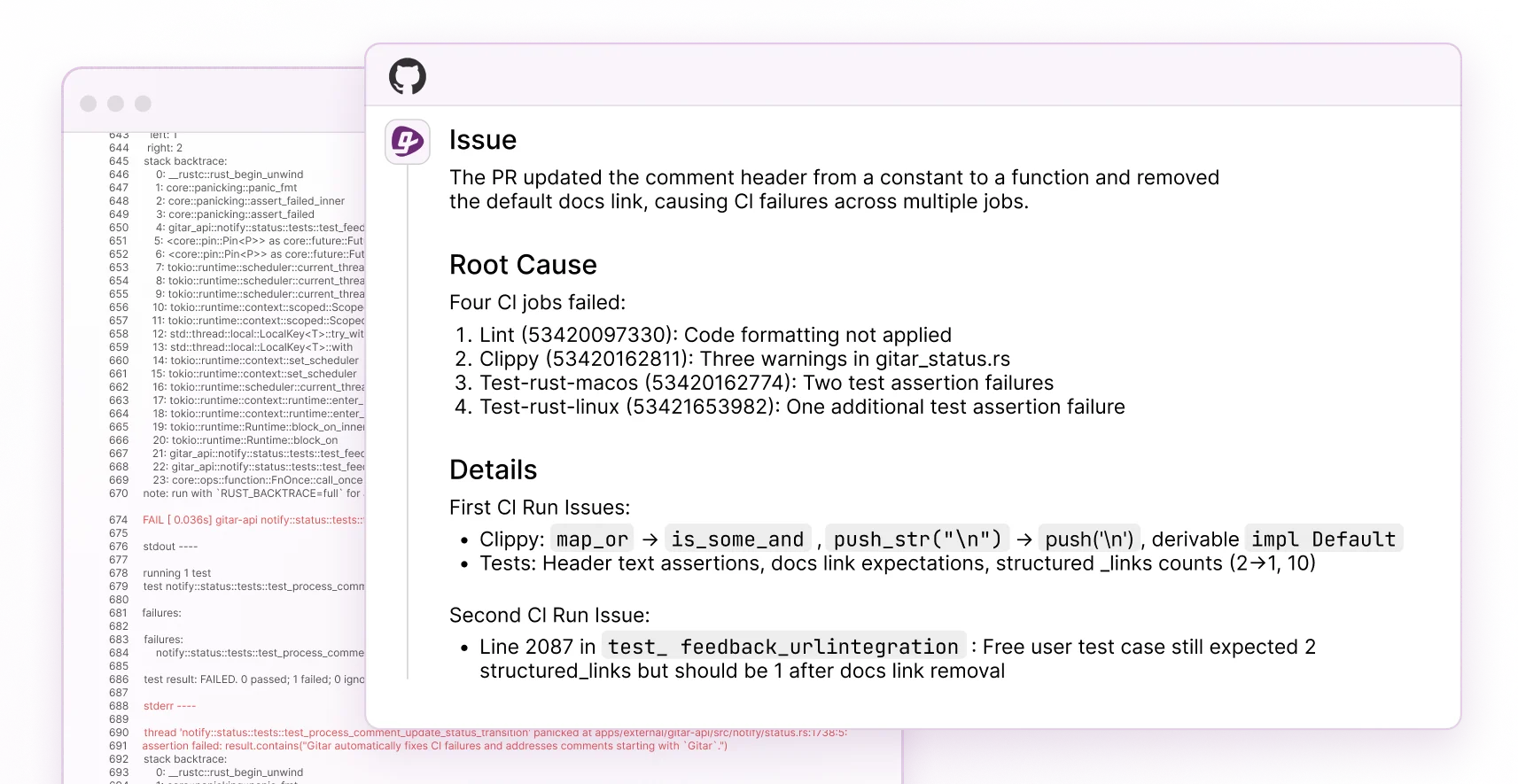
CodeRabbit focuses on code diffs and ignores CI failure logs, so it cannot reliably identify root causes. When builds fail from dependency version conflicts or missing environment variables, it offers generic advice without reading build logs, test output, or deployment errors.
2. Suggestions Only, No Automatic Fix or Validation
CodeRabbit posts fix ideas as comments but does not apply changes or verify that they resolve the failure. Developers must translate comments into code, push new commits, and wait for CI to re-run, which invites human error and extends feedback loops.
3. Missing CI Environment and Runtime Context
Many CI failures come from environment mismatches such as SDK versions, cache states, or third-party configuration. CodeRabbit operates without full CI environment visibility, so it cannot reliably propose fixes that match real runtime conditions or infrastructure dependencies.
4. High Miss Rate on Real Logic Bugs
CodeRabbit reaches only 46% accuracy on real-world runtime bugs, which trails tools that see more of the codebase and CI context. Independent tests show that CodeRabbit caught only 44% of test issues and missed critical logic errors that often break CI.
5. GitHub-Only Focus and Weak Monorepo Scale
CodeRabbit’s GitHub-centric design struggles with large monorepos and varied CI platforms. Teams on GitLab, CircleCI, or Buildkite face integration gaps, and monorepos with 50+ million lines of code, such as Pinterest’s scale, exceed its practical analysis limits.
6. Noisy Inline Comments and Alert Fatigue
CodeRabbit spreads many inline comments across PR diffs, which floods developers with notifications. Each push can trigger dozens of separate comments, making it hard to track what is resolved and adding cognitive load during urgent CI failure triage.
7. Shallow CI/CD Platform Integration
CodeRabbit integrates deeply only with GitHub Actions and has limited awareness of other CI platforms. Teams on CircleCI, Buildkite, or custom pipelines cannot rely on CodeRabbit for platform-specific failure patterns, which reduces its value in mixed or enterprise CI environments.
Why Manual Pipeline Recovery with CodeRabbit Consumes Time
Pipeline recovery with CodeRabbit follows a manual, multi-step process that slows teams. Developers read CI logs by hand, scan CodeRabbit comments for ideas, apply changes locally, push new commits, and then wait for CI to confirm whether anything worked.
This workflow collapses under complex failures that involve several dependencies, environment variables, or cascading errors across services. Because CodeRabbit never validates fixes inside the CI environment, teams often ship changes that still miss the root cause, which forces more CI cycles and delays.
Gitar vs. CodeRabbit: Automated Healing for Broken CI Builds
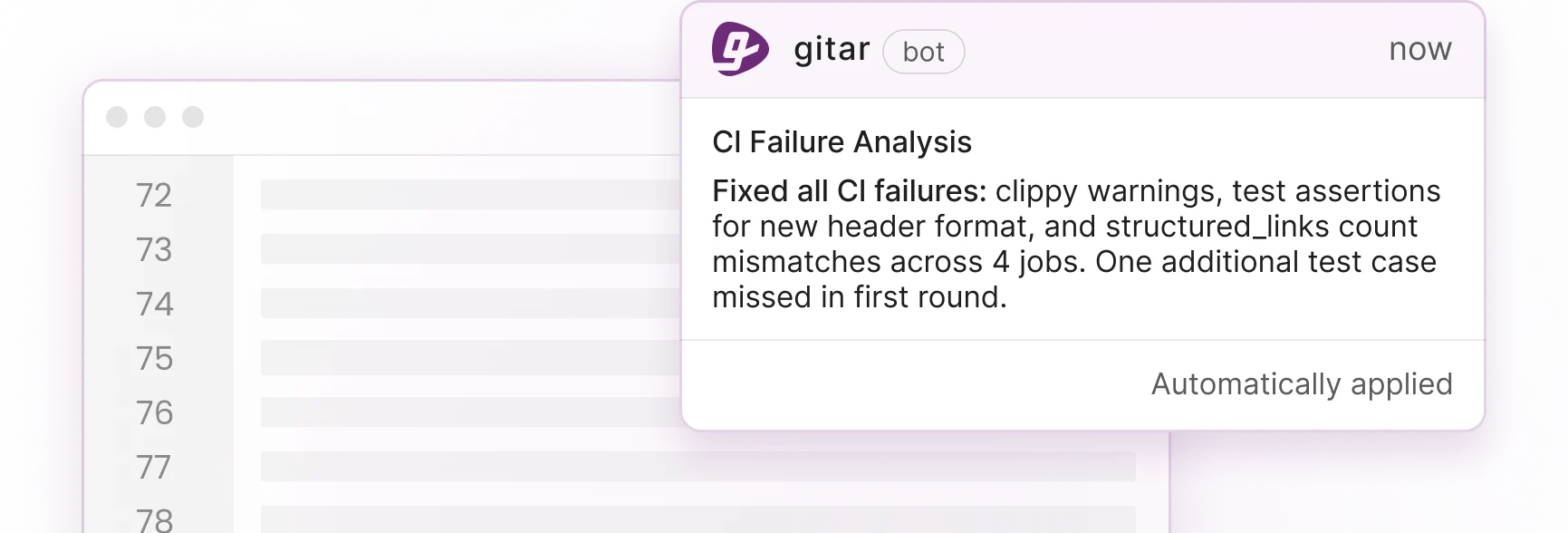
Gitar replaces manual CI failure recovery with automated analysis, fixing, and validation. CodeRabbit stops at suggestions, while Gitar reads failure logs, generates targeted fixes, validates them in CI, and commits working solutions.
| Capability | CodeRabbit | Gitar |
|---|---|---|
| CI Log Analysis | No | Yes (Free) |
| Auto-Fix & Validate | Suggestions Only | Yes (14-day Free Trial) |
| Green Build Guarantee | No | Yes |
| Pricing | $15-30/dev | Free Core |
Gitar delivers a stronger return on engineering time by cutting hours spent on broken builds. Install Gitar now to automatically fix broken builds and ship higher quality software faster.
How Teams Use Gitar on Real CI Failures
Pinterest’s engineering team manages more than 50 million lines of code and thousands of daily PRs. Gitar’s architecture supports this scale and delivers automated CI failure resolution that CodeRabbit cannot match. When dependency conflicts appear in large monorepos, Gitar reads the full dependency graph and applies fixes that respect cross-service relationships.
Collate’s engineering lead praised Gitar’s “unrelated PR failure detection,” which separates code-related failures from infrastructure flakiness. CodeRabbit cannot make that distinction without CI context. The Tigris team reported that Gitar’s PR summaries are “more concise than Greptile/Bugbot,” which shows a better signal-to-noise ratio during complex incidents.
Gitar also caught a high-severity security vulnerability in Copilot-generated code that the original AI tool missed. This example highlights how deeper analysis and CI awareness prevent serious issues from reaching production.
FAQ
How do you handle pipeline failures effectively?
Effective pipeline failure handling starts with automated root-cause analysis of CI logs, followed by validated fix generation and automatic application of working solutions. Gitar covers this full loop by reading failure logs, understanding the specific issue, generating fixes with full codebase context, validating them in the real CI environment, and committing only working changes.
This approach replaces manual log reading and guesswork with a repeatable, automated healing process.
What causes CodeRabbit dependency failures in complex projects?
CodeRabbit dependency failures arise because the tool lacks full environment context such as SDK versions, cache states, and runtime configuration. Without CI log analysis, it cannot reliably detect version conflicts, missing packages, or environment mismatches that break builds.
Even when CodeRabbit suggests the right dependency change, developers still must implement and validate it manually, which introduces more risk in large dependency graphs.
How does Gitar vs CodeRabbit CI integration compare?
Gitar offers native integration with GitHub, GitLab, CircleCI, and Buildkite, and it provides CI log analysis and automated fixing across these platforms. CodeRabbit focuses on GitHub and has limited CI awareness, so it suggests changes without validating them in the actual CI environment.
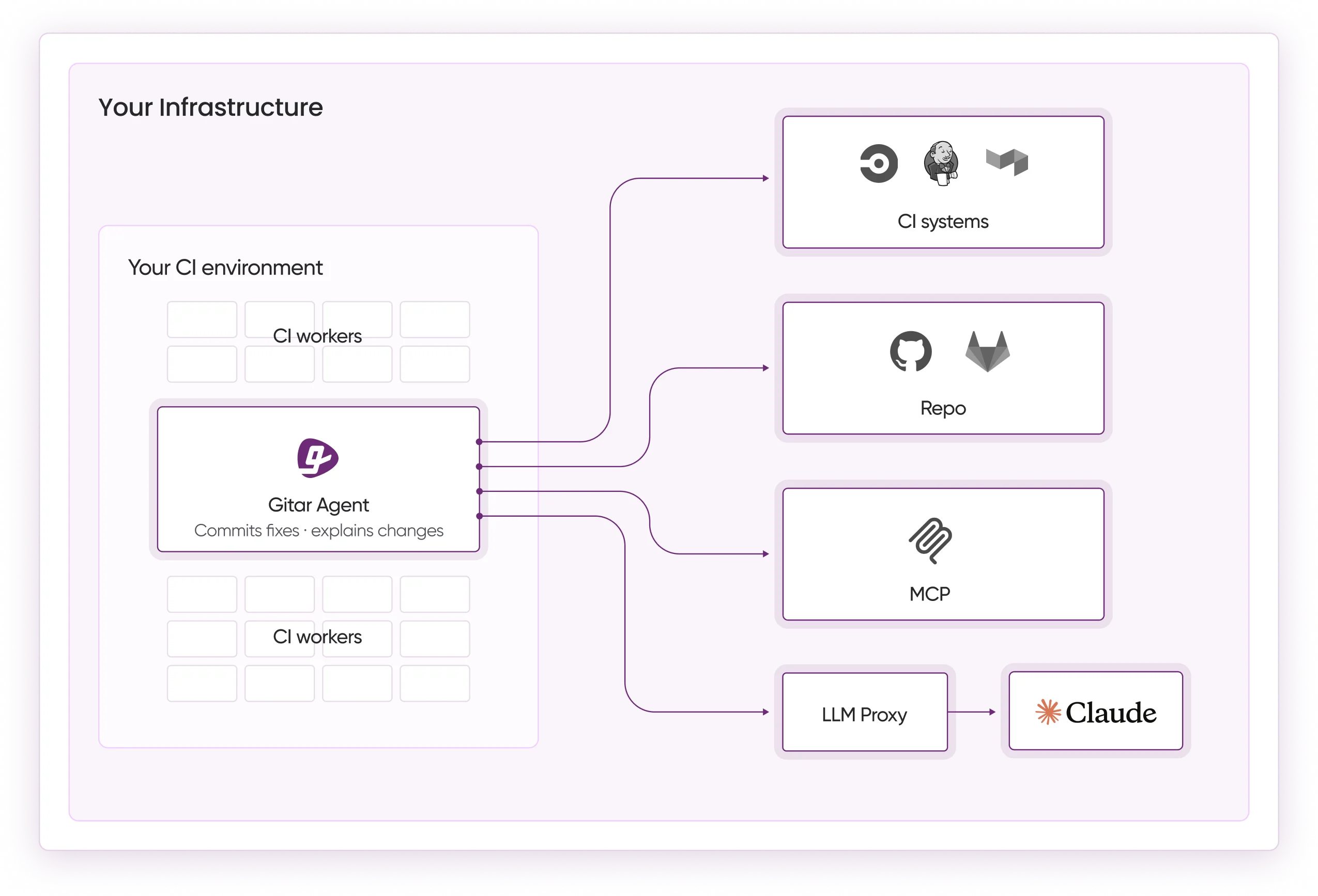
Gitar’s cross-platform design lets teams keep the same automated healing workflow regardless of CI provider, while CodeRabbit’s GitHub-only focus restricts its usefulness in mixed or enterprise setups.
Can you trust automated CI fixes from AI tools?
Trust in automated CI fixes depends on strong validation and clear controls. Gitar validates every fix in the real CI environment before committing, which ensures that changes work in practice, not just in theory.
Teams can start in suggestion mode to build confidence, then enable auto-commit for specific failure types. Enterprise customers can also run Gitar agents inside their own CI infrastructure, which keeps code and secrets under their control while still benefiting from automation.
What are CodeRabbit’s monorepo scale limitations?
CodeRabbit struggles on very large monorepos because it analyzes limited codebase context and relies on a GitHub-focused architecture. Monorepos with millions of lines of code and complex cross-service dependencies require a deeper understanding than a suggestion-only tool can provide.
CodeRabbit also lacks tight integration with many enterprise CI platforms that support large monorepo builds, which further reduces its effectiveness in complex organizations.
Conclusion: Why Teams Replace CodeRabbit with Gitar
CodeRabbit’s limits on complex CI failures come from its suggestion-only design, lack of CI context, and inability to validate fixes. Teams that pay $15 to $30 per developer and still handle implementation manually do not remove their main bottleneck.
Gitar’s free healing engine delivers automated CI failure analysis, validated fixes, and guaranteed green builds across major platforms. Install Gitar now to automatically fix broken builds and ship higher quality software faster.