

Key Takeaways for CI-Focused Code Review
- AI coding tools increase code output but slow delivery when CI reviews pile up. PRs using AI merge 16% faster, yet overall tasks finish 19% slower.
- CodeRabbit and similar tools charge $15-30 per developer for suggestions that still need manual fixes, which inflates review costs.
- Gitar leads as the top free alternative, with unlimited PR analysis, security scanning, and CI auto-fix across GitHub Actions, GitLab CI, CircleCI, and Buildkite.
- Other strong options include Qodo Merge for test generation, SonarQube for static analysis, and CodeAnt AI for one-click fixes, but most tools do not validate auto-fixes inside CI.
- Teams see 20–90% better patch rates and major ROI with healing platforms. Install Gitar now to automatically fix broken builds and ship higher quality software faster.
How We Evaluated CodeRabbit Alternatives
Our evaluation criteria focus on CI auto-fix capabilities instead of suggestion-only tools. We emphasize pricing transparency, integration depth across major CI platforms, and scalability for enterprise teams.
We analyze tools based on their ability to validate fixes in real CI environments, pricing models that support frequent usage, and integration support for GitHub Actions, GitLab CI, CircleCI, and Buildkite.
Data sources include 2026 platform documentation, GitHub repository statistics, developer community feedback, and production benchmarks. Our analysis centers on CI-validating tools that move beyond commentary to real problem resolution.
Top 10 CodeRabbit Alternatives for Automated CI Code Review in 2026
The tools below are grouped by primary strengths. Items 1–3 focus on AI-powered platforms, 4–5 on open-source options, and 6–10 on enterprise or specialized solutions.
1. Gitar – Free AI Code Review with CI Auto-Fix
Gitar delivers free AI code review that actually fixes code instead of only commenting on it. The platform provides full PR analysis, security scanning, and bug detection for unlimited repositories with no seat limits.
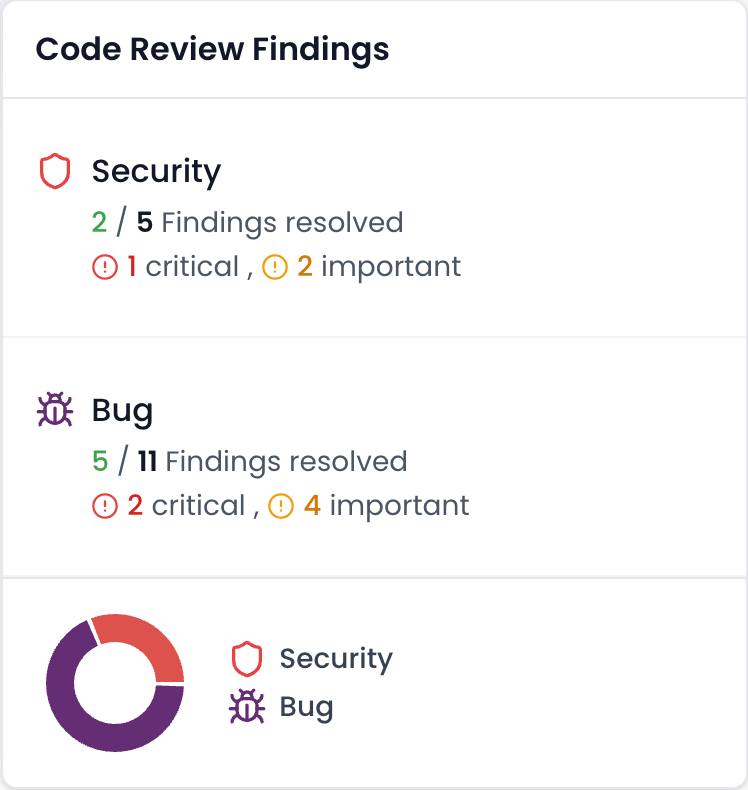
The healing engine analyzes CI failures, generates validated fixes, and commits them directly to PRs, with autofix features available through a 14-day free trial. Key features include a single-comment UI that consolidates findings, support for GitHub Actions, GitLab CI, CircleCI, and Buildkite, plus natural language repository rules that remove YAML complexity.
Enterprise teams lose 20-40% of velocity to inefficient code review processes, so Gitar’s automated approach fits especially well for scaling teams.
Ideal for: Teams that want comprehensive free code review with real CI auto-fix and room to scale to enterprise workloads.
Install Gitar now, automatically fix broken builds, start shipping higher quality software, faster.
2. Qodo Merge (formerly Codium) – AI Test Generation Focus
Qodo focuses on test generation through its Codebase Intelligence Engine, which suits GitHub-heavy enterprises with budget. The platform offers multi-agent AI review, customizable rules, and team analytics across GitHub, GitLab, and Bitbucket.
Pricing begins at paid tiers, with advanced capabilities locked behind higher plans. While powerful, Qodo receives criticism for its learning curve and heavier system resource usage.
Ideal for: Enterprise teams that prioritize test generation and accept premium pricing for AI-powered review.
3. MatterAI – Contextual PR Feedback with CI Hooks
MatterAI centers on contextual PR feedback with CI integration hooks. The platform provides detailed analysis and connects with major version control systems.
MatterAI operates mainly as a suggestion engine instead of a full auto-fix solution, so teams still apply changes manually.
Ideal for: Teams that want richer PR feedback with basic CI awareness.
4. PR-Agent – Open Source and Self-Hosted Control
Qodo Merge PR-Agent is open-source, supports GitHub, GitLab, and Bitbucket, offers unlimited PRs, and provides self-hosted options for security-focused teams. The platform requires technical setup but gives full control over deployment and data privacy.
Ideal for: Security-conscious teams with engineering capacity to manage self-hosted deployments and unlimited PR workloads.
5. SonarQube – Static Analysis for AI-Heavy Codebases
SonarQube remains a core tool for static code analysis, with free community editions available. With 42% of all committed code AI-generated or assisted in 2025, SonarQube’s guardrails, AI-native integrations, and contextual fix suggestions matter more than ever.
Ideal for: Teams that need mature static analysis with proven CI and CD integration patterns.
Install Gitar now, automatically fix broken builds, start shipping higher quality software, faster.
6. Kilo – Agentic Engineering Across the Stack
Kilo offers agentic engineering modes for implementation, architecture, debugging, and orchestration across IDE and CLI environments. The platform includes cloud agents, app builder features, and managed indexing for context-aware reviews.
Ideal for: Teams that want a broad agentic development environment that extends beyond traditional code review.
7. Greptile – Deep Codebase Context for Large Systems
Greptile supports GitHub and GitLab with deep full codebase analysis for stronger bug detection, priced at $30 per developer. The platform delivers high accuracy by using full codebase context.
Greptile faces criticism for higher costs and limited flexibility in enforcing team-specific standards, which can affect adoption.
Ideal for: Large, interconnected systems that require deep codebase analysis and have budget for premium pricing.
8. Aikido – Security-Focused Auto-Remediation
Aikido functions as a focused, fairly priced security platform with smooth Jira integration, designed for engineers rather than security specialists. The platform highlights real vulnerabilities that reach systems using both open source and proprietary scanners.
Ideal for: Security-first teams that want affordable vulnerability detection with an engineering-friendly interface.
9. CodeAnt AI – One-Click Fixes and DORA Metrics
CodeAnt.ai provides real-time AI code review, quality analysis, security scanning, one-click fixes, and continuous repo scans with DORA metrics. The platform integrates with GitHub, GitLab, Bitbucket, Azure DevOps, and CI/CD pipelines at $10 per user per month after a 14-day trial.
Ideal for: Teams that want broad code quality coverage with one-click fixes across several platforms.
10. Graphite – Stacked PR Workflows with CI Healing
Graphite Agent operates as a leading AI code review platform that improves code quality. It excels at stacked PR workflows, GitHub integration, and self-healing CI that detects and resolves failures automatically.
Ideal for: GitHub-centric teams that rely on stacked PRs and want smoother review flows.
Gitar Deep-Dive: Why It Beats CodeRabbit for Free
Gitar stands out by pairing comprehensive free code review with a healing engine that validates and commits fixes instead of leaving suggestions, with autofix features available through a 14-day free trial. The platform offers unlimited PR analysis, security scanning, and bug detection without seat limits or credit card requirements.
Gitar also connects with Jira, Slack, and Linear for cross-platform context, supports repository rules in natural language, and provides analytics for CI failure patterns. Integrated QA in CI/CD cuts production defect rates by 60–80%, with defects costing $500–$1,000 in development versus $10,000–$50,000 in production.
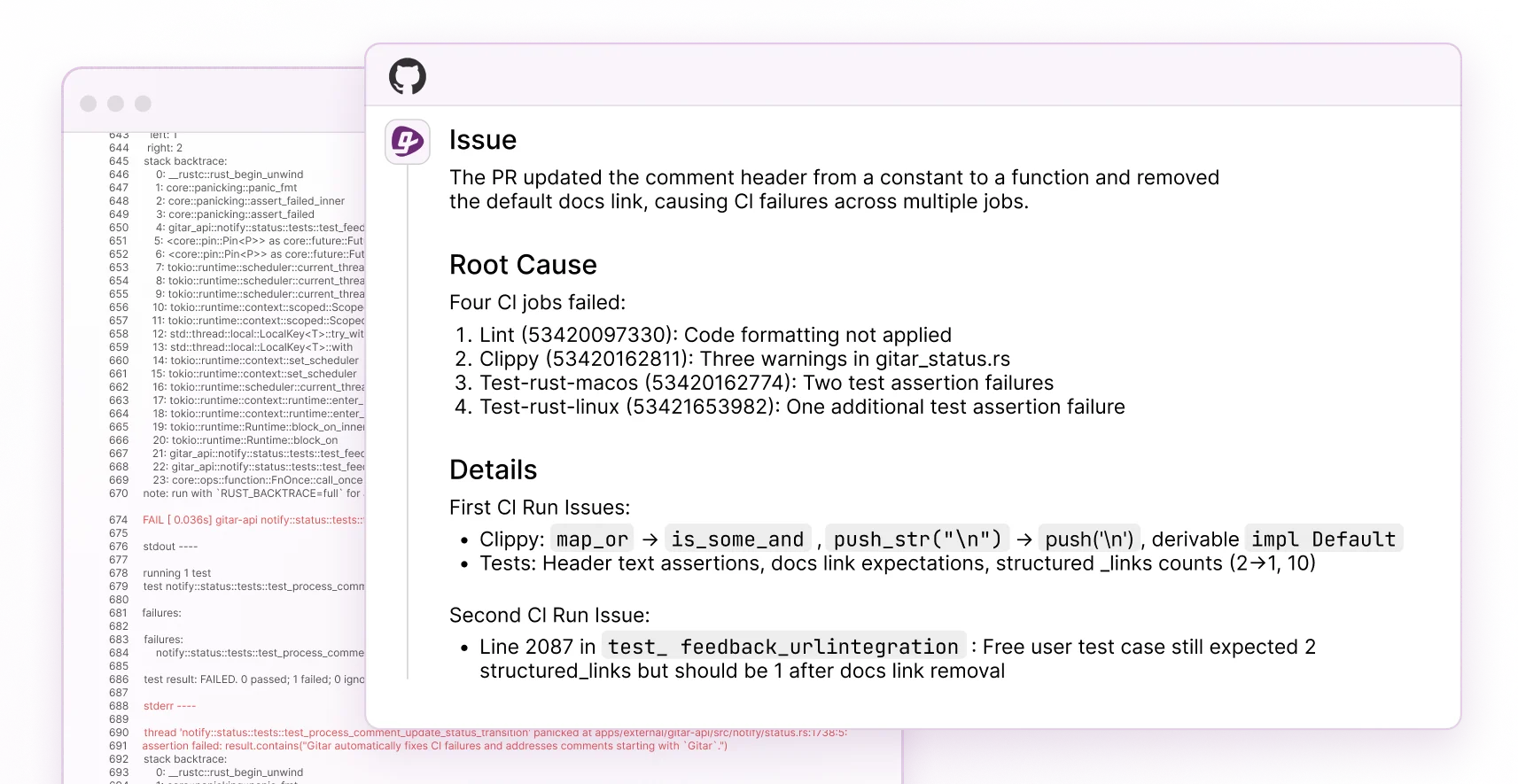
For a 20-developer team, Gitar’s ROI model shows potential savings from $1M annual productivity loss down to $250K, while competitors charge $450-900 monthly for suggestion-only tools. Setup takes about 30 seconds through a GitHub App installation, with Pinterest and Tigris testimonials confirming enterprise-scale success.
Install Gitar now, automatically fix broken builds, start shipping higher quality software, faster.
Side-by-Side Comparison of CI Auto-Fix Capabilities
| Tool | CI Auto-Fix | Pricing/Developer/Month | Key Integrations |
|---|---|---|---|
| Gitar | Yes, validates and commits fixes (14-day free trial) | Free for code review, trial for autofix | GitHub/GitLab/CircleCI/Buildkite |
| CodeRabbit | No, suggestions only | $15-30 | GitHub/GitLab/Bitbucket |
| Qodo Merge | Limited | Paid tiers | GitHub/GitLab/Bitbucket |
| Greptile | No | $30 | GitHub/GitLab |
| SonarQube | No | Free Community | Multiple CI Systems |
| CodeAnt AI | One-click fixes | $10 | GitHub/GitLab/Bitbucket/Azure |
Competitive Matchups with CodeRabbit
CodeRabbit vs Gitar
CodeRabbit charges $15-30 per developer for suggestion-only comments that still require manual work. Gitar delivers free comprehensive code review with real CI auto-fix that validates fixes in live environments before committing.
Trust in AI-generated code dropped to 29% in 2025, which makes Gitar’s validation-first approach especially valuable.
CodeRabbit vs SonarQube
SonarQube offers static analysis with AI context and strong integrations, while CodeRabbit focuses on AI-powered suggestions. Gitar combines both strengths by pairing contextual AI review with static analysis and delivering validated fixes instead of comments that developers must implement.
Free CodeRabbit Alternatives Overview
Among free alternatives, Gitar leads with feature parity to many paid tools plus unique CI auto-fix. SonarQube Community delivers core static analysis, while PR-Agent offers flexibility but introduces self-hosting overhead.
Self-Hosted CodeRabbit Replacement Options
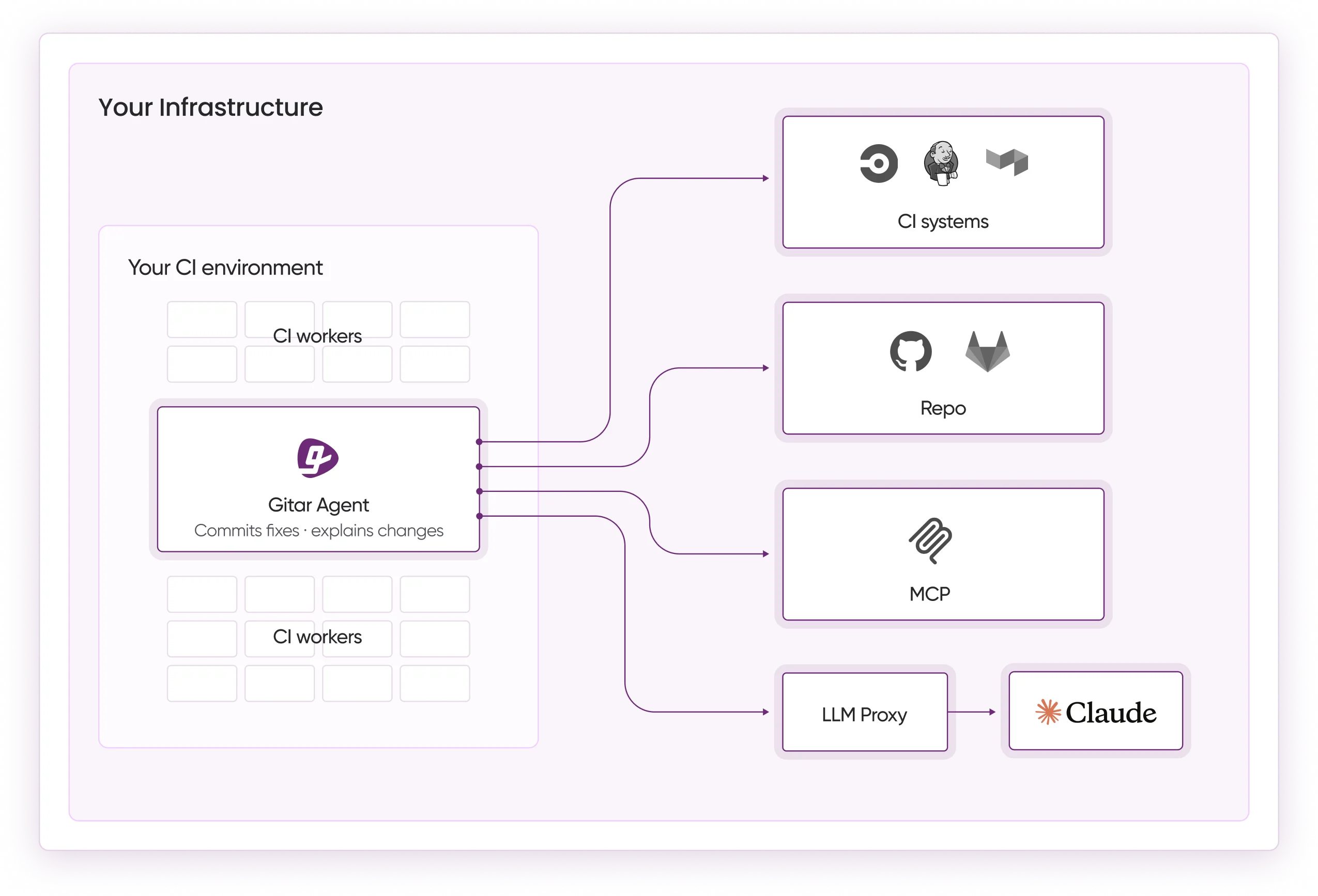
PR-Agent supports open-source self-hosting but lacks the CI integration depth and auto-fix validation found in enterprise platforms. Gitar’s Enterprise Plan runs the agent inside your CI pipeline, with full access to configs, secrets, and caches, while keeping code inside your infrastructure.
Install Gitar now, automatically fix broken builds, start shipping higher quality software, faster.
Key Buying Considerations, Tradeoffs, and ROI
Engineering leaders who want quiet, focused development environments should favor tools that consolidate feedback instead of scattering inline comments. Platform engineers benefit from natural language rule configuration instead of complex YAML workflows.
DevOps teams need CI integration depth that goes beyond basic webhook notifications. Enterprises piloting agentic remediation report 20 engineering hours saved per week and patch rates rising from 67% to over 90%.
The tradeoff between free healing engines and paid suggestion tools becomes clear when you consider total cost of ownership. Healing platforms can deliver $0 in license cost plus roughly $750K in productivity savings, while suggestion tools often charge $450-900 monthly and still rely on manual implementation.
Frequently Asked Questions on CodeRabbit Alternatives
What is the best free CodeRabbit alternative for CI integration?
Gitar offers the most complete free alternative, with code review across GitHub Actions, GitLab CI, CircleCI, and Buildkite. Gitar includes unlimited PR analysis, security scanning, and bug detection without seat limits or credit card requirements, with validated CI auto-fix available through a 14-day free trial.
How do CodeRabbit and Gitar compare for GitLab and CircleCI integration?
CodeRabbit supports GitLab but focuses on suggestion comments without deep CI context. Gitar provides native GitLab CI and CircleCI integration, analyzes failure logs, generates fixes, validates them in real CI environments, and commits working solutions.
This approach makes Gitar especially useful for teams that rely on multiple CI platforms beyond GitHub Actions.
How can teams measure ROI from AI code review tools?
Teams should track suggestion acceptance rates, time saved on repetitive tasks, cycle time changes, and bug reduction rates. Useful metrics include the percentage of AI suggestions that remain in the codebase, review turnaround times before and after rollout, and productivity gains from reduced context switching.
Tools that auto-fix instead of only suggesting usually show higher ROI because they save direct engineering time.
What are the best self-hosted CodeRabbit alternatives?
PR-Agent offers open-source self-hosting with GitHub and GitLab support but demands technical setup and lacks advanced CI integration. For enterprise teams, Gitar’s Enterprise Plan runs agents inside customer CI pipelines, providing self-hosted security with full platform capabilities, including auto-fix validation and cross-platform integration.
Which tools actually auto-fix CI failures instead of only suggesting changes?
Most alternatives, including CodeRabbit, Greptile, and Qodo Merge, provide suggestions that require manual implementation. Gitar uniquely offers validated auto-fix that analyzes CI failures, generates solutions, tests them in real environments, and commits working fixes.
CodeAnt AI supports one-click fixes, while Aikido focuses on security-specific auto-remediation.
Conclusion and Next Steps for Your Team
Modern AI-heavy development requires tools that move from suggestion engines to real problem resolution. CodeRabbit and similar platforms charge premium prices for comments that still need manual work, while Gitar leads with free comprehensive code review plus validated CI auto-fix.
Teams comparing options should prioritize auto-fix validation, deep CI integration, and pricing models that scale without per-seat penalties. The ROI gap between suggestion engines and healing platforms grows large once you factor in both subscription costs and productivity impact.
Install Gitar now, automatically fix broken builds, start shipping higher quality software, faster. Setup takes about 30 seconds with no credit card required and gives immediate access to one of the most comprehensive free code review platforms available in 2026.