
Written by: Ali-Reza Adl-Tabatabai, Founder and CEO, Gitar
Key Takeaways for Distributed Engineering Leaders
- Distributed teams face 91% longer PR review times due to AI-generated code volume and time zone delays, costing $1M annually in productivity for a 20-developer team.
- Teams can cut delays with a 7-step asynchronous workflow built around small PRs, rich descriptions, timezone-aware assignments, consolidated dashboards, and auto-fixing CI failures.
- Core automation tools include linters, CI systems like GitHub Actions, security scanners, and smart CODEOWNERS rules that route reviewers across regions.
- Gitar outperforms suggestion-only AI tools like CodeRabbit by auto-applying fixes, healing CI failures, and using a single dashboard comment to reduce notification noise.
- Start shipping faster with Gitar’s 14-day free trial, featuring natural language rules and cross-platform integrations for distributed teams.
Asynchronous Code Review Workflows: 7-Step Blueprint for Velocity
Distributed teams maintain velocity when they design code review around async collaboration, automation, and auto-healing systems like Gitar that implement fixes while teams sleep. See the Gitar documentation for details on auto-healing features, setup instructions, and full feature specifications.
This 7-step blueprint gives teams a practical structure for asynchronous code review workflows:
1. Keep PRs Small and Focused
Limit pull requests to 200-400 lines of code and single-responsibility changes. Teams maintaining median PR sizes of 50 lines ship 40% more total code than those with 200+ line PRs.
2. Write Rich PR Descriptions
Document the problem, chosen solution, discarded alternatives, and include screenshots or architectural diagrams. This context reduces back-and-forth across time zones and keeps reviews moving overnight.
3. Implement Time-Zone-Aware Assignment
Use CODEOWNERS files with timezone-based routing so the right regional team sees each PR quickly:
4. Consolidate Feedback in a Single Dashboard Comment
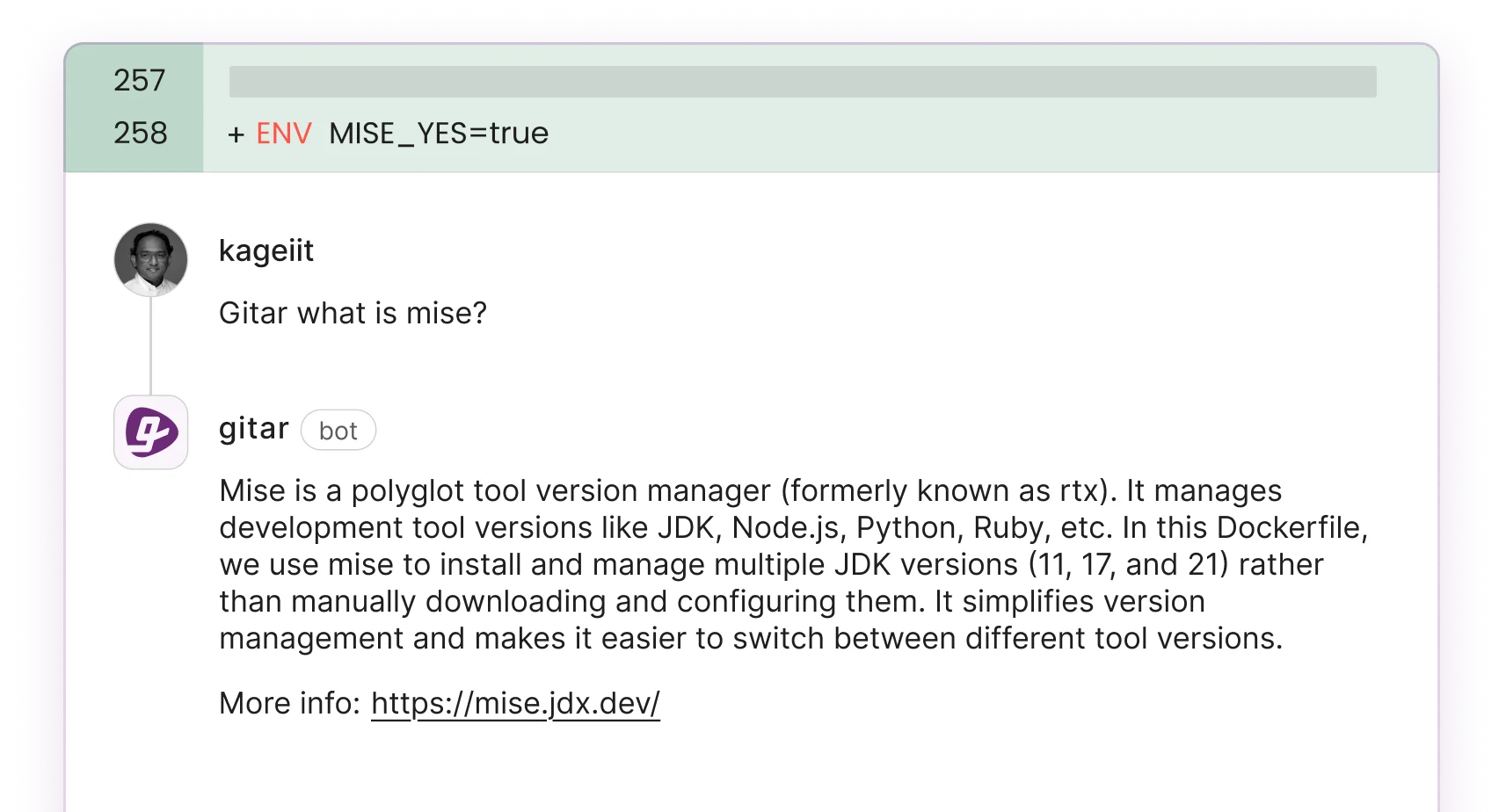
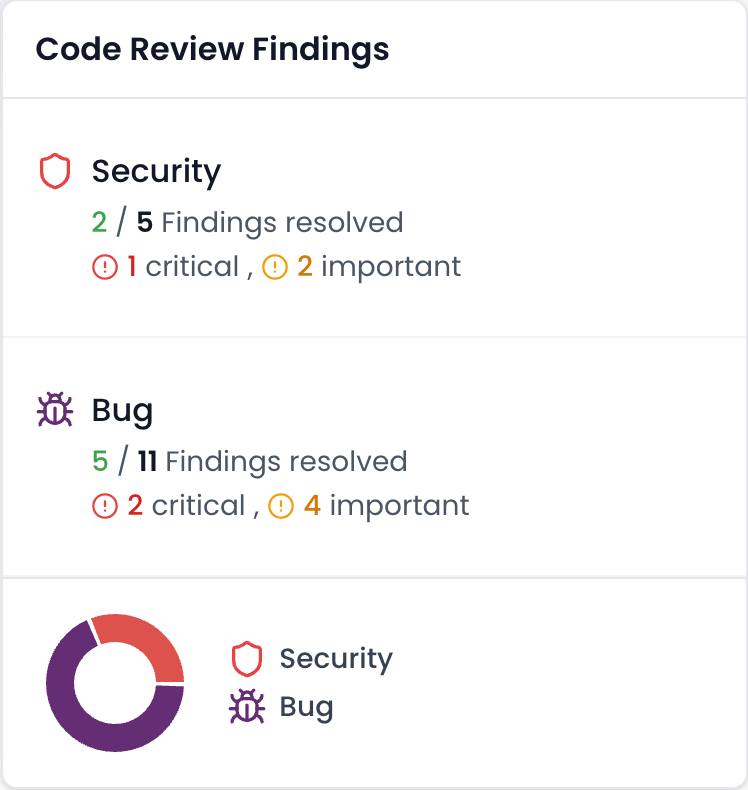
Gitar consolidates all important information in one living “Dashboard” comment that continually stays up-to-date. This approach eliminates notification spam and provides a single source of truth for each PR. For setup instructions, see the documentation.
5. Auto-Fix CI Failures
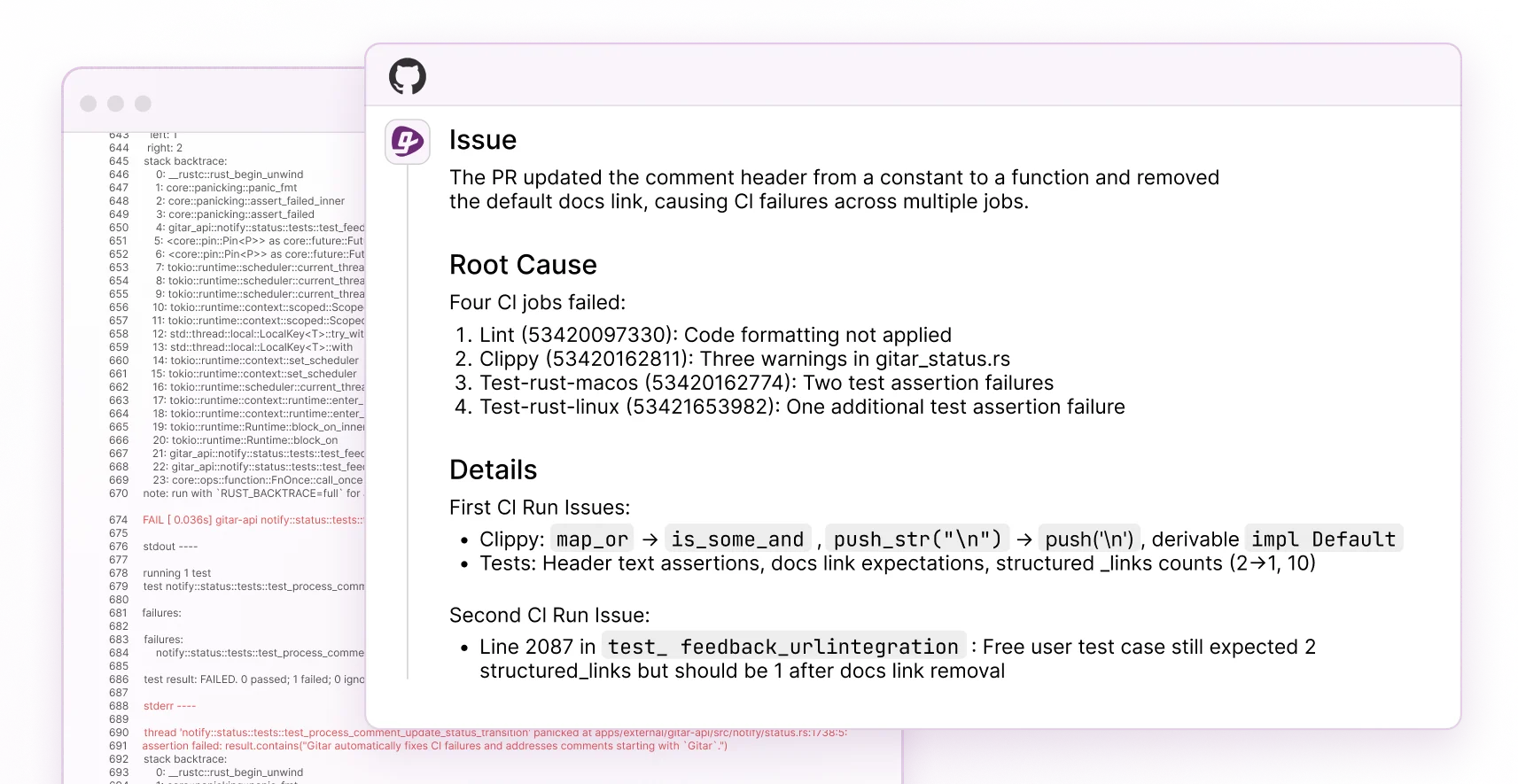
While competitors leave suggestions, Gitar’s CI agent maintains full context and works continuously to keep CI green, finding root causes and fixing them automatically. The docs explain configuration options and supported failure types in detail.
6. Define Natural Language Rules
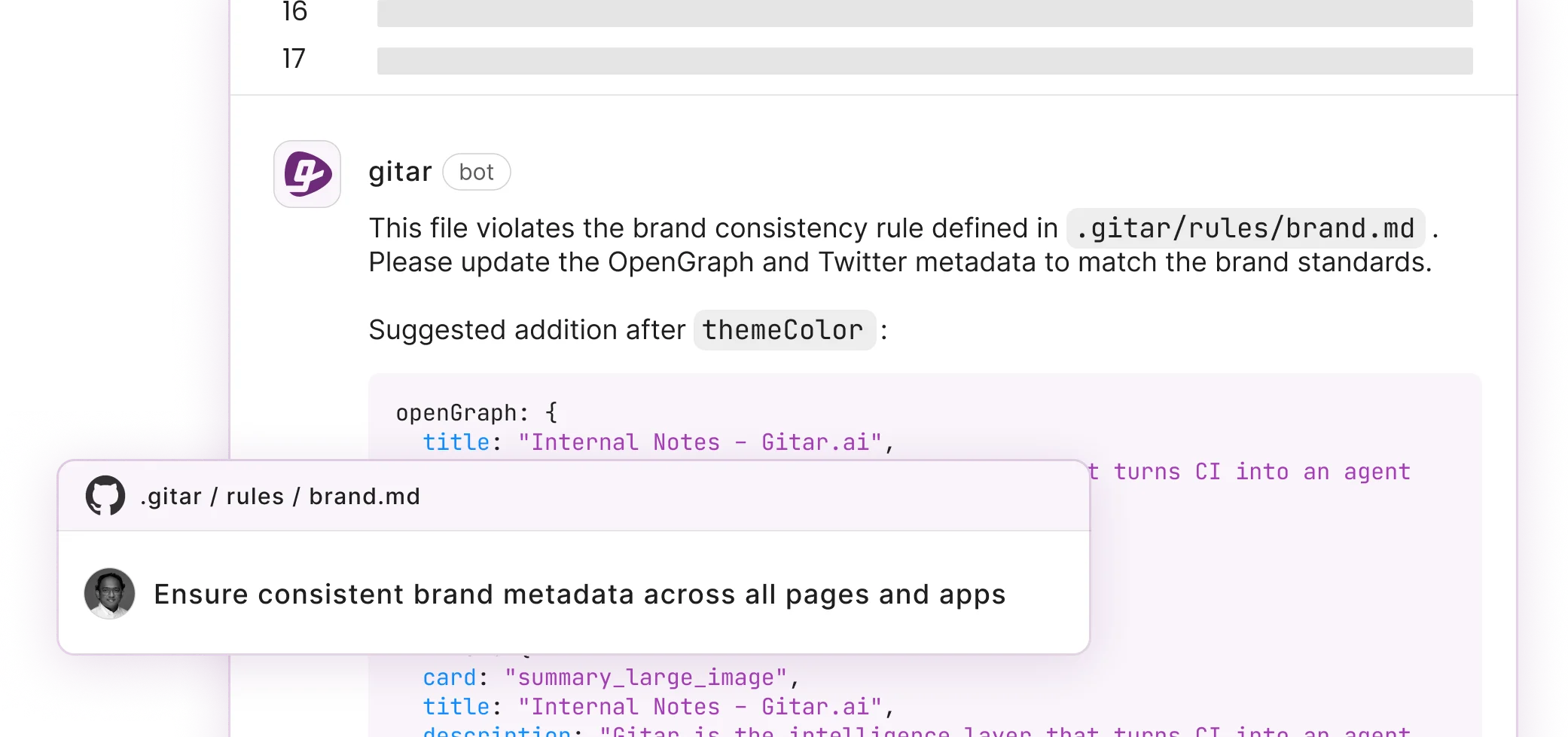
Create .gitar/rules.md files with plain English automation so non-experts can shape workflows:
7. Establish SLA Agreements for Reviews
Set team-wide Service Level Agreements such as first response within 24 hours. This timeframe prevents PRs from stalling for days while still giving reviewers flexibility to respond during their working hours, not immediately.
Essential Automation Stack: Linting, CI Gates, and Time-Zone Routing
Reliable automation gives distributed teams consistent quality gates before humans even open a PR. Configure CI/CD pipelines to run linters, security scans, and tests on every proposed change, with status checks blocking merges until requirements are met.
Effective automation stacks usually include:
- Linters: ESLint for JavaScript, Pylint for Python, RuboCop for Ruby
- CI Systems: GitHub Actions, GitLab CI, CircleCI, Buildkite
- Security Scanners: SAST tools and dependency vulnerability checks
- Smart Assignment: CODEOWNERS files with timezone-aware routing
Teams can route reviewers by both ownership and region with a simple playbook:
Gitar integrates seamlessly with existing toolchains, pulling context from Jira, Slack, and Linear while supporting GitHub, GitLab, CircleCI, and Buildkite. This cross-platform approach keeps teams flexible instead of locking them into a single vendor ecosystem.
While traditional automation tools handle linting and testing, the next frontier is AI-powered code review for distributed teams. Not all AI tools deliver the same value when teams need more than suggestions.
AI Code Review Tools Showdown: From Suggestions to Auto-Fixes
The AI code review landscape divides into two categories: suggestion engines that leave comments, and healing engines that actually implement fixes. The table below highlights the critical difference: only Gitar moves beyond suggestions to apply fixes and heal CI failures automatically for distributed teams.
|
Capability |
CodeRabbit |
Greptile |
Gitar |
|
PR Summaries |
Yes |
Yes |
Yes |
|
Inline Suggestions |
Yes |
Yes |
Yes |
|
Auto-Apply Fixes |
No |
No |
Yes |
|
CI Auto-Fix |
No |
No |
Yes |
CodeRabbit, deployed across 1M+ repositories, analyzes PRs with 46% bug detection accuracy at $12-24/developer/month but still requires manual implementation. Greptile builds knowledge graphs for architectural context but also leaves developers to implement changes manually.
Gitar’s healing engine stands apart by automatically implementing fixes and validating them against CI. The dashboard approach mentioned earlier eliminates notification spam, while configurable PR merge blocking based on review verdict severity keeps quality gates intact.
Customer feedback consistently highlights this difference. Tigris reported that Gitar’s PR summaries are “more concise than Greptile/Bugbot,” and Collate’s engineering lead praised the “unrelated PR failure detection” that saves “significant time” by separating infrastructure flakiness from code bugs.
Experience auto-fixing in action with a 14-day trial, with no seat limits and no credit card required, and see the difference between suggestions and actual solutions.
Gitar: AI Healing Engine for Distributed Codebases
Gitar adds an intelligence layer to CI that helps engineering managers ship faster with less friction through comprehensive automation that goes beyond traditional code review. The documentation covers full feature details, configuration options, and deployment patterns.
Core features include:
- CI Failure Analysis: Automatically analyzes failures and provides insights in the dashboard comment, updating dynamically with new commits.
- Auto-Fix Implementation: Generates validated fixes and commits them directly to PRs, reducing manual rework for common failures.
- Natural Language Rules: Lets teams define workflows in plain English without complex YAML, so product and QA leaders can contribute.
- Cross-Platform Integration: Provides native support for GitHub, GitLab, Jira, Slack, and Linear.
ROI comparison for a 20-developer team: by reducing daily CI and review overhead from 1 hour to 15 minutes per developer, Gitar saves $750K annually in productivity costs. This 75% reduction compounds across every sprint and release cycle.
|
Metric |
Before |
After |
|
CI/Review Time per Developer Daily |
1 hour |
15 minutes |
|
Annual Productivity Cost |
$1M |
$250K |
The healing engine approach delivers measurable velocity improvements by eliminating the manual work that suggestion-only tools still require.
Getting Started with Gitar’s 14-Day Trial
Teams can roll out Gitar in four clear phases that build trust before enabling full automation.
Phase 1: Installation – Install the GitHub App or GitLab integration in under 30 seconds.
Phase 2: Trust Building – Start in suggestion mode so reviewers can inspect and approve fixes.
Phase 3: Automation – Enable auto-commit for trusted fix types and add repository rules.
Phase 4: Platform Expansion – Connect Jira and Slack integrations and explore analytics.
The time-zone-delayed PR bottleneck and AI code floods are slowing distributed teams despite 84% AI adoption rates. Traditional suggestion engines charge premium prices for incremental improvements that still require manual work. Gitar’s healing engine automatically fixes CI failures and implements review feedback, delivering green builds and slashing the annual productivity losses mentioned earlier that plague distributed teams.
Install Gitar now to automatically fix broken builds and start shipping higher quality software, faster.
Frequently Asked Questions
How does Gitar handle time zone differences in distributed teams?
Gitar operates continuously in the background and automatically fixes CI failures while addressing review feedback. The dashboard comment consolidates all findings and updates in real time, as described above, which reduces notification noise for reviewers. Gitar supports distributed teams through its cross-platform integrations and automation features.
What is the difference between Gitar and CodeRabbit for distributed teams?
CodeRabbit analyzes PRs and leaves inline suggestions that developers must manually implement, which increases notification volume and requires additional commits. Gitar’s healing engine automatically implements fixes, validates them against CI, and consolidates all feedback in a single updating comment. While CodeRabbit charges $15-30 per seat for suggestions, Gitar provides a 14-day free trial of complete automation that actually resolves issues without manual intervention.
Is there a free trial available?
Gitar offers a comprehensive 14-day free trial of the Team Plan with full access to auto-fix capabilities, custom rules, CI analysis, and all integrations. There are no seat limits during the trial period, so entire teams can experience the platform’s velocity improvements before committing to a paid plan. The trial includes complete access to the healing engine, dashboard comments, and cross-platform integrations.
Can we control when Gitar makes automatic commits?
Teams retain full control over when Gitar commits changes. Gitar provides configurable automation modes, starting with suggestion-only where you approve every fix to build trust. You can then enable auto-commit for specific failure types like linting errors or test fixes while keeping manual approval for complex logic changes. Repository rules allow fine-grained control over when and how automation triggers so teams maintain the right balance of speed and oversight.
How does Gitar integrate with our existing CI/CD pipeline?
Gitar integrates natively with GitHub Actions, GitLab CI, CircleCI, Buildkite, and other major CI systems without pipeline changes. The platform analyzes failure logs, understands your specific build environment including SDK versions and dependencies, and generates fixes that work within your existing infrastructure. Enterprise deployments can run the agent inside your own CI environment with full access to secrets and caches, ensuring fixes validate against your complete production setup.