
Hey there, if you’re in software development, you know how frustrating Continuous Integration (CI) build failures can be. They disrupt your workflow, break your focus, and delay releases, costing your team time and money. Instead of just spotting issues or suggesting fixes, imagine a tool that steps in and resolves these problems for you. Autonomous AI agents are changing the game by automatically fixing CI failures, turning a stressful process into a smooth, hands-off experience.
Here’s a stark reality: developers often spend up to 30% of their time handling CI issues and code review feedback. That’s over an hour a day per engineer debugging broken builds. For a team of 20, this adds up to about $1 million in lost productivity each year, and the cost only grows as your team or codebase scales.
Ready to cut down on this drain? Install Gitar now to automatically fix broken builds and ship software faster.
Why CI Build Failures Hurt More Than You Think
CI failures aren’t just minor glitches. They slow down your entire team by creating delays that ripple through your projects. Pipelines taking over 10 minutes can cut deployment frequency in half compared to faster ones. Slow feedback from failed builds directly impacts how quickly your team can deliver software.
How Context Switching Drains Your Energy
Every time a build fails, you’re pulled away from your current task. You push code, move on to something else, and then a failure notification drags you back. A quick fix that should take 5 minutes can stretch into an hour because of the mental shift required. The idea of submitting a pull request and moving on rarely works out.
This issue hits harder for distributed teams. If a developer in the US pushes a pull request needing review from someone in India, simple feedback can take days due to time zone gaps. Add CI failures to the mix, and delays pile up even more.
Typical Causes of CI Failures
Many CI build failures follow familiar patterns. These include flaky tests, misconfigured scripts, dependency issues, and poor version control habits. Here’s a breakdown of common issues:
- Flaky tests that pass or fail inconsistently due to timing or external factors.
- Linting and formatting errors that could be fixed automatically.
- Dependency mismatches that work locally but fail in CI.
- Configuration mistakes like missing variables or incorrect file paths.
- Build script errors from syntax issues or wrong tool versions.
Fixing these takes up a huge chunk of developer time, even though most are predictable. Dealing with configuration errors and dependencies creates bottlenecks that slow everyone down.
Why Standard Fixes Don’t Fully Solve the Problem
Most CI tools either detect issues or suggest solutions, but they still leave the heavy lifting to developers. This means you’re stuck spending time applying and verifying fixes, which keeps productivity low.
The Limits of Suggestion Tools
AI-driven tools like CodeRabbit or Claude integrations often provide useful ideas for fixing CI failures. However, they still require developer involvement to complete the process. You might need to:
- Review and accept the suggested changes.
- Test the fix on your local machine.
- Commit and push the updated code.
- Wait for CI to rerun and hope it passes.
This back-and-forth means context switching remains a problem, and there’s no guarantee the fix will work in your specific setup.
The Challenge of Custom Integrations
Some teams use large language models like Claude for CI fixes, but these often require custom setups. You’ll need to invest in integration work, prompt design, and context handling, basically building your own solution from scratch.
Even with AI help, manual debugging eats up time. It often uncovers hidden test flakiness or configuration gaps, adding to mental strain and project delays.
How Autonomous CI Tools Save Your Team Time
A new wave of tools goes beyond suggestions by actively solving CI problems. These systems detect issues, analyze causes, apply fixes, and verify them, all without needing your input. It’s like having a CI pipeline that heals itself.
What Sets Autonomous Fixing Apart
Unlike reactive tools, autonomous CI systems take a proactive approach. They handle issues before you even notice them by:
- Spotting failures the moment they happen.
- Digging into root causes with full environment details.
- Creating fixes tailored to the problem and your codebase.
- Testing fixes in the CI environment before applying them.
- Implementing solutions with options to undo if needed.
This shifts CI failures from distractions to background tasks that resolve on their own.
Meet Gitar: Your Autonomous CI Assistant
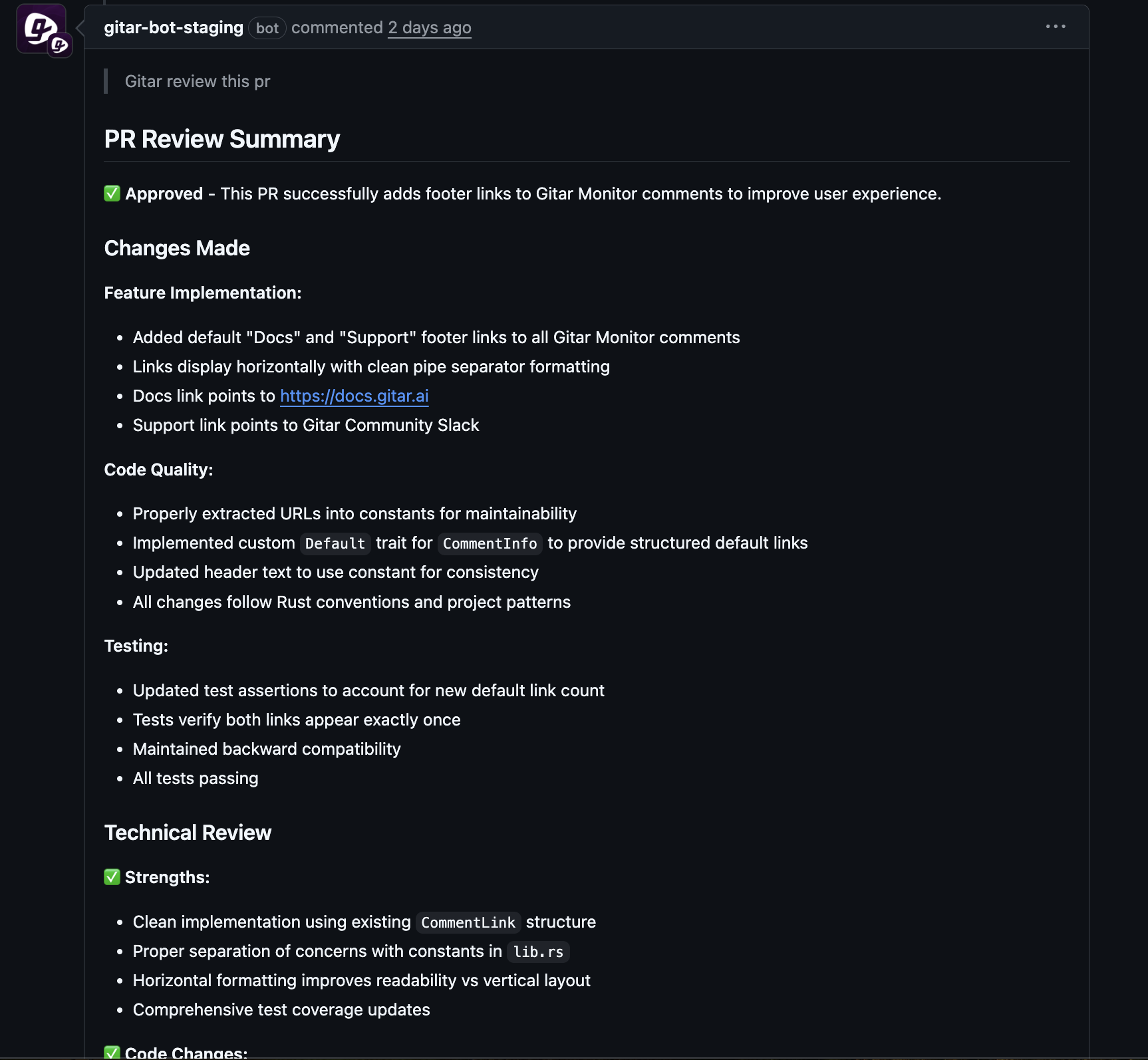
Gitar takes CI tools to the next level. It’s an AI agent that doesn’t just point out problems, it fixes them for you. Whether it’s a failed pipeline or code review feedback, Gitar steps in to analyze, correct, and update your pull request with a working solution.

How Gitar Gets the Job Done
Gitar follows a detailed process, matching the exact environment your code runs in:
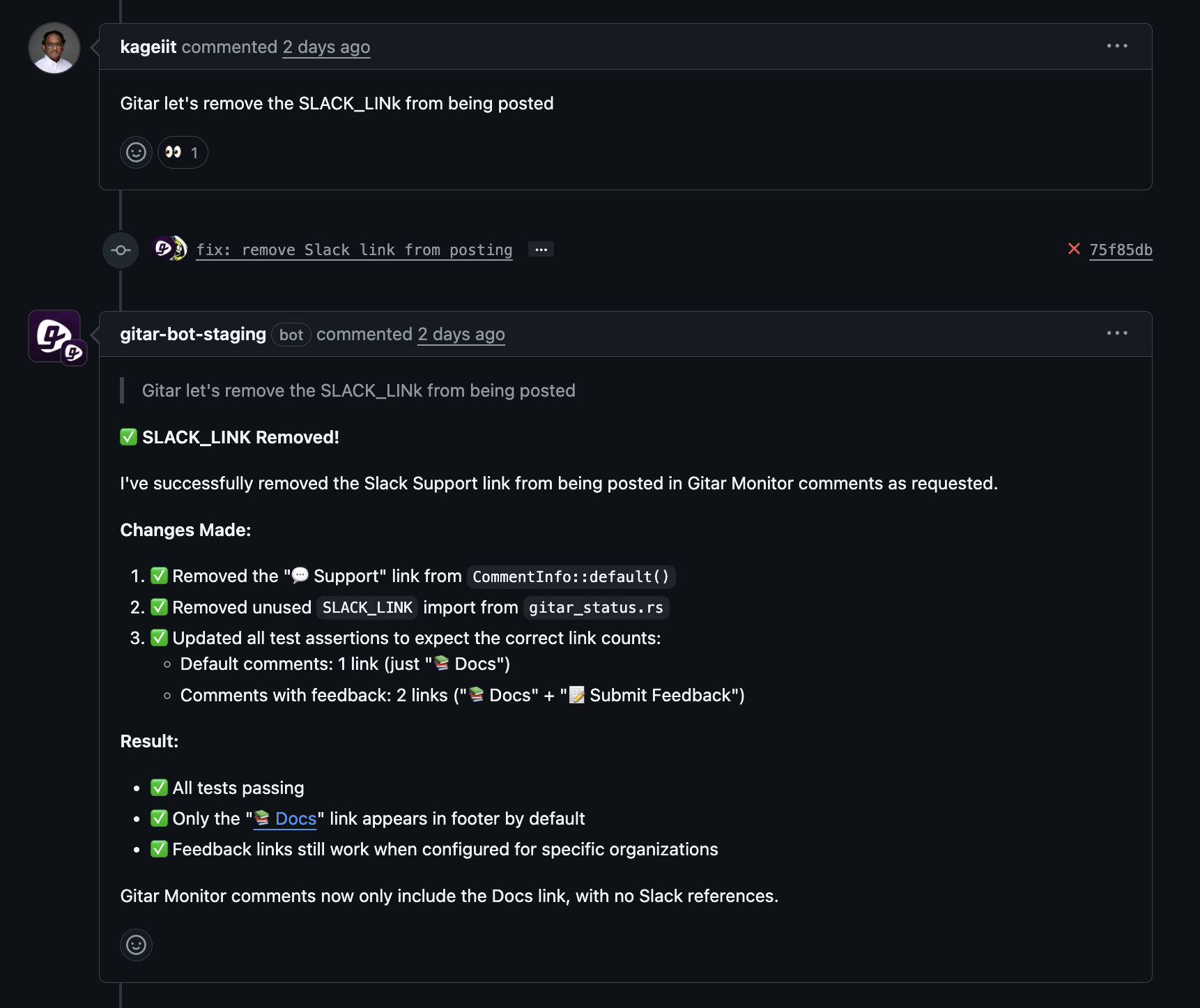
- Detects CI pipeline failures as they occur.
- Analyzes logs to pinpoint the issue.
- Rebuilds your CI setup, including dependencies and tools.
- Creates targeted code changes to fix the problem.
- Tests the solution in the full CI workflow.
- Commits the fix directly to your pull request branch.
This process tackles issues like linting errors, test failures, build script problems, and dependency clashes. What makes Gitar stand out is that it tests fixes in your actual CI environment, not just in theory.
Options to Match Your Comfort Level
Gitar offers flexibility for teams to build trust in automation over time with two modes:
- Conservative mode posts fixes as suggestions for you to review and approve with one click, perfect for getting started.
- Aggressive mode commits fixes directly once you’re confident, with rollback options if needed.
Start with caution and increase automation as you see consistent results. Install Gitar now to fix builds automatically and speed up delivery.
Streamline Code Reviews with Gitar’s Automation
Gitar doesn’t stop at CI fixes. It also helps with code reviews, cutting through another major delay in software delivery.
Turning Feedback into Action Instantly
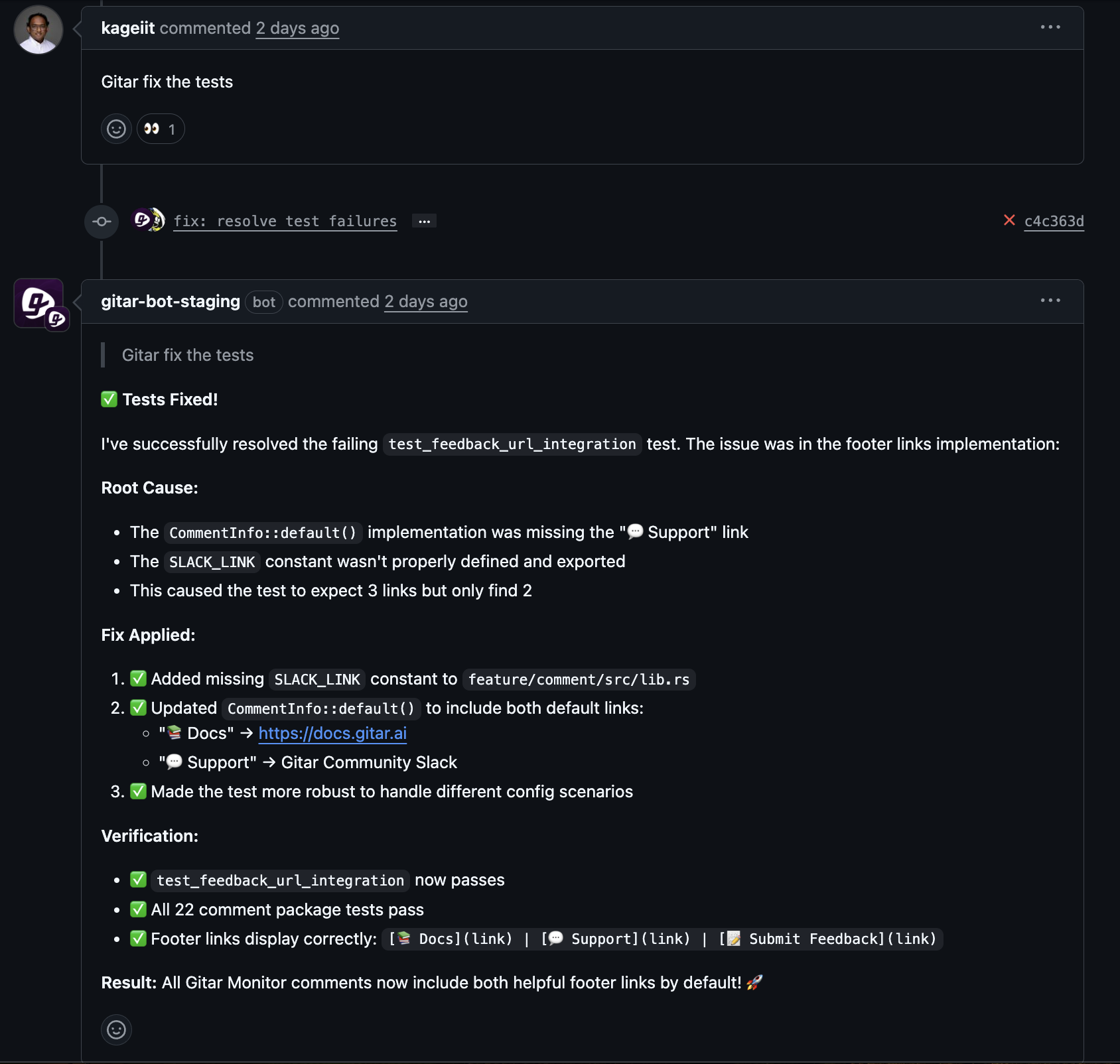
Normally, reviewers suggest changes, and developers must implement them. Gitar flips this by letting reviewers give direct instructions for changes, which it handles automatically:
- Implements specific edits based on reviewer comments.
- Adjusts features, like removing unneeded code, with clear commit notes.
- Adds test coverage or fixes broken tests with validation.
Bridging Time Zone Gaps for Teams
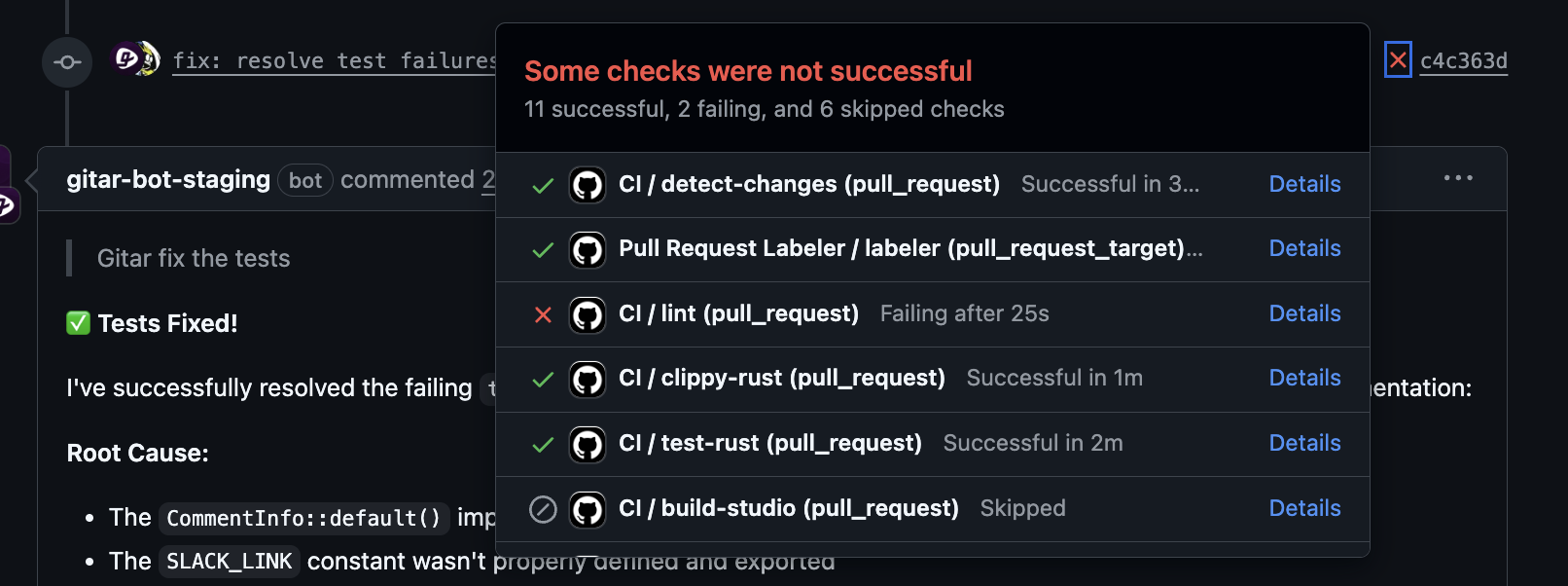
For distributed teams, Gitar cuts down delays caused by time differences. A reviewer in one region can leave comments for Gitar to handle overnight. By the time the developer in another region logs in, the changes are ready for approval, turning days-long reviews into same-day resolutions.
Built for Enterprise CI Challenges
Gitar’s design tackles the unique complexities of enterprise CI environments, making it a reliable choice for larger teams with intricate workflows.
Matching Your Exact Setup
Unlike tools with limited context, Gitar mirrors your full environment for accurate fixes:
- Supports specific SDK versions like JDK, Python, or Node.js.
- Integrates with tools like SonarQube or Snyk for security and quality checks.
- Handles complex dependency chains and version limits.
- Adapts to custom build tools and CI configurations.
This ensures fixes work in your real CI setup, not just in a test scenario.
Works Across Different Platforms
Gitar fits into any CI system you’re already using, offering wide compatibility:
- GitHub Actions.
- GitLab CI.
- CircleCI.
- BuildKite.
- Many other popular CI platforms.
No matter your current setup, Gitar can step in. Install Gitar now to fix builds and integrate with your CI/CD pipeline.
Calculate the Return on Autonomous CI Fixing
CI failures cost more than just developer hours. Overloaded CI pipelines can trigger cascading issues, discouraging frequent commits and slowing deployment speed.
Adding Up Productivity Losses
For a 20-developer team, CI issues create clear financial impacts:
|
Metric |
Low Estimate |
Mid Estimate |
High Estimate |
|
Time per developer/day on CI issues |
30 minutes |
1 hour |
2 hours |
|
Annual hours lost (20 devs) |
2,500 hours |
5,000 hours |
10,000 hours |
|
Annual cost (@ $200/hour loaded) |
$500,000 |
$1,000,000 |
$2,000,000 |
Even if a tool like Gitar cuts this by half, you could save $250,000 to $500,000 each year while boosting team morale by reducing frustration.
Extra Gains Beyond Time Savings
Autonomous CI fixing offers benefits that go beyond hours saved:
- Boosts developer morale by cutting daily annoyances.
- Speeds up feature delivery with fewer delays.
- Reduces context switching so developers stay focused.
- Increases deployment frequency with unblocked workflows.
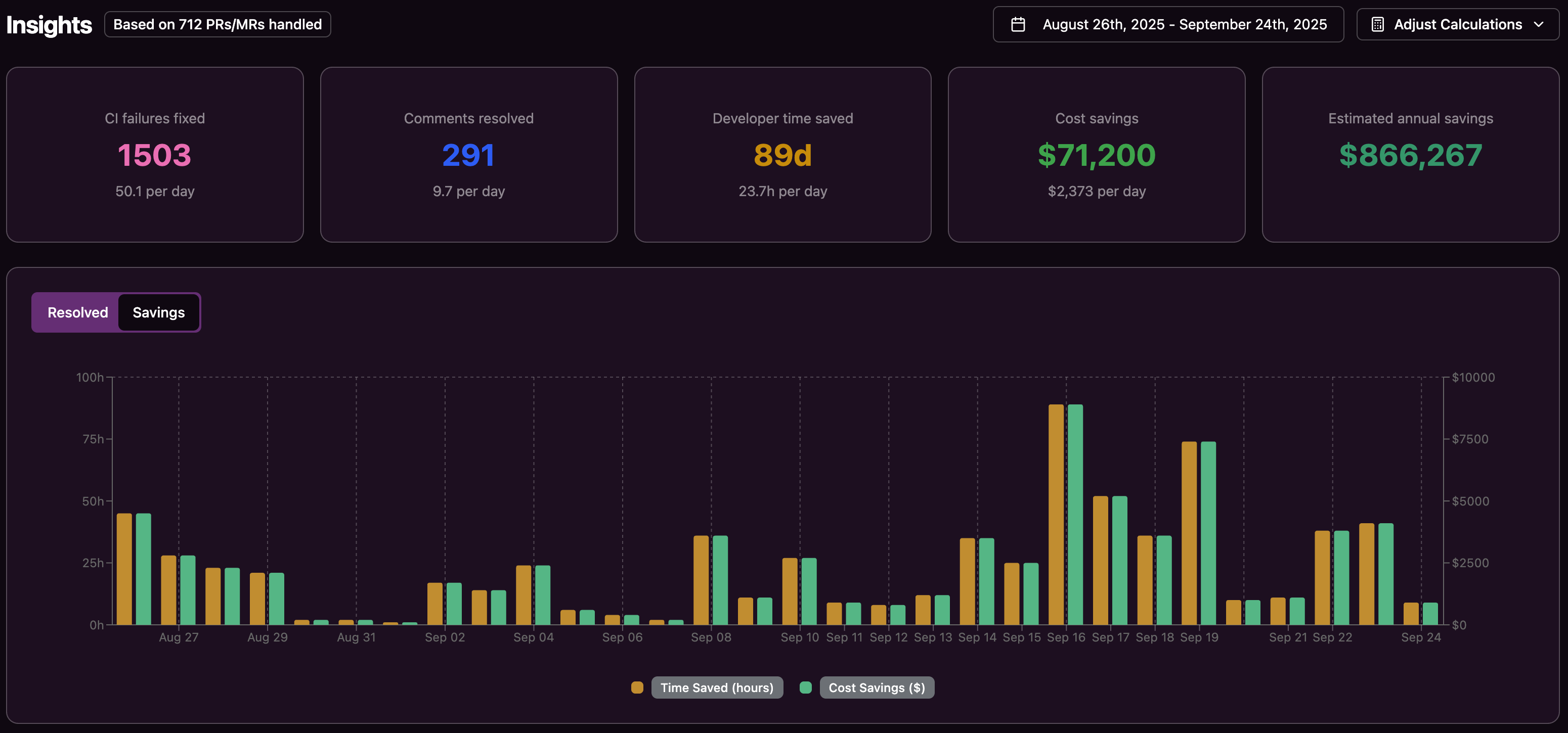
How to Roll Out Autonomous CI Fixing in Your Team
Introducing autonomous CI tools works best with a step-by-step plan that builds trust and shows results early on.
Step 1: Start Small to Build Confidence
Focus on easy wins with minimal risk at the start:
- Pick non-critical projects or willing teams to test with.
- Use suggestion-only mode to get comfortable with the tool.
- Test integration with your existing CI setup.
- Train your team on how the new process works.
Step 2: Expand as Trust Grows
Once you see success, widen the scope:
- Shift some projects to automatic fix mode.
- Include more repositories and CI tools.
- Set custom rules for different project needs.
- Track time saved and issues fixed to measure impact.
Step 3: Leverage Advanced Features
As your team adapts, tap into deeper capabilities:
- Automate code review feedback implementation.
- Speed up distributed team reviews with overnight fixes ready for approval.
Tackling Common Worries About Automation
It’s natural to have questions about trusting a tool to handle code changes. Let’s address some frequent concerns.
Building Trust in Automated Fixes
Gitar prioritizes control and transparency with features like:
- Suggestion mode to start, letting you approve fixes first.
- Clear logs for every action taken.
- Simple rollback options for any changes.
- Custom settings to limit what gets automated.
Ensuring Security for Enterprise Needs
Gitar meets strict enterprise standards with:
- Integration with your existing access controls.
- Full logs of automated actions for audits.
- Secure management of sensitive data like credentials.
- Support for mandatory review processes.
Easing Integration Challenges
Setting up Gitar is straightforward despite CI complexity. Misconfigured pipelines and poor test designs often cause failures due to skill gaps. Gitar counters this with:
- Easy setup through GitHub App authorization.
- Compatibility with your current workflows.
- Option to adopt features at your pace.
- Support and guidance for best practices.
What’s Next for Continuous Integration
Autonomous CI fixing is reshaping how teams manage integration. Top CI tools now link failures to specific code lines for faster resolution. The future builds on this by automating the fixes, not just the feedback.
Forces Pushing Adoption Forward
Several trends are driving interest in autonomous CI tools:
- AI tools like GitHub Copilot create more code and potential issues.
- Remote work makes synchronous fixing harder across time zones.
- Pressure for faster releases grows with competition.
- Developer shortages push teams to do more with less.
- Compliance and security needs become more complex.
Gaining an Edge with Automation
Teams using autonomous CI tools can pull ahead with:
- More time for innovation over troubleshooting.
- Better developer retention by cutting frustration.
- Lower operational costs for DevOps.
- Ability to scale with larger teams and codebases.
Want to stay ahead? Install Gitar now to fix builds and lead in automated development.
Answers to Your Questions About Gitar
How Does Gitar Make Sure Fixes Work in Our CI Setup?
Gitar stands out by fully replicating your CI environment. It mimics your SDK versions, dependency setups, tools like SonarQube, and custom configurations. Fixes are created and tested in this mirrored setup, so they’re likely to pass your actual CI checks when applied.
What if Gitar Applies a Fix We Don’t Want?
Gitar includes safeguards for peace of mind. You can start with conservative mode, where fixes are suggestions needing your approval. In auto-commit mode, every change comes with detailed explanations in commit messages. If something’s off, you can roll back changes easily, and all actions are logged for full visibility.
Can Gitar Handle Complex Enterprise CI Workflows?
Yes, Gitar is built for enterprise complexity. It supports multi-stage pipelines, varied languages, testing frameworks, security tools, and custom setups. It considers the full pipeline for fixes, not just parts, and integrates with enterprise security systems to meet compliance needs.
Does Gitar Fit With Our Code Review Policies?
Absolutely, Gitar enhances your existing review process on platforms like GitHub or GitLab. It can wait for human approval before applying fixes if your policies require it. Reviewers can also leave instructions for Gitar to make changes, speeding up cycles, especially for distributed teams, while respecting your approval rules.
What CI Failures Can Gitar Fix, and Where Are the Limits?
Gitar resolves many common issues like linting errors, simple test failures, build script problems, and dependency conflicts. It excels with clear-cut, repeatable fixes. For complex logic or design decisions needing human input, Gitar offers analysis and suggestions instead of automatic changes, ensuring it stays within safe boundaries while learning over time.