
Key takeaways
- Manual CI/CD failure resolution and slow code reviews can consume close to 30% of developer time and create significant productivity and cost drag.
- Self-healing CI pipelines that automatically fix common failures reduce context switching and keep engineers focused on feature work.
- Context-aware, environment-specific remediation helps teams handle complex enterprise pipelines, third-party scans, and multi-SDK builds more reliably.
- Automated code review feedback loops and optimized CI resource usage support distributed teams, lower infrastructure costs, and improve developer morale.
- Teams can use Gitar as an autonomous AI engine to fix failing CI, action code review feedback, and reduce developer toil; install Gitar to start automating CI failure fixes.
The High Cost of Manual CI/CD Failure Resolution
Manual handling of CI/CD pipeline failures and code review issues creates a measurable productivity loss. Developers can spend up to 30% of their time resolving CI and review problems, which can cost close to $1M annually for a 20-person team.
Infrastructure reliability amplifies this problem. 45% of network outages stem from configuration and change management failures, and 85% of human error outages result from procedure failures. Organizations see an average of 86 outages per year and more than five hours of downtime monthly, which often pushes CI/CD systems into repeated failure cycles.
Context switching adds another hidden tax. A small fix that might take five minutes often expands into an hour after the developer leaves the pull request, starts a new task, then has to reload the mental model of the original change and its tests.
Why Autonomous AI Works Well as CI/CD Pipeline Failure Resolution Software
Traditional AI tools that only suggest code changes rarely close the gap between a failing pipeline and a fully passing build. Gitar addresses this by acting as an autonomous AI agent that can fix failing CI pipelines and implement code review feedback, creating a self-healing CI experience and reducing manual intervention.
End-to-end fixing that goes beyond suggestions
Gitar does not stop at proposing code snippets. It analyzes logs, generates code changes, applies those changes, and validates them against real CI workflows so that the final pull request shows passing jobs. This reduces trial-and-error cycles and the need for developers to wire in suggestions manually.
Full environment replication for complex CI/CD setups
Modern pipelines often involve specific JDK versions, multiple SDKs, security scans, and snapshot tests. Gitar emulates these enterprise workflows, including tools such as SonarQube and Snyk, so that the fixes it applies match the exact environment where the failure occurred.
Intelligent code review assistant for faster feedback loops
Gitar also supports human-centric review workflows by implementing requested changes in response to code review comments. Reviewers leave comments, Gitar updates the code and commits the change, and the pull request moves closer to merge without waiting for multiple back-and-forth rounds.
Configurable trust model that fits your risk profile
Teams can configure Gitar to operate in suggestion-only, approval-required, or fully autonomous modes. This flexibility allows organizations to start conservatively, keep visibility into every change, and increase automation as trust grows.
Cross-platform support for existing CI/CD tools
Gitar integrates with GitHub Actions, GitLab CI, CircleCI, BuildKite, and other major CI systems. This lets teams adopt autonomous CI healing without replacing their existing platforms or workflows.
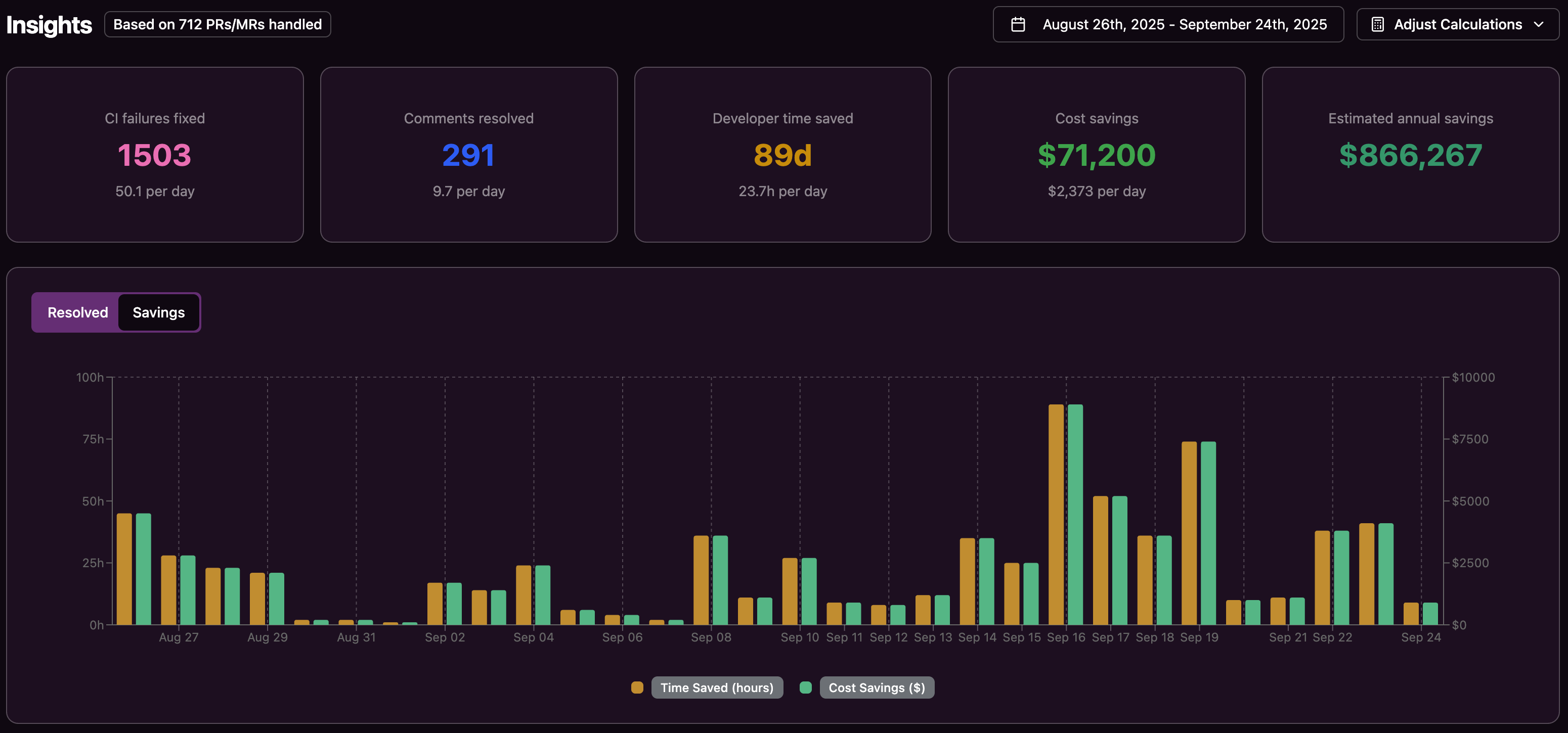
Teams that want to see this model in practice can install Gitar and automate CI failure fixes.
1. Implement Self-Healing CI for Common Failures
Self-healing CI for routine issues removes a large share of repetitive toil. Common targets include linting and formatting errors, flaky or simple test failures, and build or dependency issues.
Pre-merge check failures occur at a 5:3 rate compared with post-merge failures, and pre-merge checks run at roughly 15:1 the total volume of post-merge checks. This volume makes pre-merge failures an ideal automation surface.
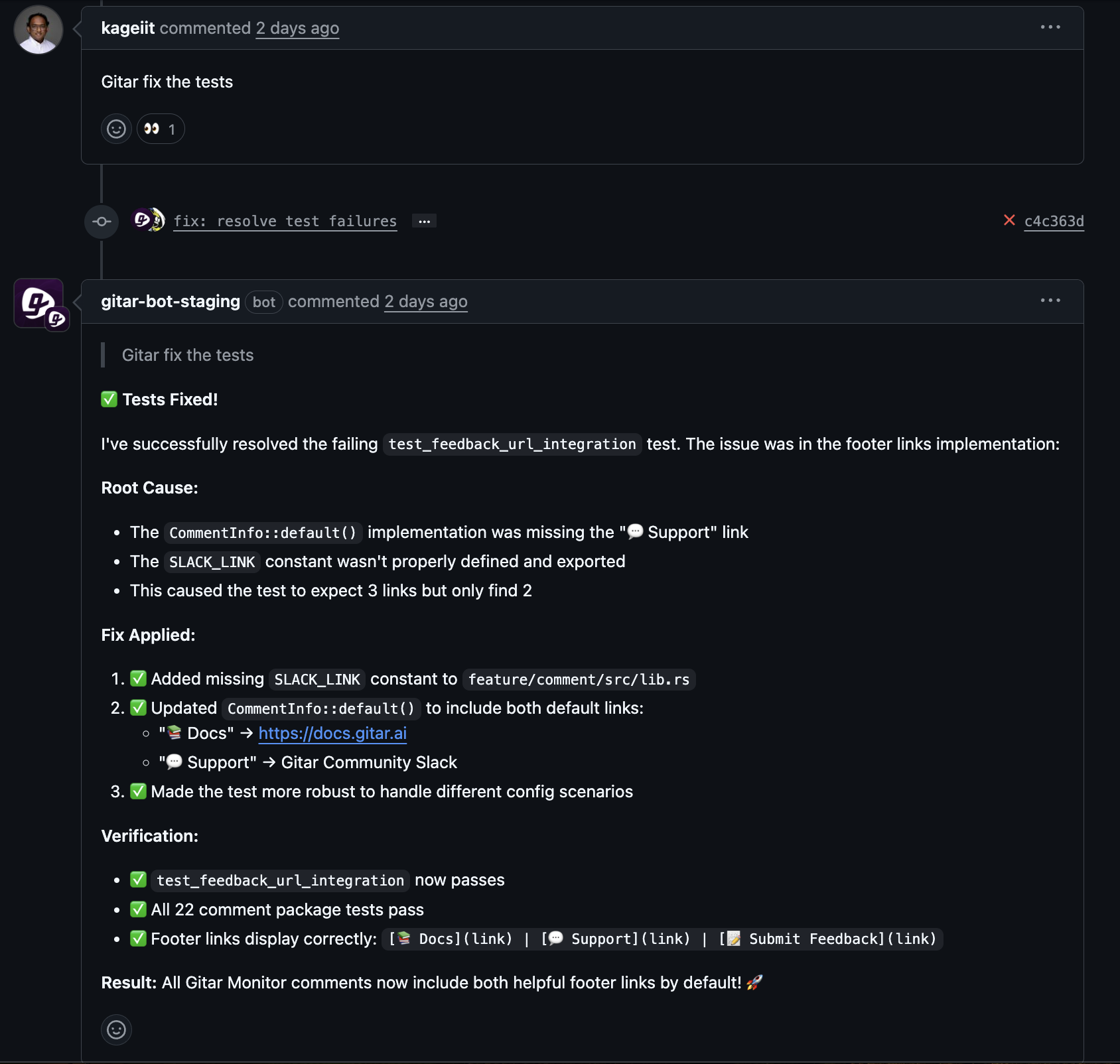
Gitar analyzes failure logs, proposes and applies changes, and pushes commits that resolve linting issues, update snapshots, or correct dependency mismatches. Many failures get resolved before the original author even returns to the pull request.
2. Use Context-Aware Remediation for Complex Environments
Many teams run pipelines that stress infrastructure or rely on fragile configuration. Hardcoded secrets, overloaded servers, and congested networks slow pipelines and can reduce deployment frequency. Insufficient test environment provisioning also causes failures as projects scale.
Gitar addresses these situations by reproducing the full workflow that ran during the failure. It considers specific runtimes, dependencies, and third-party tools so that the remediation respects real-world constraints rather than relying on generic best guesses.
This context-aware approach helps teams keep complex CI environments stable without asking individual developers to understand every infrastructure detail.
3. Automate Code Review Feedback Loops for Distributed Teams
Global teams often lose days to review latency. Each round of feedback waits on time zones, meeting schedules, and availability. A 58% rise in incidents affecting GitHub in the first half of 2025 also showed how platform issues can block progress when pipelines depend on manual review and re-triggered runs.
Gitar reduces this friction by acting on review comments directly. A reviewer leaves a note such as “remove this Slack link” or “update this test,” and Gitar updates the code, commits the change, and lets CI re-run.
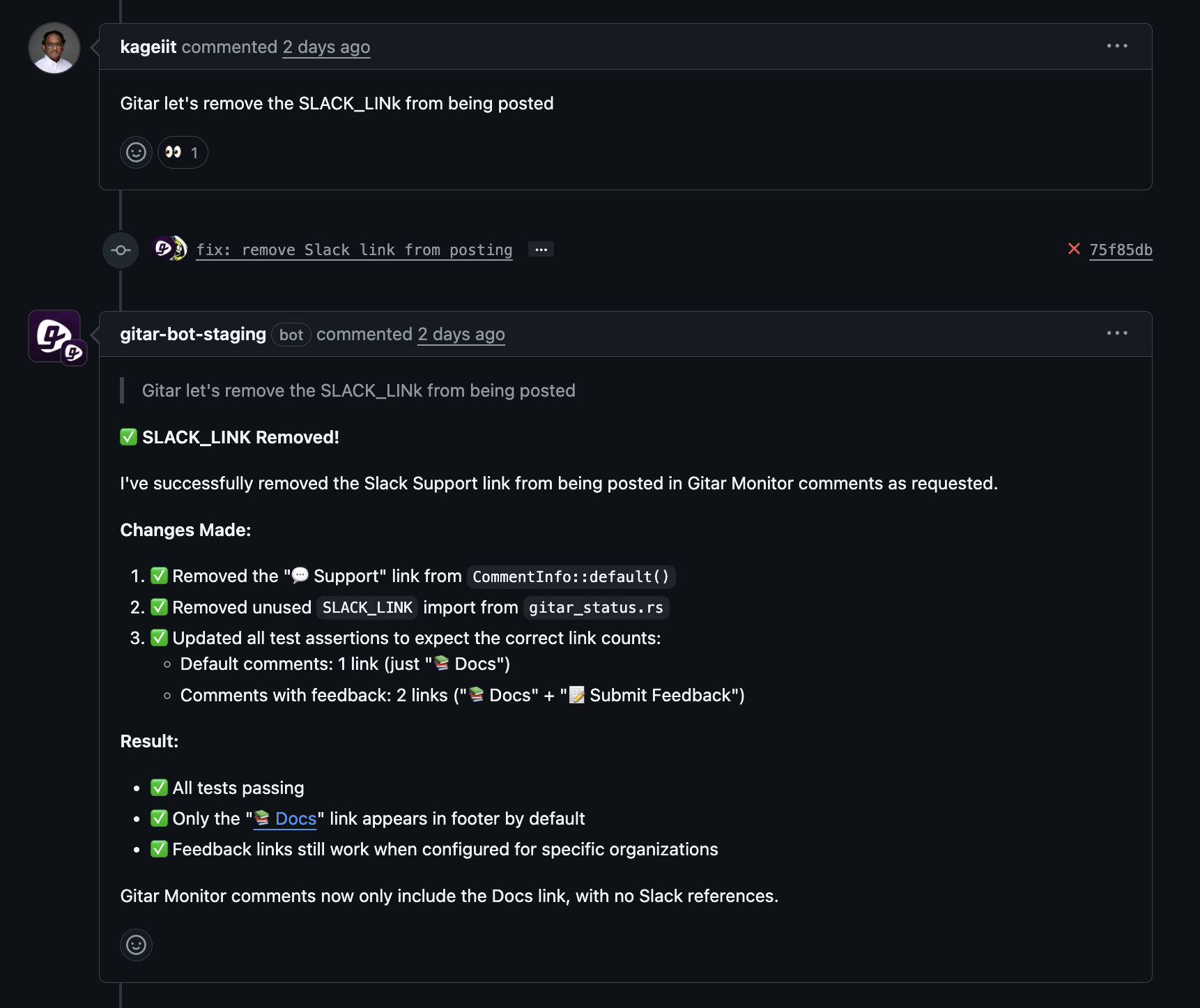
A reviewer can work at the end of their day and still hand back a ready-to-merge pull request by the time the author in another region returns online.
4. Optimize CI Costs and Resource Utilization with Fewer Failed Runs
Every failed run consumes compute, storage, and attention. Growing projects need more resources to run tests, which can lengthen execution time and delay feedback.
Gitar aims to cut the number of failed runs by fixing issues earlier and with higher accuracy, which reduces retries and re-runs. Fewer failed pipelines can lower CI minutes, shorten time-to-feedback, and free capacity for additional builds or test coverage.
5. Reduce Developer Toil and Support High-Velocity Engineering Culture
Persistent CI failures and manual review loops erode morale and slow delivery. Automation that handles repetitive fixes lets engineers spend more time on design, architecture, and new features.
For a 20-person team, productivity losses from CI and review issues can reach around $1M per year. Effective CI/CD failure resolution, especially with autonomous AI, can reclaim a meaningful share of this value while also improving job satisfaction.
Teams using autonomous CI helpers often describe a more predictable, less frustrating deployment process. Over time, this reliability encourages more frequent, smaller changes and a healthier shipping culture.
Compare CI/CD Pipeline Failure Resolution Approaches
|
Feature / Tool |
Gitar (Healing Engine) |
CodeRabbit (Suggestion Engine) |
Manual Work (Status Quo) |
|
Primary function |
Autonomous CI fixes and code review actioning |
AI code review suggestions |
Manual debugging and fixing |
|
Fix application |
Applies, commits, and validates fixes |
Provides suggestions and one-click fixes |
Developer researches, writes, and applies fixes |
|
CI validation |
Validates fixes against CI workflows |
Runs static analysis and some security checks |
Developer manually re-runs CI |
|
Time to resolution |
Often minutes with full automation |
Reduced time with assisted fixes |
Hours to days with manual work |
Teams can move from suggestion-only tools to an autonomous healing model by installing Gitar and enabling automated CI failure fixes.
Frequently Asked Questions About CI/CD Pipeline Failure Resolution Software
How does Gitar handle sensitive information and security within CI pipelines?
Gitar supports enterprise security practices through configurable trust modes, including suggestion-only behavior for sensitive projects. It can run within existing security frameworks, and organizations that require more control can choose on-premise deployment options.
Can Gitar integrate with a highly customized and complex CI setup?
Gitar is built to replicate full enterprise workflows, including language runtimes, dependencies, multi-SDK builds, and tools like SonarQube and Snyk. This design helps ensure that fixes respect each organization’s unique setup.
How does Gitar compare to AI reviewers like CodeRabbit?
AI reviewers focus on suggestions and partial automation. Gitar focuses on the full healing loop by detecting issues, applying changes, and validating fixes through the CI pipeline so developers spend less time on the last mile of getting pipelines to green.
How quickly can teams see ROI from Gitar?
Teams that currently lose significant time to CI failures and review loops often see benefits within a few months. Reduced toil, faster merges, and lower CI waste all contribute to payback.
Does Gitar work with existing tools and workflows?
Gitar integrates with GitHub and GitLab repositories and supports CI platforms such as GitHub Actions, GitLab CI, CircleCI, and BuildKite. Setup typically involves minimal configuration and preserves familiar workflows.
Conclusion: Autonomous CI/CD Failure Resolution in 2026
Efficient resolution of CI/CD pipeline failures is now a core requirement for teams that want to maintain productivity and ship reliably. The strategies in this article show how autonomous AI can reduce manual firefighting, shorten feedback loops, and improve both cost efficiency and developer experience.
The shift from suggestion-based tools to autonomous healing engines marks a significant evolution in how organizations manage CI/CD reliability. Teams that adopt this approach in 2026 can gain an advantage in time-to-market and engineering satisfaction.
Teams ready to explore this model can install Gitar and start automating CI failure fixes today.