
Key Takeaways
- Manual CI/CD in GitHub quietly consumes developer time, delays releases, and increases infrastructure and tooling spend.
- Context switching from failed checks and review rework breaks flow and can divert a meaningful share of engineering capacity away from feature delivery.
- Complex CI configurations and fragmented documentation make pipelines fragile and expensive to migrate or maintain over time.
- Autonomous CI/CD fixes in GitHub can reduce failed runs, accelerate time to merge, and improve code quality while preserving team control.
- Teams can use Gitar to automatically diagnose and fix CI failures and apply code review feedback directly in GitHub Pull Requests.
Reveal the Hidden Costs of Manual CI/CD in GitHub
Context Switching Drains Time and Morale
Many developers push a pull request with confidence, then face a wall of red CI failures. A lint error, flaky test, or missing dependency forces a shift into log reading, local reproduction, small fixes, and new pipeline runs. That cycle turns simple issues into long interruptions.
Developers can lose a significant share of their week to CI and review friction. The ideal flow of submitting a PR and moving on to the next task rarely holds. Notifications pull them back into old branches, break deep work, and reduce both output and job satisfaction.
Delivery Delays Slow Competitive Response
CI failures and manual review loops slow delivery for many software teams. Each failed run adds queue time, and each comment adds another back-and-forth cycle. Release trains slip, features reach customers later, and teams struggle to respond quickly to market or customer needs.
AI code generation tools such as GitHub Copilot have increased the amount of code that reaches pull requests. That volume can shift the bottleneck to validation, since more code means more tests, checks, and potential failures to resolve before merge.
Operational Costs Rise With Every Failed Run
GitHub Actions bills excess minutes at usage-based rates, so repeated failed builds become a direct cost line item. Large teams that exceed included minutes face higher bills or must invest in self-hosted infrastructure.
Tools that appear free at first, such as Jenkins, carry significant hidden costs. Infrastructure, maintenance, security, and administration demand internal time and expertise. Self-hosted runners add provisioning, patching, and monitoring work that competes with core product engineering.
CI Configurations Stay Complex and Fragile
YAML-heavy CI configs are hard to test and debug. Developers often rely on commit-and-pray cycles, adjusting small pieces of configuration, pushing, and waiting for feedback from the pipeline.
Critical CI knowledge often lives in chats or forum threads, not in clear documentation. Platform migrations can take months or years, with old and new systems running in parallel. Permission models and security settings add more complexity, which increases the odds of breakage and manual intervention.
Use Autonomous Fixes to Simplify GitHub Workflows
Let Gitar Handle CI Failures and Review Feedback
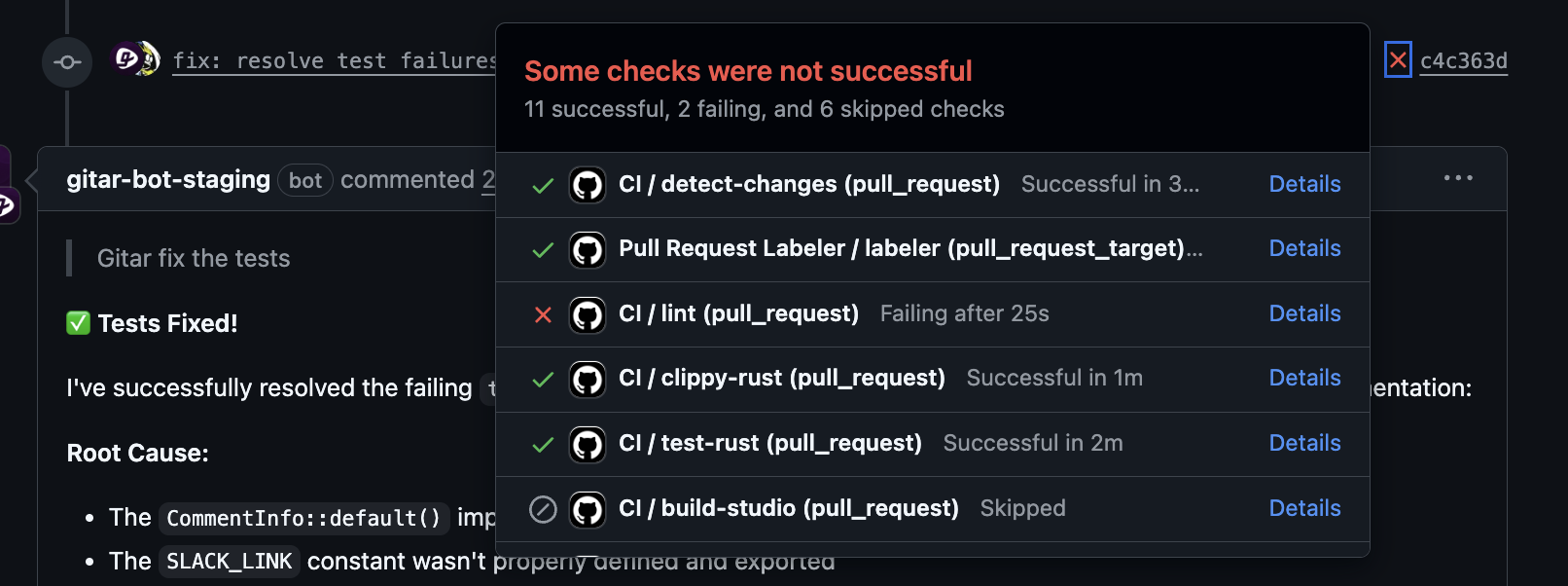
Gitar acts as an autonomous AI agent inside your GitHub workflows. When CI checks fail or reviewers leave feedback, Gitar analyzes the problem, proposes a fix, and applies it directly in the pull request.
The system covers common failure types such as lint and formatting issues, snapshot and unit test failures, and many dependency or build problems. Developers avoid the loop of reading logs, reproducing errors, and pushing small corrective commits.

Reviewers can also tag Gitar in a comment with specific instructions. Gitar then updates the code, commits the change, and posts an explanation, which reduces back-and-forth and keeps distributed teams moving even outside shared working hours.
Match Enterprise Environments and Tooling
Gitar replicates full environments so fixes align with real-world setups. The agent respects SDK versions, multi-language builds, and third-party tools such as SonarQube, Snyk, and snapshot test frameworks. This context improves the accuracy of fixes, especially in complex enterprise pipelines.
Control How Aggressive Automation Should Be
Teams can adopt Gitar gradually through a configurable trust model. In Conservative Mode, Gitar posts suggested fixes as comments or suggestions so developers can review and apply them with a click. This mode works well for early rollout and sensitive repos.
Teams that build confidence in Gitar’s output can move to a more autonomous mode. In this setting, Gitar commits fixes directly with clear messages and preserves rollback options. A status thread in the pull request tracks each action so maintainers retain full visibility.
See how Gitar fits into your existing GitHub workflows.
Translate Autonomous Fixes Into ROI
Reclaim Developer Time and Focus
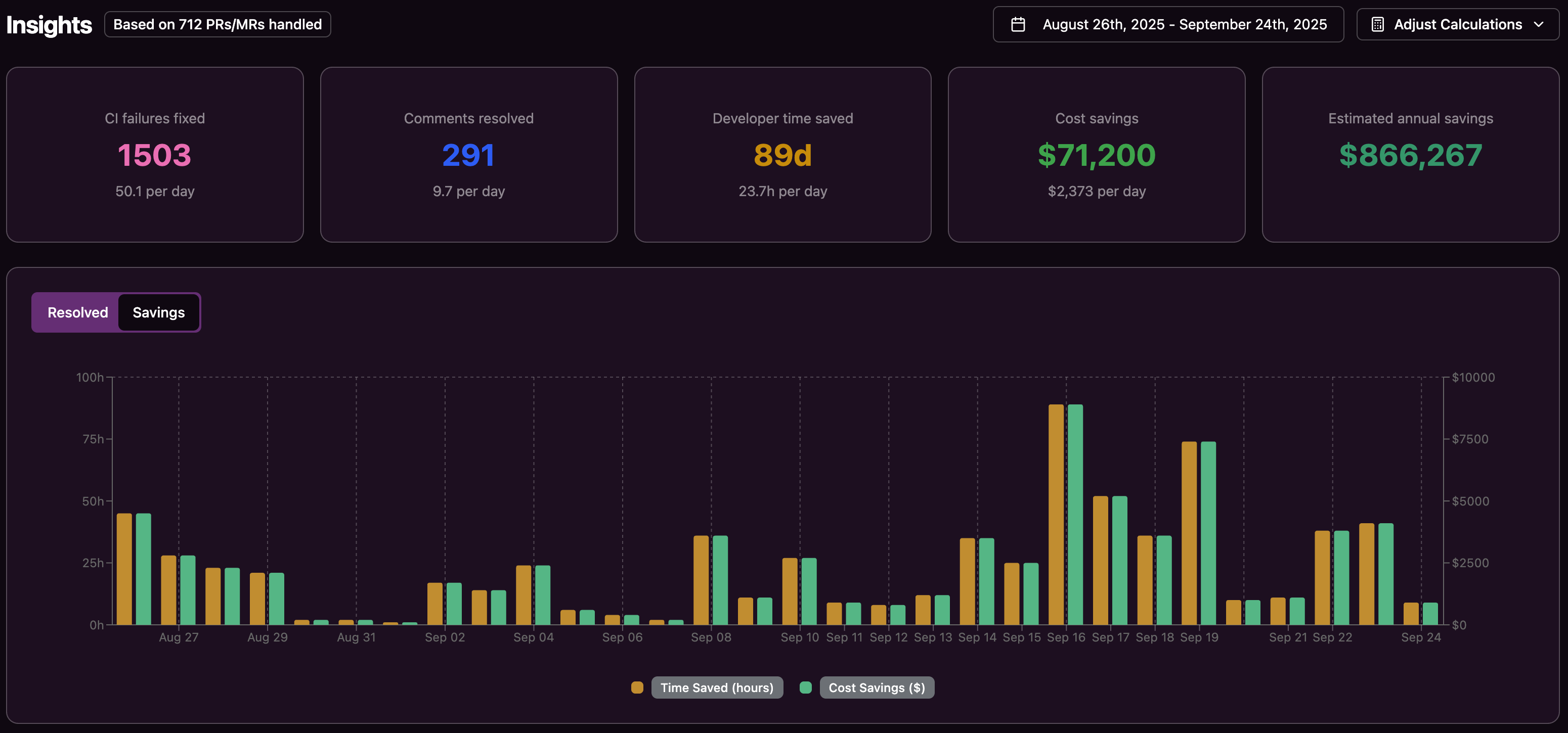
Engineering teams unlock value when developers spend more hours on product work and fewer on pipeline care and feeding. Even modest savings per person add up quickly for larger teams.
A 20-developer team that recovers roughly one hour per workday per developer from CI and review friction can reclaim the equivalent of several full-time engineers. That time can shift toward feature delivery, refactoring, and user-facing improvements instead of repetitive fixes.
Shorten Time to Merge and Release
Fewer manual interventions create a smoother path from first commit to merged pull request. Gitar resolves many issues in the background, which reduces idle time between reviews and follow-up commits.
Shorter merge cycles support more predictable release cadences. Product managers gain clearer timelines, and operations teams see fewer last-minute changes as developers rush to fix broken checks before a cut.
Lower CI Costs and Operational Overhead
Every failed run consumes CI minutes and compute. Gitar helps reduce the number of failed attempts by fixing issues earlier and more consistently, which lowers usage-based CI costs over time.
The platform also reduces internal toil related to managing homegrown scripts or one-off automation for CI healing. Teams can rely on a consistent mechanism for detection and repair instead of building and maintaining their own tools.
Improve Code Quality With Consistent Standards
Automatic fixes for style violations, tests, and security checks support a cleaner codebase. Gitar enforces consistent patterns across the repo without requiring reviewers to repeat the same comments on every pull request.
Integration with existing scanners and linters means teams can keep using their preferred tools while relying on Gitar to apply the resulting changes.
Compare Manual Work, Suggestions, and Autonomous Fixes
|
Feature or benefit |
Manual CI/CD process |
AI suggestion engines |
Gitar autonomous CI healing |
|
Who fixes problems |
Developer manually debugs and edits |
Tool suggests code, developer applies |
Gitar identifies, generates, and applies fixes |
|
Context switching |
High, every failure interrupts flow |
Moderate, suggestions help but work remains manual |
Low, fixes apply in the background |
|
Time to merge |
Slow, many review and fix cycles |
Moderate, some speedup from suggestions |
Faster, self-healing pipelines unblock pull requests |
|
CI minute efficiency |
Low, repeated failed runs |
Medium, may still require retries |
High, fewer failed runs and retries |
Install Gitar to reduce CI failures and speed up pull request merges.
Frequently Asked Questions (FAQ)
Q: How does Gitar handle complex GitHub Actions workflows and proprietary tools?
Gitar works within complex environments by mirroring workflows, SDK versions, and third-party scans such as SonarQube and Snyk. The agent uses that context to generate fixes that align with real production setups instead of generic code snippets.
Q: We already use GitHub Copilot. How is Gitar different for our CI/CD?
GitHub Copilot focuses on code generation inside the IDE before commits. Gitar operates after code reaches GitHub. The platform monitors CI runs and review comments, then repairs failures and applies requested changes directly in pull requests. Both tools can work together to support the full lifecycle from authoring to merge.
Q: Is automating fixes risky for our GitHub repos?
Teams control how Gitar behaves through automation levels. Conservative settings keep fixes as suggestions that developers can inspect and apply. More aggressive settings allow direct commits with full history and rollback options. A status feed in each pull request records actions for traceability.
Q: How does Gitar affect our CI minute usage?
Gitar aims to reduce overall CI consumption by cutting down on failed runs and retries. The system uses your CI only to validate proposed fixes, not for its internal processing, so successful first-time runs increase over time.
Focus Developer Time on Product, Not Pipelines
Manual CI/CD management in GitHub carries real costs in time, morale, and infrastructure. Repeated context switches, fragile configurations, and frequent failed runs limit how much value engineering teams can deliver.
Gitar gives teams a way to automate CI healing and apply review feedback directly in pull requests while preserving control and visibility. That shift turns CI from a constant source of interruptions into a more reliable, self-correcting system.
Book a demo with Gitar to measure the impact of autonomous CI/CD fixes on your GitHub workflows.