
Key Takeaways
- Enterprise DevOps teams lose significant time to CI failures and code review delays, especially as AI-assisted coding increases pull request volume.
- CI healing engines apply and validate fixes automatically, while suggestion engines only recommend changes and still rely on developer time and attention.
- Accurate environment replication and full CI validation matter for enterprises that use complex toolchains and multiple CI providers.
- Autonomous CI fixing can recover hundreds of thousands of dollars in wasted engineering time for mid-sized teams by reducing rework and context switching.
- Teams can use Gitar to automatically fix broken builds, reduce CI toil, and ship reliable software with less manual effort.
The Critical Challenge: Bridging the Gap in Enterprise DevOps Automation
CI failures and slow code reviews create a major productivity drag for modern development teams. Developers often push confident pull requests, then see red builds from missing dependencies, flaky tests, or style violations. Each failure interrupts focus and turns quick fixes into long delays that affect entire sprints.
The financial impact grows quickly for distributed teams, where time zone gaps prolong review cycles. Developers can waste up to 30% of their time dealing with CI and code review issues. For a 20-developer team, that can reach about $1M per year in lost productivity. As AI-assisted coding speeds up code creation, more pull requests flow into already constrained CI and review pipelines.
Enterprise DevOps automation software aims to reduce this friction through smarter pipelines, automated fixes, and more efficient reviews. The key decision is whether to adopt tools that only soften these problems or systems that directly remove the manual work causing the delays.
Introducing Gitar: The Autonomous CI Healing Engine for Enterprises
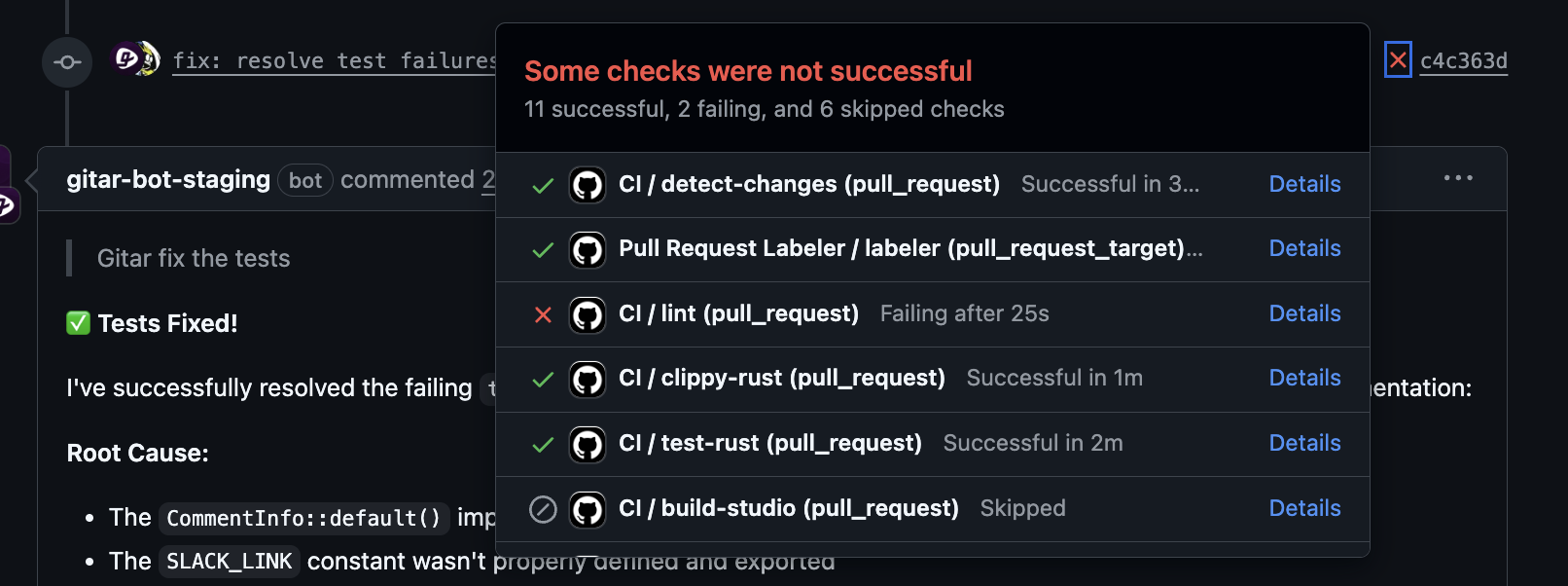
Gitar is an autonomous CI healing engine that acts as an AI agent inside your existing workflows. It automatically fixes failing CI pipelines and addresses common code review feedback with minimal developer input. Instead of only commenting on problems, Gitar applies changes, runs CI, and verifies that builds pass.

Key capabilities that matter for enterprises include:
- End-to-end autonomous fixing, where Gitar applies changes and validates them through complete CI workflows, not just unit tests.
- Accurate replication of complex environments, including specific JDK versions, multiple SDKs, and integrations such as SonarQube, Snyk, and snapshot testing.
- Support for major CI systems, including GitHub Actions, GitLab CI, CircleCI, and BuildKite, which helps teams avoid lock-in to a single ecosystem.
- A configurable trust model that ranges from suggestion-only mode with one-click approvals to fully autonomous commits with rollback options.
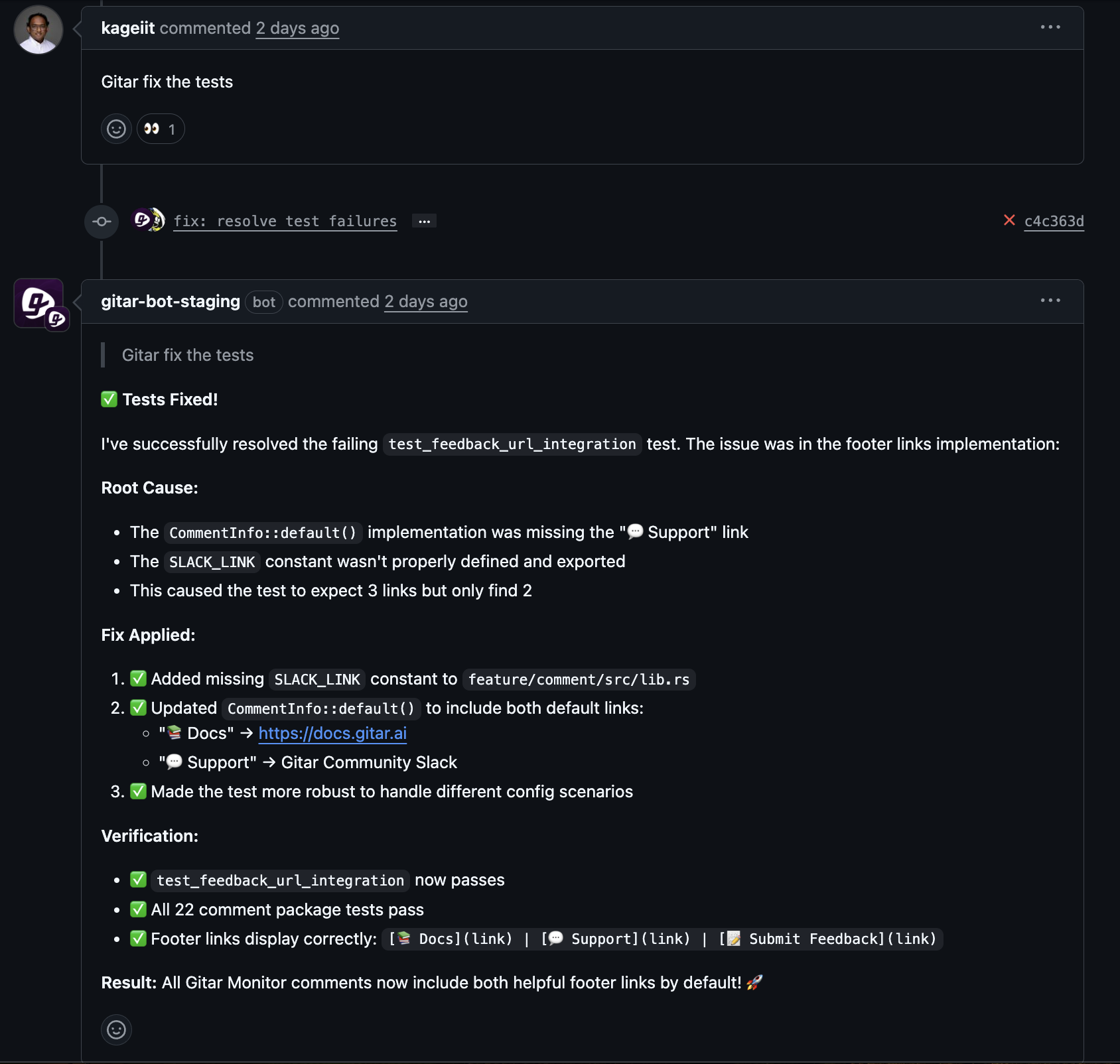
For distributed teams, Gitar can handle review feedback and CI issues while developers are offline. That approach shortens feedback loops across time zones and reduces idle waiting on red builds. Install Gitar to see autonomous CI fixes inside your existing repositories.
CI Healing Engines vs. Suggestion Engines: A Deep Dive into Enterprise DevOps Automation Software
The choice between a CI healing engine and a suggestion engine has a direct effect on developer productivity. Healing engines such as Gitar apply and validate fixes so that developers return to green builds. Suggestion engines only provide recommendations, leaving engineers responsible for editing code, rerunning CI, and confirming success.
Core Comparison: Healing Engine (Gitar) vs. Suggestion Engines and Manual Approaches
|
Criteria |
Gitar (Healing Engine) |
AI Code Reviewers |
Manual Status Quo |
|
Automation Depth |
Autonomous Fix & Validate |
Suggestion Only |
Manual Detection & Fix |
|
Environment Replication |
Full Enterprise Workflow |
Limited/None |
Developer Local Setup |
|
Fix Validation |
Complete CI Validation |
No Validation |
Manual Testing |
|
Trust Model |
Configurable Aggression |
Fixed Suggestion |
Human Judgment |
Gitar extends beyond typical AI code reviewers by turning analysis into concrete, validated changes. Many tools highlight issues or suggest patches but do not run full pipelines or guarantee that the final state of the branch is green. Gitar keeps its focus on successful CI outcomes, not just code comments.
DIY AI integrations can appear flexible, but they often require extensive prompt engineering, context handling, and infrastructure work to reach basic reliability. Gitar offers an end-to-end solution that plugs into existing CI/CD systems, reduces custom code, and avoids the ongoing maintenance burden of homegrown automation.
Real-World Impact: Quantifying Gitar’s ROI for Enterprises
Gitar is designed to slot into existing development processes with minimal retraining. Suggestion-only tools often introduce new steps that developers must learn and remember, while a healing engine operates largely in the background. Teams can adjust Gitar’s automation level over time, but the day-to-day workflow in Git and CI can stay familiar.
Engineering leaders can evaluate impact through simple scenarios. Consider a 20-developer team:
- If each developer spends one hour per day on CI issues and review-related fixes, that equals about 5,000 hours per year.
- At a loaded cost of $200 per hour, that time equals roughly $1M in annual productivity loss.
- If autonomous fixing removes even half of that effort, the recovered value reaches about $500K per year, while also reducing frustration and context switching.
These gains free engineers to focus on feature work, reliability improvements, and architectural decisions rather than repetitive CI repair. Install Gitar to reduce CI waste and measure the impact on your own team.
Frequently Asked Questions (FAQ) on Enterprise DevOps Automation
How Gitar handles complex enterprise CI environments
Gitar is built for full environment replication. It can emulate detailed enterprise workflows, including specific JDK versions, multiple SDKs, security and quality scans with tools such as SonarQube and Snyk, and snapshot testing. This depth helps ensure that fixes are accurate for the real pipelines that guard production.
How Gitar builds trust in automated fixes
Gitar uses a configurable aggression model so teams can adopt automation at a comfortable pace. Organizations often start with conservative mode, where Gitar posts proposed changes as suggestions that need one-click approval. After developers review the quality of these fixes, teams can switch to more autonomous modes that allow auto-commits with rollback options.
How Gitar differs from AI code review tools and IDE assistants
AI code review tools generally surface issues and suggest edits but stop short of owning CI outcomes. IDE assistants help during code authoring before commits. Gitar operates after code is committed, applies changes directly to branches, and validates them through full CI workflows. The goal is a passing build, not just a set of comments.
How Gitar integrates with existing CI/CD infrastructure
Gitar connects to major CI platforms such as GitHub Actions, GitLab CI, CircleCI, and BuildKite through straightforward authorization. Teams can keep their current pipelines and tools while Gitar listens for failures, proposes or applies fixes, and reruns workflows as needed.
What types of CI failures Gitar can resolve automatically
Gitar addresses many common CI issues, including linting and formatting problems, test failures from outdated snapshots or assertions, and build failures related to dependencies or scripts. Its understanding of the environment lets it craft fixes that align with project-specific rules and tools.
Conclusion: Moving Toward Autonomous Enterprise DevOps Automation
The choice of DevOps automation software shapes how much time developers spend on CI repair instead of product work. Suggestion engines can highlight problems but still rely on engineers to close the loop. A CI healing engine such as Gitar focuses on delivering green builds with less manual work.
Many enterprises carry high hidden costs from recurring CI failures and review bottlenecks. Request a Gitar demo to see how autonomous CI healing can reduce bottlenecks, lower operational overhead, and help your teams ship reliable changes more consistently.