
Picture this: you’ve just pushed a pull request, feeling confident, only to see your CI pipeline fail. A small linting error or a failing test turns a quick merge into a frustrating debugging session. Hours slip away as you analyze logs, fix issues, and wait for the pipeline to run again. This cycle doesn’t just annoy developers; it slows down entire engineering teams, costing significant time and money.
CI build failures are a hidden obstacle in software development today. Even with AI coding tools speeding up code creation, more code means more pull requests and more chances for CI issues. The real challenge has shifted from writing code to getting it merged without delays.
Imagine a CI pipeline that fixes itself. Failing builds could be identified, corrected, and validated without your input. Autonomous CI validation makes this possible, creating self-healing pipelines that keep your workflow moving. Curious to see how it works? Let’s dive in.
Install Gitar now to fix broken builds automatically and ship quality software faster.
Why CI Build Failures Slow Down Your Engineering Team
The Hidden Cost of Interrupted Work
CI build failures do more than cause technical glitches; they disrupt focus. When a build fails, developers must stop their current tasks to debug minor issues like a failed lint check. This interruption can turn a quick fix into a major time sink, draining productivity.
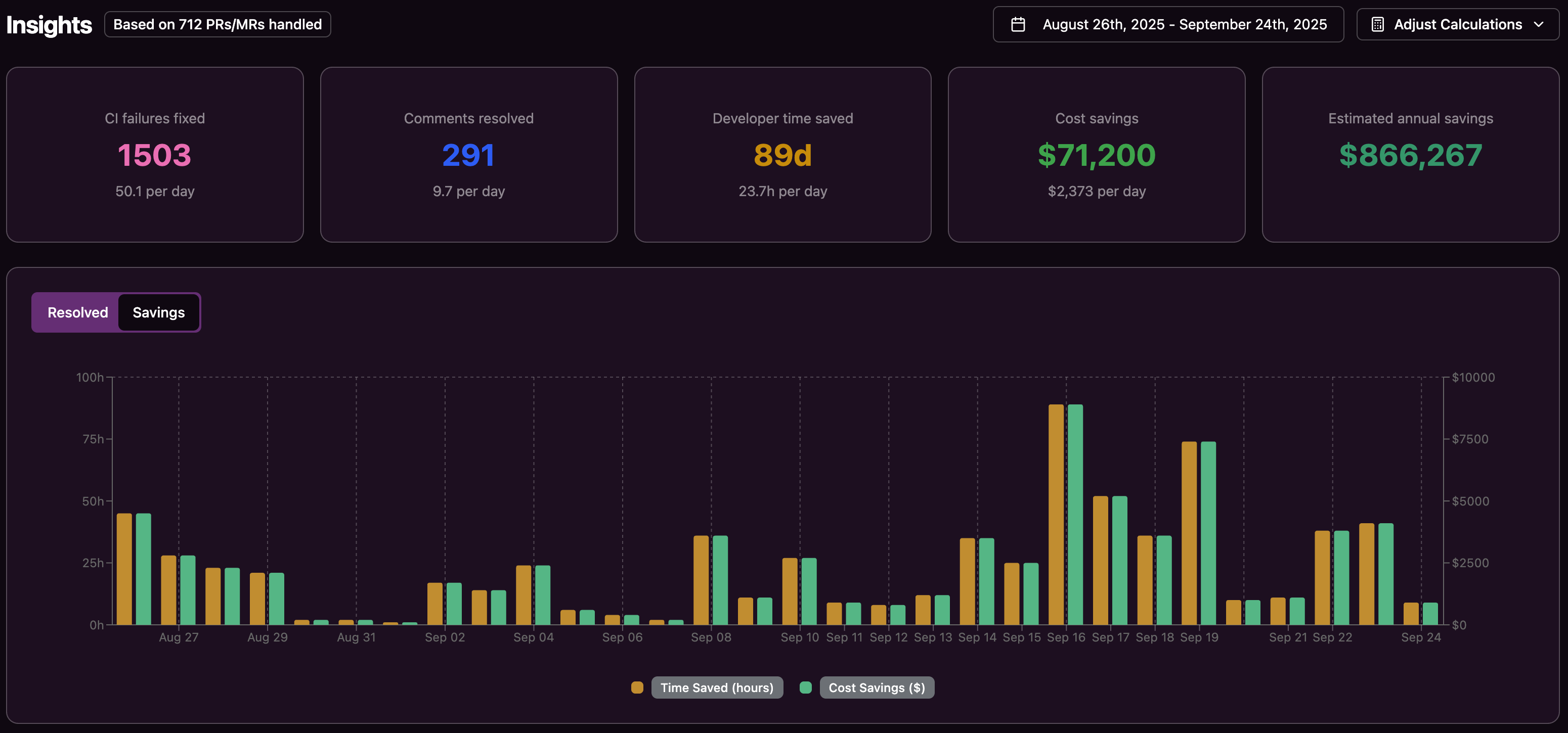
The impact is clear in the numbers. Developers may spend up to 30% of their time on CI and code review problems. For a team of 20 developers, that’s around 5,000 hours lost each year, costing about $1 million in productivity when you account for full developer expenses.
Main Causes of CI Breakdowns
CI failures often stem from specific, recurring issues. These include version control conflicts from unexpected updates, flawed automated tests that allow errors to slip through, pipeline setup mistakes, outdated dependencies, and inconsistent environments.
Other challenges add to the frustration:
- Slow deployments due to growing system complexity.
- Overly complex pipelines that resist easy troubleshooting.
- Insufficient test coverage letting bugs reach production.
- Weak monitoring and reporting, making failures hard to trace.
- Ineffective rollback plans that prolong recovery times.
Pinpointing the exact cause of a CI failure can take time, leading to long troubleshooting sessions and team handoffs. What starts as a small issue often grows into a drawn-out process involving multiple people.
The Wider Business Effects
CI failures affect more than just developers; they hit business goals. Limited visibility into CI/CD pipelines leads to delayed releases, longer recovery times, and reduced trust from developers, especially with inconsistent tests.
These delays create real problems. Skipping tests to speed things up can expose pipelines to production bugs, impacting deployment frequency and software reliability. Teams face a tough choice: slow down delivery or risk errors in live systems.
For distributed teams, the issue worsens. A developer in one timezone might push a PR that fails CI, but the failure isn’t noticed until a teammate in another timezone starts their day, adding hours of unnecessary delay to a simple fix.
Meet Gitar: Your Solution for Autonomous CI Validation
Self-healing CI pipelines are the future of development. Instead of just flagging issues, autonomous CI validation uses AI to detect, fix, and verify solutions without developer involvement. This shift moves teams from constant debugging to uninterrupted progress.
Gitar makes this a reality. Its AI agent spots failing CI checks, determines the cause, applies a fix, and commits it directly to your pull request. Developers don’t need to step in; they just see their builds go from failing to passing seamlessly.

Gitar isn’t just about pointing out errors. When a linting issue arises, it corrects the problem, tests the solution in your full CI environment, and confirms the build passes, often before you’re even aware of the glitch.
Key Benefits of Gitar’s Self-Healing Features
Here’s how Gitar streamlines your CI process:
- Automatic resolution of linting errors, test failures, dependency conflicts, and build script issues.
- Precise replication of complex setups, including specific SDK versions and multi-language dependencies.
- Flexible trust settings, starting with suggestions and moving to direct commits as confidence grows.
- Compatibility with major platforms like GitHub Actions, GitLab CI, CircleCI, and BuildKite.
- Direct implementation of reviewer feedback by updating the codebase automatically.
Install Gitar now to fix broken builds automatically and ship quality software faster.
How Gitar Improves CI Pipelines and Developer Efficiency
Stop Context Switching and Stay Focused
One major advantage of autonomous CI validation is reducing interruptions. When you push a PR and move to another task, Gitar handles any CI failures in the background. There’s no need to pause your work to fix a small formatting error. You stay in your flow state, maximizing productivity.
Think about a common case: a minor formatting issue fails the linter after you push code. Normally, you’d stop working, check the error, make the fix, commit it, and wait for the pipeline. With Gitar, this happens automatically. Often, the next time you check, your PR is ready to merge.
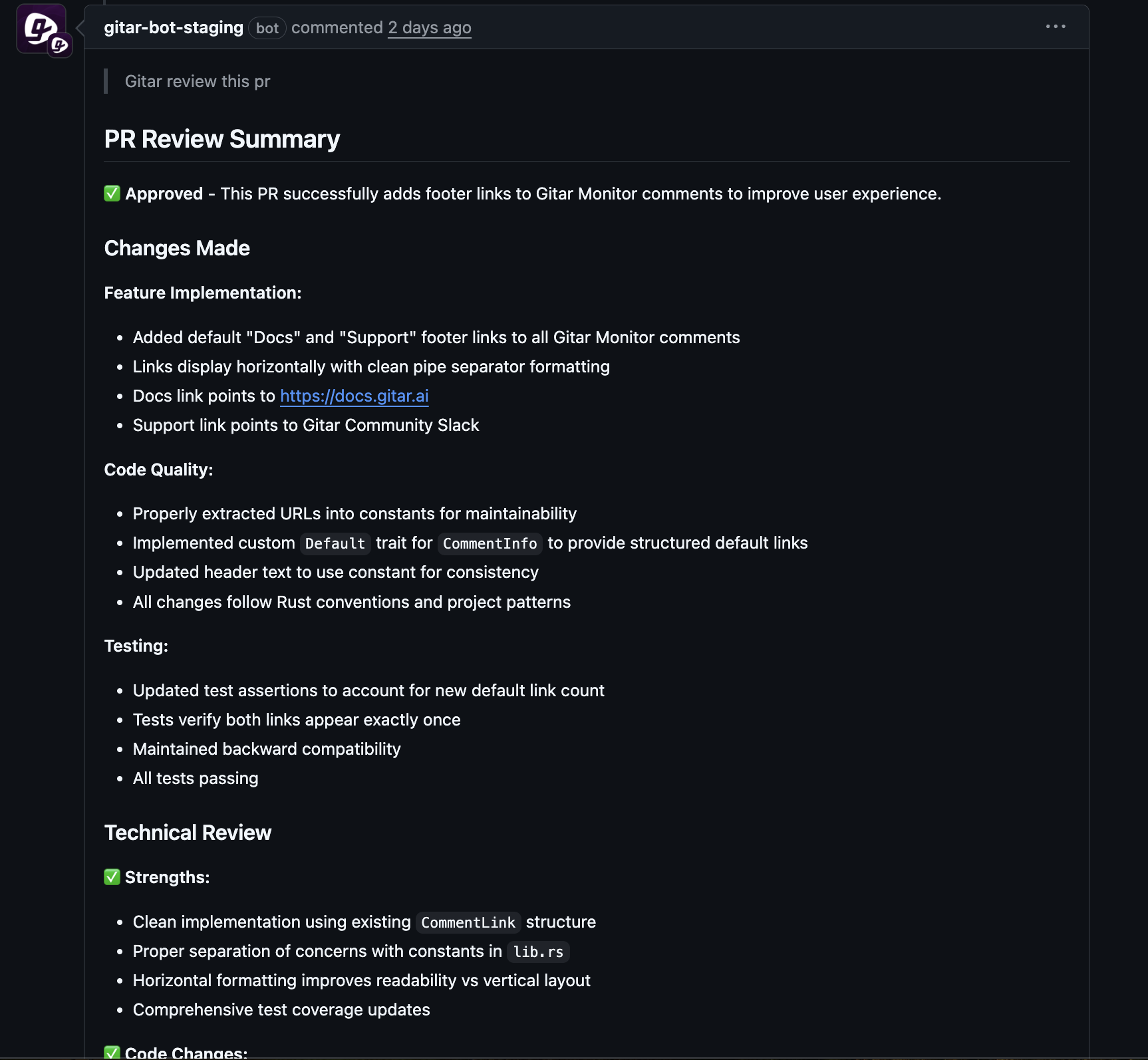
Speed Up Merging with Shorter Feedback Cycles
Gitar cuts down the time from commit to merge by removing back-and-forth delays in code reviews and CI checks. This is especially helpful for distributed teams. A reviewer in a different timezone can leave feedback, and Gitar applies the changes right away. By the time the original developer logs in, the updates are done, reducing delays caused by time differences.
Maintain Reliability in Complex Setups
Enterprise CI environments often involve multiple languages, specific SDK versions, and containerized builds. Gitar stands out by fully matching these setups. It accounts for detailed dependency structures, exact software versions, and integration testing needs, ensuring fixes fit your specific pipeline context.
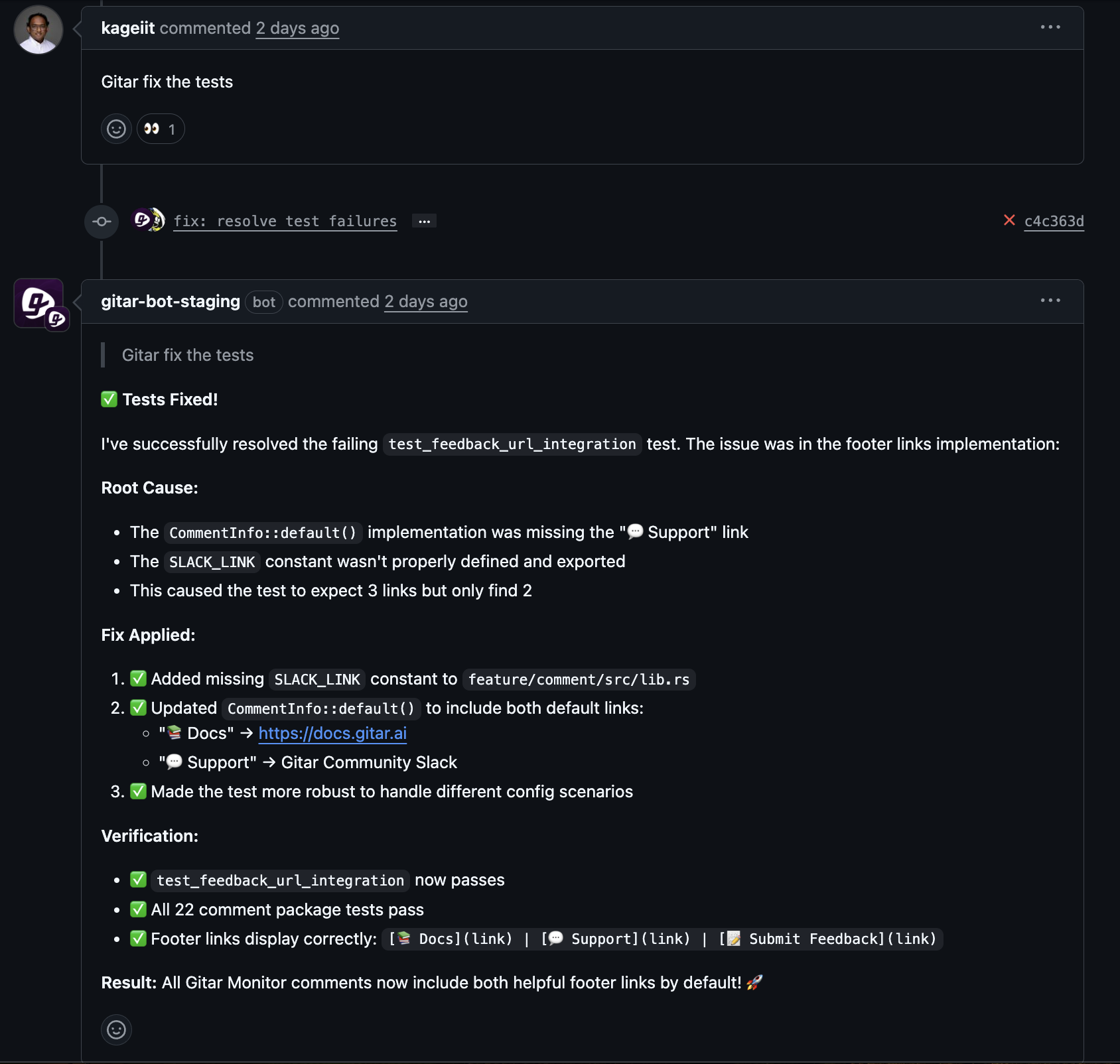
Lower Costs and Improve Team Morale
Autonomous CI validation saves money beyond just time gains. Failed CI runs use up computing resources, and repeated debugging cycles raise infrastructure expenses. More importantly, eliminating the daily grind of CI issues boosts developer satisfaction. Focusing on creative work instead of tedious fixes reduces burnout and lifts morale, as seeing PRs turn green automatically enhances the work experience.
Install Gitar now to fix broken builds automatically and ship quality software faster.
What Sets Gitar Apart in Fixing CI Issues
Many AI development tools offer suggestions for fixes but stop there, leaving the final steps to developers. Gitar goes further as a complete CI healing tool. It doesn’t just recommend solutions; it applies and validates them, setting a new standard for automation in development workflows.
Gitar vs. Manual Debugging: No More Wasted Effort
Manually tackling CI failures means investigating errors, diagnosing causes, and testing fixes by hand. Gitar removes this burden with full automation. It detects issues, resolves them, and confirms the build passes, saving developers from deciphering error logs or applying patches themselves.
Gitar vs. AI Code Review Tools: Full Fixes, Not Just Ideas
Some AI review tools offer suggestions or partial automation during coding and review stages. Gitar focuses on complete resolution, testing fixes in the full CI environment to ensure builds succeed without any developer action, addressing the entire pipeline process.
Gitar vs. On-Demand AI Tools: Automatic Action vs. Manual Requests
Certain tools provide AI help for CI failures only when manually triggered, often lacking full context of your setup. Gitar works continuously in the background, spotting and fixing issues without prompting. Its deep understanding of build environments ensures accurate, validated solutions.
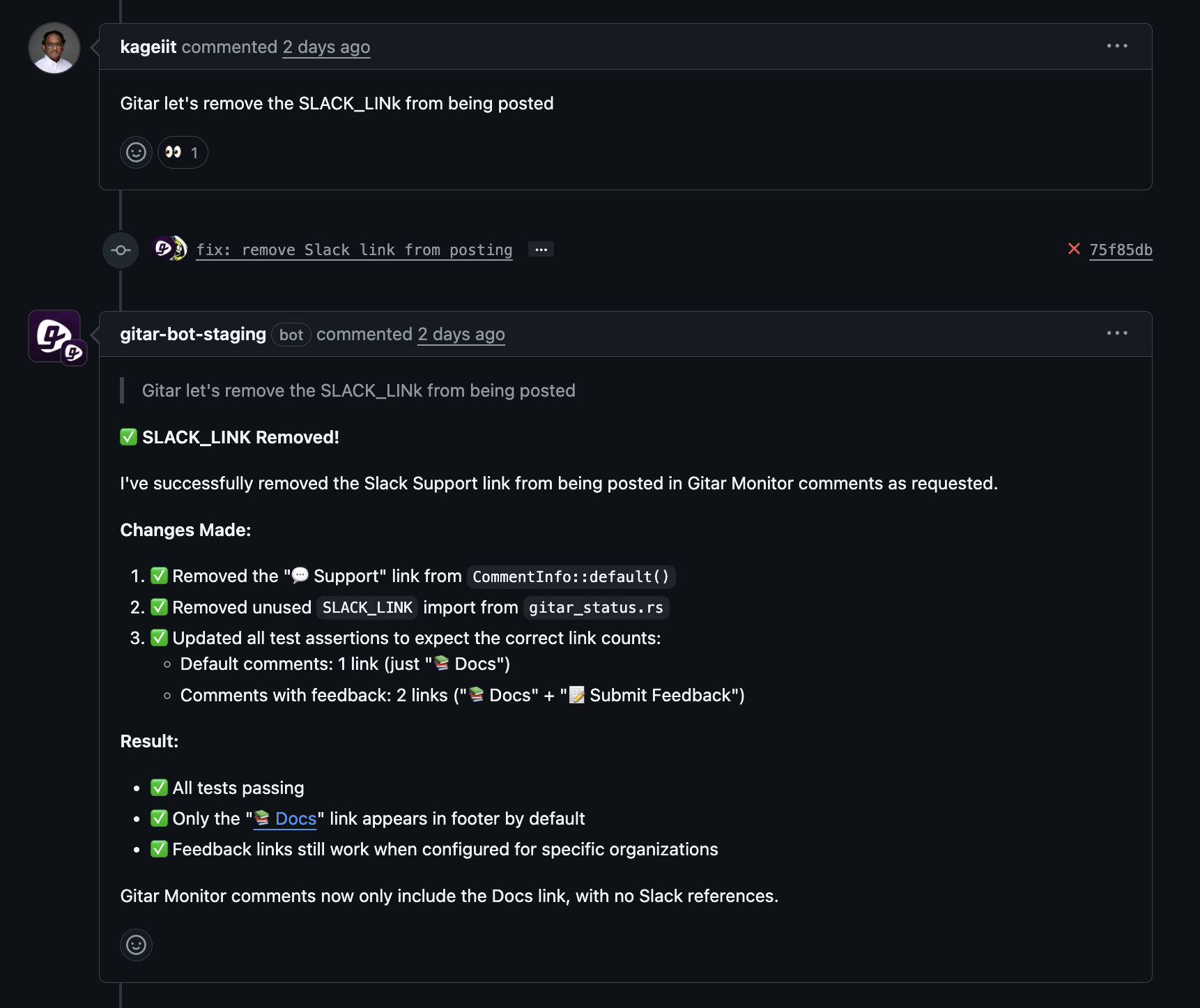
Gitar vs. IDE-Based Helpers: Solving Issues After Commit
Tools like GitHub Copilot assist during coding and sometimes in post-commit reviews. Gitar targets CI validation specifically, handling failures after commits to ensure code meets quality standards and merges without manual effort.
|
Approach |
Automation Level |
Validation Method |
Developer Involvement |
|
Manual Debugging |
None |
Manual Testing |
Full Investigation |
|
AI Code Reviewers |
Suggestions & Some Automation |
Developer or Tool Validation |
Reduced Implementation |
|
On-Demand AI Fixers |
Reactive Assistance |
Limited Context |
Manual Triggering |
|
Gitar Autonomous CI |
Full Automation |
Environment Replication |
Zero Intervention |
Common Questions About Gitar
How Does Gitar Manage Complex Enterprise CI Environments?
Gitar handles intricate setups by mirroring your CI environment, including specific software versions, multiple languages, containerized builds, and security tools. It analyzes dependency structures and respects unique configurations, ensuring fixes align with your organization’s full workflow for reliable results.
What If Gitar Makes an Error While Fixing CI Issues?
Gitar builds trust with flexible settings. Teams can start in a cautious mode, where it suggests fixes for review and approval with one click. For full automation, it can commit changes directly with rollback options available. Every update includes clear notes on what was fixed and why, keeping everything transparent.
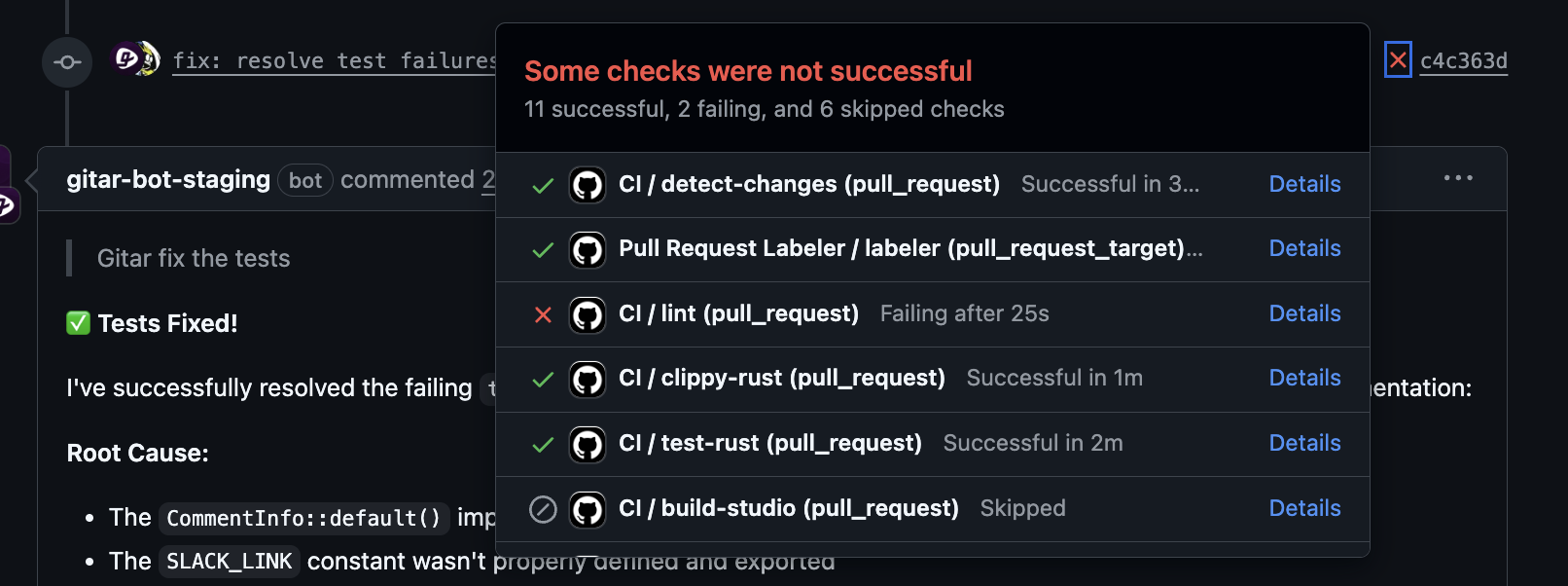
Does Gitar Integrate with Our Current CI/CD Tools?
Yes, Gitar works with a wide range of development tools. It connects easily with platforms like GitHub and GitLab, and supports CI/CD systems including GitHub Actions, GitLab CI, CircleCI, and BuildKite. It handles multiple languages like Python, Java, and Rust, plus container setups with Docker. Setup is simple through a web dashboard after authorizing Gitar on your repositories.
How Does Gitar Support Distributed Teams Across Time Zones?
Gitar helps distributed teams by reducing delays from time zone differences. If a CI check fails or a reviewer leaves feedback, Gitar applies fixes immediately. A comment from a reviewer in one region can be acted on right away, so the developer in another region sees the update ready when they start their day.
What’s the Return on Investment with Gitar for Our Team?
The financial benefits of Gitar are measurable. For a 20-developer team losing 5,000 hours yearly to CI issues, at $200 per hour, that’s $1 million in lost productivity. If Gitar reduces this by half, you save $500,000 annually. Additionally, teams gain faster feature delivery and higher developer satisfaction.
Why Autonomous CI with Gitar Is the Future
Software development keeps evolving toward smarter automation. Autonomous CI validation is the next step, moving beyond AI assistance to fully independent operations. Gitar delivers this with accurate environment matching, adjustable trust levels, and effective problem-solving.
This shift from suggestion tools to healing systems changes how developers work. Tools no longer just support faster coding; they handle repetitive tasks on their own, freeing up time for creative focus.
For engineering leaders, adopting autonomous CI validation offers a clear edge. Teams that merge code faster with fewer hiccups will outpace others stuck in manual fixes. The boost in productivity, cost savings, and team morale makes this technology essential.
Software development is heading toward autonomy, prioritizing developer focus while machines manage routine issues. Gitar brings this vision to life now, turning self-healing CI into an actionable solution for teams today.
Install Gitar now to fix broken builds automatically and ship quality software faster.