
Software development teams often face a productivity challenge that slows their progress and impacts morale. Developers can spend up to 30% of their time resolving CI and code review issues, creating bottlenecks in workflows. For many organizations, CI pipeline failures delay projects significantly. This article discusses how autonomous AI-driven CI fixes can address build failures, turning reactive debugging into a proactive, self-correcting system that speeds up development, cuts costs, and improves developer satisfaction.
Why Manual CI Build Fixes Hurt Your Team
Developer Focus: CI Failures Disrupt Workflow
CI failures break a developer’s concentration. Picture this: you submit a pull request, expecting a smooth process, only to face error notifications. You then stop your current task, dig through confusing logs, recreate the issue, apply a fix, commit it, and wait for the pipeline to rerun, hoping for success.
This interruption can turn a quick fix into a long distraction. Switching tasks adds mental strain, making it hard to refocus on deep work. Developers may lose up to 30% of their productive time dealing with these issues, shifting their focus from creative solutions to repetitive problem-solving.
The unpredictability of CI failures adds to the frustration. Developers can’t fully move on to the next task, knowing a failure might pull them back at any time. This constant risk of disruption hinders the focused state needed for complex coding challenges.
Business Costs: Delays and Financial Impact
CI build failures affect more than just developers, they create real business challenges. For a team of 20 developers, the lost time from CI issues can add up to $1 million yearly in engineering costs, factoring in average salaries and hours spent debugging.
These delays slow down product releases, putting companies at a disadvantage in competitive markets where speed matters. When CI failures block critical updates or features, revenue opportunities slip away, and customer trust may erode. This impact grows during key launches or urgent fixes.
Beyond direct costs, CI issues disrupt entire workflows. Product managers adjust timelines, QA teams rush testing in tighter windows, and support staff handle customer complaints about delays. The uncertainty in scheduling often costs more than the direct productivity loss.
Why Traditional CI/CD Methods Fall Short
Conventional CI/CD quality checks struggle to meet modern development needs. Failures often stem from version control conflicts, poor testing, misconfigured pipelines, dependency mismatches, or inconsistent environments, all of which demand human effort to resolve.
These methods are reactive, spotting issues only after they happen, requiring manual fixes. Limited error detection, unclear reporting, and lack of real-time monitoring slow down the process even more.
As development speeds up with AI coding tools, traditional debugging can’t keep up. More code means more pull requests and tests, increasing the chances of CI failures. Relying on manual fixes simply doesn’t scale with today’s fast-paced workflows.
Install Gitar now to fix broken builds automatically and ship quality software faster.
How Autonomous AI Creates Self-Correcting CI Systems
Self-correcting CI marks a shift from manual fixes to automated problem-solving. AI agents monitor pipelines constantly, fixing issues as they appear, so developers don’t have to step in. This turns CI failures from workflow blockers into background tasks handled without interruption.
Most CI failures follow recognizable patterns, like linting errors, failed tests, or dependency issues. AI can analyze the context, create fixes, and test them against the full CI setup, all independently. This removes the burden from developers.
A key benefit is reducing Mean Time To Recovery, or MTTR. Unstable CI operations and unreliable tests often cause delays and increase MTTR. Autonomous fixes can cut this recovery time from hours to minutes, making development more predictable.
Unlike reactive systems that alert developers to issues, autonomous AI acts immediately. Developers stay focused on creative work while routine fixes happen automatically, saving time and mental energy.
Meet Gitar: Your AI Agent for CI Fixes
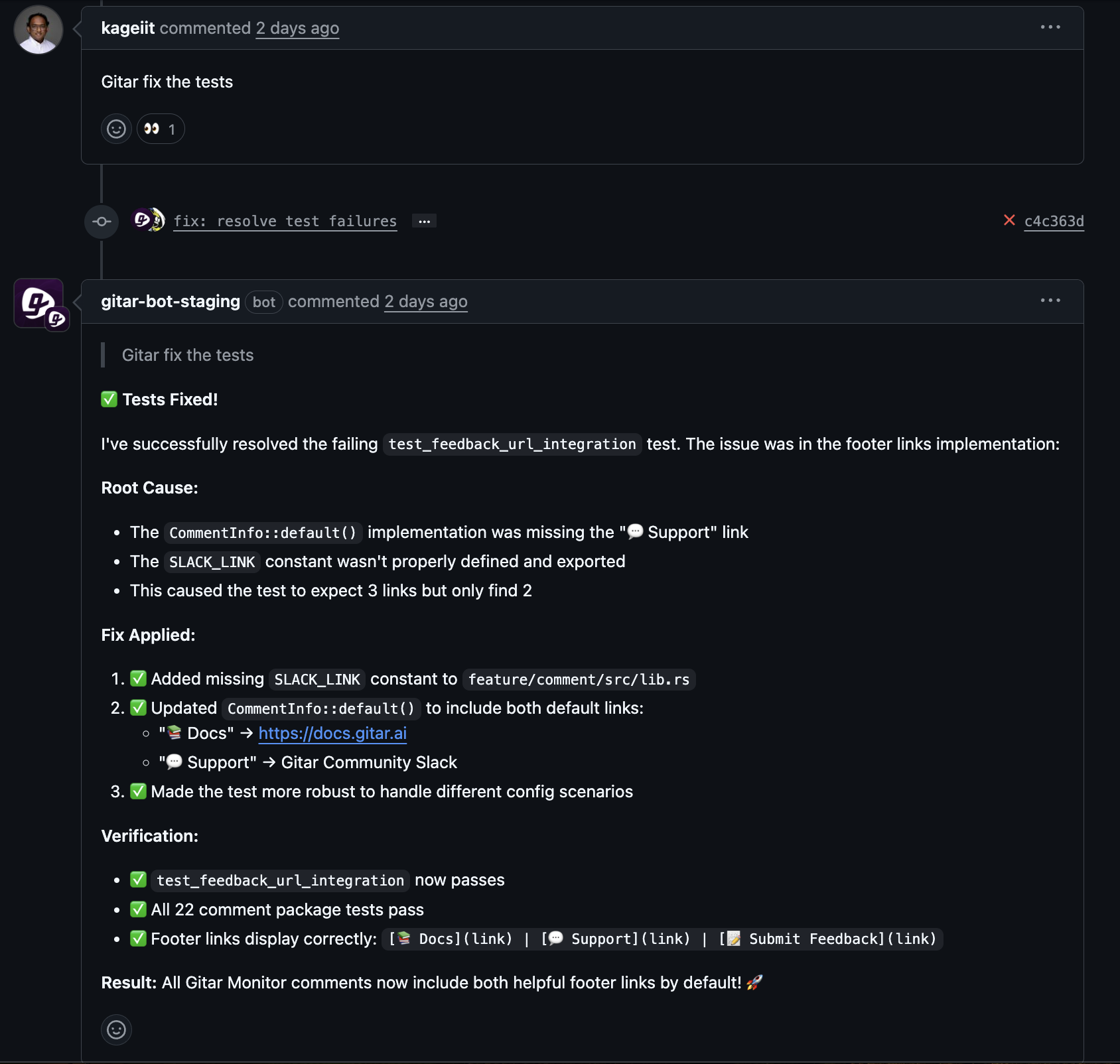
Gitar is an AI tool that automatically resolves failing CI pipelines and handles code review feedback. It saves developers hours daily by managing CI checks and code approvals. Unlike tools that only suggest fixes, Gitar acts as a complete solution, handling issues from detection to validation.

Here are some key features of Gitar:
- Complete Fix Process: Automatically applies fixes, tests them in full CI workflows, and ensures pull requests pass all checks.
- Environment Matching: Replicates complex setups, including specific JDK versions, multi-SDK dependencies, and third-party scans like SonarQube or Snyk, for accurate fixes.
- Customizable Automation: Offers a cautious mode with suggestions for review or a direct mode with automatic commits and rollback options, adapting to team preferences.
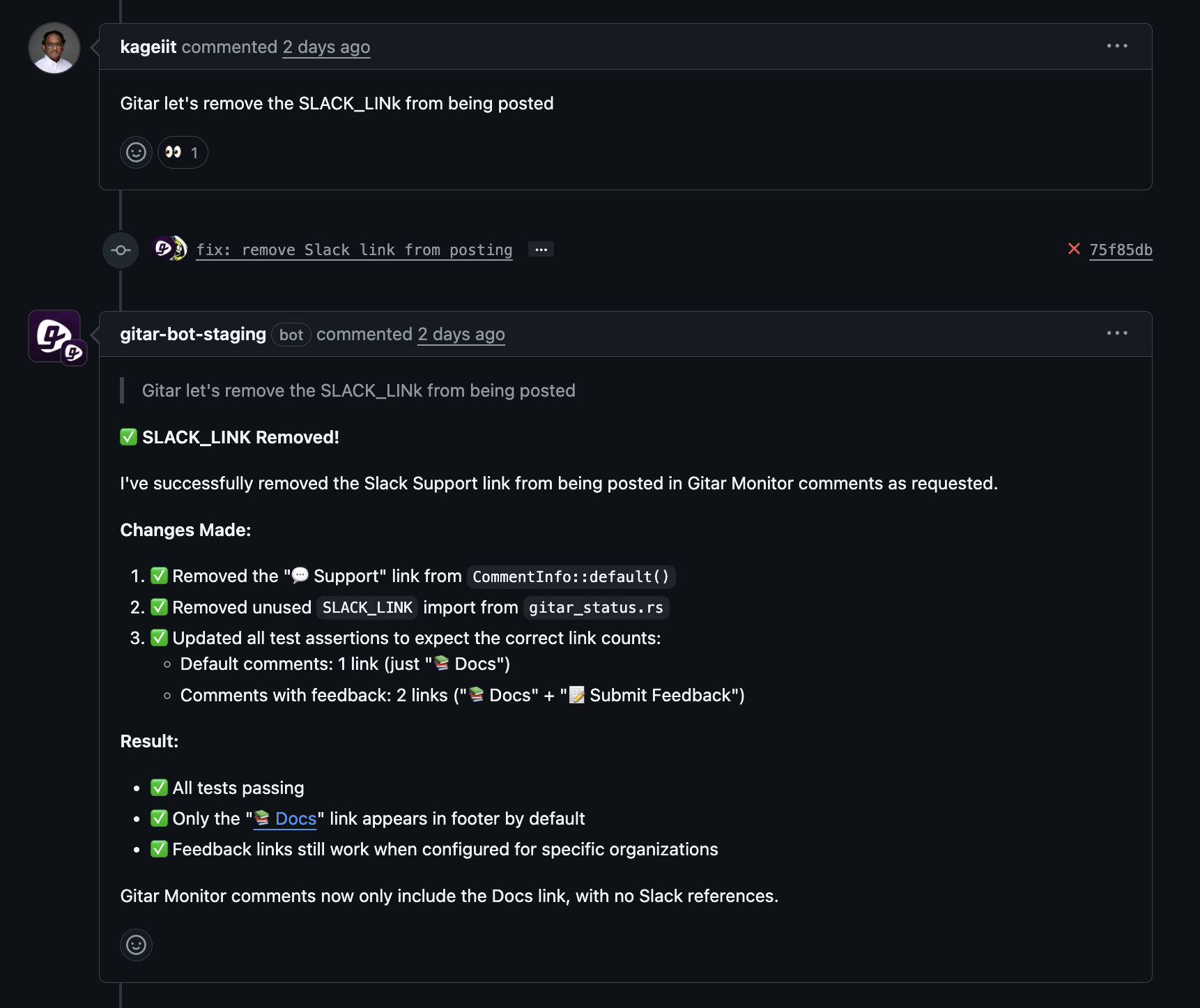
- Code Review Support: Responds to reviewer comments by making changes, like removing features or refining code, beyond just CI fixes.
- Platform Compatibility: Works with GitHub Actions, GitLab CI, CircleCI, BuildKite, and other systems, fitting various environments.
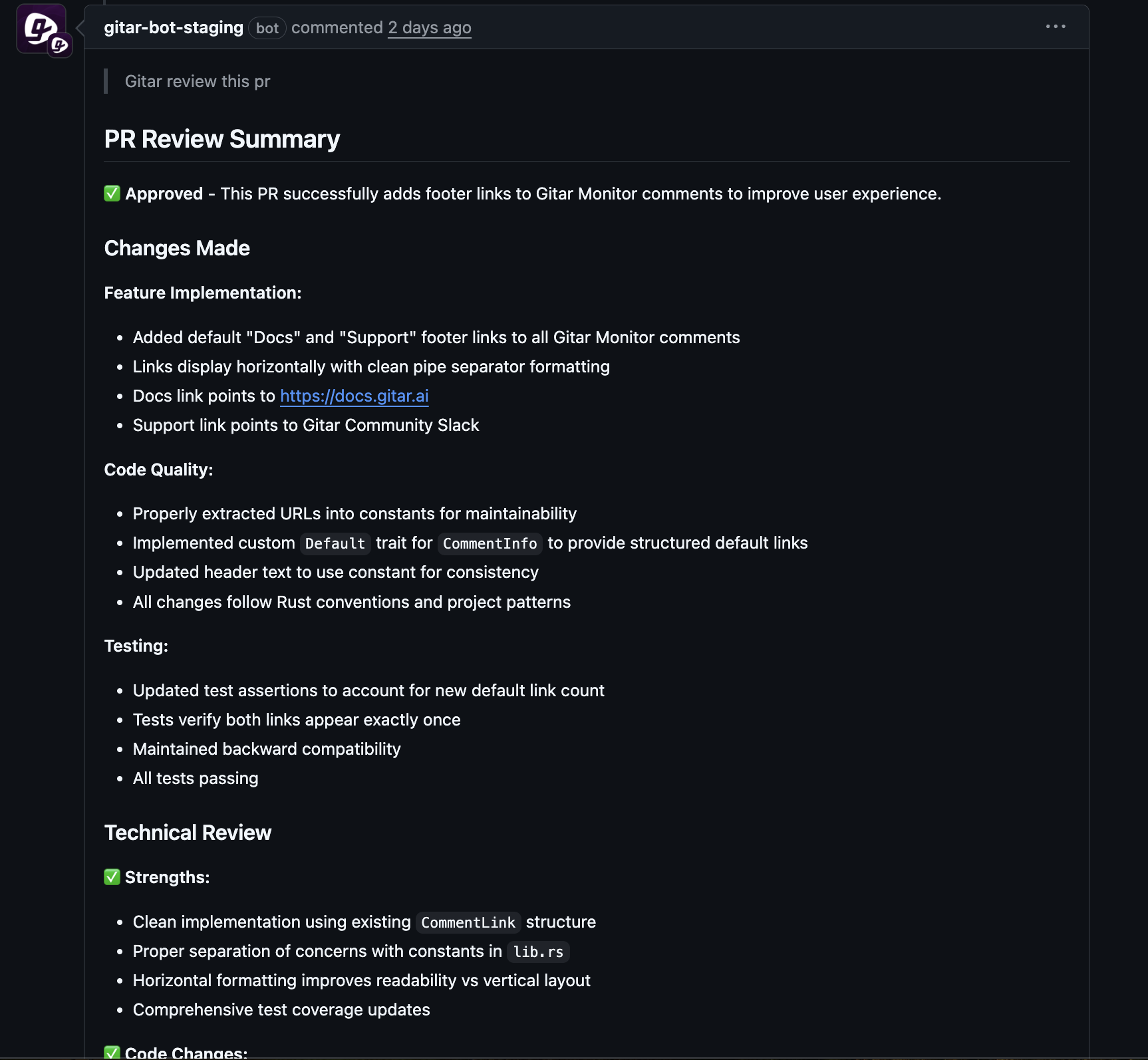
Gitar stands out by managing the intricacy of enterprise setups. It mirrors full workflows to create targeted fixes, ensuring they pass CI checks and meet compliance needs while minimizing human error.
Install Gitar now to fix broken builds automatically and ship quality software faster.
Key Advantages of Using Gitar for CI Fixes
Speed Up Development and Merge Times
Gitar boosts development speed by cutting down the wait between code submission and merging. It resolves CI failures and code review feedback automatically, shortening timelines without sacrificing quality.
For teams with detailed CI checks, the effect on merge times is noticeable. Gitar upholds strict standards while removing delays, helping deliver code more quickly.
Organizations that improve CI/CD processes can reduce infrastructure failures by 60% and cut build times in half. Gitar delivers similar gains through automation, benefiting teams regardless of size.
Improve Developer Focus and Satisfaction
Gitar frees developers from repetitive CI debugging, letting them concentrate on meaningful tasks. This reduction in mundane work lowers frustration, leading to better code quality and job satisfaction.
The improvement isn’t just about time saved. Developers approach tasks with confidence, knowing CI issues won’t interrupt their plans. This leads to better focus and less stress from unexpected setbacks.
Avoiding constant task-switching pays off over time. When developers finish features without CI disruptions, they produce stronger results, which boosts morale and team unity.
Cut Costs and CI Resource Waste
Gitar tackles hidden expenses in development by reducing wasted CI resources from failed runs. It applies correct fixes on the first try, making better use of pipeline capacity.
This efficiency extends to overall operations. Less time debugging means lower engineering costs, faster feature rollouts, and better planning. Teams can focus resources on innovation instead of upkeep.
For a 20-developer team, Gitar can save substantial yearly costs from lost productivity. Even at partial effectiveness, it offers clear financial returns by reducing time spent on CI and review tasks.
Maintain Quality and Reliability as You Grow
Gitar’s ability to mimic full environments ensures consistent code quality and pipeline stability, even in complex systems. Testing fixes against real conditions lowers the risk of environment-specific problems.
This consistency helps organizations with multiple teams or varied tech stacks. Gitar delivers uniform fix quality, enhancing system reliability and reducing differences in debugging methods.
As organizations expand, Gitar scales effectively. It maintains reliable performance no matter the team size or project complexity, supporting growth without added strain.
Bridge Gaps in Distributed Teams
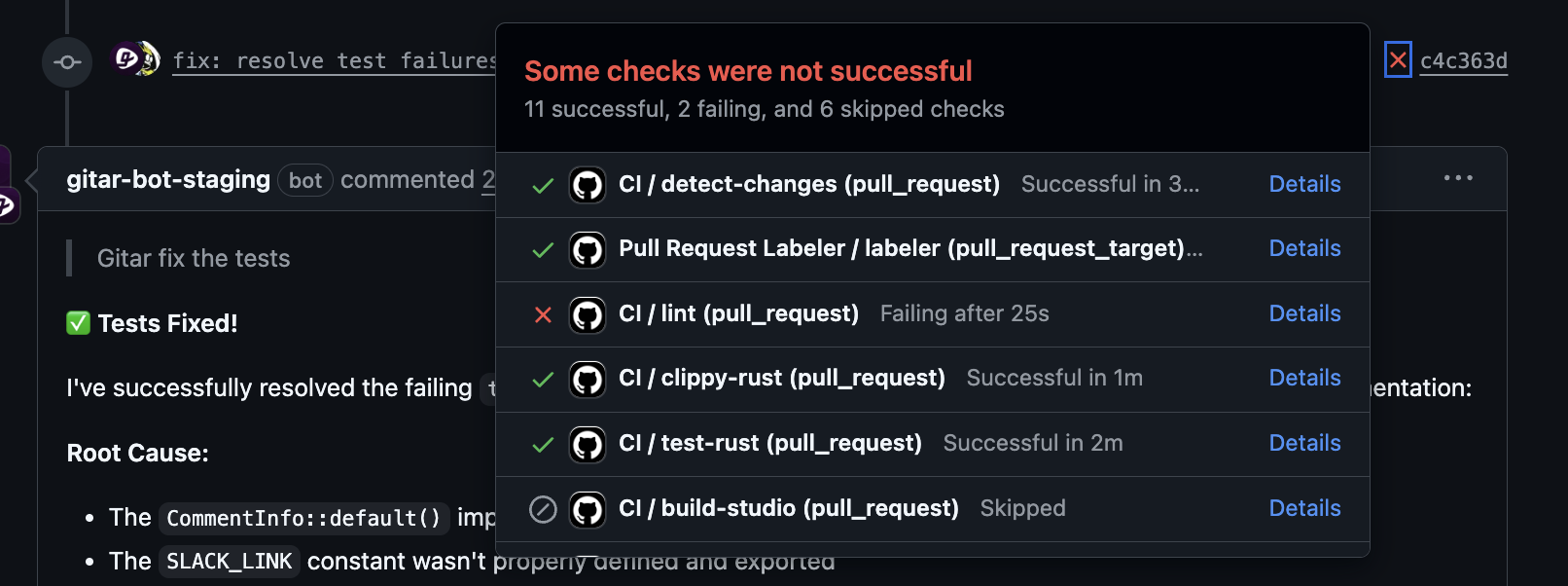
For teams spread across locations, Gitar removes delays in code review and CI failure resolution. It applies reviewer feedback and fixes issues automatically, keeping progress steady across time zones.
A reviewer can leave instructions for Gitar, and by the next workday, the fixes are ready for approval. This creates near-constant development progress without needing round-the-clock staff.
Removing time zone delays helps with urgent fixes and key features. Unclear ownership of pipeline stages often slows resolution in large teams. Gitar ensures steady fixes no matter where team members are based.
Install Gitar now to fix broken builds automatically and ship quality software faster.
How Gitar Differs from Basic CI Tools
Many CI solutions act as suggestion tools, offering ideas for fixes that developers must apply and test themselves. Gitar works differently as a healing system, automatically implementing and validating fixes before showing the results.
|
Feature/Capability |
Gitar (Autonomous AI Fixing) |
Manual Work / Suggestion Tools |
|
Root Cause Analysis & Fix Creation |
Identifies issues and creates tested fixes automatically |
Offers ideas that need manual application |
|
Fix Application & Testing |
Implements fixes and confirms builds pass CI checks |
Leaves implementation and testing to developers |
|
Environment Awareness |
Matches exact enterprise setups with all dependencies |
Often misses specific environment details |
|
CI Platform Support |
Works across GitHub Actions, GitLab CI, CircleCI, BuildKite |
Usually limited to specific platforms or needs heavy setup |
The main difference is in testing. Suggestion tools leave developers to verify fixes, often requiring multiple attempts. Gitar handles the full process, testing every solution against the CI environment for reliable results.
This matters in enterprise settings where complex pipelines increase error risks and manual fixes take longer. Gitar cuts out uncertainty with thorough validation.
Common Questions About Autonomous CI Fixes with Gitar
How Does Gitar Compare to Other AI Code Review Tools?
Many AI code review tools, like CodeRabbit or Claude integrations, offer suggestions for improvements but don’t always test them against your CI pipeline. Some provide quick fixes, while others still need manual work to apply changes and confirm builds pass.
Gitar goes further by applying fixes and validating them across your entire CI setup. It ensures builds are ready before you review them, removing guesswork and fitting your specific environment.
Can Gitar Handle a Complex CI Setup?
Gitar is built for complex CI environments. It mirrors your exact setup, including dependency versions, SDK needs, third-party scans like SonarQube or Snyk, and custom scripts. Fixes are tested in matching conditions for reliability.
It manages details like environment mismatches or dependency conflicts by creating identical replicas of your CI system for testing, ensuring fixes work across different setups and languages.
Is It Safe to Let an AI Fix Our Code?
Gitar offers a flexible trust model for security. Start with a cautious mode where fixes are suggestions for review. As trust grows, switch to automatic commits with rollback options if needed.
For enterprise needs, Gitar supports on-premise setups to keep code processing internal. It maintains audit logs and integrates with access controls to meet compliance standards.
Will Gitar Raise Our CI Costs with Extra Runs?
Gitar lowers CI costs by optimizing resources. Manual debugging often leads to repeated failed runs, wasting CI minutes. Gitar gets fixes right the first time, using isolated environments for validation that don’t count against your CI limits, saving money.
Does Gitar Support Different Languages and Frameworks?
Gitar works with Python, Go, JavaScript, TypeScript, Java, Rust, Docker, Terraform, and many other common languages and tools. It understands specific testing frameworks and build processes for each, delivering accurate fixes tailored to your stack.
Conclusion: Boost Productivity with Autonomous CI Fixes
Manual CI debugging and reactive fixes are becoming outdated. Autonomous systems now keep builds running smoothly and remove productivity hurdles. The drawbacks of older methods, like lost developer time, delayed releases, and rising costs, are no longer sustainable with today’s demand for speed.
Gitar changes CI/CD pipelines into self-correcting systems. By fixing failures automatically, testing solutions, and ensuring builds pass, it cuts out the task-switching that slows teams down while upholding quality.
Adopting autonomous CI fixes sets teams up for faster development in the future. As AI coding tools speed up code creation, validation and merging become the new bottlenecks. Using Gitar today helps teams stay ahead in leveraging AI-driven workflows.
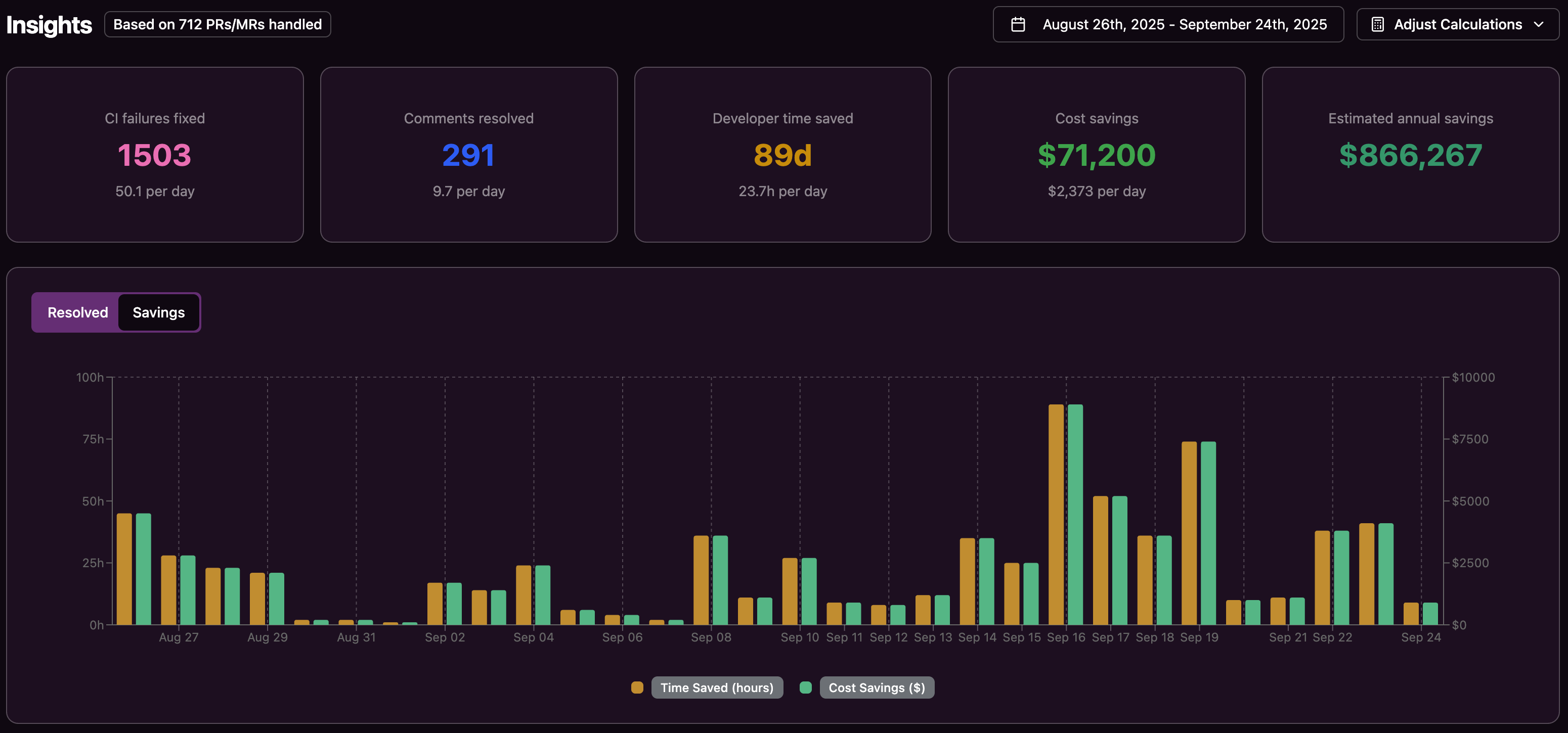
Ready to try a self-correcting CI system and increase your team’s output? Install Gitar now to fix broken builds automatically and ship quality software faster.