
Key Takeaways
- Autonomous CI in 2026 addresses growing CI/CD bottlenecks by fixing failures automatically instead of only flagging them.
- Context switching from broken builds and code review loops erodes focus time, increases costs, and slows releases across engineering teams.
- Self-healing pipelines require deep environment awareness, especially in complex enterprise stacks with multiple SDKs, tools, and security gates.
- Engineering leaders can measure the impact of autonomous CI with DORA metrics, reclaimed developer hours, and improvements in time-to-merge.
- Teams that want to reduce CI toil and speed up delivery can try autonomous fixes with Gitar by visiting Gitar.ai/fix.
Why Advanced CI CD Automation is Critical in 2026
The Developer Productivity Crisis: Beyond Traditional CI Bottlenecks
Many developers now face a daily cycle of red builds, flaky tests, and linter complaints. Each failure forces a shift from focused work into log reading, local reproduction, patching, and waiting for another pipeline run.
Worklytics 2026 benchmarks show median software teams achieve only about 4.2 focus hours per day, in part because of interruptions from CI failures and review feedback. This context switching often consumes a large share of engineering time and creates a persistent “CI tax.”
AI-assisted coding tools such as GitHub Copilot increase code volume, which shifts the bottleneck to validation and merging. More pull requests mean more tests, more checks, and more opportunities for CI to fail.
The High Cost of CI/CD Inefficiencies
One analysis estimates productivity loss can reach $1 million per year for a 20-developer team if each person spends roughly one hour per day on CI issues and review-driven rework.
These inefficiencies delay projects, slow time-to-market, and contribute to burnout and attrition. Repeated failed runs also increase infrastructure costs, since the same jobs execute multiple times for minor issues that could be fixed automatically.
From Automation to Autonomy in CI/CD
Traditional CI/CD automation focuses on orchestration. Pipelines run tests and deployments reliably, yet developers still fix failures manually.
Autonomous CI extends this model. A self-healing pipeline not only detects failures but also diagnoses root causes, proposes changes, applies fixes, and re-runs checks until the pipeline is green, all with minimal human involvement.
Limitations of Current CI CD Automation Approaches
Suggestion Engines vs. Healing Engines
Most AI tools in CI/CD work as suggestion engines. They add comments, point out smells, or propose patches, but developers still apply changes and validate results.
Healing engines follow a different pattern. These systems own the full loop by:
- Generating concrete fixes
- Applying them to the branch or pull request
- Re-running the full CI workflow
- Surfacing a verified green build
Suggestion engines reduce diagnostic time but keep the context switching. Healing engines aim to remove that loop entirely for a large class of failures.
The Complexity of Enterprise CI Environments
Enterprise CI stacks often include multiple languages, specific SDK and JDK versions, complex dependency graphs, and tools such as SonarQube, Snyk, and snapshot testing frameworks. A fix that compiles locally can still break in this environment.
Generic AI tools rarely replicate this full context. They operate on code snippets or partial logs, which limits accuracy. Autonomous CI needs to model the real pipeline, including configuration, secrets, and external checks, so that fixes succeed under production CI conditions.
Distributed Teams and Time Zone Delays
Distributed teams frequently stretch simple reviews across days. A reviewer in one region adds requested changes, then waits for the original author in another region to respond and fix issues. CI failures extend that loop further.
Autonomous CI that can both implement requested edits and fix related CI failures shortens these cycles and reduces dependence on overlapping working hours.
Introducing Gitar: An Autonomous CI Platform for Self-Healing Pipelines
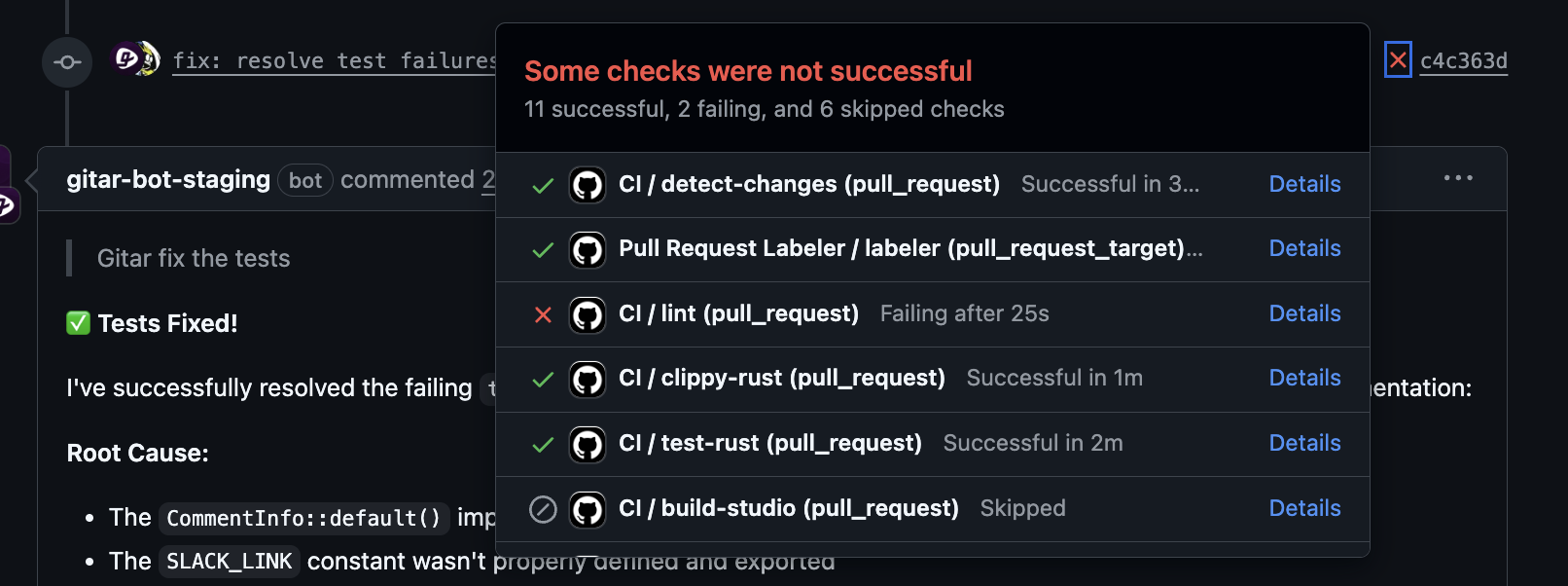
Gitar provides an autonomous CI layer that focuses on fixing failing checks and acting on review comments, rather than only highlighting problems. The platform treats each failure or comment as a task for an AI agent that owns the full fix-and-validate loop.
When a CI job fails or a reviewer leaves a comment, Gitar inspects the code, tests, and logs, proposes a change, applies it, and re-runs the configured workflow. Developers receive updated commits and passing checks instead of only suggestions.
Key Capabilities of Gitar for Autonomous CI
- End-to-end fixes: Gitar applies code changes for lint errors, test failures, build issues, and common dependency problems, then validates them in the real CI pipeline.
- Full environment awareness: The platform respects project configuration, SDK versions, and integrations with tools such as SonarQube and Snyk so that fixes pass the same gates developers use.
- Configurable trust levels: Teams can start in a conservative mode where Gitar opens suggestions or separate commits for review, then move toward more direct commits with rollback paths as confidence grows.
- Review-aware automation: Reviewers can direct Gitar through pull request comments, which helps distributed teams avoid back-and-forth delays.

Strategic Advantages of Adopting Autonomous CI CD Automation
Developer Flow and Productivity Gains
High-performing teams often achieve a larger share of time on new feature work instead of reactive tasks. Reducing time spent fixing CI issues supports that shift.
When an agent handles common CI failures, developers stay in flow on design and implementation. Fewer context shifts lead to better focus, less frustration, and more consistent throughput.
Faster Cycle Time and Time-to-Market
Self-healing pipelines shorten the path from first commit to merged code. Automatic fixes reduce review backlogs, shrink “waiting for CI” time, and help teams ship small, frequent changes.
Cost Reduction and ROI
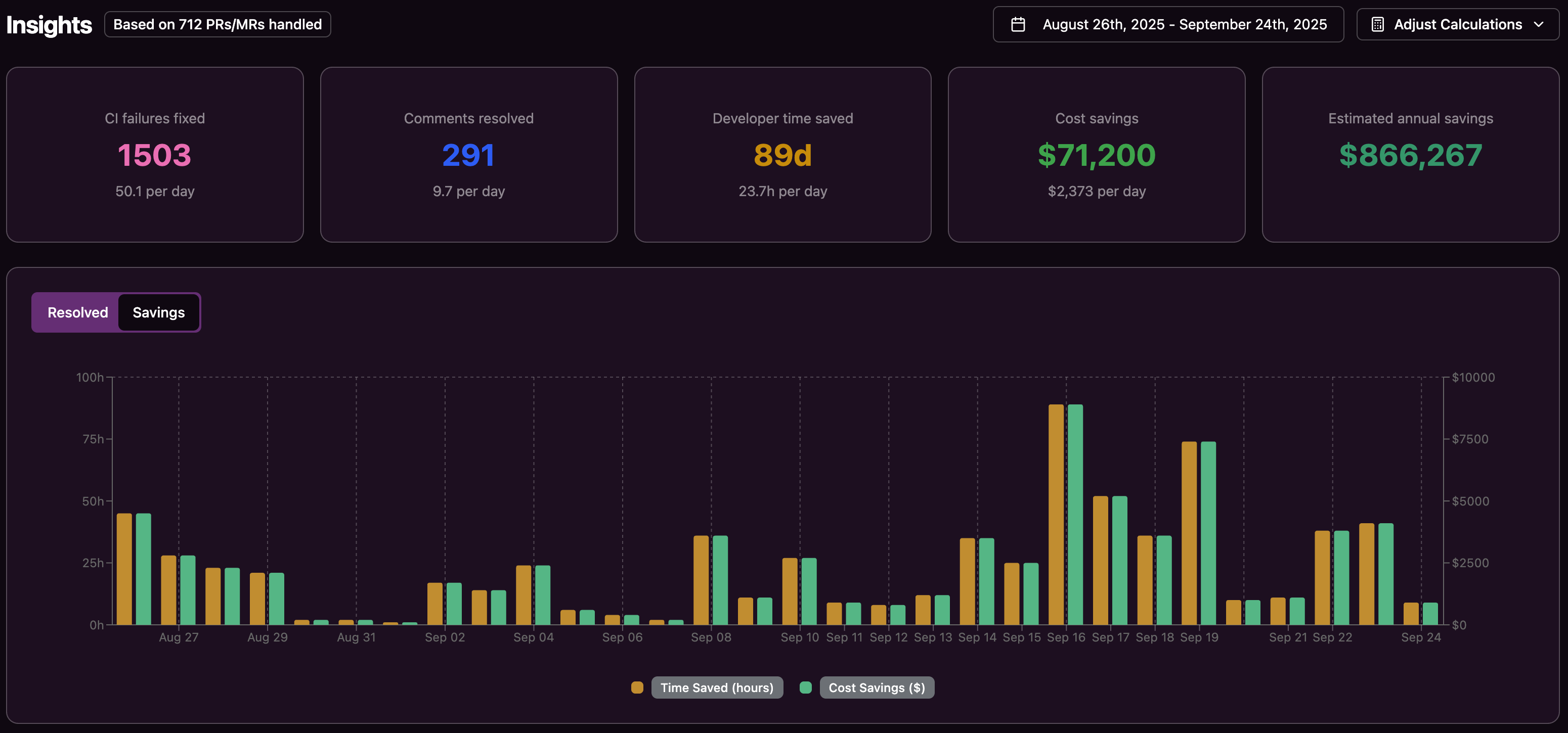
For a 20-developer group, the combination of saved engineering hours and fewer repeated job runs can represent hundreds of thousands of dollars per year in value, even if automation covers only a portion of failures.
Implementing Autonomous CI: Strategic Considerations for Engineering Leaders
Readiness and Rollout Strategy
Organizations with consistent branching models, clear code quality gates, and stable CI pipelines usually adopt autonomous CI more quickly. A gradual rollout by team or repository allows leaders to monitor accuracy and adjust trust levels.
Many teams begin with suggestion-style output, then enable automatic commits for well-understood failure types such as lint and formatting issues.
Measuring ROI and Success Metrics
DORA metrics such as lead time for changes, deployment frequency, change failure rate, and time to restore service provide an objective view of delivery performance.
Teams that measure AI developer productivity typically align metrics with executive priorities, such as faster customer impact or lower unit costs. Tracking hours saved on CI toil and multiplying by fully loaded labor rates gives a simple financial estimate.
Avoiding Common Pitfalls
Challenges often arise when teams treat autonomous CI as a simple plugin rather than a workflow change. Clear guidelines on where automation may commit directly, how reviewers interact with the agent, and how to handle edge cases improve outcomes.
Gitar integrates with GitHub Actions, GitLab CI, CircleCI, and Buildkite, which lets teams adopt autonomous fixes without replacing existing CI platforms.
Gitar vs. Alternatives: Autonomous CI Fixes Comparison
|
Feature / Tool |
Gitar (Autonomous CI) |
AI Code Reviewers (e.g., CodeRabbit) |
Manual Workflow (Status Quo) |
|
Primary action |
Applies fixes, re-runs CI, and returns green builds when possible |
Highlights issues and suggests patches |
Developers diagnose issues, write fixes, and re-run CI |
|
Fix validation |
Uses the full CI workflow for validation |
Often relies on developer to run CI |
Relies entirely on manual validation |
|
Environment context |
Works with project configuration and enterprise tools |
Focuses mainly on code-level context |
Limited to the developer’s local and CI setup |
|
Level of autonomy |
Configurable, from suggestions to direct commits |
Partial automation for select cases |
No automation |
Teams that want to evaluate autonomous fixes in their own pipelines can start with a limited rollout by visiting Gitar.ai/fix.
Key Topics on CI CD Automation and Autonomous CI
Impact of Autonomous CI on DORA Metrics and Engineering Velocity
Autonomous CI improves lead time for changes and deployment frequency by reducing time spent waiting on failing pipelines and review-driven rework. Shorter feedback loops support smaller, more frequent releases.
Handling Complex Enterprise CI/CD Environments
Platforms such as Gitar target real-world enterprise setups that involve multiple SDKs, security scans, and quality checks. Accurate environment modeling ensures that automated fixes succeed in the same pipelines that ship production code.
Building Trust in Automated Fixes
Teams can control how far automation goes. Conservative modes keep humans in the loop for every change, while more assertive modes allow direct commits for low-risk fixes, backed by CI validation and rollback options.
Typical ROI from Advanced CI CD Automation
Even partial coverage of failures can free thousands of developer hours per year for a mid-sized team. That time shifts from reactive maintenance toward feature delivery, architectural improvements, and other high-impact work.
Integration with Existing Workflows and Tools
Modern autonomous CI tools integrate through version control apps and CI providers rather than replacing them. Setup usually involves granting repository access, installing an app, and defining basic project rules so the agent knows when and how to act.
Conclusion: Autonomous CI as a Strategic Capability for 2026 and Beyond
Manual handling of recurring CI failures no longer scales with modern code volume and release expectations. Autonomous CI and self-healing pipelines give engineering teams a way to reduce this operational load while keeping existing tools and processes.
Gitar focuses on closing the loop from failure detection to validated fix so developers can spend more time on product work and less on repetitive CI tasks.
Teams that want to explore autonomous CI in their own environments can request access and start testing with real pull requests at Gitar.ai/fix.