
Last updated: March 10, 2026
Key Takeaways
- AI coding tools have increased PR volumes by 91% and CI failures. Developers now can spend hours daily on CI issues, which costs teams $1,000,000 annually in productivity losses.
- Automating CI pipeline fixes cuts daily fix time from 1 hour to 15 minutes per developer.
- The core ROI formula is: (Annual Savings – Automation Costs) / Automation Costs × 100. This calculation includes direct time savings, fewer context switches, and faster releases.
- Gitar’s auto-fix platform commits validated fixes directly to PRs. It outperforms suggestion-only tools by guaranteeing green builds with no manual implementation work.
- Start your 14-day free trial with Gitar to measure real ROI, remove CI toil, and speed up software delivery.
Why CI Pipeline Automation ROI Matters in 2026
The AI coding surge created a new bottleneck in CI. Tools like GitHub Copilot speed up code generation by 3-5x, which floods CI pipelines with more PRs than teams can comfortably manage. Flaky tests now affect 26% of teams, up from 10% in 2022, and developers spend 2.5 hours daily waiting for CI feedback.
Manual CI toil quickly becomes expensive. A 20-developer team that spends 1 hour daily on CI fixes loses $1,000,000 in productivity each year.
Traditional tools often charge $15-30 per developer and only suggest fixes that still require manual work. Gitar’s zero-setup trial removes upfront costs and manual effort by applying automated fixes that validate against your real CI environment.
Step-by-Step CI Automation ROI Calculation
This five-step process helps you calculate CI automation ROI with clear numbers.
1. Baseline Manual Time and Costs
First, track the current time spent on CI failures. Industry benchmarks show developers spend about 1 hour daily on CI issues. Use this formula: Developer hourly rate × hours × team size × working days. For 20 developers, the cost is $100 × 1 × 20 × 250, which equals $500,000 annually.
2. Quantify Automation Time Savings
Elite performers achieve MTTR under one hour, while low performers require weeks. Automation usually cuts CI fix time by about 85%. Daily time per developer drops from 60 minutes to 15 minutes.
3. Calculate Net Savings After Automation
Next, subtract automation costs from your savings. With Gitar’s free trial, initial costs are zero. After the trial, the platform cost remains far lower than the productivity gains from automated fixes.
4. Add Intangible Productivity Benefits
Then, include value from fewer context switches, faster release cycles, and higher developer satisfaction. These benefits often match or exceed the direct time savings.
5. Convert Savings Into Annual ROI Percentage
Finally, apply the formula: ROI = (Annual Savings – Annual Costs) / Annual Costs × 100. Teams that adopt comprehensive automation often see returns of 500% or more.
CI Pipeline Fixes ROI Formula and Example Table
Use this table to plug in your own numbers and calculate ROI for CI automation.
|
Metric |
Manual Process |
Automated (Gitar) |
Annual Savings |
|
MTTR per Developer |
1 hour/day |
15 minutes/day |
45 min/day/dev |
|
20-Dev Team Cost |
$1,000,000 |
$250,000 |
$750,000 |
|
Context Switches |
Multiple daily |
Near zero |
$100,000+ |
ROI Formula: ROI = [(Time Savings × Hourly Rate × Developers × Days) – Automation Costs] / Automation Costs × 100
Example Calculation: $375,000 savings – $75,000 costs = $300,000 net benefit. ROI = $300,000 / $75,000 × 100 = 400%.
How to Model CI Automation Savings in Excel
A simple Excel model helps you track CI automation ROI over time.
Input Variables:
- Team size (developers)
- Average hourly rate
- Current daily CI time per developer
- Expected time reduction percentage
- Working days per year
Calculation Formulas:
- Annual Manual Cost = Team Size × Hourly Rate × Daily Hours × Working Days
- Time Savings = Daily Hours × Reduction Percentage
- Annual Savings = Team Size × Hourly Rate × Time Savings × Working Days
- ROI = (Annual Savings – Automation Costs) / Automation Costs × 100
Reference Gitar’s documentation for setup guidance and metric tracking during your trial.
Gitar ROI Example for a 20-Developer Team
A 20-developer team can achieve strong ROI from Gitar’s automated CI fixes using the projections below.
|
Metric |
Before Gitar |
After Gitar |
Improvement |
|
Daily CI Time/Dev |
1 hour |
15 minutes |
75% reduction |
|
Annual Productivity Cost |
$1,000,000 |
$250,000 |
$750,000 savings |
|
Context Switches/Day |
Multiple |
Near zero |
Significant reduction |
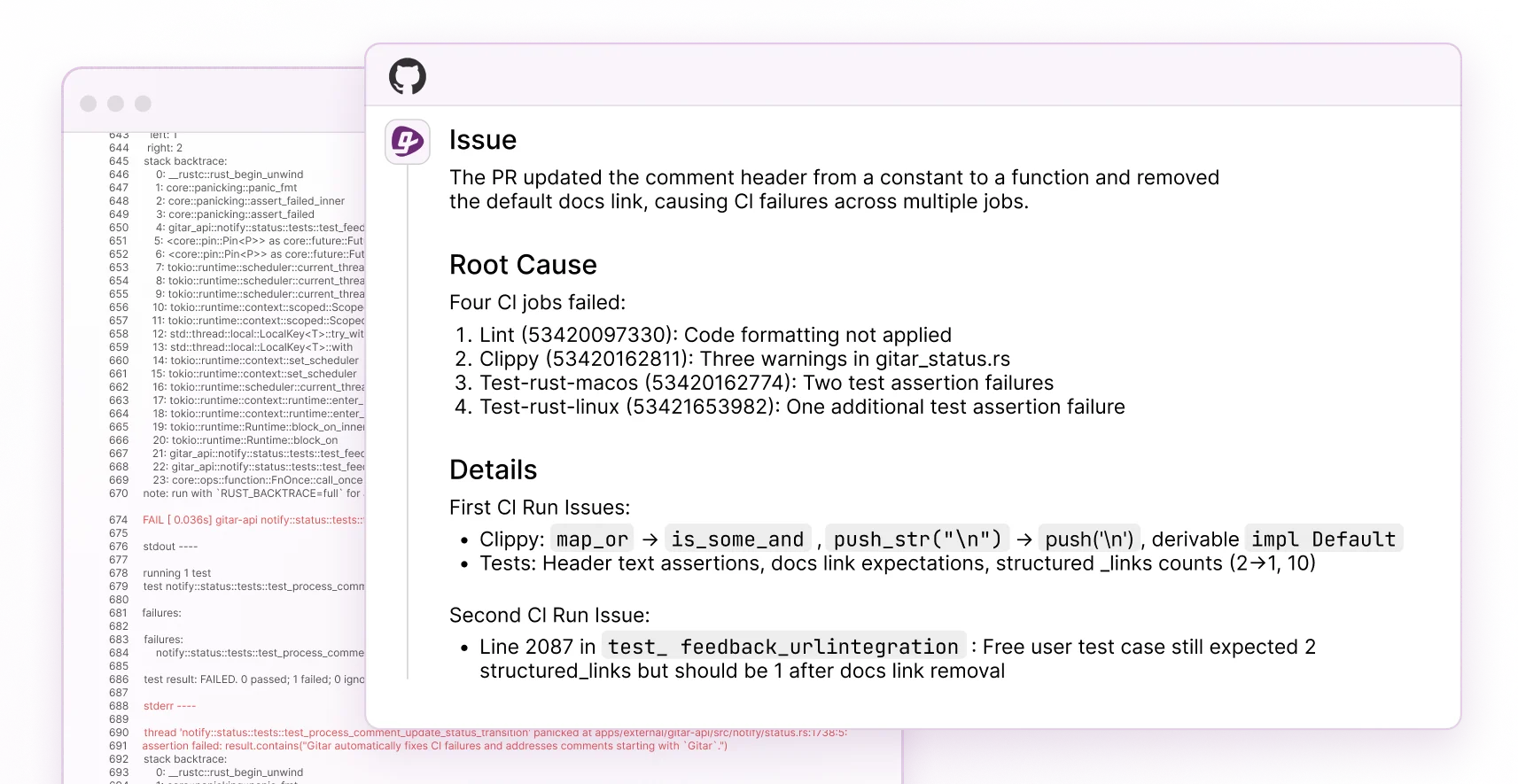
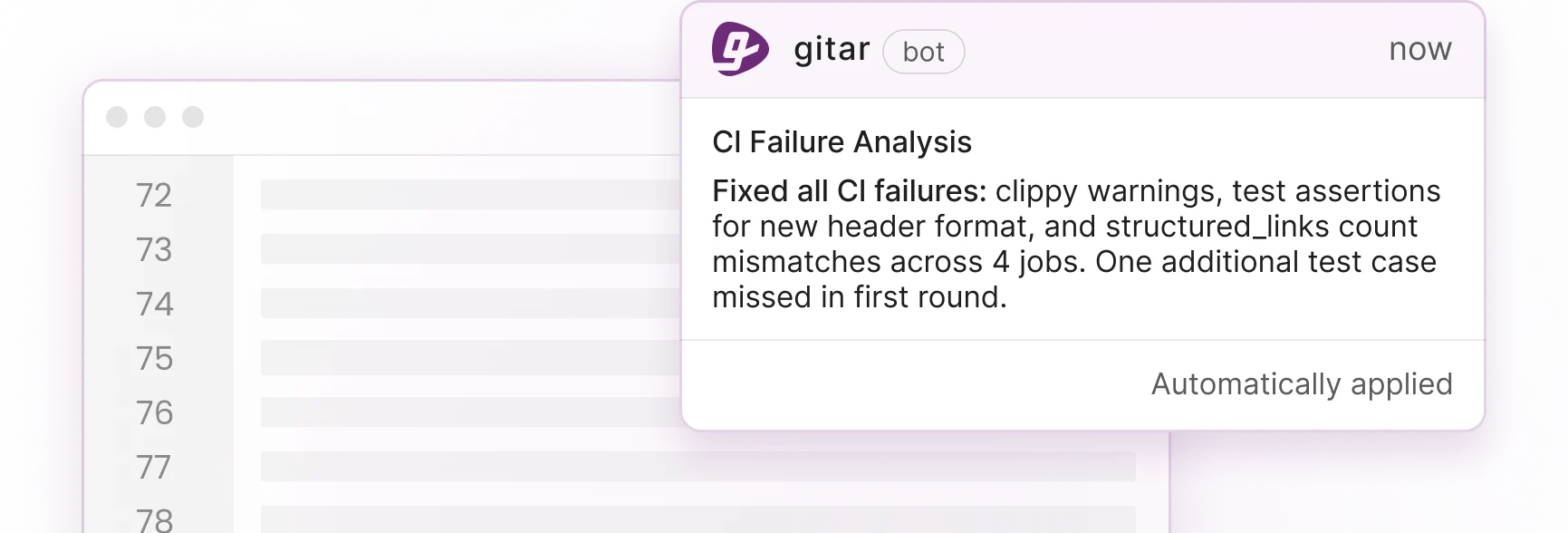
Gitar’s healing engine analyzes CI failures, generates contextually accurate fixes, and validates them against the actual build environment. Unlike suggestion-only tools such as CodeRabbit or Greptile, Gitar commits working fixes directly to PRs.
The Tigris engineering team reported that Gitar’s PR summaries are “more concise than Greptile/Bugbot.” They highlighted the single-comment approach, which reduces notification noise while still providing a complete analysis.
Common CI Automation ROI Mistakes to Avoid
Teams often miscalculate CI automation ROI in predictable ways.
Underestimating Manual Costs: Include hidden time such as context switching, queue waiting, and rework cycles. Organizations report 40% faster deployment cycles with proper automation.
Ignoring PR Volume Increases: AI coding tools generate 91% more PRs that require review and CI validation. Include this growth when you set your baseline.
Overrelying on Suggestion Tools: Tools that only suggest fixes still need manual implementation and validation. True automation, such as Gitar’s auto-fix capability, delivers measurable time savings.
Missing Intangible Benefits: Developer satisfaction, lower burnout, and faster feature delivery often exceed direct cost savings but rarely appear in ROI calculations.
FAQ
What is the average ROI for CI automation tools?
Industry benchmarks show strong ROI for automation. Comprehensive CI auto-fix platforms like Gitar deliver higher returns by removing manual implementation work through validated automatic fixes instead of simple suggestions.
How does Gitar calculate actual savings during the trial?
Gitar provides detailed analytics for CI failure categorization and pattern detection. The platform helps you measure how automated fixes affect sprint velocity during the 14-day Team Plan trial.
Can I use Excel to track CI automation ROI?
You can use Excel to track CI automation ROI. Create a spreadsheet that includes team size, hourly rates, daily CI time, and automation costs. Then apply formulas to calculate annual savings and ROI percentages. Update the sheet monthly with actual metrics from your CI automation tool to compare projected and real returns.
What MTTR reduction should I expect from CI automation?
Automated CI fixes usually reduce daily developer time spent on CI and review issues from 60 minutes to about 15 minutes. The exact reduction depends on your CI complexity and how often failures occur.
Conclusion: Turn CI Toil Into Measurable ROI
CI pipeline automation delivers large productivity gains through automated fixes. Manual CI issues can cost mid-sized teams $1,000,000 each year, and AI-driven PR volumes have increased by 91%. Automation has become essential for maintaining competitive engineering velocity.
Gitar’s platform goes beyond suggestion-only tools by fixing CI failures, validating solutions, and helping teams reach green builds consistently. The 14-day free trial gives you a risk-free way to measure real ROI before you commit budget.