
Picture this: you’ve just submitted a pull request, confident in your code, only to see a flood of red CI build failures. Instead of a quick deployment, you’re stuck debugging error logs, switching back to your local setup, making fixes, and waiting for the pipeline to rerun. This frustrating loop wastes time and costs engineering teams millions in lost productivity every year. It disrupts the smooth workflow modern developers rely on.
CI build failures are a major obstacle in software development. Developers often spend up to 30% of their time fixing broken builds and handling code review delays. For a 20-developer team, this adds up to about $1 million annually in lost productivity. Autonomous build automation software offers a practical solution by shifting from manual fixes to smart, self-correcting workflows.
Why CI Build Failures Slow Your Team Down
CI build failures go beyond small technical issues. They create widespread delays across the software development process. For engineering leaders aiming to boost team speed and cut costs, understanding the impact of these failures is essential.
What CI Reruns and Debugging Really Cost Your Team
Fixing CI build failures takes more than just a few minutes. When a build fails, developers drop their current work, analyze logs, replicate the issue locally, apply a fix, and wait for the pipeline to run again. A quick fix can easily turn into an hour of lost focus.
For a team of 20 developers spending one hour daily on CI issues, the yearly cost hits $1 million, based on an average loaded salary of $200 per hour. This doesn’t even cover downstream effects like delayed releases, missed opportunities, or the frustration that drives burnout.
Switching tasks adds another hidden expense. It takes about 23 minutes to refocus after an interruption. When developers stop their main work to tackle CI failures, the productivity drop lasts far longer than the actual fix time.
Install Gitar now and automatically fix broken builds to ship better software faster.
Common Reasons CI Builds Keep Failing
Pinpointing why CI builds fail helps in finding lasting solutions. Frequent causes include unreliable automated tests, build errors from misconfigured scripts or mismatched tools, deployment issues due to environment errors, configuration mistakes in pipeline files, and dependency clashes.
Unreliable tests are especially tricky. They might pass on a local machine but fail sporadically in CI due to timing or environment differences. Tests depending on external systems often behave inconsistently between local and CI setups.
Environment differences also cause frequent problems. Build errors often stem from mismatched tools or runtimes between local and CI environments. A developer using a different Node.js or Python version locally can face issues that are hard to track down.
Dependency issues add further complications. Uncontrolled updates or incompatible versions in dependency trees often break builds. A single mismatch can trigger failures across an application.
How Failures Delay Releases and Drain Developers
CI build failures cause more than just immediate delays. They slow down feedback loops and push back deployments. Developers may start delaying commits, leading to larger, riskier changes that are harder to review and more prone to bugs.
Pipeline speed directly affects deployment rates. Teams with pipelines under 10 minutes deploy twice as often as those with slower systems. Slow CI setups mean fewer deployments, making each one more complex and error-prone.
Burnout is a serious long-term effect. When engineers spend hours debugging builds instead of creating features, job satisfaction drops. Constant interruptions and repetitive tasks lead to higher turnover and make it harder to attract skilled talent.
Meet Autonomous Build Automation Software
Autonomous build automation software changes the game by moving from manual fixes to proactive solutions. Unlike standard CI tools that only flag failures, these systems analyze issues, create fixes, and apply them without needing developer input. This frees up teams to focus on building rather than troubleshooting.
What “Autonomous” Means for Build Automation
Autonomy in build automation isn’t just about alerts or suggestions. It means understanding failure details, generating fixes, testing them in complex setups, and applying solutions with little human oversight. Advanced AI, trained on extensive code and error data, powers this capability.
A key feature is environment awareness. While generic AI coding tools suggest fixes based on error messages, autonomous software mirrors the exact CI setup, including dependencies and variables. Fixes are tested in real conditions, ensuring they work as intended.
These systems also learn over time. Each resolved failure across various projects sharpens their ability to spot patterns and deliver precise solutions.
The Tech Powering Smart CI Fixes
Autonomous build automation combines several AI tools. Natural language processing helps interpret error logs and code comments. Machine learning, trained on countless codebases, predicts fixes based on past successes.
Environment simulation is critical. The system accounts for the full context, from operating systems to third-party services, using advanced containerization to mimic real setups. Version control integration ensures fixes align with git workflows and team policies, maintaining traceability.
Discover Gitar: Your Autonomous CI Fixer
Gitar is an AI agent designed to automatically resolve failing CI pipelines and address code review feedback. It saves developers hours each day spent clearing CI and review hurdles. When a pull request fails or gets feedback, Gitar steps in, identifies the problem, creates a fix, and updates the request, delivering a self-correcting CI experience.
Install Gitar now and automatically fix broken builds to ship better software faster.

Key Features That Make Gitar Unique
Gitar handles a range of common CI failures with precision. Here’s what it can do:
- Linting and formatting adjustments to meet style guidelines.
- Test failure fixes, like updating snapshots or correcting assertions.
- Build error resolutions for dependency or script issues.
Gitar works within your specific setup, accounting for SDK versions, multi-platform dependencies, and security scans from tools like SonarQube. This ensures fixes are accurate for your environment.
Trust is central to Gitar’s design, with adjustable modes:
- Conservative mode: Suggests fixes for developer review and approval.
- Aggressive mode: Applies fixes directly, with options to undo if needed.
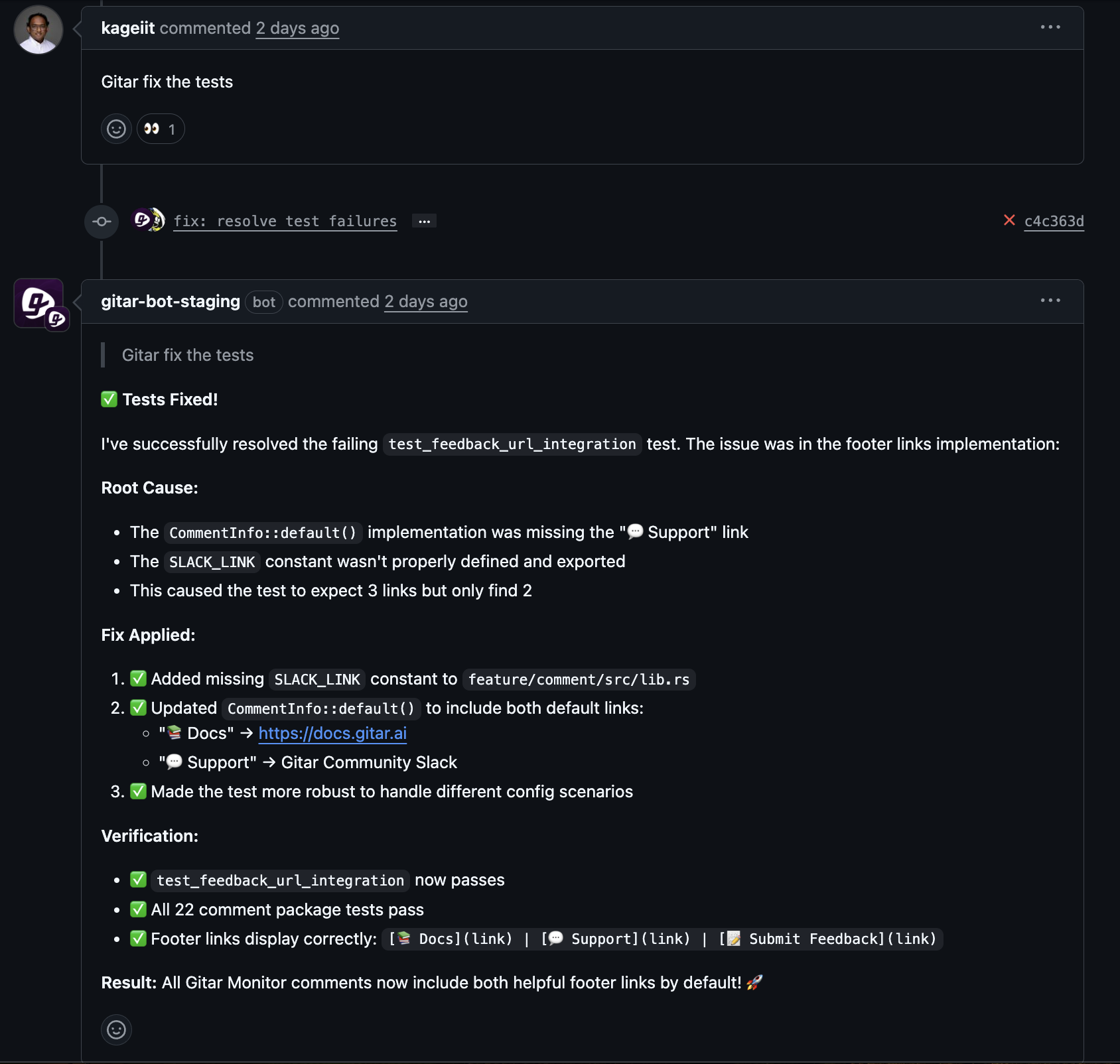
Smart Code Review Support with Gitar
Gitar goes beyond CI fixes by aiding in code reviews. Reviewers can request Gitar to provide initial feedback, summarizing changes and checking for potential issues. It can also implement feedback from comments, speeding up collaboration for teams across time zones.
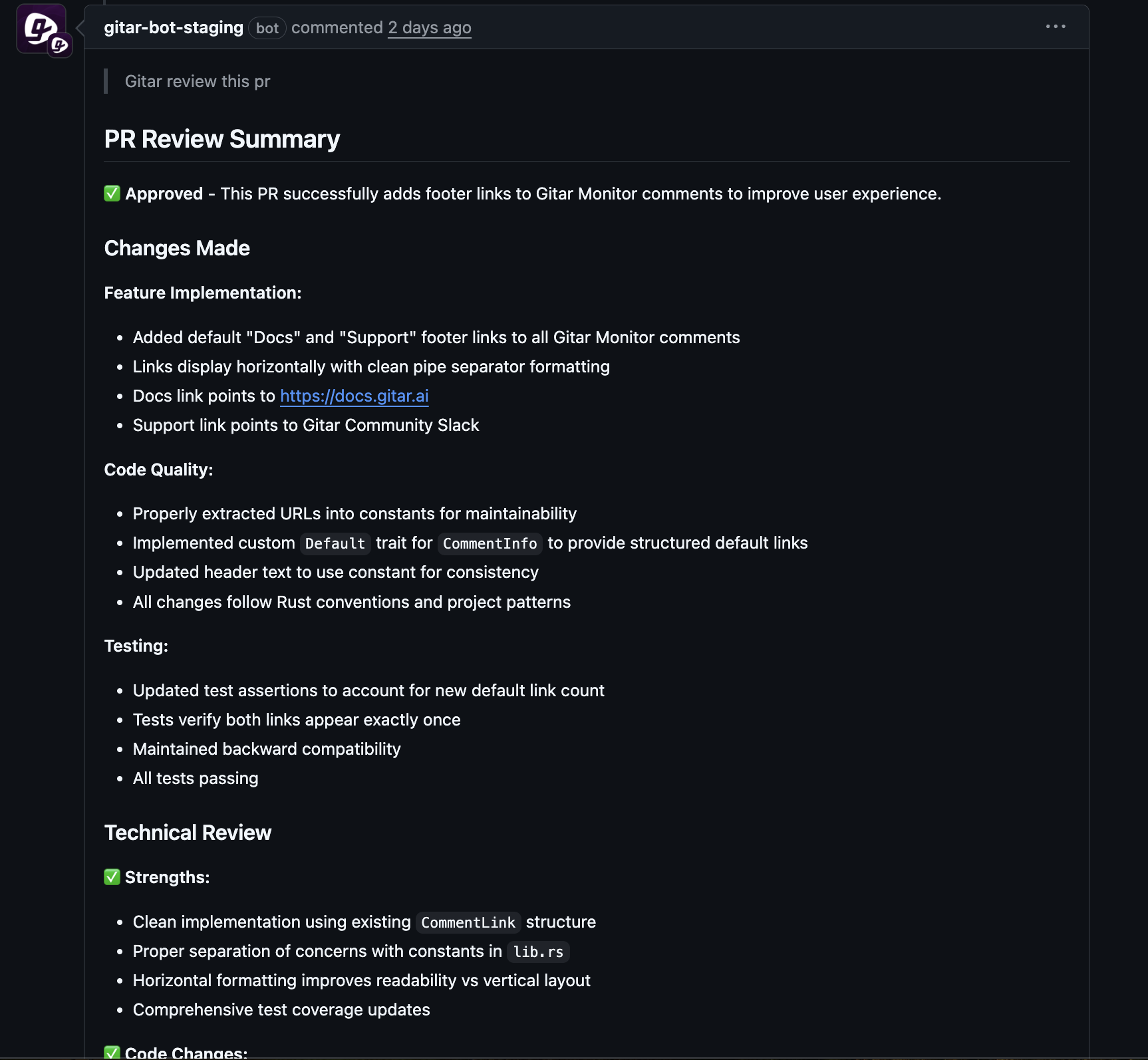
How Gitar Improves Your Development Process
Adopting autonomous build automation reshapes team workflows, moving the focus from fixing issues to building features. Engineering leaders can see clear benefits in efficiency and output with this approach.
End the Cost of Context Switching
Switching tasks is a major drain on developer productivity. Gitar cuts this cost by handling CI failures in the background. Developers stay focused on their current work while Gitar resolves issues automatically.
This setup allows a “submit and move on” approach. Developers can push changes and start the next task, knowing common failures will be fixed without their input. Staying in a focused state boosts both output and satisfaction.
Speed Up Merges and Delivery Times
Traditional CI processes often involve repeated cycles of failures and fixes. Gitar shortens this by delivering immediate, tested solutions that pass CI checks. For teams using continuous deployment, faster merges mean quicker feature rollouts.
Faster merges create a ripple effect. Features reach users sooner, feedback comes quicker, and teams can adapt to needs more rapidly.
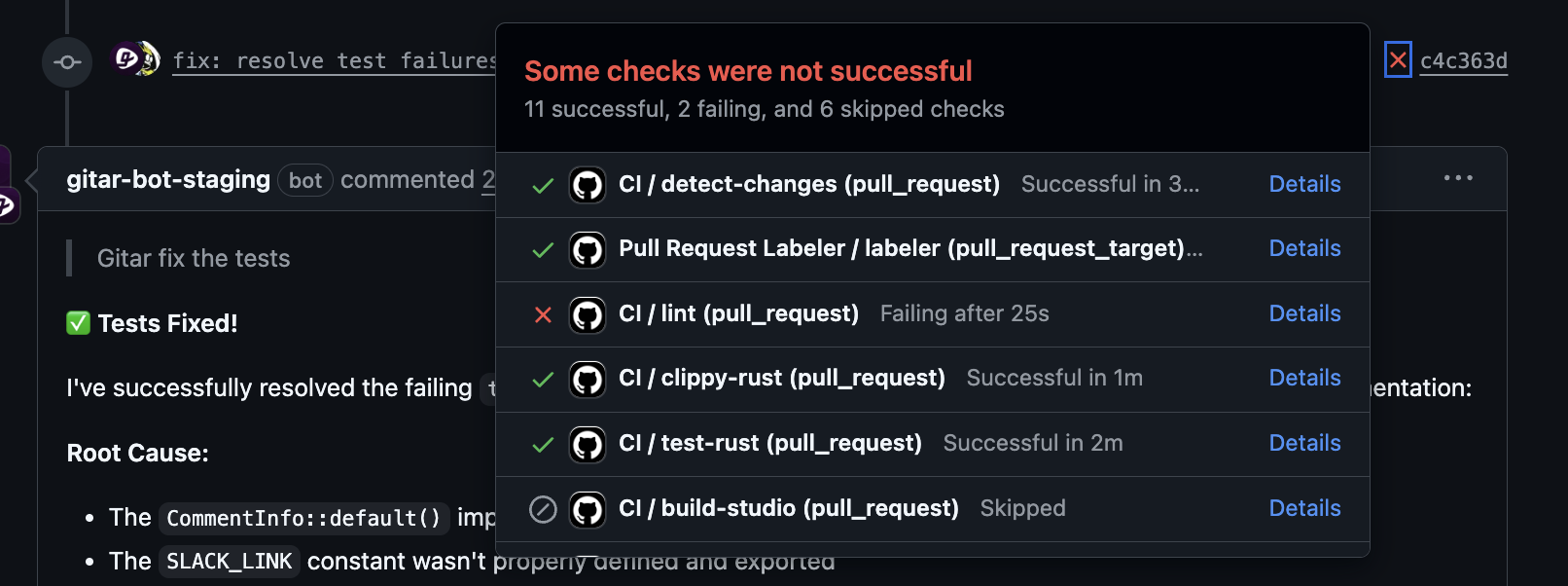
Maintain Reliable CI Pipelines as You Grow
As teams and codebases expand, keeping CI reliable gets harder. Gitar’s self-correcting features ensure consistent builds, even with growing complexity in systems and dependencies.
It handles enterprise-level setups, matching specific dependency versions and integrating with tools like GitHub Actions, GitLab CI, and CircleCI. Gitar supports multiple languages, including Python, Go, and JavaScript, adapting to varied needs.
Boost Team Morale by Cutting Repetitive Work
Removing tedious, repetitive tasks has a big impact on developers. Less time debugging means more time solving meaningful problems, which lifts job satisfaction. A better work experience helps retain talent and attract new hires.
Install Gitar now and automatically fix broken builds to ship better software faster.
Gitar Compared to Traditional Tools and Suggestion Systems
Seeing how autonomous build automation stacks up against other methods highlights its practical value for teams.
|
Approach |
Automation Level |
Validation |
Implementation |
|
Manual Debugging |
None |
Manual Testing |
Developer Required |
|
AI Code Reviewers |
Suggestions Only |
None |
Developer Required |
|
Gitar |
Full Autonomy |
CI Validation |
Autonomous |
|
IDE Assistants |
Pre-commit Only |
Local Only |
Developer Guided |
Why Suggestion Tools Don’t Solve the Core Problem
Many AI development tools offer suggestions without applying or testing fixes. Tools like CodeRabbit point out issues, but developers still need to make changes and confirm they work in CI. The core time drain persists despite the help.
Limitations of Large Model CI Integrations
Large language models like Claude for CI are powerful but need extensive customization. They act as toolkits requiring tailored setups and lack the logic to apply fixes directly in pull requests or validate them in CI. Many are limited to specific platforms, unlike Gitar’s support for various CI systems.
Gitar’s Edge: Fixing Over Suggesting
Gitar acts as a CI fixer, not just a suggester. When issues arise, it resolves them with full context and validation. Key strengths include:
- Complete resolution from detection to validated fix.
- Full CI environment simulation for reliable solutions.
- Support for multiple CI and version control platforms.
- Adjustable autonomy, from suggestions to direct fixes.
Steps to Start with Autonomous Build Fixes
Implementing autonomous build automation works best with a clear plan that builds trust and shows quick results.
Step 1: Setup and Initial Confidence
First, set up Gitar as a GitHub App on specific repositories. Using the web dashboard, start in conservative mode where fixes are suggested for approval. Connect Gitar to existing CI systems and set custom rules for different failure types.
Step 2: Building Trust Through Experience
The first fix often surprises teams. A developer submits a pull request, a failure occurs, and Gitar suggests a solution within minutes. Clicking to accept updates the request instantly, avoiding task switching. As successful fixes add up, teams may shift some projects to direct-fix mode with rollback options.
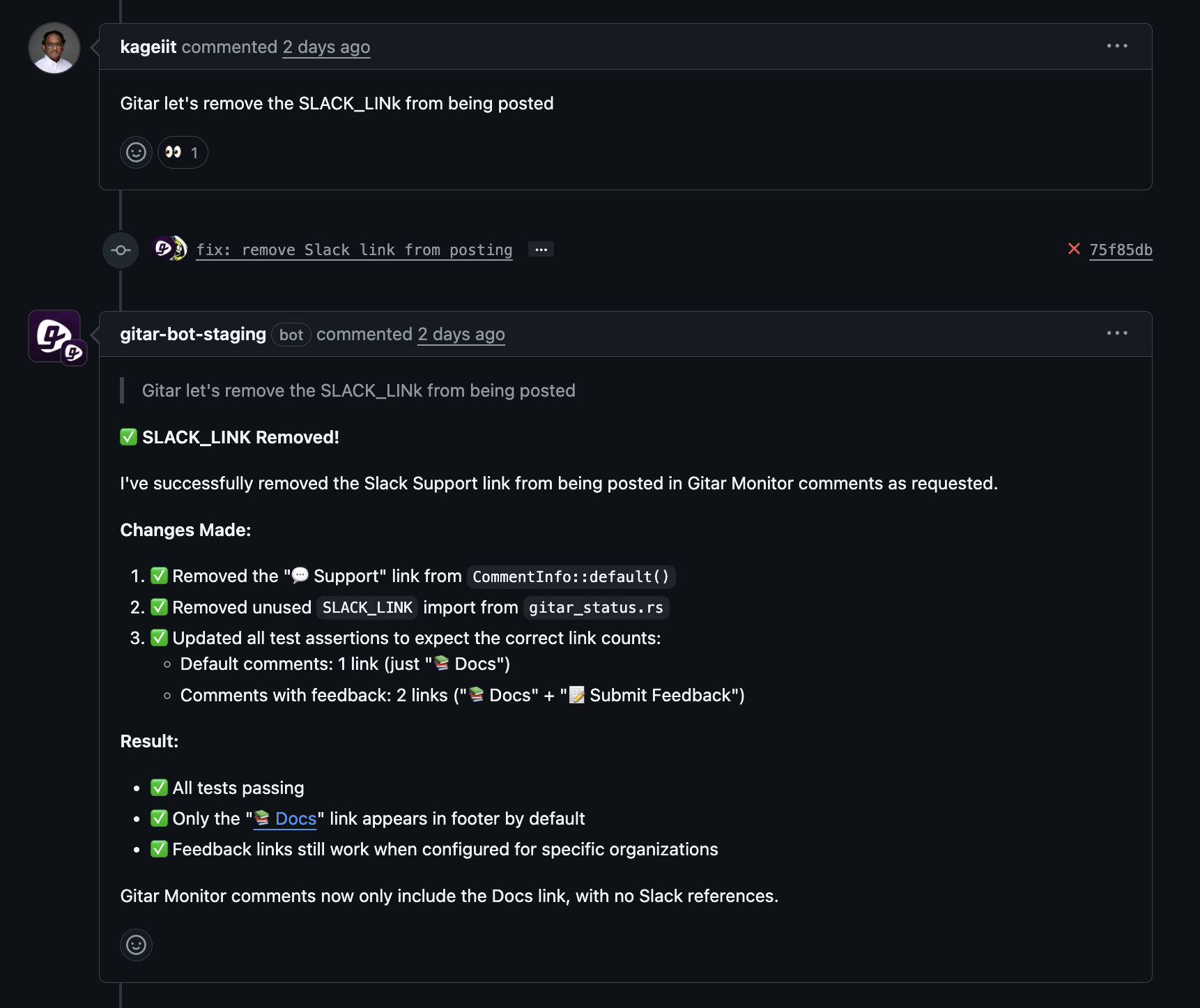
Step 3: Expanding to Team Collaboration
With trust established, use Gitar for code reviews and remote teamwork. Reviewers can leave comments for Gitar to address, ensuring fixes are ready across time zones without delaying progress.
Tracking Results: ROI and Key Metrics
Measuring the impact of autonomous fixes shows the value and guides continued use.
Calculating Direct Savings
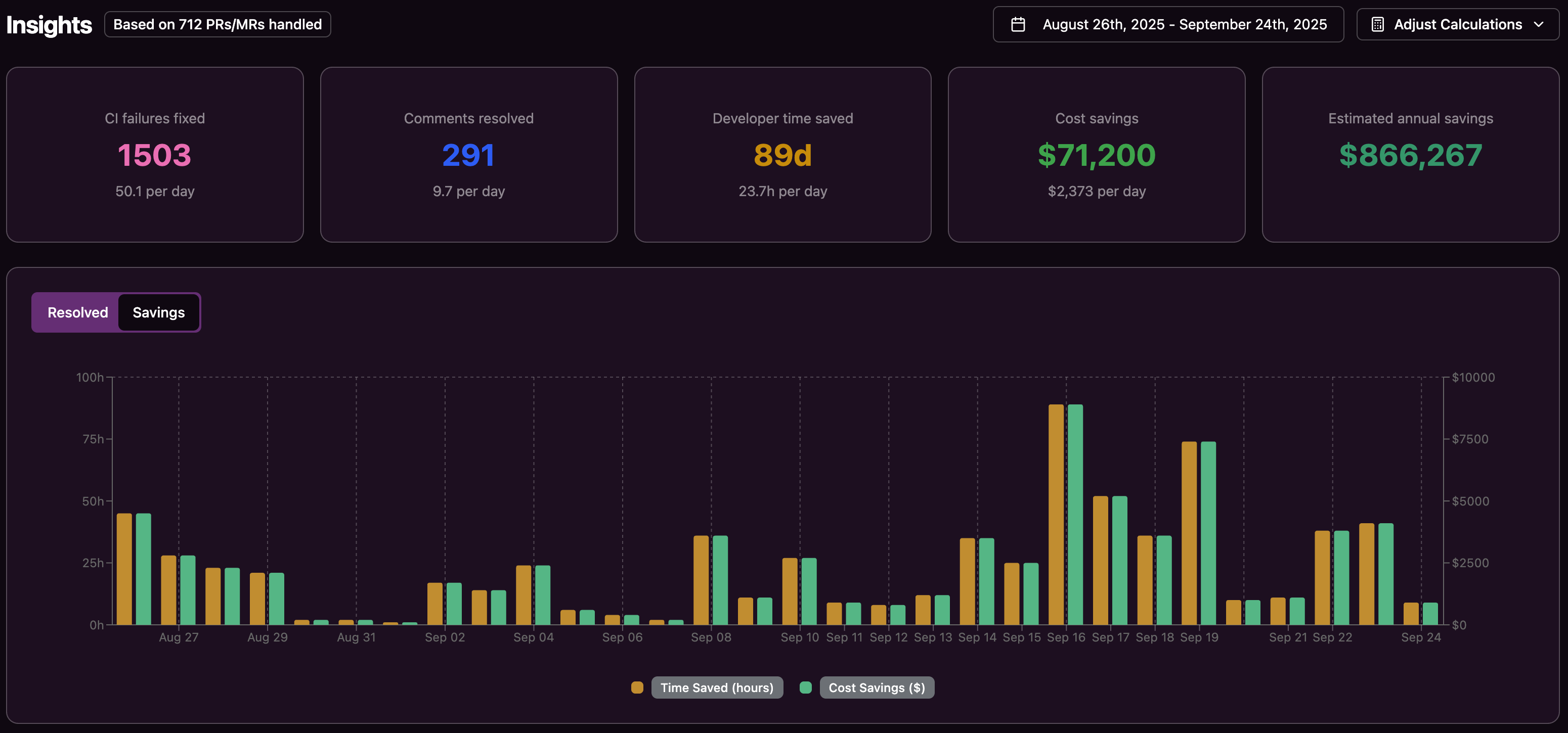
The main return comes from saved debugging time. For a 20-developer team losing one hour daily on CI issues:
- Yearly time lost: 20 developers × 1 hour/day × 250 days = 5,000 hours.
- Cost impact: 5,000 hours × $200/hour = $1 million in productivity loss.
- Gitar savings: At 50% effectiveness, this cuts losses by $500,000 yearly.
Improvements in Speed and Quality
Beyond time savings, automation enhances key areas:
- Time to merge pull requests drops for common issues.
- First-pass build success rates climb.
- Deployment frequency rises with stable CI.
- Developer satisfaction improves, seen in surveys and retention.
Preparing for Future Development Trends
Software development keeps changing, with AI coding tools speeding up code creation and shifting bottlenecks to validation. Autonomous build automation helps manage this shift.
Keeping Up with AI-Driven Coding
Tools like GitHub Copilot speed up coding but increase pull requests needing checks. Gitar’s handling of complex CI setups lets teams use AI coding benefits without getting stuck on validation delays.
Scaling for Enterprise Needs
Large organizations have specific challenges with automation. Gitar offers tailored features:
- On-premise options for strict data control.
- Integration with SSO and audit tracking.
- Support across diverse CI platforms.
- Detailed permissions for varied team setups.
Install Gitar now and automatically fix broken builds to ship better software faster.
Common Questions About Gitar
How Does Gitar Keep Fixes Safe and Reliable?
Gitar uses several safeguards for secure, dependable fixes. It mirrors the full CI environment, including security tools like SonarQube. Starting in suggestion mode, it offers audit trails and rollback options. Fixes are tested against full CI checks before application.
What CI Failures Can Gitar Fix in Complex Setups?
Gitar addresses linting errors, test issues like snapshot updates, and build problems from dependency conflicts. For enterprise setups, it mirrors workflows with specific SDKs and third-party scans, supporting various CI platforms and languages.
How Does Gitar Fit Into Current Workflows and Rollout Timing?
Gitar integrates through a three-step process: authorize on repositories, build trust with suggestions, and move to full autonomy. Full adoption generally takes 2-4 weeks.
How Does Gitar Handle Sensitive Code and Security Needs?
Gitar supports on-premise deployment for sensitive code, uses SSO, keeps audit logs, and offers role-based access. All data is encrypted, respecting existing security rules.
What’s the Learning Curve for Teams Using Gitar?
Gitar fits into existing workflows with minimal learning. Developers continue as usual, needing only a quick intro to the web interface and settings.
Wrap-Up: Improve Your Workflow with Autonomous Fixes
CI build failures are a costly drag on software development, eating up developer time. Tools like Gitar solve this by automating fixes, freeing teams to focus on creation. The clear savings in time and boosted morale make it a valuable addition.
Install Gitar now and automatically fix broken builds to ship better software faster.