
Key Takeaways
- Manual CI/CD troubleshooting and code review delays reduce developer velocity by creating rework, context switching, and long wait times.
- Self-healing CI uses intelligent automation to detect failures, identify root causes, apply fixes, and validate changes without extra manual steps.
- Gitar acts as an autonomous AI agent that replicates full CI environments, applies targeted fixes, and supports configurable trust levels for teams.
- Engineering leaders can justify automation by tracking time-to-merge, CI failure rates, and the cost of developer time spent on repetitive pipeline work.
- Teams that want to reduce CI toil and code review delays can install Gitar to start turning failing builds and review feedback into automated, validated fixes.
The Developer Velocity Bottleneck: Why Manual CI/CD Approaches Fall Short
The High Cost of the CI/CD Gauntlet
Many engineers push a PR with confidence, then watch CI turn red on a missing dependency, flaky test, or lint error. They read logs, switch back to a local environment, make a small fix, push again, and wait for the pipeline to run. A change that should take minutes often expands into an hour of lost flow and delayed feedback.
The Context Switching Tax
The ideal flow where a PR runs cleanly and merges quickly rarely matches reality. Developers open a new task, then get pulled back by CI failures or review comments on previous work. Each interruption breaks concentration, and even a 30-minute CI fix can consume an hour of productive time once mental context switching is included.
Code Reviews on Distributed Teams
Distributed teams feel this even more. A developer in one region may wait many hours for a review from a teammate in another. Simple questions or requested edits that could be completed within one work session spread across several days. Basic AI review tools often add more suggestions, but still require humans to implement and validate every change.
The Right-Shift Bottleneck
Tools like GitHub Copilot and Cursor accelerate code creation, which increases the volume of PRs and tests. The main constraint shifts from writing code to validating, fixing, and merging it. Review capacity and CI reliability now often define throughput.
Why Automation Matters
Pipeline failures and manual review loops now represent a major share of engineering time. Teams can lose a meaningful portion of work hours to CI issues and feedback changes, which slows delivery and raises project costs across many organizations. Automation that handles more of this work directly improves both developer experience and business outcomes.
What Intelligent Automation for Developer Velocity Looks Like
Intelligent automation moves CI/CD from a reactive system into one that can understand context and act on it. Traditional scripts follow fixed rules. Modern AI systems interpret logs, source code, and environment details, then propose or apply targeted fixes.
Self-healing CI focuses on continuous detection and repair rather than only reporting failures. Systems ingest real-time events, understand how services and tools connect, and apply corrections without waiting for manual intervention. CI then operates more as a quiet background process than a constant source of manual debugging.
Effective autonomous CI usually includes wave-based execution across stages, accurate replication of the full build environment, and adaptive learning that improves outcomes over time. Teams can add these capabilities to existing pipelines by installing Gitar.
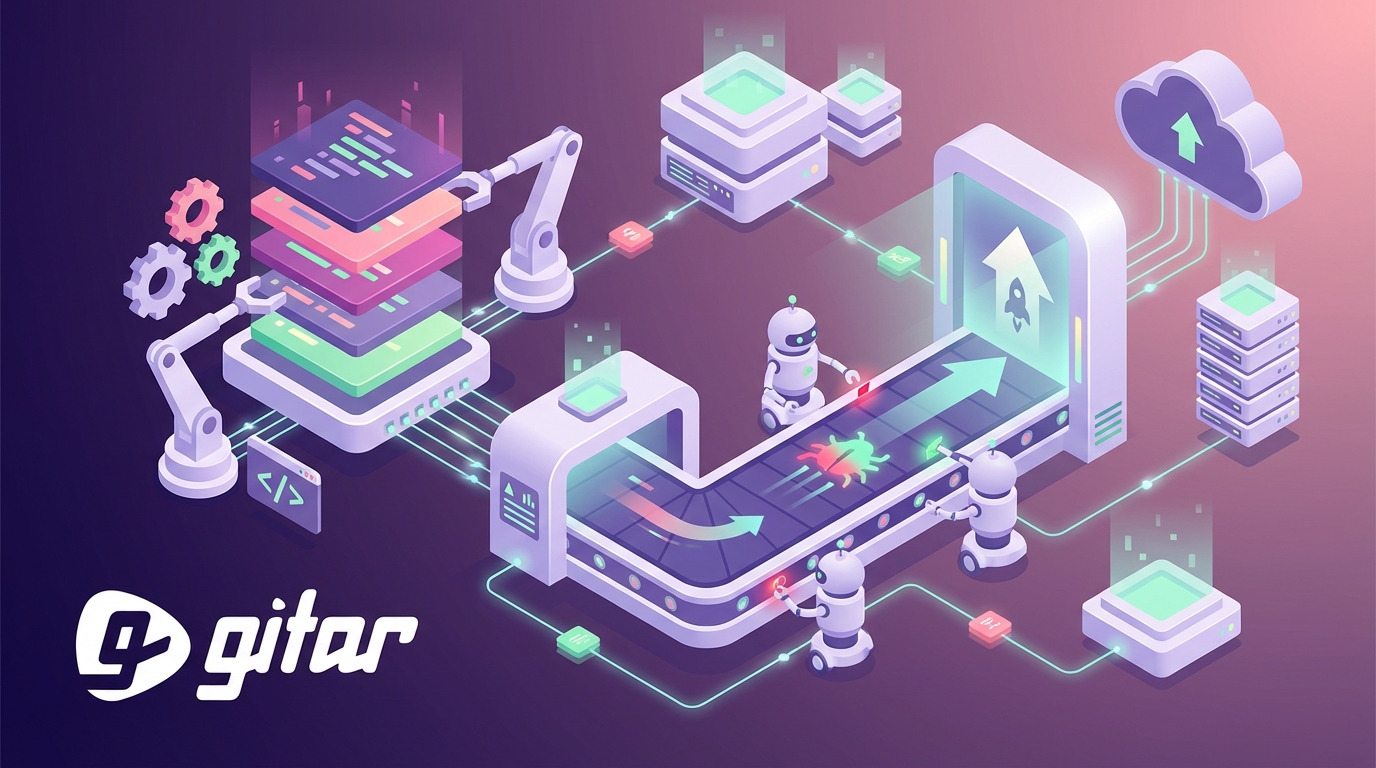
Gitar embodies this approach as an autonomous AI agent that not only identifies problems, but also proposes, applies, and validates fixes inside real CI environments.
How Gitar Helps Teams Increase Developer Velocity
End-to-End Fixing Instead of Suggestions
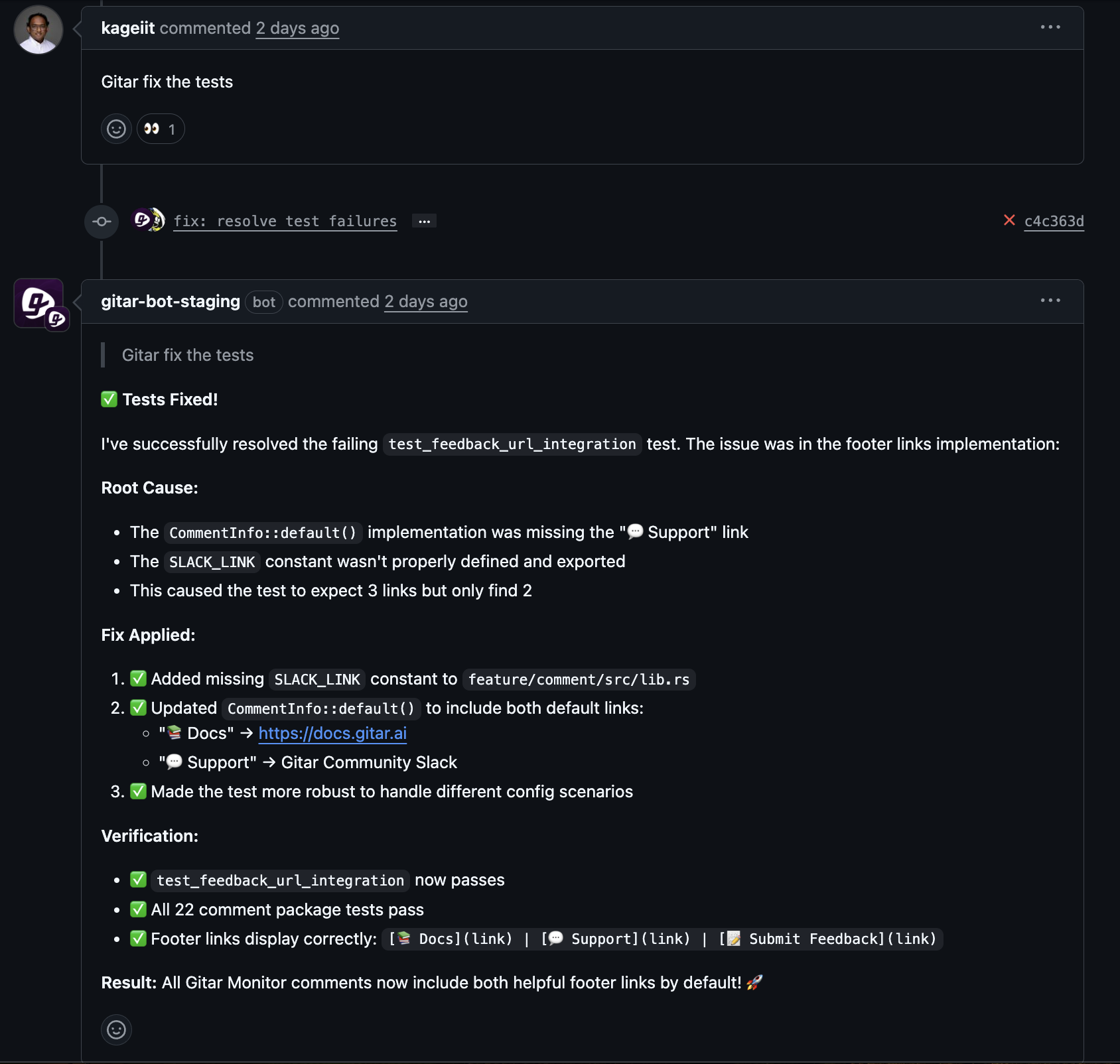
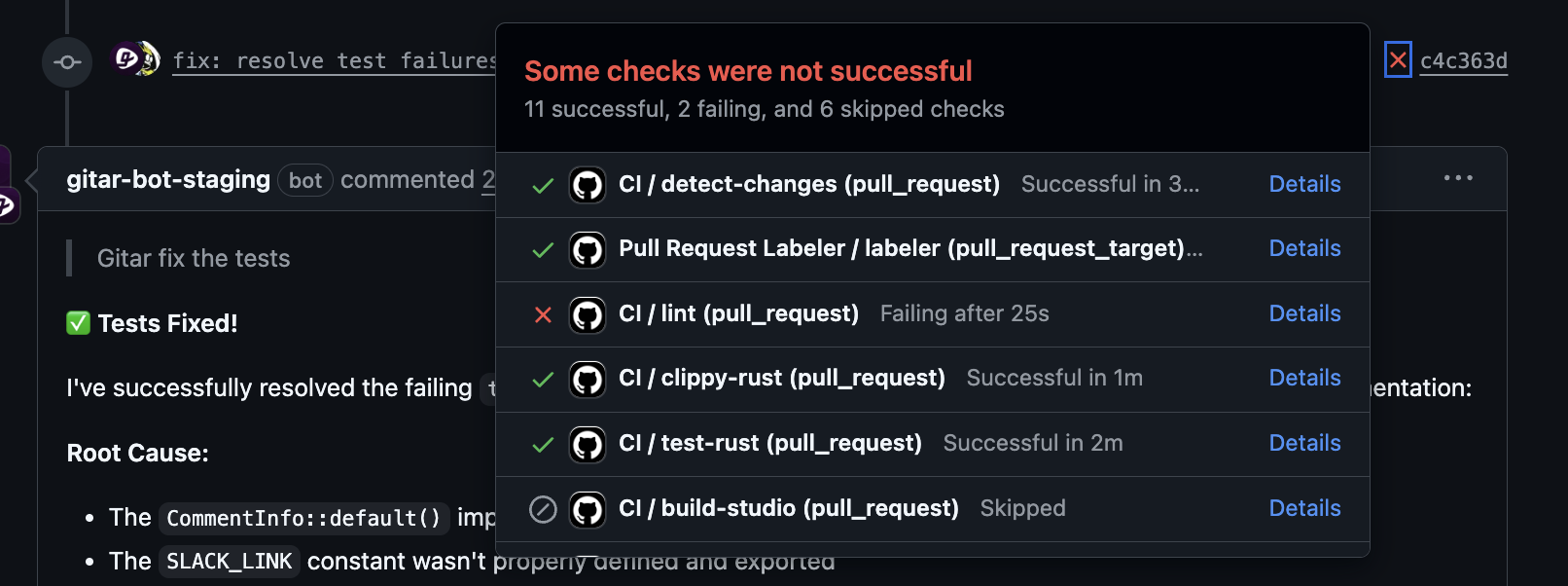
Most tools stop at suggestions and leave developers to implement and validate changes. Gitar operates as a healing engine. When a check, such as npm run lint, pytest, or a build step fails, Gitar reviews logs, identifies the cause, proposes a code change, applies it, and commits the fix to the PR branch. Typical issues include lint violations, test failures, and dependency or configuration problems.
Full Environment Replication for Complex CI
Enterprise CI often spans multiple SDKs, language versions, and third-party tools. Gitar emulates these workflows, including specific JDK versions, multi-SDK builds, security and quality scans such as SonarQube and Snyk, and snapshot tests. Fixes are validated in the same environment that runs production pipelines, which reduces the risk of environment-specific failures.
Configurable Trust Model for Gradual Adoption
Many teams want automation but prefer clear control over how it acts. Gitar uses configurable modes that let teams decide how autonomously it operates. In Conservative Mode, Gitar posts fixes as suggestions that developers can review and accept with a click. Teams that gain confidence in the results can move to more aggressive settings where Gitar commits directly, with rollback options in place.
Intelligent Code Review Assistance
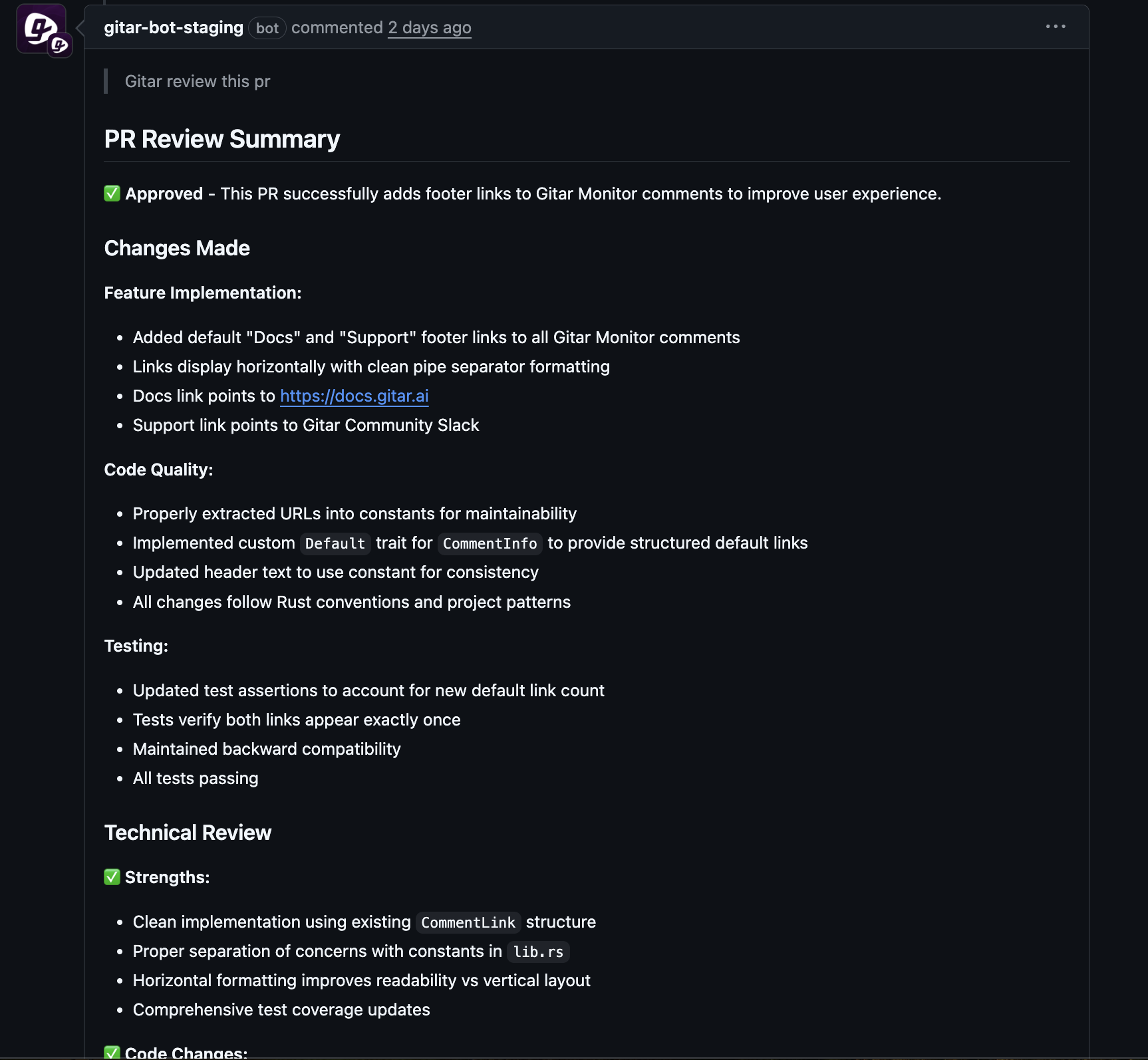
Gitar also supports human reviewers. Reviewers can tag Gitar for a first pass on a PR, then ask it to implement specific requested changes through comments. For instance, a reviewer can request removal of a feature from the current PR, and Gitar updates the code and pushes a commit with a clear explanation.
Cross-Platform Support in Existing Toolchains
Gitar works with major CI platforms such as GitHub Actions, GitLab CI, CircleCI, and BuildKite. Teams can keep existing pipelines and repositories, then add Gitar as an overlay that reacts to failures and review comments.
Strategic Considerations When Adopting Automation
Build vs. Buy for CI Automation
General-purpose language models provide building blocks rather than a full CI solution. Teams that assemble their own system must handle custom integrations, prompt and context design, concurrency across users and pipelines, out-of-order events, and multi-stage workflows. Dedicated products like Gitar package these capabilities so teams focus on configuration and adoption instead of infrastructure.
Measuring ROI and Success
A 20-developer team that spends one hour per person per workday on CI and review issues can lose around 5,000 hours per year. With a loaded cost of $200 per hour, this equals about $1 million in lost productivity. Even partial automation can recover a large share of that time while improving time-to-merge and developer satisfaction.
Managing Organizational Change
Teams improve time management when they first understand how they spend their time. The same idea applies to CI automation. Teams that measure where hours go, introduce Gitar in conservative modes, and expand usage based on observed results usually see smoother adoption and higher trust.
Comparing Intelligent Automation Options
Gitar vs. Manual Fixing
Manual fixing requires developers to pause current work, study logs, modify code, and push new commits for every failure. This pattern consumes attention and calendar time. Gitar automates detection, diagnosis, and remediation, so engineers see more green builds without repeated manual effort.
Gitar vs. AI Code Reviewers
AI code reviewers focus on analysis and comments related to style, structure, and potential bugs. These insights help, but developers still apply and validate changes themselves. Gitar assumes responsibility for both the change and the validation step in CI.
Gitar vs. Big-Model Integrations and IDE Assistants
Big-model integrations inside pipelines often require custom scripting to trigger runs, gather context, and apply fixes. IDE assistants such as GitHub Copilot help during coding on local machines but do not usually manage post-commit CI failures. Gitar operates directly in hosted repositories and CI, taking action based on actual pipeline results.
Real-World Impact: The First Self-Healing CI Moment
Many engineers describe a clear shift the first time Gitar fixes a CI failure on its own. A lint or test error triggers, Gitar pushes a new commit with a concise explanation, and the build turns green before the author returns to the PR. Teams can experience this self-healing workflow by installing Gitar.
Frequently Asked Questions About Increasing Developer Velocity with Automation
How does Gitar build trust for autonomous fixes?
Gitar uses configurable aggression modes so teams can control how it acts. New users often start with suggestion-only behavior, then move toward direct commits once they see consistent, high-quality fixes. Rollback controls support safe experimentation.
Can Gitar handle complex CI environments?
Gitar replicates CI environments that include multiple SDKs, specific JDK versions, and third-party tools such as security scanners and snapshot test frameworks. This approach increases the chance that a fix passing in Gitar’s environment will also pass in the real pipeline.
How is Gitar different from AI reviewers like CodeRabbit?
AI reviewers emphasize recommendations and comments. Gitar focuses on completing work by applying fixes, running checks, and returning green builds where possible. This difference reduces context switching and repetitive manual edits.
What ROI can engineering leaders expect?
Teams that spend substantial time on CI and review rework often see savings in both time and cost once Gitar is in place. Benefits include shorter merge times, fewer blocked engineers, and more time available for feature work and architecture improvements.
How does Gitar integrate with existing workflows?
Gitar connects to GitHub and GitLab repositories and works with major CI platforms. Setup usually involves authorizing Gitar as an application and configuring project-level rules. Teams keep existing branching strategies, build scripts, and review practices while adding automated fixes on top.
Conclusion: Use Self-Healing CI to Improve Developer Velocity in 2026
Manual CI debugging and reactive review cycles now limit many teams more than code creation itself. Intelligent automation shifts repetitive work, such as log reading, small fixes, and validation, from humans to systems that can run continuously. Time management techniques are often grouped into themes such as focus, prioritization, explicit time periods, task management, motivation, and time awareness. Gitar applies similar ideas to engineering by protecting focused work time and offloading routine CI edits.
Teams that adopt self-healing CI reduce interruptions, shorten time-to-merge, and help developers spend more hours on meaningful product work. Install Gitar to start turning failing builds and review feedback into automated, validated fixes.