
Written by: Ali-Reza Adl-Tabatabai, Founder and CEO, Gitar
Key Takeaways for Bitbucket Teams
- AI coding tools increase output by 25–35%, and automated code review clears the pull request backlog they create.
- Gitar leads with an auto-fix healing engine that applies validated fixes, while most competitors only suggest changes.
- Our testing shows Gitar and Rovo provide automated fixes, while Qodo, CodeAnt AI, Codacy, Snyk, and SonarQube focus on suggestions and analysis.
- Automation cuts review time by 70–80%, can save about $1M per year for a 20-developer team, and removes YAML-heavy workflows.
- Start your 14-day Gitar Team Plan trial for full auto-fix access with no seat limits.
Why Bitbucket Code Review Automation Is Critical in 2026
AI tools are flooding pull requests with changes that lack system-wide context. 66% of developers report frustration with “almost right” changes caused by missing system-wide context, and 45% of developer time is spent debugging integration issues caused by hidden service dependencies. Manual review processes simply cannot scale to handle this volume.
Automation delivers measurable gains for Bitbucket teams. You can expect a 70–80% reduction in manual review overhead, 91% faster review cycles, and potential savings of $1M annually for a 20-developer team. Bitbucket’s manual code reviews are painful due to a lack of sufficient built-in features for automation and scalability, so third-party automation tools become essential for competitive development velocity.
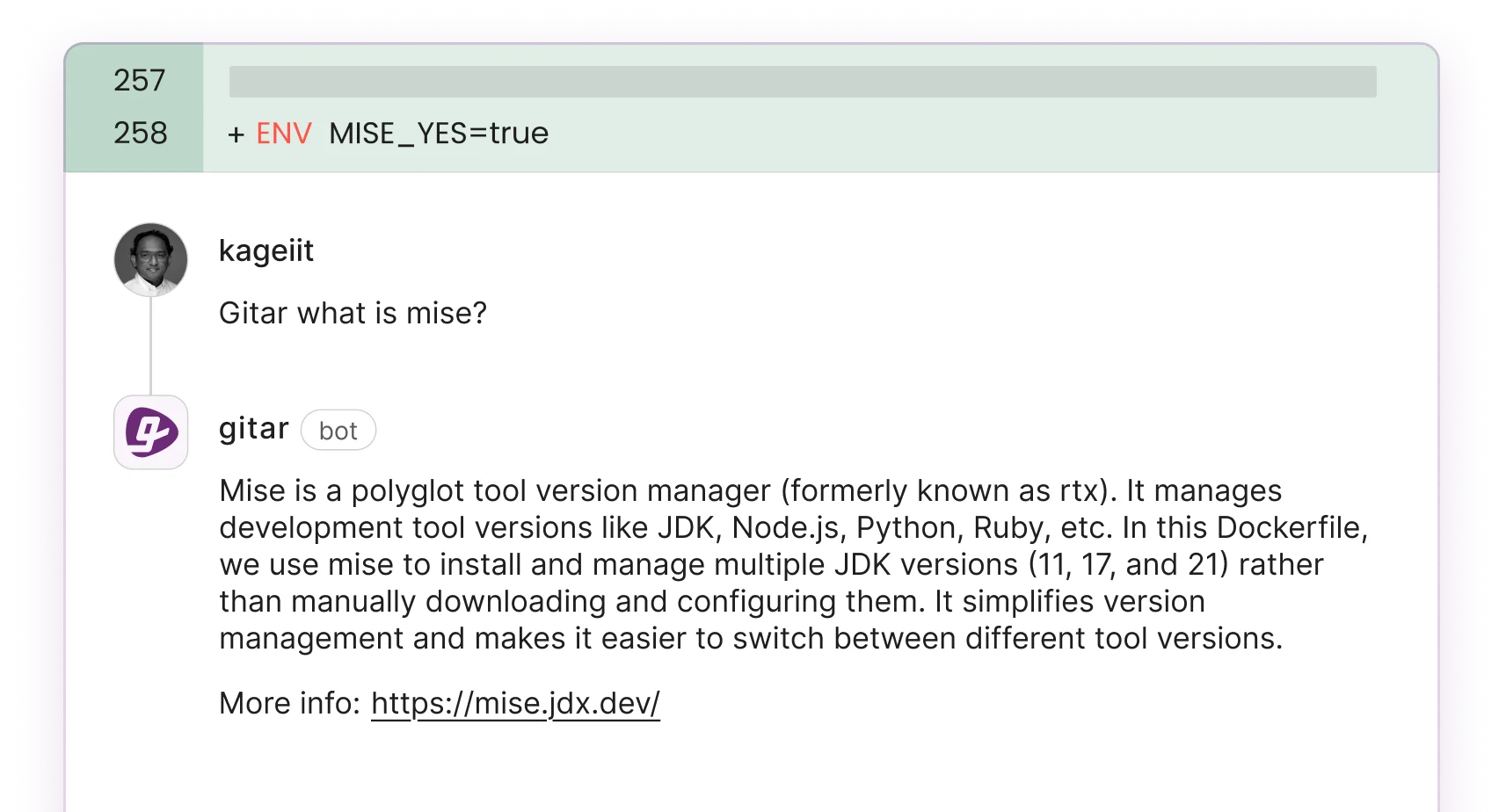
Given these stakes, we evaluated leading Bitbucket-focused tools to see which ones actually reduce manual work and which ones only add more comments to your pull requests.
7 Best Bitbucket Code Review Automation Tools Tested in 2026
1. Gitar – Gitar ranked first in our testing with a healing engine that auto-applies validated fixes for CI failures, test issues, and review feedback. Unlike suggestion-only tools, Gitar provides single-comment updates, Jira and Slack connectivity, and consistently delivers passing builds across GitHub, GitLab, CircleCI, and Buildkite. The 14-day Team Plan trial offers full access to auto-fix capabilities without seat limits.
2. Qodo – Qodo provides native integration with Bitbucket Pipelines, ingesting CI/CD pipeline failures, test outcomes, and policy checks directly into pull request reviews. It offers strong context awareness and Jira integration, but it remains limited to suggestions rather than automated fixes.
3. CodeAnt AI – CodeAnt AI offers native Bitbucket pull request integration with line-by-line AI suggestions, secret and vulnerability scanning, and custom rules. Pricing starts at $24 per user each month, with both cloud and on-premises options.
4. Atlassian Rovo – Atlassian’s Rovo Dev enables AI-powered workflows in Bitbucket Pipelines, including code generation from Jira issues and AI code review. It costs $20 per user each month and supports agentic CI/CD automation that can include build fixes.
5. Codacy – Codacy integrates with Bitbucket to provide AI-enhanced static code analysis and automated quality enforcement. Pricing starts from $18 per user each month, with CI/CD pipeline integration for consistent checks.
6. Snyk – Snyk integrates with Bitbucket Pipelines for automated dependency, container, and Infrastructure as Code scanning with security findings and fixes. Paid plans start at $25 per user each month and focus primarily on security posture.
7. SonarQube – SonarQube provides traditional static analysis with Bitbucket pull request decoration. The Cloud Team plan starts from $32 per month, and the self-hosted Developer edition starts from $160 per year. It lacks AI-powered insights and auto-fix capabilities, so it works best as a quality gate rather than an automation engine.
The table below compares the four most capable tools for automated remediation and native Bitbucket Pipelines support. It highlights where you can expect hands-off fixes versus suggestion-only workflows.
|
Tool |
Auto-Fix CI Failures |
Bitbucket Pipelines Native |
Pricing |
|
Gitar |
Yes (validated fixes) |
No |
14-day full trial |
|
Qodo |
No, suggestions only |
Yes |
Paid |
|
CodeAnt |
Suggestions |
Yes |
$24/user/mo |
|
Rovo |
Yes (agentic) |
Yes (agentic) |
$20/user/mo |
As this comparison shows, Gitar focuses on guaranteed, validated fixes, while Rovo, Qodo, and CodeAnt emphasize AI assistance within Bitbucket Pipelines. To see Gitar’s healing engine in practice, install Gitar and start automatically fixing broken builds while shipping higher quality software, faster.
Setting Up Bitbucket Code Review Automation with Pipelines
Bitbucket Pipelines provides the backbone for automated reviews, and a simple setup unlocks powerful workflows. Implementing code review automation in Bitbucket requires five connected steps.
1. Enable Pipelines – Navigate to repository settings and activate Bitbucket Pipelines for your project. This step creates the foundation for automation by enabling CI/CD capabilities.
2. Add YAML Triggers – After Pipelines is active, configure pipeline triggers for pull request events and CI failures. These triggers define when your automation tools run and how they respond to code changes.
3. Tool Integration – With triggers in place, install your chosen automation tool through a webhook or app integration. For Gitar, confirm compatibility with your Git provider (GitHub or GitLab) and CI system (GitHub Actions, GitLab CI, CircleCI, or Buildkite) so the healing engine can observe and fix failing builds.
4. Test PR Workflow – Create a test pull request and verify that the automation pipeline responds correctly to failures and feedback. This validation step ensures your rules, triggers, and integrations behave as expected before you roll them out to the full team.
5. Scale Rules – Once the basic workflow runs reliably, expand your automation with custom rules and policies. As your team’s confidence grows, you can shift more repetitive review tasks into automated checks.
Many teams struggle with YAML-heavy configurations in Bitbucket Pipelines. Traditional Bitbucket PR automation approaches often suffer from authentication failures, permission issues, and dependency on unreliable token ecosystems. Gitar avoids this problem through natural language configuration that removes YAML complexity from the workflow.
Gitar for Bitbucket: Healing Engine for Passing Builds
Gitar stands apart from competitors by fixing code instead of only suggesting changes. Gitar supports GitHub, GitLab, CircleCI, and Buildkite, and you can check the latest integrations page for current platform coverage. When a build breaks in a supported environment, Gitar analyzes the failure, generates the correct fix, validates that the fix works, and commits the solution in a single, clean comment.
The $1M annual cost mentioned earlier breaks down into specific time and budget savings for a typical 20-developer team. The table below shows how Gitar’s healing engine changes daily work patterns and annual spend.
|
Metric |
Before |
After |
|
CI/review time per dev |
1 hour/day |
15 minutes |
|
20-dev team cost/year |
$1M |
$250K |
|
Context switching |
Multiple/day |
Near-zero |
Gitar’s healing engine delivers comprehensive auto-fix coverage across CI failures and review feedback, which gives teams confidence to rely on automation for everyday work. This shift frees developers to focus on design and complex logic instead of repetitive fixes.
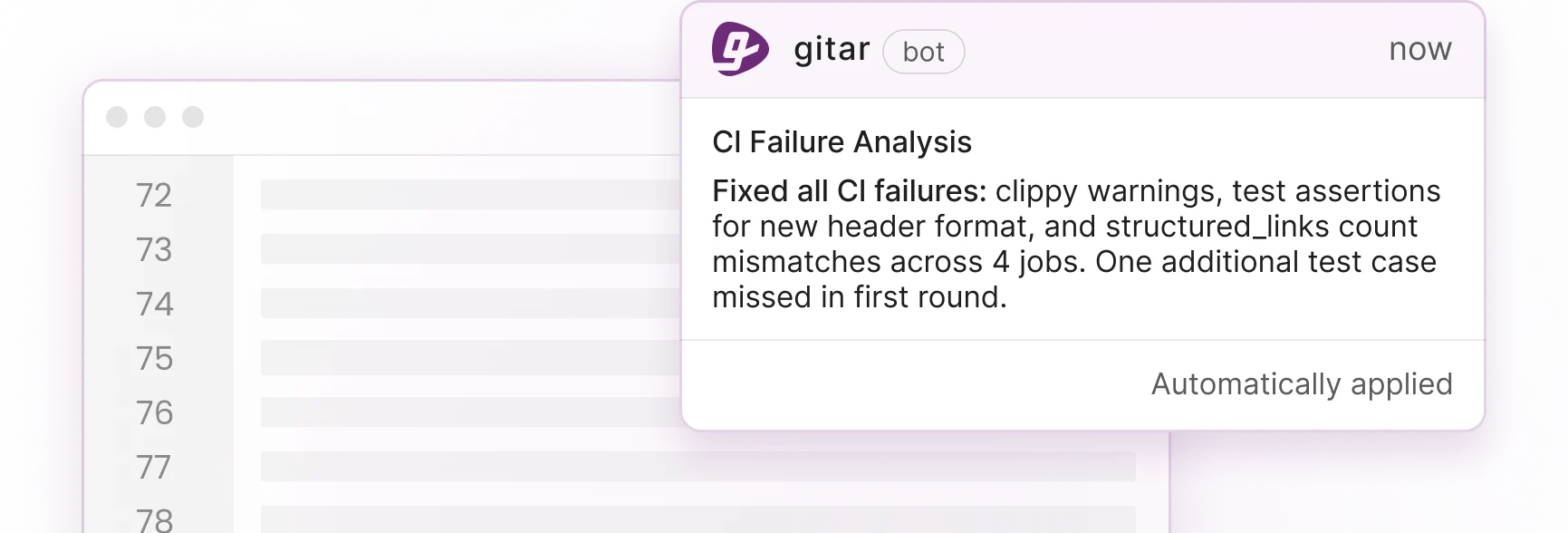
Experience passing builds with a 14-day trial of Gitar’s Team Plan and see the impact of validated auto-fixes on your Bitbucket workflows.
Advanced Bitbucket PR Automation and Gitar Integrations
Advanced automation with Gitar extends beyond basic code review comments and taps into natural language rules and team tools. Natural language rule configuration through .gitar/rules/*.md files handles security policies, auto-labeling, and workflow triggers without YAML expertise. These rules keep your standards consistent while remaining easy to adjust.
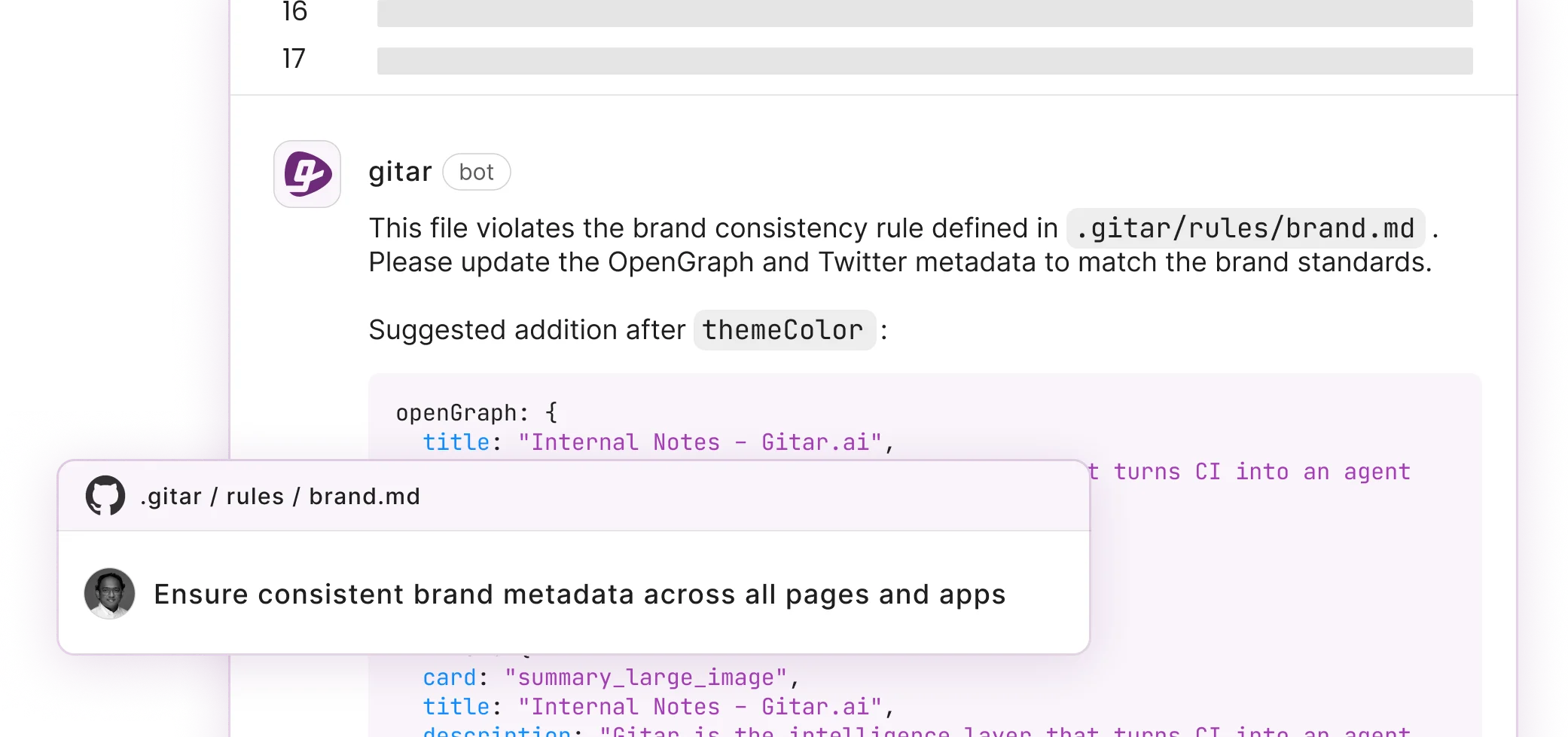
The same system connects directly to Jira for ticket validation and to Slack for team notifications, so developers see relevant updates where they already work. This combination of rules and integrations turns Gitar into a central automation layer across planning, coding, and communication.
Gitar’s healing loop operates continuously. When CI fails, the system analyzes logs, generates fixes, validates solutions in an isolated environment, and commits working code. This process creates a self-healing development pipeline that maintains velocity even as code complexity increases.
Bitbucket Pipelines’ Agentic CI/CD, launching in Q1 2026, introduces new triggers and agentic steps defined via natural language. These features will enable validated fixes and autonomous workflows directly in Bitbucket. Gitar’s approach already delivers similar value today through proven auto-fix capabilities that you can adopt without waiting for new platform releases.
Frequently Asked Questions
How do I integrate Gitar with Bitbucket Pipelines?
Gitar supports GitHub, GitLab, CircleCI, and Buildkite. Visit Gitar’s platform page to confirm compatibility and start your 14-day Team Plan trial. Full setup documentation is available at docs.gitar.ai. The trial provides complete auto-fix functionality without seat limits.
How does Gitar compare to Rovo or CodeAnt?
Gitar heals CI failures and implements review feedback through validated commits, while Rovo ($20 per seat) and CodeAnt ($24 per seat) provide AI-powered reviews and automation features. Gitar’s healing engine delivers passing builds by testing fixes before applying them, which reduces the risk of new regressions.
What does the free trial include?
The 14-day Team Plan trial provides full access to auto-fix capabilities, custom rules, CI failure analysis, review feedback implementation, and all integrations with no seat limits. Your entire team can experience the platform’s value and measure impact before making a purchase decision.
How do I measure ROI from code review automation?
Track pull request cycle time reduction, CI failure resolution speed, and developer time savings. A typical 20-developer team saves approximately $750K annually through reduced manual intervention and faster delivery cycles, which aligns with the earlier $1M cost baseline and Gitar’s savings breakdown.
Can Gitar handle complex CI environments?
Gitar emulates your full CI environment, including specific SDK versions, multi-dependency builds, and third-party integrations. The Enterprise tier runs agents inside your own CI with access to secrets and caches, which ensures that fixes work in production-like environments. For detailed setup instructions, see the Gitar documentation.
Conclusion: Turning Bitbucket Reviews into a Self-Healing Workflow
Gitar delivers a practical, self-healing approach to Bitbucket code review automation in 2026. Competitors charge premium prices for suggestion engines, while Gitar’s healing engine fixes the code that currently traps development teams in manual review cycles. You can test the velocity impact through the comprehensive 14-day trial and feel the difference between suggestion-heavy reviews and automated, validated solutions.
Start your 14-day Gitar Team Plan trial and let Gitar automatically repair broken builds while your team ships higher quality software, faster.