
Key Takeaways
- Gitar ranks #1 as the top Qodo PR Agent alternative, with free unlimited AI code review and autonomous CI fixes that remove manual implementation.
- By 2026, 84% of developers use AI tools, which increases PR review time by 91%. Autofix tools like Gitar remove this bottleneck, unlike suggestion-only models.
- Competitors such as CodeRabbit and Greptile charge $15-30 per developer each month for suggestions without autofix, while Gitar offers core features at $0.
- Gitar supports GitHub, GitLab, Jira, and Slack and has enterprise scale proven at Pinterest, saving teams about 45 minutes per developer each day.
- Teams can switch to Gitar for validated fixes and higher velocity: Install Gitar free now – no credit card required.
Best Qodo PR Agent Alternatives Ranked for 2026
1. Gitar – Free AI Code Review with Autonomous Fixes
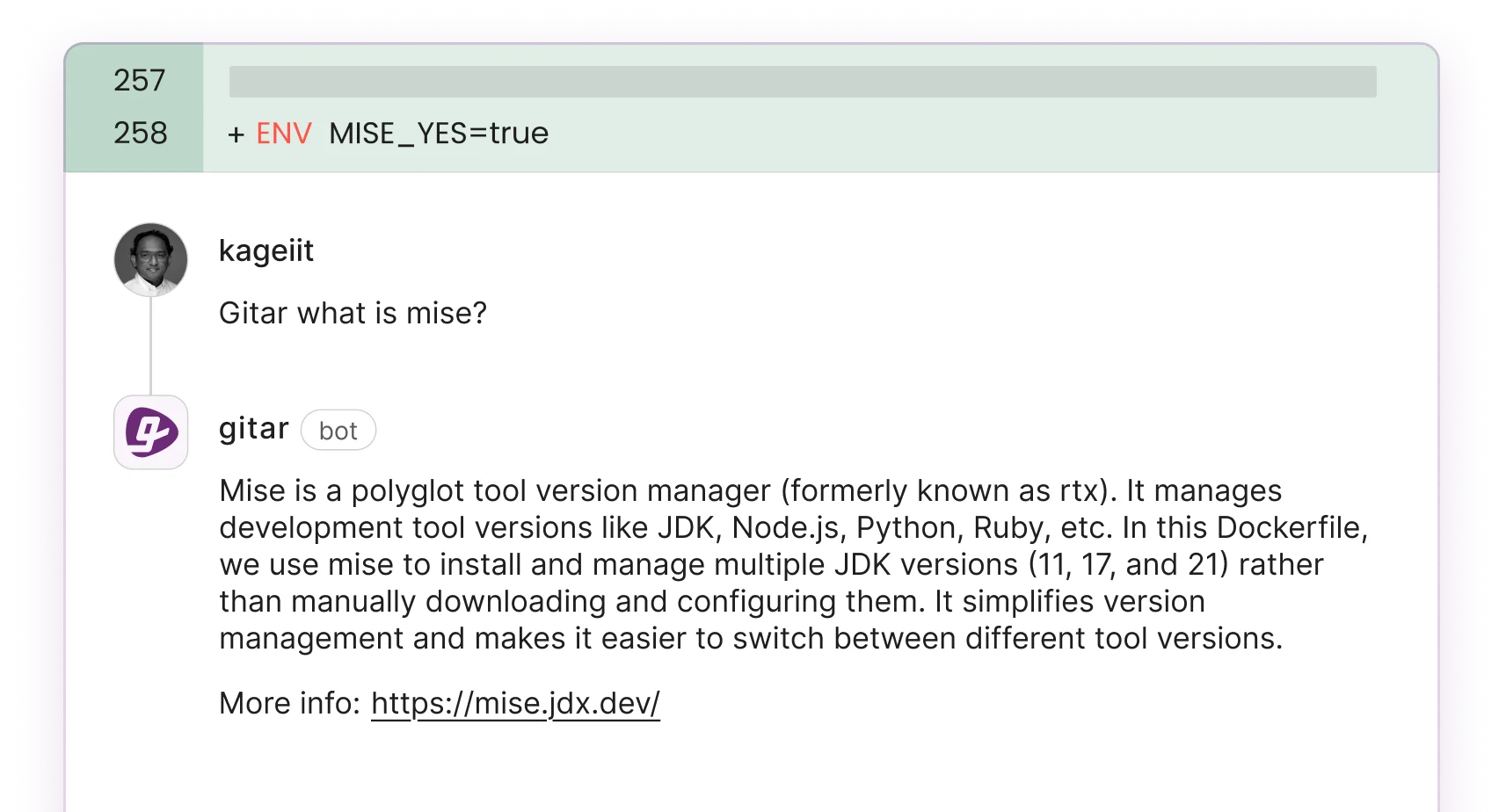
Gitar is the leading Qodo PR Agent alternative and delivers full AI code review for free with unlimited repositories and no seat limits. Qodo only suggests changes, while Gitar acts as a healing engine that resolves CI failures, addresses review feedback, and commits validated fixes directly to pull requests.
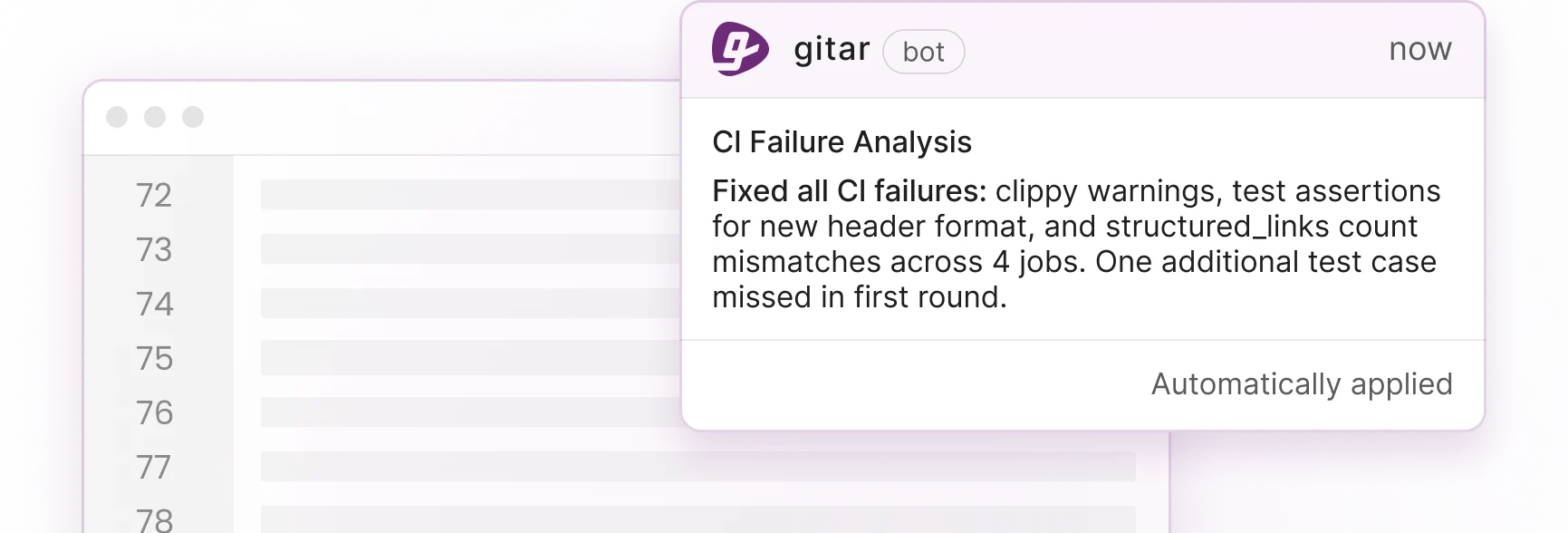
Gitar’s main advantage is its CI failure analysis. When builds break, tests fail, or lint errors appear, Gitar reads the failure logs, identifies the root cause, and proposes targeted fixes. It validates these fixes against the full codebase and then commits working solutions automatically. This workflow removes the manual implementation loop that slows Qodo users. See Gitar documentation for details.

Gitar uses a single dashboard comment that consolidates CI analysis, review feedback, and rule checks in one place. The comment updates as new information appears. Teams report less notification fatigue compared with tools that scatter inline comments across diffs. Gitar supports GitHub and GitLab and integrates with Jira, Slack, and Linear.
Enterprise teams such as Pinterest run Gitar at scale across more than 50 million lines of code and thousands of daily PRs. These teams save about 45 minutes per developer each day on CI and review issues. For a 20-developer team, this time savings creates large annual productivity gains while core features remain free.
Pros: Free unlimited code review, autonomous CI fixes, single updating comment, cross-platform support, proven enterprise scale
Cons: Autofix features move to paid plans after a 14-day trial, newer platform with an evolving feature set
Pricing: $0 for code review, 14-day free trial for autofix capabilities
Verdict: Gitar outperforms Qodo’s value with stronger automation at zero cost for core review
2. CodeRabbit – AI Code Review with Limited Automation
CodeRabbit offers AI-powered code review with PR summaries and inline suggestions at $15-30 per developer each month. It provides solid analysis and fits well into GitHub workflows, but it does not apply fixes automatically, which keeps it in the suggestion-only category.
Teams value CodeRabbit’s detailed PR summaries and contextual analysis. However, engineers must still implement every suggestion by hand, which recreates the same bottleneck that frustrates Qodo users. Costs rise quickly for larger teams while automation remains limited, which makes it hard to handle higher PR volumes from AI coding tools.
Pros: Comprehensive PR analysis, strong GitHub integration, detailed summaries
Cons: No autofix capabilities, expensive at scale, suggestion-only model, heavy notification volume
Pricing: $15-30 per developer per month
3. Greptile – Codebase Context Without Fixes
Greptile focuses on deep codebase understanding and contextual review at $30 per developer each month. It handles large codebases well and produces context-aware suggestions, but it lacks automation and fix validation.
Greptile’s strength lies in codebase comprehension, yet it does not provide CI integration or autofix features. Teams that want to remove manual review cycles often find this limiting. The higher price without autonomous capabilities makes Greptile less attractive than free tools that include automated fixing.
Pros: Excellent codebase context, thorough analysis
Cons: No autofix capabilities, expensive, limited CI integration, manual implementation required
Pricing: $30 per developer per month
Try Gitar free to automatically fix broken builds and ship higher quality software faster
4. Panto – Autonomous PR Generation for Refactors
Panto specializes in autonomous pull request generation and code improvements. It can create full PRs for refactoring and performance work, which offers a different style of automation than traditional review tools.
Panto’s PR creation is powerful, but teams should confirm how far its autofix and CI integration features extend. It can support several development use cases, including code review, yet it may not fully replace workflows that require deep security scanning or strict compliance checks.
Pros: Autonomous PR creation, proactive code improvements
Cons: Possible integration gaps for complex workflows
Pricing: Contact for pricing
5. Snarktank – AI Code Reviewer with Community Support
Snarktank has strong visibility in developer communities for its AI code review features. It provides code analysis and review feedback with some automation, though teams should confirm CI integration depth and fix validation.
Community reviews suggest Snarktank delivers useful insights during review. However, teams moving from Qodo should still evaluate its autofix strength and enterprise readiness before committing.
Pros: Strong community presence, AI review capabilities
Cons: Limited enterprise features, unclear autofix depth
Pricing: Varies by plan
6. DeepSource – Static Analysis with a Narrow Free Tier
DeepSource offers static code analysis and security scanning with a small free tier. It focuses on code quality and security and includes Autofix features that support modern development workflows.
DeepSource’s static analysis and autofix tools provide real value. However, the restricted free tier makes it less appealing for teams that want a full Qodo replacement with broad automation at no cost.
Pros: Strong static analysis, security focus, Autofix capabilities
Cons: Limited free tier
Pricing: Limited free tier, paid plans for full features
Install Gitar now for free unlimited code review with autonomous fixes
7. Bugbot – PR Summaries with One-Click Autofix
Bugbot delivers PR summaries and code analysis with autofix options such as one-click fixes. It supports review workflows and adds automation that helps teams handle rising PR counts from AI coding tools.
Pros: PR summaries, basic code analysis, one-click fixes
Cons: Focuses mainly on summaries rather than deep CI healing
Pricing: Contact for pricing
8. CodiumAI – Testing-First Reviews with 1-Click Fixes
CodiumAI centers on test generation and code quality analysis. It offers testing insights, 1-click issue resolution, and CI pipeline integration.
Pros: Strong testing focus, quality analysis, 1-click fixes
Cons: Primarily a testing tool rather than a full review and CI healing platform
Pricing: Freemium model with paid tiers
9. Other Qodo Merge Alternatives with Suggestion-Only Models
Many other tools attempt to solve Qodo’s gaps but still rely on suggestion-only workflows with premium pricing and limited automation. These tools usually provide basic review and comments without the healing engine needed to remove manual implementation work.
Common limitations: Paid plans without autofix, no CI healing, suggestion-only models
Qodo Alternatives Comparison Table for 2026
| Tool | Autonomous Fixes | Free Tier | CI Integration | Pricing |
|---|---|---|---|---|
| Gitar | Yes, full autofix with validation | Unlimited review | GitHub, GitLab, CircleCI, Buildkite | $0 review, 14-day autofix trial |
| CodeRabbit | No, suggestions only | Limited | GitHub focused | $15-30/dev/month |
| Greptile | No, context only | None | Basic | $30/dev/month |
| Panto | Yes, PR generation | Unknown | GitHub, GitLab, Bitbucket | Contact for pricing |
| Snarktank | Partial | Varies | Basic | Varies |
| DeepSource | Yes, Autofix™ | Limited | Comprehensive | Freemium |
| Bugbot | Yes, one-click fixes | Unknown | PR-triggered | Contact for pricing |
| CodiumAI | Yes, 1-click resolution | Limited | CI pipelines | Freemium |
Why Free Autofix Tools Like Gitar Outperform Paid Qodo Options
Qodo and similar paid tools share a core problem: they only suggest changes. These platforms analyze code and leave comments, but developers still implement fixes, push commits, and hope that CI passes. Teams then pay premium per-developer prices for tools that do not remove the main bottleneck.
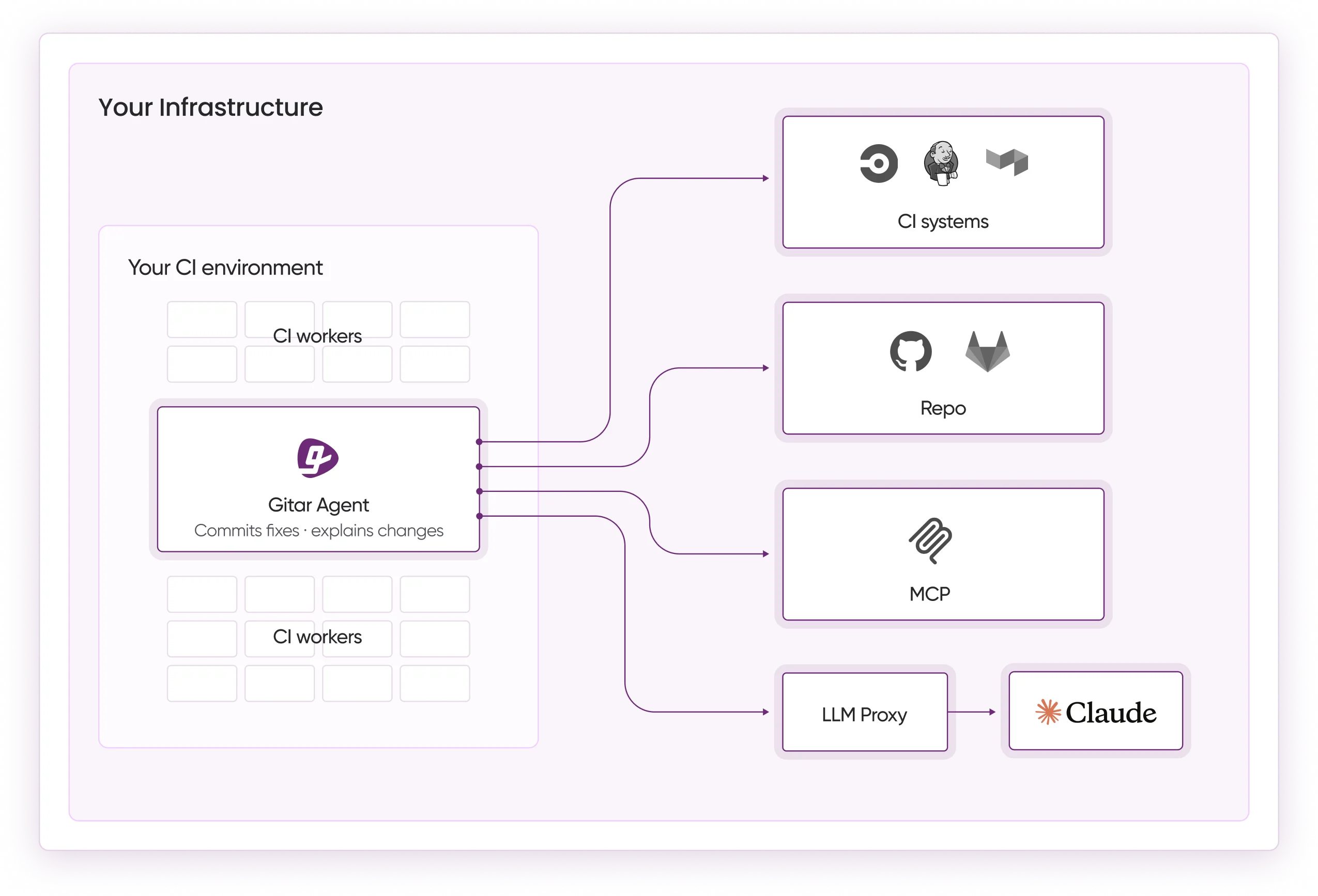
Gitar’s healing engine solves this problem by reading CI logs, generating targeted fixes, and validating those fixes in the full build environment before committing. Its CI integration gives it access to failure context that suggestion-only tools never see. See Gitar documentation for more information.
ROI numbers highlight the gap. A 20-developer team that pays for suggestion-only competitors can lose about $1M each year to CI and review delays. Gitar offers free code review that increases delivery speed while keeping tool costs at zero for core features. Developers also report less context switching and faster resolutions.
Gitar installs in about 30 seconds and delivers value immediately. Many paid tools require complex setup and training. Teams can move from suggestion-based workflows to autonomous fixing without changing their existing processes.
Start shipping higher quality software faster with Gitar’s free AI code review
Key Factors When Switching from Qodo
Teams that evaluate Qodo alternatives should focus on tools that remove manual implementation work instead of tools that only improve suggestions. Engineers want fewer context switches. Engineering leaders need clear velocity gains. DevOps teams look for self-healing CI that cuts maintenance effort.
A strong free tier matters for teams already paying high prices for limited automation. Gitar’s zero-cost review and 14-day autofix trial support full evaluation without budget risk. SOC 2 compliance and enterprise security features ensure that Gitar fits strict organizational standards.
Many teams worry about hidden catches in free tools because of past freemium models with heavy limits. Gitar treats code review as a basic commodity and builds long-term value from advanced workflow automation and analytics.
Install Gitar now and automatically fix broken builds
Frequently Asked Questions
What is the best free alternative to Qodo PR Agent?
Gitar is the most complete free alternative to Qodo PR Agent. It offers unlimited code review across all repositories with no seat limits and no credit card. Gitar also includes autonomous fix capabilities with a 14-day free trial, CI failure analysis, and a single dashboard comment that reduces notification overload.
How do autofix capabilities compare to suggestion-only models?
Autofix tools such as Gitar validate changes in CI environments and then commit working solutions directly. Suggestion-only tools such as Qodo require manual implementation and provide no guarantee that fixes will pass CI. Autofix removes the review bottleneck, saves time, and reduces context switching for developers.
Does Gitar support GitLab in addition to GitHub?
Yes, Gitar supports both GitHub and GitLab. It also integrates with CircleCI, Buildkite, and other CI systems. This cross-platform support separates Gitar from GitHub-only tools and lets teams with mixed stacks use autonomous review and fixing.
What ROI can teams expect from switching to automated code review?
Teams usually save significant time per developer each day by removing manual CI fix cycles and review implementation work. A 20-developer team using Gitar’s free review can cut productivity loss from CI and review issues and avoid paying $450-900 each month for competing tools, while keeping core features free.
How difficult is migrating from CodeRabbit or other existing tools?
Migration to Gitar takes about 30 seconds through a GitHub App install and needs no extra configuration. Gitar can run alongside existing tools during testing, which lets teams compare results before switching fully. Teams can add repository rules and workflow automation gradually without disrupting current processes.
What integrations are available beyond code review?
Gitar integrates with Jira, Slack, and Linear to provide shared context and notifications. It supports natural language workflow rules, automated PR labels, team assignment, and custom actions that trigger from repository events. These features extend automation beyond basic review.
How has the AI code review market evolved in 2026?
By 2026, the market clearly separates suggestion engines from healing platforms. Teams now expect autonomous fixes instead of more comments. CI agent integration has become essential because AI coding tools create more PRs, and teams need validation plus automatic resolution to protect development speed.
Conclusion: Why Gitar Replaces Qodo PR Agent
Gitar directly addresses Qodo PR Agent’s limits by offering free, comprehensive code review with autonomous fixes that remove manual implementation cycles. Competitors charge high prices for suggestion-only workflows, while Gitar delivers validated fixes, CI healing, and workflow automation at no cost for core review.
Gitar’s healing engine, enterprise scale, and cross-platform support make it a strong choice for teams facing post-AI coding bottlenecks. Teams can start with the free tier and experience the difference between tools that suggest and tools that solve.