
Written by: Ali-Reza Adl-Tabatabai, Founder and CEO, Gitar
Key Takeaways
- AI coding assistants such as GitHub Copilot speed up code generation 3–5x, yet PR review time rises by 91% as teams struggle to validate AI-generated changes at scale.
- CodiumAI PR-Agent tops open source alternatives with the largest community following and the most active development cadence.
- Tabby and CodeAnt AI deliver strong self-hosting with enterprise support, but most tools still lack auto-fixes and deep CI integration.
- Open source shines for privacy and cost but leaves manual implementation gaps, while Gitar’s healing engine auto-applies fixes and targets green builds.
- Try Gitar’s Team Plan free for 14 days to remove PR bottlenecks and reclaim up to $1M in annual productivity for a 20-developer team.
How We Tested and Ranked These PR Review Agents
Our evaluation focused on practical deployment factors that matter in real engineering teams. We measured review depth and conversational capabilities, self-hosting effort such as Docker setup time and VRAM requirements, and fix accuracy across five pull requests that included lint errors and failing tests. We also considered GitHub star count, development momentum, and support for GitHub and GitLab.
We sourced data from GitHub repositories, developer community discussions, and hands-on testing. Testing centered on mid-size repositories and standard CI configurations, so results may differ for very large monorepos or custom pipelines. Based on these criteria, here are the top seven open source alternatives ranked by their practical value for development teams.
7 Best Open Source AI PR Review Agents Like Qodo in 2026 (Ranked)
1. CodiumAI PR-Agent
CodiumAI PR-Agent leads with 10,500 GitHub stars and active development, including recent releases such as v0.27. The tool provides interactive PR chat, detailed summaries, and inline code suggestions for both GitHub and GitLab. What makes it especially attractive for privacy-focused teams is the 5-minute Docker setup combined with Ollama integration, which together enable complete data sovereignty with zero external API calls.
This ease of self-hosting is reinforced by highly configurable review rules and robust local model support. Current limitations include unresolved configuration bugs in GitHub Issues #2098 and #2083, which can trigger fallback to hardcoded GPT models despite local settings. Install with: docker run -p 8000:8000 qodoai/pr-agent. Ideal for: Privacy-focused startups that want customizable review workflows and are comfortable working around configuration quirks.
2. CodeAnt AI
CodeAnt AI delivers full-codebase context analysis and reports roughly 80% auto-fix accuracy across multiple programming languages. The platform combines security vulnerability scanning with architectural review and integrates with GitHub, GitLab, Bitbucket, and Azure DevOps. These capabilities create a strong fit for teams that treat security and architecture as first-class review concerns.
Strengths include comprehensive security analysis and broad language coverage. Limitations include heavy resource requirements and significant compute needs for large repositories, which can slow adoption for smaller teams. Ideal for: Security-conscious organizations with robust infrastructure and dedicated DevSecOps support.
3. Tabby
Tabby commands 69,800 GitHub stars, with version v1.0.230 released in January 2026. This self-hosted AI coding assistant includes code review features and supports local models for complete data control. The University of Toronto maintains verified Docker Compose configurations that simplify production deployment for academic and enterprise environments.
Strengths include a large community, proven enterprise adoption, and mature deployment patterns. Limitations include complex Helm deployment requirements and a minimum 8GB VRAM footprint, which rises for larger models. Initial indexing can take about 30 minutes for large repositories, which affects first-time setup. Ideal for: Universities and enterprises that need a proven self-hosted solution and can invest in infrastructure.
4. Snarktank AI
Snarktank AI offers 57 GitHub stars as a lightweight GitHub Action that uses Anthropic’s Claude models for quick PR reviews. The MIT license and simple Action configuration keep deployment straightforward for teams already using GitHub Actions. Strengths include easy setup and direct Claude model integration without extra services.
Limitations include experimental status, only two contributors, and no formal tagged releases, which can affect long-term reliability. The tool fits teams that want to try Claude-powered reviews without committing to a full platform. Ideal for: Small teams experimenting with Claude-based PR feedback inside GitHub.
Before you explore the remaining tools, consider how far open source agents can take you. These projects provide valuable analysis and suggestions, yet they still leave your team applying and validating fixes by hand. Teams that want automated implementation and CI-validated changes may want to explore Gitar’s approach.
5. Kodus AI
Kodus AI maintains 976 GitHub stars, with version 2.0.22 released in March 2026. This agent-based tool supports self-hosting and shows strong momentum with 129 releases. The architecture favors modular agents that can handle different review tasks, which appeals to teams that like composable systems.
Strengths include the agent-based design and consistent release cadence that signals active maintenance. Limitations include documentation gaps that make complex polyglot setups harder to adopt. The project shows promise but needs clearer guides and examples. Ideal for: Teams comfortable with agent-based workflows that are willing to contribute documentation and improvements.
6. villesau/ai-codereviewer
This lightweight GitHub Action has about 1,000 GitHub stars and 882 forks, which indicates strong community interest. The tool provides GPT-4 powered code reviews through a simple Action configuration that fits neatly into existing workflows. Strengths include minimal setup overhead and a high fork count that suggests active community maintenance even without frequent official releases. Limitations include a basic feature set and stale core development, with the last release in December 2023. Ideal for: Teams that want straightforward GPT-4 reviews with almost no configuration.
7. Hexmos LiveReview
Hexmos LiveReview targets GitLab users with 22 GitHub stars and 717 commits, showiIn g active development through February 2026. The tool supports GitHub, GitLab, Bitbucket, Gitea, and other platforms while integrating with Ollama models for self-hosted deployments. Strengths include GitLab-focused optimization and flexible Ollama support for local inference. Limitations include a relatively small community and a narrower focus that may not fit every stack. The project fills a clear niche for GitLab-centric teams that want local AI review. Ideal for: GitLab-native teams that require self-hosted AI review with multi-platform support.
Open Source vs. Gitar: Feature Comparison
The following comparison highlights a key difference between open source PR review tools and Gitar. Open source agents excel at analysis and suggestions, while Gitar closes the loop by automatically implementing and validating fixes inside your CI pipeline.
|
Feature |
Open Source Tools |
Gitar |
Winner |
|
PR Summaries |
Yes |
Yes (Trial/Team) |
Tie |
|
Inline Suggestions |
Yes |
Yes (Trial/Team) |
Tie |
|
Auto-Apply Fixes |
Suggest-only |
Yes (Trial/Team) |
Gitar |
|
CI Auto-Fix |
No |
Yes |
Gitar |
|
Green Build Guarantee |
No |
Yes |
Gitar |
|
Platform Support |
Limited |
GitHub/GitLab/CircleCI/Buildkite |
Gitar |
As the table shows, open source tools excel at analysis but stop at suggestions, while Gitar’s healing engine closes the loop by implementing and validating fixes. Open source agents still leave teams with manual implementation overhead that grows with repository size. Gitar’s comprehensive platform removes this gap by applying fixes and checking them against your CI environment. See the Gitar documentation for setup details and feature coverage.
Why Upgrade to Gitar for Automated Fixes
Gitar’s healing engine turns PR review from suggestion into solution by actually implementing fixes instead of only flagging issues. This action-first approach extends to the user experience, where a single-comment interface consolidates feedback and eliminates notification spam. Natural language rules in .gitar/rules/*.md make workflow automation accessible without YAML complexity, so teams can describe policies in plain English.
These workflow improvements gain even more value through Jira and Slack integrations that provide cross-platform context missing from most open source tools. Teams report about $1M in annual productivity savings for a 20-developer group through reduced manual intervention and faster merges. Concerns about auto-commit safety are addressed with configurable approval workflows and gradual trust-building controls. For implementation details, review the Gitar documentation.
See the difference between analysis and action. Try Gitar’s healing engine free for 14 days and watch broken builds repair themselves.
When Open Source Falls Short in CI Workflows
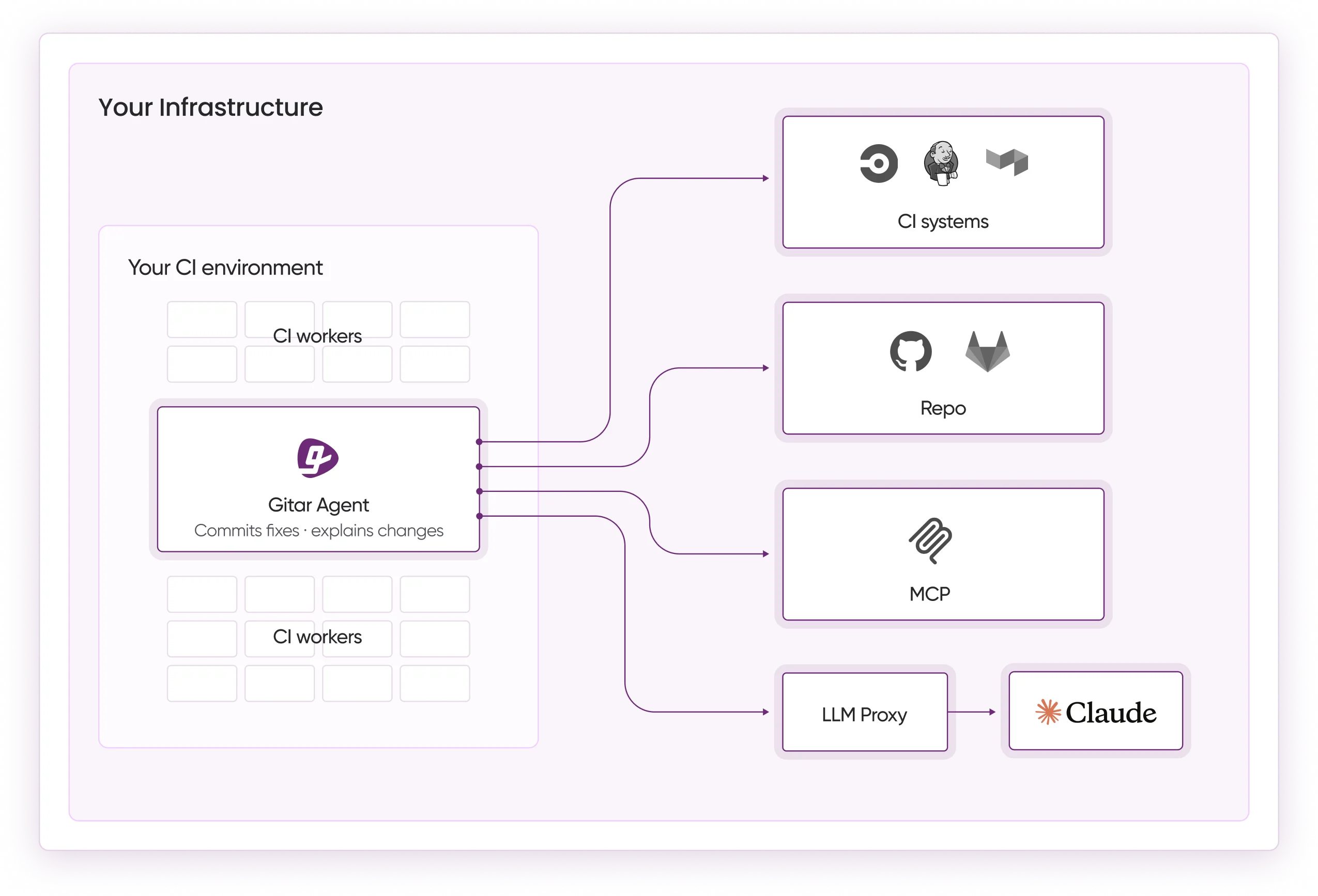
The fundamental limitation of open source PR agents appears inside CI pipelines. Without CI context, these tools miss 91% of the workflow where real failures occur. They can identify issues in code, yet they cannot validate solutions against your specific build environment, dependency graph, or test suites.
This gap between suggestion and implementation wastes developer time and slows releases. Gitar bridges this gap with full CI integration, understanding your build context and confirming that fixes work before committing them. Developers see less noise and faster resolution, engineering leaders gain measurable velocity improvements, and DevOps teams benefit from self-healing pipelines that reduce manual firefighting.
Frequently Asked Questions
What is the best free GitHub alternative to Qodo?
CodiumAI PR-Agent stands out with 10,500 GitHub stars, active development, and rich features such as PR summaries, inline suggestions, and conversational review. It supports self-hosting with Ollama for full data control, although configuration bugs may require workarounds during setup. For teams that want proven reliability plus automatic fixes, Gitar’s 14-day free trial delivers more value by implementing suggested changes instead of only identifying them.
What are the main challenges with self-hosting these tools?
Self-hosting typically requires at least 8GB of VRAM for local models such as CodeLlama-7B, with 16GB recommended for production workloads. Setup timelines often range from 6 to 13 weeks when you include infrastructure provisioning, security reviews, and integration work. Configuration issues such as PR-Agent’s hardcoded model fallbacks can block local deployments until patched. Ongoing maintenance covers model updates, security patches, and scaling decisions as usage grows. Gitar avoids these challenges with zero-setup deployment and fully managed infrastructure.
How do accuracy rates compare between Qodo and open source alternatives?
Open source tools usually reach 70–80% accuracy on standard lint and test fixes, although results vary with model choice and prompt design. CodiumAI PR-Agent and Tabby show the most consistent performance in our tests, while newer tools such as Snarktank AI remain experimental. Accuracy alone does not close the loop, because suggestions still require manual validation and application. Teams must factor in this validation gap when comparing tools.
Should we migrate from CodeRabbit to an open source solution?
The right choice depends on your priorities around cost, control, and maintenance. Open source tools reduce license spend and improve data sovereignty but demand significant setup and ongoing operations work. CodeRabbit offers a polished hosted experience at $15–30 per developer each month. Both paths still leave your team implementing fixes manually. Gitar provides superior ROI by automating the entire fix–validate–commit cycle, which often justifies the investment through productivity gains alone.
How does Gitar compare to building our own LLM integration?
Custom LLM integrations require substantial engineering effort for CI context extraction, fix validation, multi-platform support, and continuous model management. Many teams underestimate the complexity of reliable auto-commit workflows, robust error handling, and security controls. Gitar delivers an end-to-end platform with proven reliability across thousands of repositories, so your engineers can focus on product development instead of infrastructure plumbing.
Conclusion
CodiumAI PR-Agent leads the open source category with proven reliability and comprehensive features, while Tabby serves teams that need enterprise-grade self-hosting. All open source options, however, share a core limitation: they stop at suggestions and still require manual implementation.
Gitar changes this pattern by fixing the code, validating changes against CI, and targeting green builds as the default outcome. The healing engine approach closes the suggestion–implementation gap that makes traditional tools feel incomplete.

Install Gitar now for a 14-day free Team Plan trial to automatically fix broken builds and ship higher quality software faster. Start your trial and experience the difference between suggestions and solutions.