

Last updated: February 17, 2026
Why Automated AI Code Fixing Matters in 2026
- AI coding tools generate code 3-5x faster but increase review times by 91%, so teams now need automated fixing platforms.
- Gitar uniquely auto-fixes CI failures by analyzing logs, validating solutions, and committing working code directly to PRs.
- Most competitors like CodeRabbit and Qodo offer suggestions only in free tiers and lack true automation and CI integration.
- Gitar provides free unlimited code review for all repositories with no seat limits, plus a 14-day auto-fix trial and multi-CI support.
- Teams achieve 33.8% cycle time reduction with automated fixing; install Gitar now to ship higher quality software faster.
How We Evaluated AI Code Review Platforms
Our 2026 evaluation focuses on platforms that deliver real automation instead of suggestions alone. We prioritize CI failure analysis, auto-commit capabilities, unlimited free tiers without seat restrictions, and multi-platform integrations across GitHub, GitLab, and CircleCI. We also value low-noise user experiences with consolidated feedback, enterprise scalability for 50M+ lines of code, and measurable ROI through time savings. Our research draws on vendor documentation, developer forum feedback, GitHub activity, and benchmarks that report fix success rates above 90% where available.
8 Best Free Automated AI Code Review Platforms That Fix Code (2026)
This list ranks platforms by automated fixing strength, free tier generosity, and depth of CI integration.
1. Gitar: Automated CI Healing With Unlimited Free Review
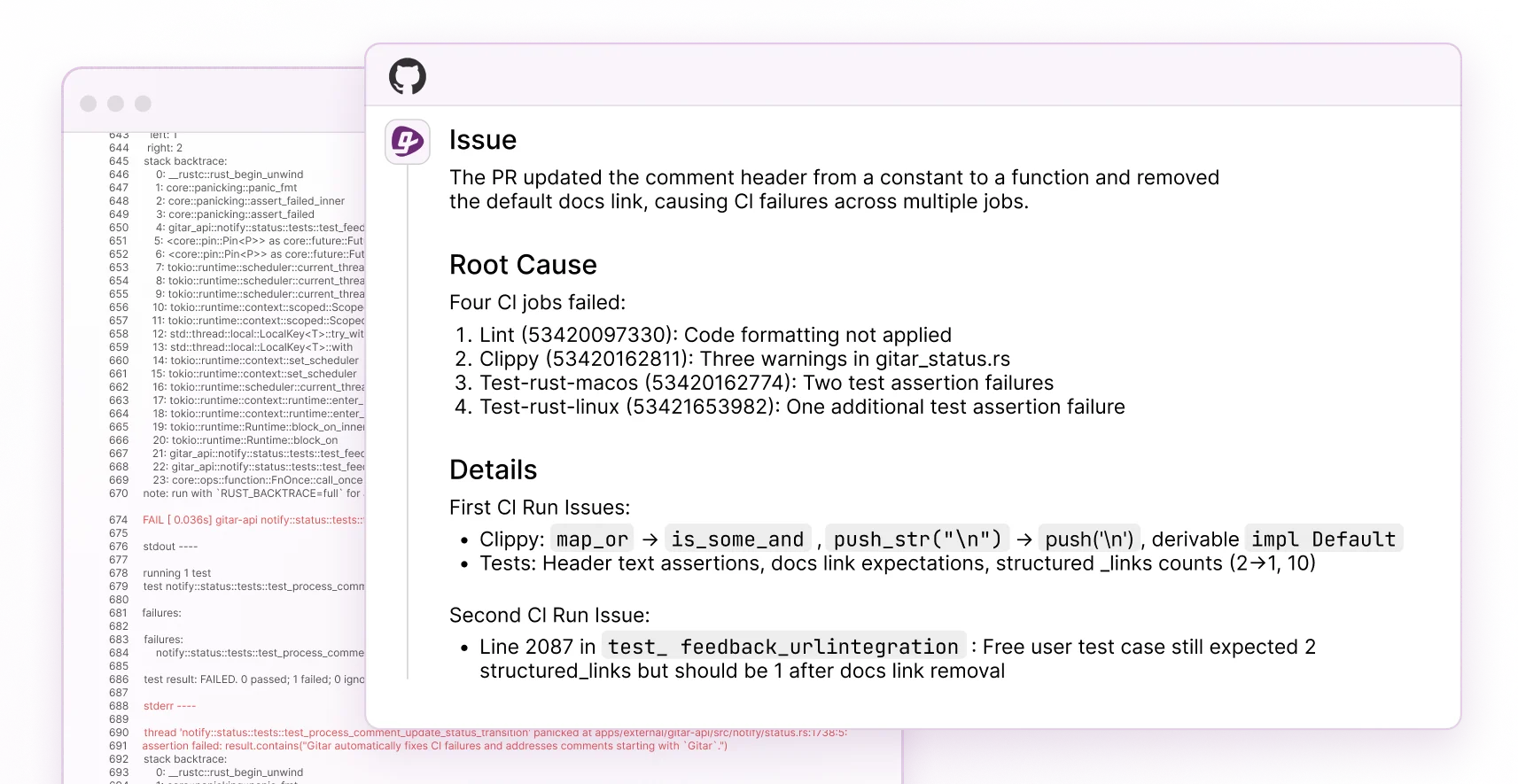
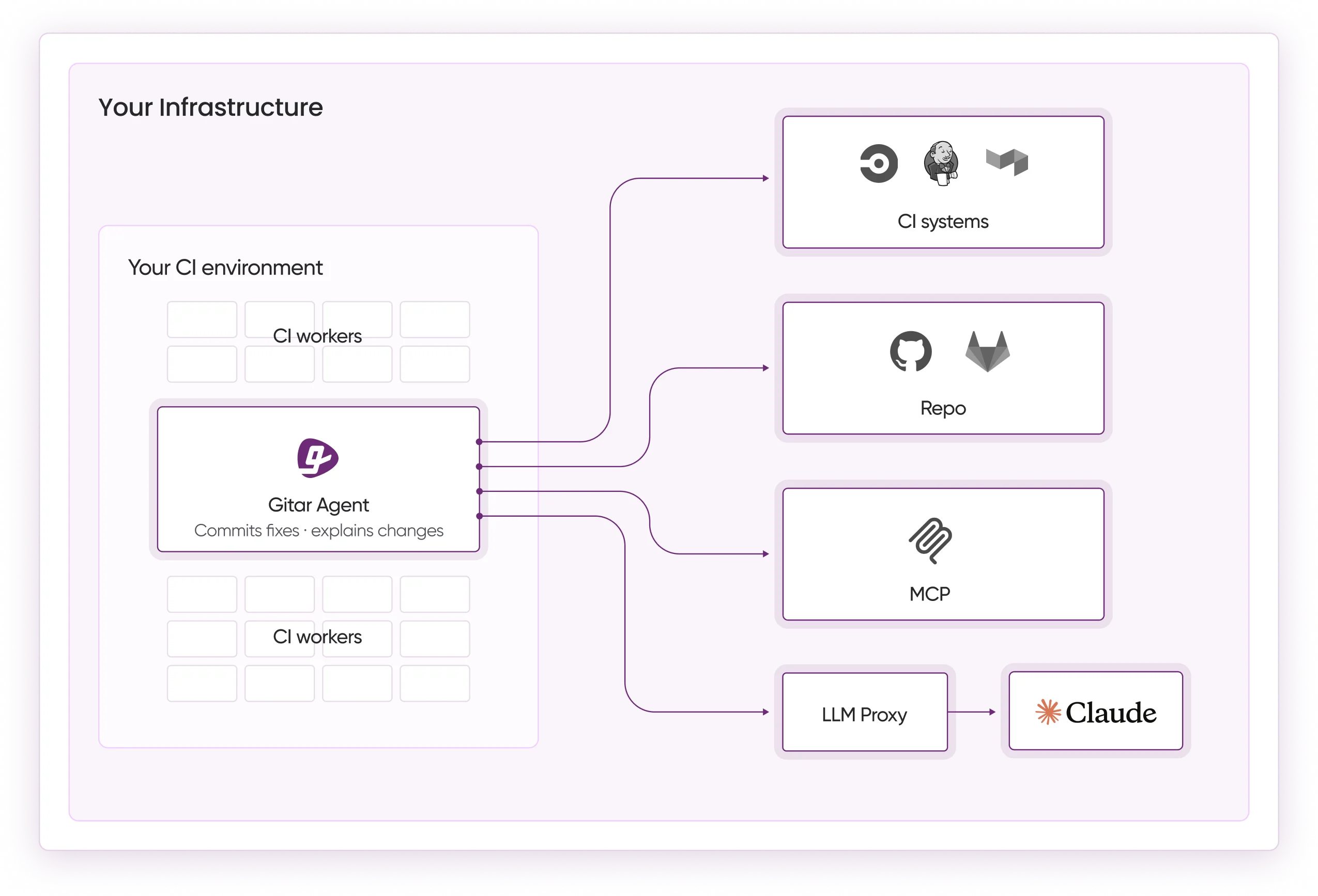
Gitar stands out as the free AI code review platform that automatically resolves CI failures. When lint errors, test failures, or build breaks occur, Gitar analyzes failure logs, generates context-aware fixes, validates them in your CI environment, and commits working solutions directly to your PR. The platform consolidates all findings into a single updating comment, which reduces the notification spam that many competitors create.
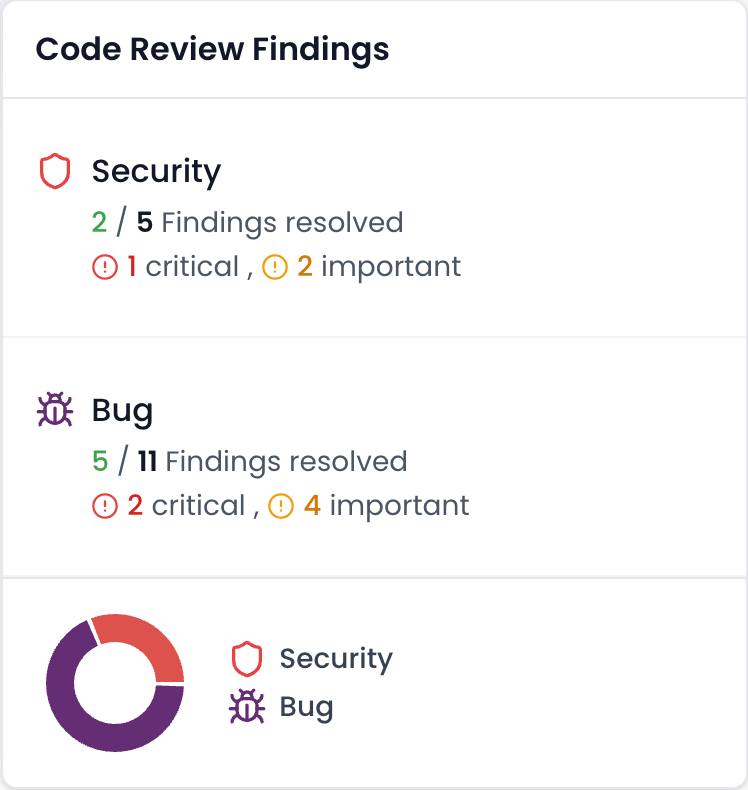
Key differentiators include support for multiple CI systems such as GitHub Actions, GitLab CI, CircleCI, and Buildkite. Gitar also supports natural language workflow rules stored in .gitar/rules/*.md files and handles enterprise-scale validation for clients processing more than 50M lines of code. The 30-second GitHub app installation requires no credit card, and code review remains free for unlimited repositories with full PR analysis, security scanning, bug detection, and performance review, all without seat limits.
Gitar’s auto-fix capabilities come with a 14-day free trial and extend beyond basic linting to complex multi-file refactoring, dependency updates, and security vulnerability patches. The platform’s hierarchical memory system maintains context per line, per PR, and per repository, which enables smarter fixes over time.
2. CodeRabbit: Strong Suggestions Without Auto-Fix
CodeRabbit offers a free tier with unlimited public and private repositories and provides comprehensive PR analysis with line-by-line comments and summaries. The platform supports more than 40 programming languages and integrates with GitHub, GitLab, and Bitbucket, adapting its feedback based on team preferences and historical patterns.
CodeRabbit functions as a suggestion engine rather than an automated fixer. It can generate test files and documentation, but it does not auto-commit fixes or validate solutions against CI pipelines. Paid tiers start at $12 per user per month for Lite and $24-30 per user per month for Pro, which becomes expensive for teams that want actual automation.
3. Qodo (formerly CodiumAI): Enterprise Tests With Paid Auto-Fix
Qodo provides a free tier focused on test generation and basic static analysis. The platform offers Git interface integration for PR reviews, IDE plugins, and CLI tools for CI integration, targeting enterprise-scale codebases that handle high PR volumes.
The platform shows promise with agentic PR analysis and context-aware suggestions. However, auto-fix capabilities remain limited to the Ultimate Plus tier and do not appear in free or basic plans. This positioning makes Qodo a stepping stone instead of a complete automation solution for teams that want immediate CI healing.
4. Refact.ai: IDE Auto-Fix Without PR Context
Refact.ai offers a free tier with IDE-integrated auto-fixing for linting and basic code quality issues. The platform provides model choice flexibility and chat-based code assistance, which helps individual developers working on smaller projects.
Key limitations include the lack of PR-level integration and CI pipeline context. While useful for daily development tasks, it does not fully replace comprehensive code review processes and requires significant setup effort for deployment across teams.
5. SonarLint Community Edition: Rule-Based Checks Only
SonarQube Community Edition provides free, open-source automated code review but relies on rule-based analysis instead of AI-powered intelligence. It catches common code quality issues effectively but lacks the contextual understanding and automated fixing capabilities that modern AI platforms deliver.
6. Codacy Free Tier: Traditional Quality Gates
Codacy offers a free tier that focuses on security and quality gates with basic automated checks. The platform integrates with popular CI systems but provides limited AI-powered analysis and no automated fix application. It functions more as a traditional code quality tool than an intelligent automation platform.
7. PR-Agent OSS: Self-Hosted AI Without Auto-Fix
PR-Agent is self-hosted and AI-powered with Ollama support for GitHub and GitLab, giving teams complete control over their review process. However, it does not include automated code fixing capabilities and requires substantial infrastructure setup and ongoing maintenance.
8. DIY Claude or GPT Integration: Flexible but High Effort
Custom LLM integrations using Claude or GPT APIs give teams flexibility when they have very specific requirements. Free AI assistants like ChatGPT help with architectural questions but lack repository context and demand significant engineering work to build CI integration, fix validation, and automated commit workflows.
Gitar vs. Others: Feature Breakdown
|
Platform |
Auto-Fix & CI Integration |
Free Unlimited |
Multi-Platform Support |
|
Gitar |
Yes (14-day free trial), full CI healing with validation |
Yes, free unlimited code review |
GitHub, GitLab, CircleCI, Buildkite |
|
CodeRabbit |
No, suggestions only |
Yes, unlimited public and private repos |
GitHub, GitLab, Bitbucket |
|
Qodo |
Paid tier only |
Basic tier with limited features |
GitHub, GitLab |
|
Refact.ai |
IDE only, no PR integration |
Yes, individual use |
IDE-focused |
This comparison shows Gitar’s unique position as the only platform that combines true automated fixing with free code review and broad CI integration. Teams using automated CI tools achieve 33.8% cycle time reduction and 29.8% review time reduction, which highlights the ROI potential of platforms that move from suggestions to actual fixes.
How Different Teams Should Choose a Platform
Solo developers gain the most from plug-and-play solutions like Gitar that require minimal setup while delivering strong automation. Engineering teams should evaluate total cost of ownership and compare it with actual automation levels. Paid platforms like CodeRabbit cost $12-30 per user per month, which makes a 20-developer team spend $2,880-7,200 annually for suggestion-only tools.
DevOps engineers should favor platforms that support natural language rule configuration instead of complex YAML workflows. Trust-building features such as suggestion mode before enabling auto-commits help teams adopt automated fixing gradually. Enterprise teams that manage complex CI environments need platforms that can emulate full build contexts with access to secrets and caches.
Frequently Asked Questions
Best Free AI Code Review Platform for Automatic CI Fixes
Gitar offers free unlimited code review with a healing engine that automatically resolves CI failures, with a 14-day free trial for auto-fix. Unlike competitors that charge $15-30 per developer for suggestions, Gitar analyzes CI logs, generates validated fixes, and auto-commits working solutions. The platform supports GitHub, GitLab, CircleCI, and Buildkite with no seat limits or credit card requirements for code review.
How Gitar Compares to CodeRabbit for Automation
CodeRabbit delivers strong PR analysis and suggestions but requires manual implementation of every fix. Gitar goes further by automatically applying, validating, and committing fixes that restore green builds. CodeRabbit’s free tier supports unlimited public and private repositories, while Gitar offers unlimited access for all repository types. For teams that want true automation instead of enhanced suggestions, Gitar delivers stronger ROI.
Usage Limits on Free AI Code Review Platforms
Most platforms impose meaningful restrictions on free tiers. CodeRabbit offers a free tier with unlimited public and private repositories. Qodo restricts auto-fix features to paid plans. Gitar provides free unlimited code review for unlimited repositories with no seat limits, plus a 14-day trial of auto-fix capabilities. This structure makes Gitar the most generous free option for teams that need comprehensive code review.
Setup Time for Automated Code Fixing
Setup complexity varies widely across platforms. Gitar requires only a 30-second GitHub app installation with no configuration. CodeRabbit and Qodo require account setup and repository permissions but do not offer automated fixing in free tiers. DIY solutions using Claude or GPT demand substantial engineering work to build CI integration and fix validation systems. Teams that want immediate automation get the fastest path to value with Gitar.
Expected ROI From Automated Code Fixing
Teams that adopt automated CI tools report strong productivity gains. Research shows 33.8% cycle time reduction and 29.8% review time reduction for teams that use automated fixing solutions. For a 20-developer team spending one hour daily on CI issues, automated fixing can save about $375,000 annually in productivity while also eliminating $2,880-7,200 in tool subscription fees compared with suggestion-only platforms.
Conclusion: Move From Suggestions to Automatic Fixes
The AI coding surge requires platforms that move beyond suggestions and deliver real automated fixing. Many tools charge premium prices for basic commentary, while Gitar offers free unlimited code review with true CI healing capabilities. As agentic quality control becomes standard in 2026, teams need platforms that automatically handle the growing volume of AI-generated code that demands validation and fixes.