
Key Takeaways
- CI failures, flaky tests, and code review delays consume significant developer time and break focus across modern engineering teams.
- Traditional continuous integration tools surface problems but still rely on manual debugging, re-runs, and code changes from developers.
- Autonomous CI tools use full-environment context, log analysis, and root-cause detection to fix failures directly in pull and merge requests.
- Reducing context switching and automating fixes shortens time-to-merge, improves developer morale, and lowers engineering costs.
- Teams can adopt self-healing CI today with an autonomous agent like Gitar that automatically fixes CI failures and code review feedback.
The Problem: Why Traditional Continuous Integration Tools Hinder Developer Productivity
Context Switching Taxes
Many engineers push a pull request that looks clean, then face a failed build because of a missing dependency, flaky test, or linter warning. Each failure forces a return to logs, a switch back to the local environment, a small fix, and another pipeline run. This cycle turns a quick correction into a lengthy interruption that breaks flow and delays delivery.
The Endless Debugging Loop
The ideal of submitting a pull request and moving on rarely matches reality. Developers move to a new task, then get pulled back by CI failures or review comments. Each return to an old context adds mental overhead, so a 30-minute fix can effectively consume an hour of productive time.
Distributed Team Bottlenecks
Distributed teams feel these delays even more. A developer in one region may depend on review from someone many time zones away, so a simple back-and-forth extends reviews from hours to days. AI review tools that only suggest changes still require manual edits and re-runs, so the bottleneck remains.
The Right-Shift Burden
Tools that accelerate code generation increase pull request volume and change frequency. Teams then spend more time validating, debugging, and merging work, which shifts effort away from new feature development and toward integration overhead.
Hidden Costs
Many teams see up to 30 percent of developer time absorbed by CI and code review issues. That loss becomes a business problem, delaying projects and increasing costs for a large share of organizations. For a 20-person engineering team, this lost time can approach one million dollars per year in productivity value.
The Solution: Introducing Gitar, The Autonomous CI Fixer for Engineering Teams
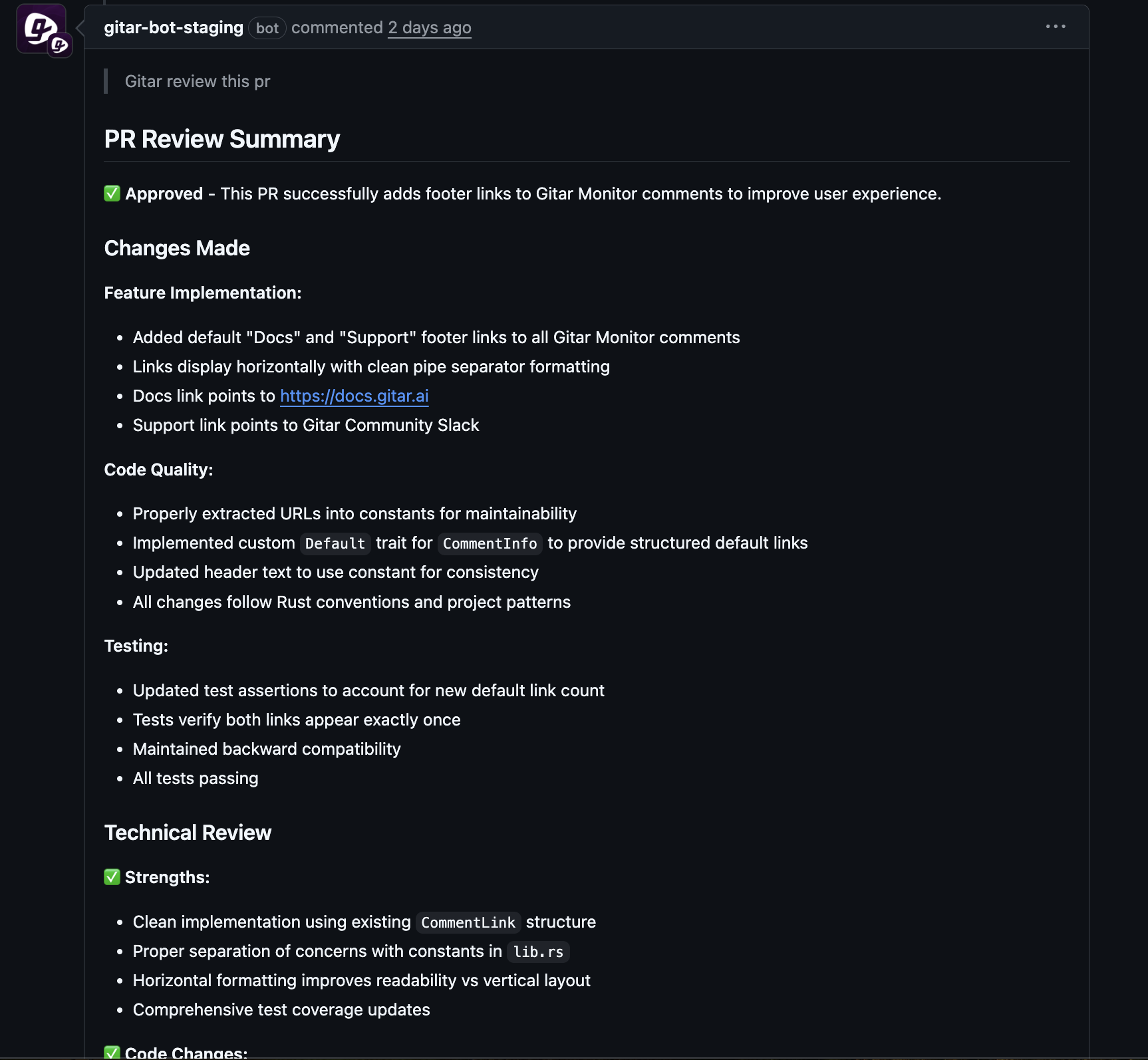
Gitar focuses on the core productivity drain in modern development: failing CI pipelines and repetitive code review changes. When a pull or merge request receives review comments or a CI failure, Gitar detects the event, analyzes the problem, generates the fix, and updates the request. This creates a self-healing CI experience that turns manual rework into an automated background process.
How Gitar Improves Your CI/CD
- End-to-end autonomous fixing, with changes applied automatically and validated against the full CI workflow to reach a green build.
- Full environment replication that handles complex enterprise stacks, including specific JDK or SDK versions, multi-language builds, and tools such as SonarQube and Snyk.
- Intelligent code review assistance, where reviewers leave clear instructions and Gitar performs refactors, cleanups, or removals directly in the pull request.
- A configurable trust model that supports modes from suggestion-only to automatic commits with rollback, so teams can adopt automation at their own pace.

Rethinking Best: What Makes a Continuous Integration Tool Truly Autonomous?
The market is shifting from CI tools that only report failures to tools that diagnose and fix them. Traditional systems act as monitoring layers, while autonomous systems act as active participants in delivery.
Proactive Problem Resolution vs. Reactive Reporting
Self-healing CI pipelines automate failure diagnosis through log analysis, anomaly detection with machine learning, and root cause analysis. Tools that go further by applying fixes prevent many failures from ever reaching developers, so CI becomes a safety net instead of a constant interruption.
Deep Environmental Context for Accurate Fixes
Enterprise CI environments rely on complex dependency graphs, multi-SDK builds, and numerous third-party integrations. The most effective continuous integration tools recreate this environment with high fidelity, so they can propose and apply fixes that work reliably under real build conditions.
Eliminating Context Switching and Preserving Flow State
Autonomous fixing keeps developers focused on feature work instead of firefighting CI issues. Frequent pipeline failures come from flaky tests, asynchronous testing issues, non-deterministic environments, and unpinned dependencies. When an agent resolves these issues on its own, teams avoid repeated context switches and retain deep work time.
Accelerating Time-to-Merge and Reducing Cycle Time
AI-driven root cause analysis reduces both failure rates and mean time to resolution. Applying fixes automatically shortens feedback loops, clears pull request blockers faster, and reduces the time from first commit to final merge.
Best Continuous Integration Tools: A Comparison of Approaches (2026)
|
Feature |
Gitar (Autonomous CI Fixer) |
AI Code Reviewers |
Big Model Integrations |
|
CI Failure Resolution |
Autonomous fixes with validated green builds |
Recommendations only, manual fixes required |
Custom glue code required, no end-to-end resolution |
|
Code Review Actions |
Implements feedback directly in pull requests |
Text suggestions, developer must edit and re-run |
Depends on in-house tooling and orchestration |
|
Context Switching |
Reduces interruptions by handling fixes automatically |
Interrupts developers to apply changes |
Interrupts developers to interpret outputs |
|
Environment Awareness |
Replicates full enterprise CI environments |
Limited context from code and partial logs |
Depends on custom integration work |
Fueling Engineering Velocity: How Gitar Drives Real-World Impact
Boosting Developer Flow State and Morale
Lower CI friction keeps engineers in deep work instead of cycling between implementation and debugging. When Gitar fixes lint errors, test failures, or configuration problems, developers keep momentum on higher-value tasks instead of repeating the same corrections.
Significant Cost Reduction and ROI for Engineering Leaders
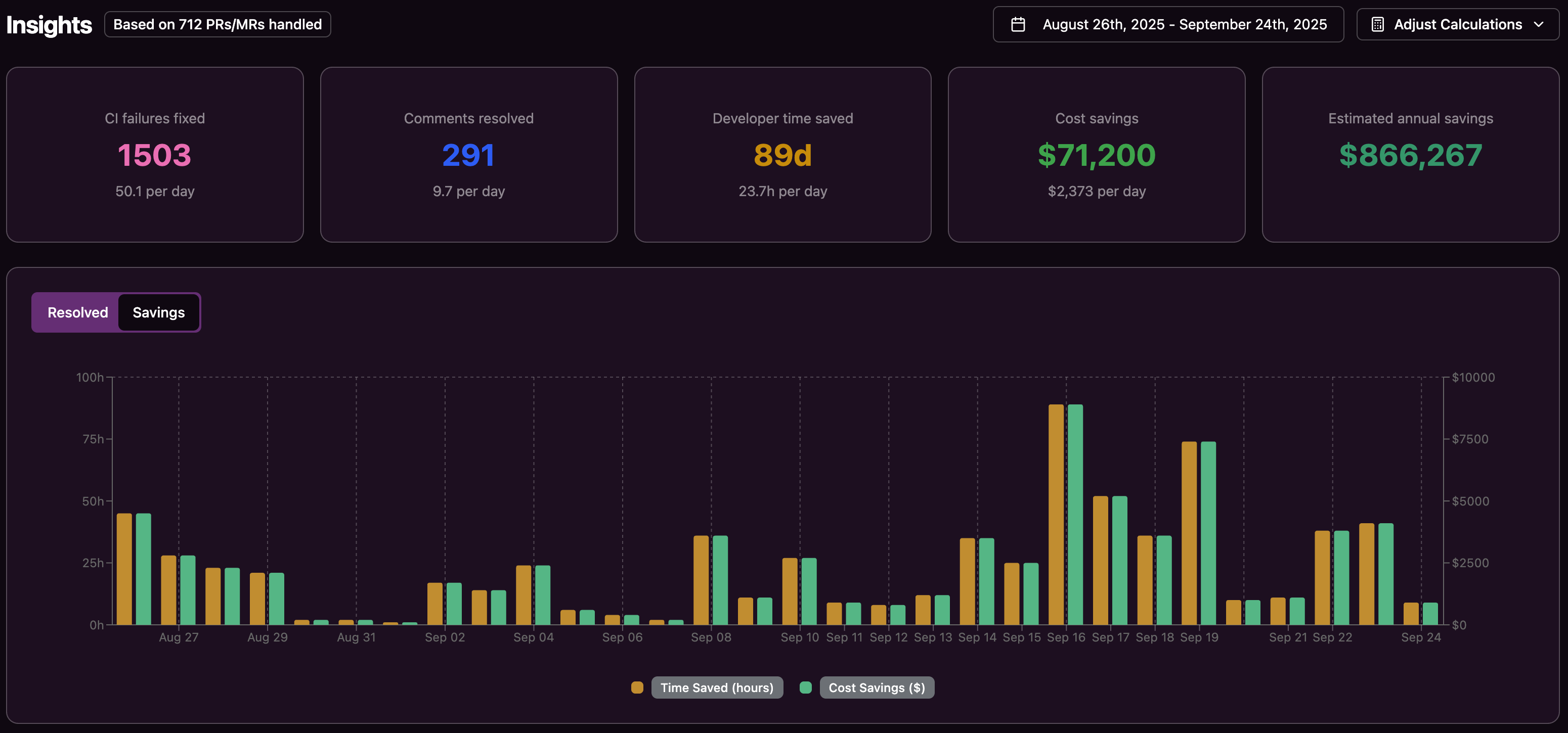
A 20-developer team that spends one hour per person per day on CI and review issues loses around 5,000 hours annually. With an estimated loaded rate of 200 dollars per hour, that equals one million dollars in productivity. If an autonomous CI fixer cuts even half of that cost, leaders see substantial savings along with faster delivery.
Ensuring CI/CD Reliability at Scale for DevOps and Platform Engineers
Gitar helps keep pipelines stable even as systems grow more complex. Typical CI/CD pipelines include pre-commit checks like linting, testing, and security scans. When these checks fail, autonomous fixing prevents them from turning into long-running incidents or repeated manual interventions.
Faster Onboarding for New Team Members
New hires often struggle more with CI configuration than with business logic. Gitar reduces this burden by fixing environment gaps, minor configuration issues, and common mistakes directly in the pipeline, so new developers can ship code sooner while they learn the stack.
Explore how Gitar can reduce CI toil and code review overhead for your engineering team.
Frequently Asked Questions (FAQ) about the Best Continuous Integration Tools
What are the primary reasons CI pipelines fail, even with the best tools?
Many pipelines fail because of flaky tests, unpinned or conflicting dependencies, brittle test data, and non-deterministic environments. These problems often demand manual investigation, which disrupts workflow and slows down merges.
How can AI truly fix CI failures instead of just making suggestions?
AI-driven CI tools analyze logs, trace failures back to specific code or configuration issues, and generate targeted changes. With Gitar, these changes run through the full CI workflow before merging, so only fixes that pass all checks reach the main branch.
Is it safe to automate CI fixes in complex enterprise environments?
Automation can be safe when tools accurately mirror production-like CI environments and include guardrails. Gitar supports this by modeling dependencies and integrations, then providing trust controls so teams can start with suggested changes, advance to auto-generated pull requests, and later adopt auto-commits with rollback.
How does an autonomous CI fixer like Gitar improve time-to-market?
Automated handling of CI failures and review edits removes many small delays between first commit and final merge. This reduction in wait time and rework helps teams release features and fixes more quickly.
What makes continuous integration tools best-in-class in 2026?
Leading tools in 2026 do more than run tests and report failures. They understand full environments, resolve many issues autonomously, reduce context switching for developers, and let teams configure how much automation to adopt at each stage.
Conclusion: The Future of Continuous Integration is Self-Healing
Persistent CI challenges like flaky tests, dependency conflicts, and configuration drift now require more than better dashboards. The best continuous integration tools in 2026 emphasize proactive, autonomous resolution instead of simple failure reporting. Major platforms already use AI to resolve CI/CD pipeline failures more quickly, which signals that self-healing capabilities are becoming standard for competitive software delivery.
Gitar reflects this shift by automating CI fixes and implementing code review feedback, turning many blockers into background tasks. With fewer interruptions and less manual toil, engineering teams can spend more time building high-quality software.