
Last updated: March 10, 2026
Key Takeaways
- AI coding tools speed up code generation 3 to 5 times, but PR review bottlenecks remain.
- Gitar leads with a healing engine that auto-detects and fixes bugs, security issues, CI failures, performance problems, and architecture flaws with near-zero false positives.
- Competitors like CodeRabbit and Snyk add value but lack Gitar’s auto-fixing, unlimited private repo trial access, and broad detection coverage.
- Key evaluation criteria include less than 5% false positives, 30-second setup, multi-CI integration, and repo-wide scanning, and Gitar performs strongly across all of them.
- Small teams save more than $750K annually in productivity; start Gitar’s 14-day Team Plan trial for guaranteed green builds and automated issue resolution.
How We Evaluated AI Code Review Platforms for Comprehensive Detection
Our evaluation criteria focus on the real constraints facing small development teams in 2026. We prioritized unlimited private repository access, broad issue detection across bugs, security, CI, performance, and architecture, and reliable auto-fixing capabilities. We also required false positive rates under 5%, seamless GitHub and GitLab integrations, and setup times under one minute.
Testing used hands-on evaluation of 10 AI-generated PR repositories across Python, JavaScript, and Go codebases. Our analysis combines these benchmarks with direct testing of each platform’s ability to detect issues across the full development lifecycle.
Top 7 Free AI Code Review Platforms for Comprehensive Issue Detection in 2026
#1 Gitar
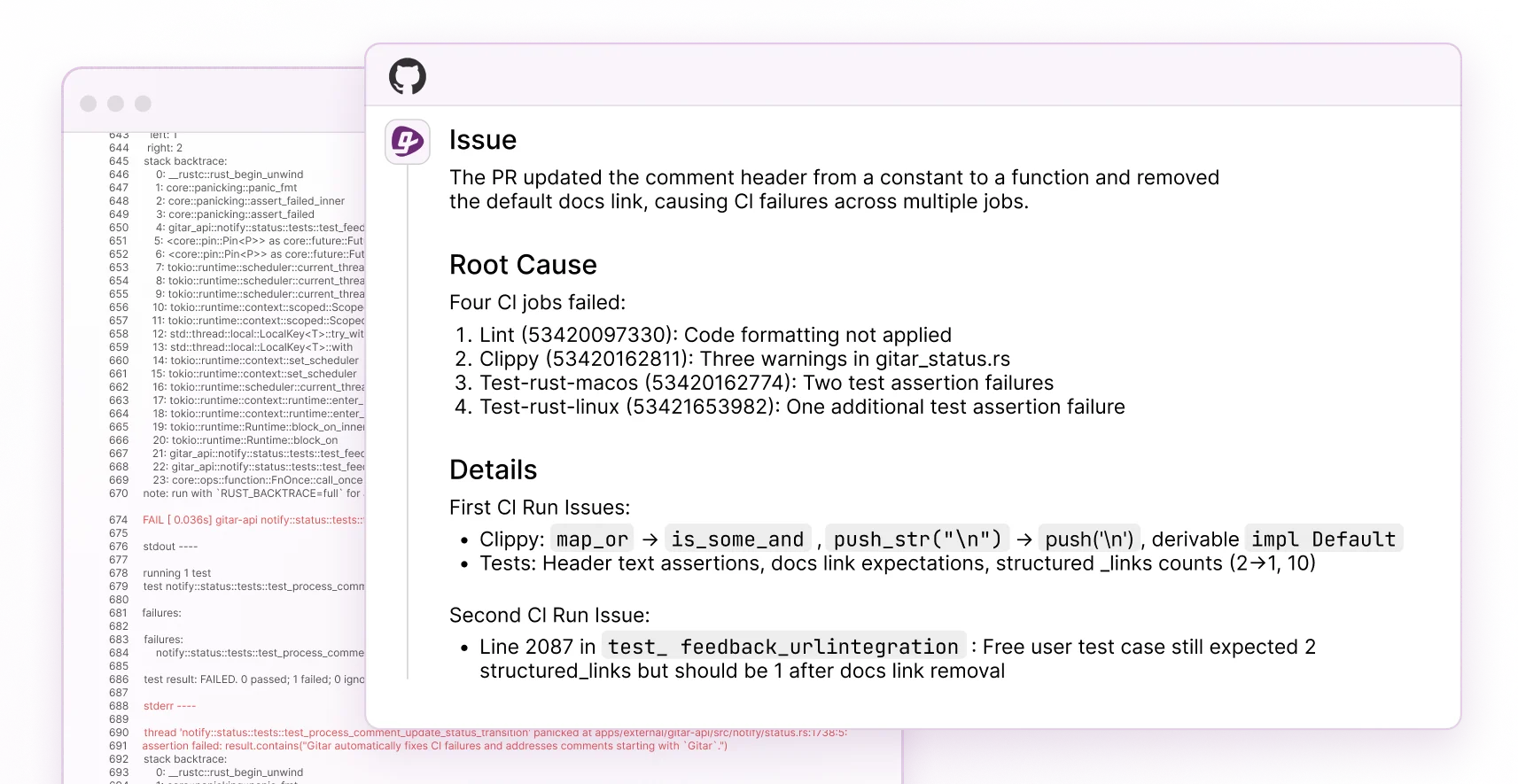
Gitar stands out as the only platform with a complete healing engine that detects issues and then automatically fixes them. When CI fails because of lint errors, test failures, or build breaks, Gitar’s healing engine analyzes failure logs, generates validated fixes, and commits them directly to your PR. The system does not simply suggest changes and hope they pass. It acts as an autonomous engine that consistently delivers green builds.
Key features include unlimited private and public repositories during the 14-day Team Plan trial and broad detection across bugs, security vulnerabilities, CI failures, performance issues, and architectural problems. The platform integrates with GitHub Actions, GitLab CI, CircleCI, and Buildkite, along with native Slack, Jira, and Linear connections.
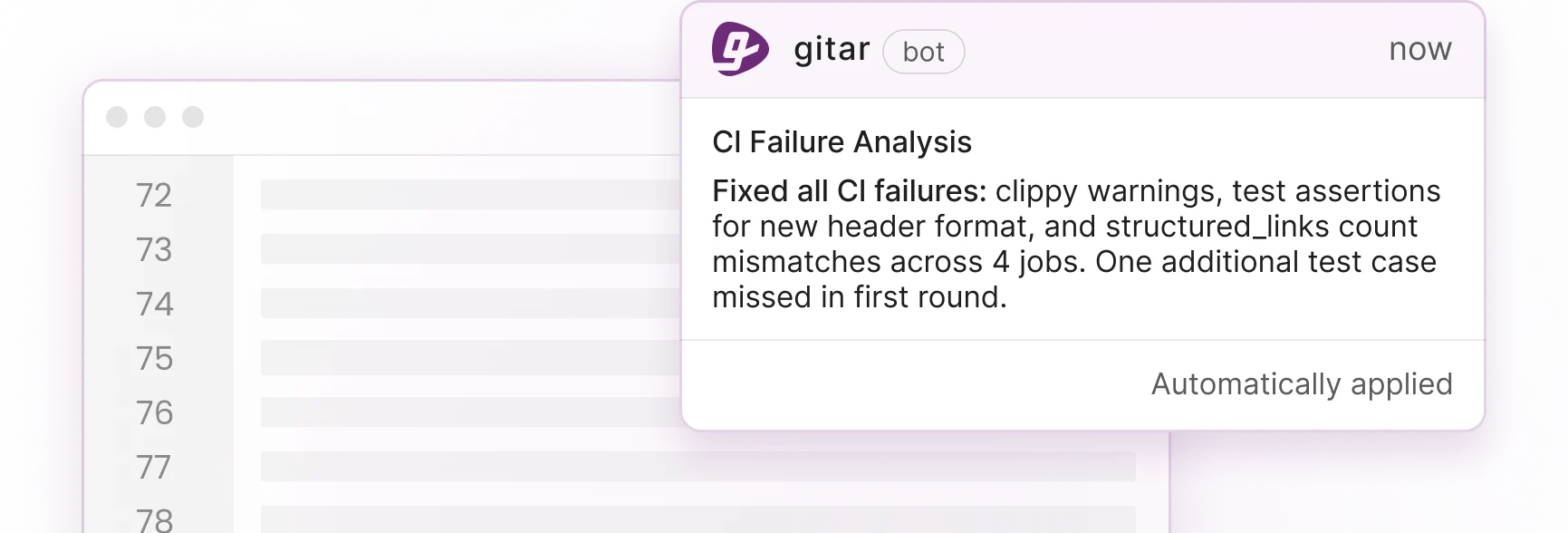
The single updating comment model reduces notification noise, since all findings appear in one clean dashboard that refreshes as issues resolve.
Strengths: Healing engine with validated auto-fixes, unlimited access during 14-day Team Plan trial, cross-platform CI support, natural language workflow rules, single comment interface
Ideal for: Teams that want guaranteed green builds and comprehensive automated issue resolution
Experience Gitar’s healing engine with your 14-day comprehensive detection trial.
#2 CodeRabbit
CodeRabbit delivers codebase-aware reviews with dependency understanding across files. The platform connects linters, SAST tools, and security scanners for broad analysis, but it still works as a suggestion engine that requires manual fixes.
Strengths: Code graph analysis, pre-merge quality gates, unit test generation
Limitations: Rate limits on reviews, no auto-fixing capabilities, high notification volume
Ideal for: Teams comfortable applying all fixes manually
#3 Snyk Code
Snyk Code focuses on security-first scanning inside PR workflows using semantic analysis. The free tier covers core vulnerability detection but does not provide full bug detection or architectural analysis.
Strengths: Strong security focus, semantic analysis engine
Limitations: Narrow security-only focus, limited comprehensive detection, no CI failure analysis
Ideal for: Security-conscious teams that mainly need targeted vulnerability scanning
#4 SonarQube Community Edition
SonarQube Community delivers static analysis for code quality, security, and maintainability with build pipeline integration and pull request decoration. The community edition does not include advanced AI-powered analysis.
Strengths: Mature platform, broad static analysis, build integration
Limitations: No advanced AI-powered insights, more complex setup
Ideal for: Teams that rely on traditional static analysis and already know SonarQube
#5 Codacy
Codacy offers enforceable PR gates with AI-supported explanations and wide language coverage. The platform can run slower on large repositories.
Strengths: Broad language support, enforceable gates, rule customization
Limitations: High false positive rates without careful tuning, slower analysis on large repositories
Ideal for: Teams that can invest time in configuration and rule tuning
#6 cubic
cubic provides free reviews for public repositories with unlimited reviews and 20 reviews per month for private repos across your GitHub organization, using context-aware analysis that learns project conventions. The platform offers one-click GitHub integration and learns from maintainer feedback.
Strengths: Free unlimited public repository reviews, context-aware learning, simple setup
Limitations: Review limits on private repos, newer platform with fewer ecosystem integrations
Ideal for: Open source maintainers focused mainly on public repositories
#7 BugBot
BugBot keeps false positives low by focusing on genuinely problematic code instead of style issues. The platform performs well at spotting edge cases, race conditions, and security vulnerabilities in AI-generated code.
Strengths: Low false positives, strong for AI-generated code analysis, IDE auto-fixes
Limitations: Limited coverage for full-stack comprehensive detection
Ideal for: Teams that value accuracy more than broad coverage
Free AI Code Review Tools Comparison 2026
|
Tool |
Free Limits & Detection |
Auto-Fix & False Positives |
Setup & Integrations |
|
Gitar |
Unlimited private/public (14-day Team Plan trial) | Full bugs/security/CI/arch |
Yes (healing engine) | Low (0-2%) |
30s | GitHub/GitLab/CircleCI/Slack/Jira |
|
CodeRabbit |
Unlimited private/public | Code quality/security |
No | Medium (36%) |
2-5min | GitHub/GitLab/Azure |
|
Snyk Code |
Limited scans | Security-focused |
No | Medium |
5-10min | GitHub/GitLab |
|
SonarQube |
Unlimited | Static analysis |
No | High without tuning |
15-30min | Build systems |
Start comprehensive AI code review detection with Gitar’s 14-day Team Plan trial.
Why Gitar Delivers Stronger Comprehensive Detection
Gitar’s healing engine architecture creates the core advantage. When CI failures occur, Gitar analyzes logs to identify root causes, generates fixes with full codebase context, validates that fixes work, and commits them automatically. This process forms a feedback loop that adapts to your CI environment and codebase patterns.
The single updating comment model cuts the notification overload that many teams experience with other tools. Instead of dozens of inline comments that interrupt focus, Gitar groups CI analysis, review feedback, and rule evaluations into one dashboard that updates as issues close.
Natural language workflow rules let teams automate complex processes without writing YAML. Repository rules in plain English can assign security reviewers, add labels, or trigger custom actions based on specific code changes.
Key Buying Factors for Small Engineering Teams
False positives remain a major issue as tools flag many non-issues per PR, which erodes developer trust.
ROI modeling for a 20-developer team shows potential savings of more than $750K per year when comprehensive automation cuts CI and review friction from one hour to 15 minutes per developer per day. The move from suggestion engines to healing platforms shifts results from small incremental gains to large productivity improvements.
Platform selection should reflect engineering leader goals for higher velocity, developer needs for fewer context switches, and DevOps priorities for self-healing CI that reduces rerun costs and maintenance work.
Frequently Asked Questions
What is the best free AI code review platform for comprehensive issue detection?
Gitar delivers the most complete experience through its 14-day Team Plan trial, with unlimited private repository access, full healing engine capabilities, and full CI integration. Competing tools often restrict features or only provide suggestions, while Gitar includes auto-fixing, validated commits, and cross-platform CI support without feature limits during the trial.
How do CodeRabbit’s free tier limitations compare to other platforms?
CodeRabbit’s free tier applies rate limits on reviews and does not support auto-fixing, so teams must implement every suggestion manually. It still offers strong analysis with unlimited private repo access, but higher review volumes may require paid plans. Other platforms such as cubic provide unlimited public reviews but limit private ones, while Gitar’s trial grants full access to both private and public repositories with complete automation features.
Does Gitar integrate with existing GitHub workflows and CI systems?
Gitar integrates natively with GitHub, GitLab, GitHub Actions, GitLab CI, CircleCI, and Buildkite. The platform also connects with Slack, Jira, and Linear to support end-to-end workflow automation. Setup usually takes about 30 seconds through the GitHub App installation, and the healing engine immediately starts analyzing CI failures and applying fixes across your development pipeline.
How can teams measure ROI from AI code review automation?
Teams measure ROI by tracking time saved from fewer CI failures, faster PR cycles, and reduced manual fixing. Common metrics include CI rerun reduction, shorter review cycle times, and developer hours saved through automated resolution. Gitar’s analytics dashboard reports on fixes implemented, CI failures prevented, and productivity gains across your workflow.
Can comprehensive AI code review handle complex CI environments?
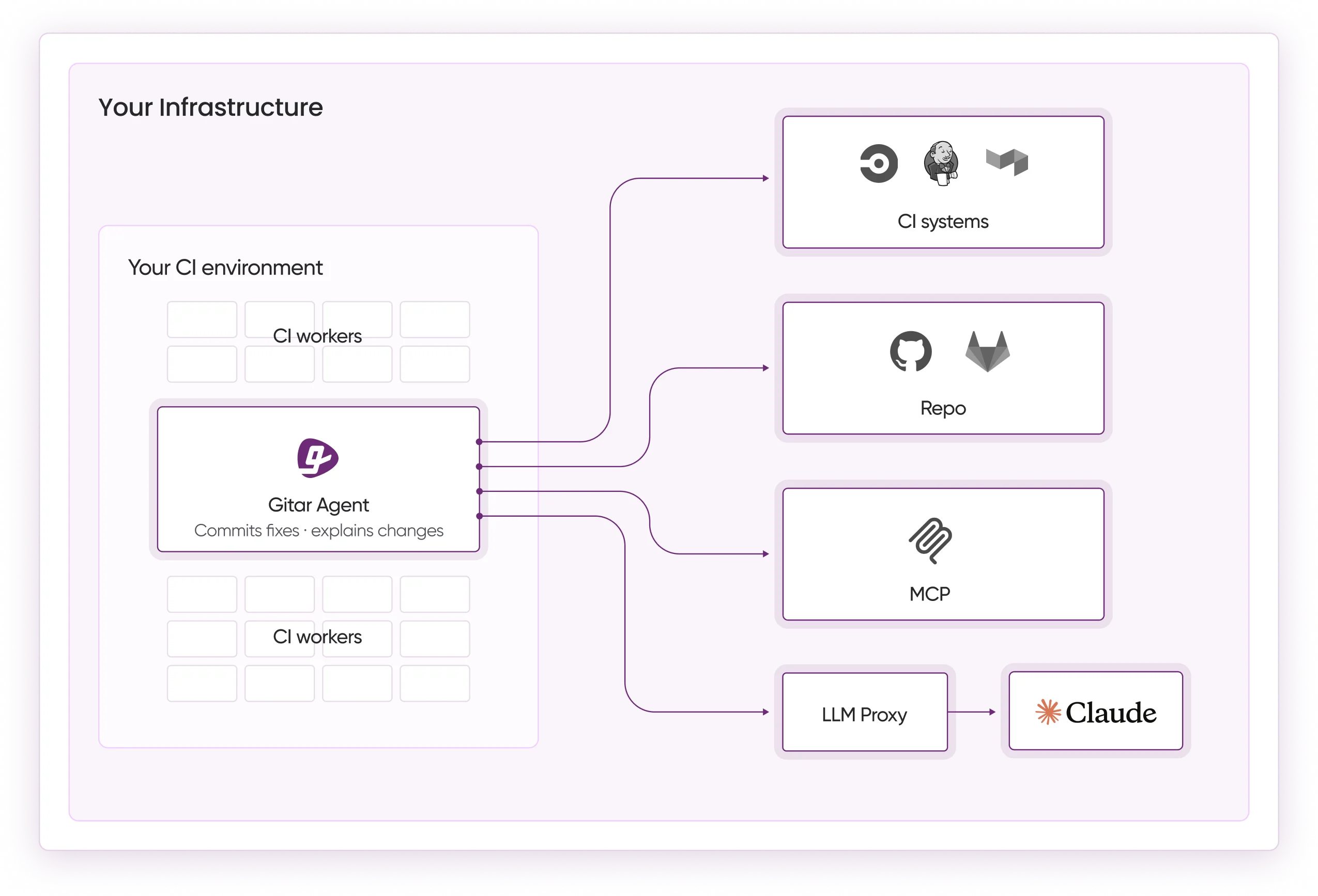
Advanced platforms such as Gitar handle complex CI environments by emulating full setups, including specific SDK versions, multi-dependency builds, and third-party integrations. The healing engine reads complete CI logs, understands environmental context, and generates fixes that succeed in production environments instead of isolated tests. Enterprise teams can also run agents inside existing CI infrastructure for maximum context and security.
Conclusion: Why Gitar Leads AI Code Review in 2026
Gitar stands as the clear leader for comprehensive AI code review detection, with unlimited access during its 14-day Team Plan trial, full healing engine automation, and validated CI fixes. While many competitors charge premium prices for suggestion-only tools, Gitar delivers automation that guarantees green builds and removes most manual toil from the review process.