
Written by: Ali-Reza Adl-Tabatabai, Founder and CEO, Gitar
Key Takeaways for Multi-Repo and Monorepo Teams
- AI coding tools generate code 3 to 5 times faster, yet code review bottlenecks have increased 91%, slowing teams across multi-repo and monorepo setups.
- Most code review tools only add suggestions, without fixing CI failures or analyzing cross-repo dependencies, so engineers still apply changes manually.
- Gitar focuses on automated fixes, CI healing, large-scale repository coverage across GitHub, GitLab, CircleCI, and Buildkite, plus natural language repository rules for enterprise governance.
- Competitors such as CodeRabbit and Greptile handle scale but lack full auto-fix and CI healing, which keeps manual work high and notification noise constant.
- Teams report $750K annual savings with Gitar’s healing engine; try Gitar free for 14 days to keep builds green across all repositories.
Why Multi-Repo and Monorepo Code Review Automation Breaks at Scale
Current code review automation tools struggle once teams reach serious scale. Most tools review each pull request in isolation and ignore cross-repo context, so engineers must track dependencies and service impacts by hand. Salesforce reported about a 30% increase in code volume from AI-assisted coding, with pull requests often exceeding 20 files and 1,000 lines of change, which pushed review latency higher every quarter. This volume surge exposes the fundamental architectural limits of today’s tools.
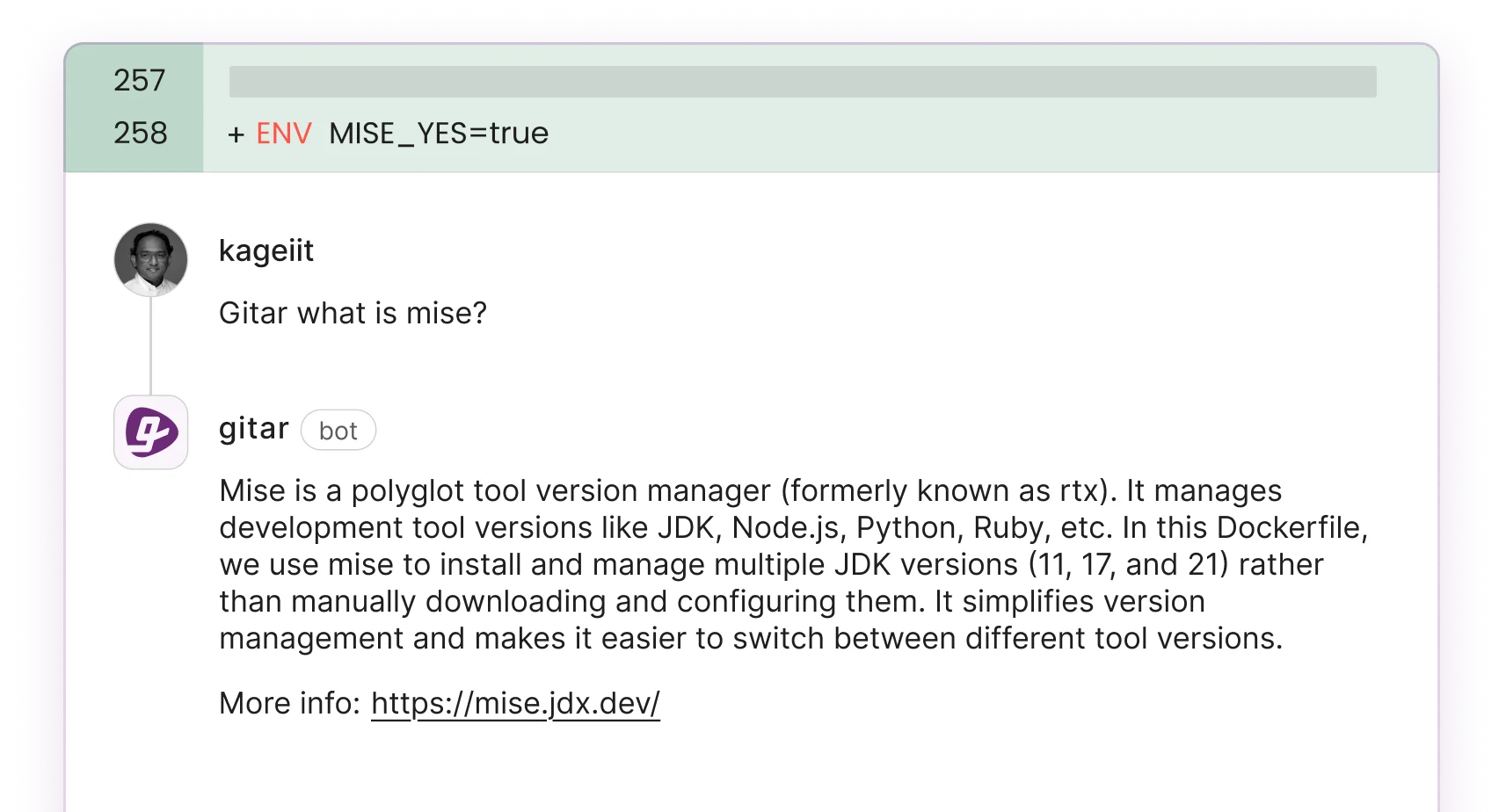
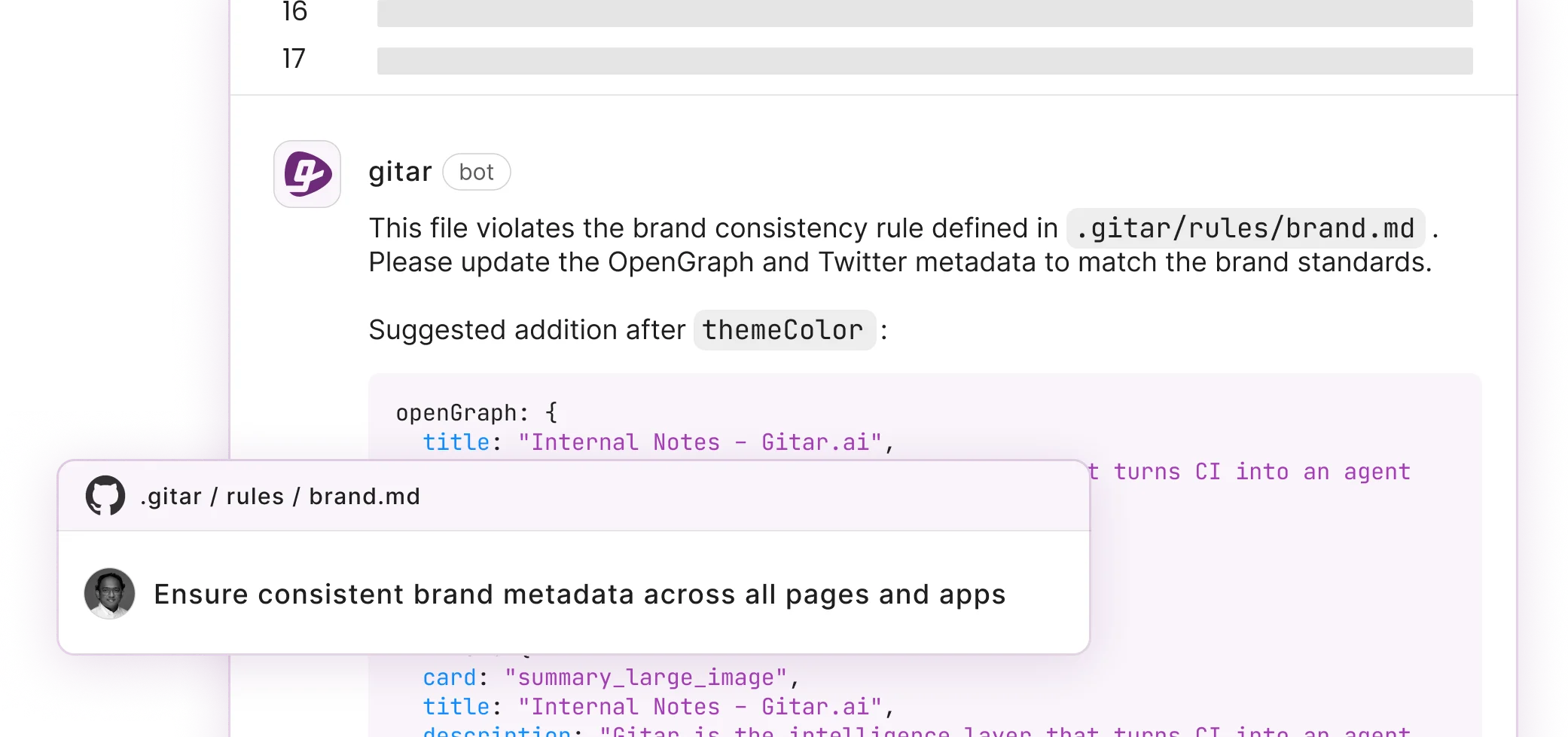
The main gaps include suggestion-only feedback that still needs manual work, no CI failure analysis with reliable auto-fix, and notification overload from scattered inline comments. Teams need centralized governance, support for large numbers of repositories, and real fixes instead of more comments. Gitar addresses these issues through repository rules written in natural language (release notes) and CI analysis that resolves failures across complex environments. See the Gitar documentation for implementation details.
How We Evaluated Code Review Automation Platforms
Our evaluation criteria focused on multi-repo scale, auto-fix and CI healing beyond comments, cross-platform coverage for GitHub, GitLab, CircleCI, and Buildkite, setup simplicity, and proven ROI. We ran hands-on benchmarks across more than 50 pull requests in Python and JavaScript, covering both monorepo and multi-repo environments. We also reviewed vendor documentation, including the Gitar documentation, GitHub statistics showing 82 million monthly pushes, and feedback from engineering teams using these tools in production.
Top 7 Code Review Automation Tools for Multi-Repo and Monorepo Teams in 2026
#1 Gitar – Healing Engine for Enterprise-Scale CI
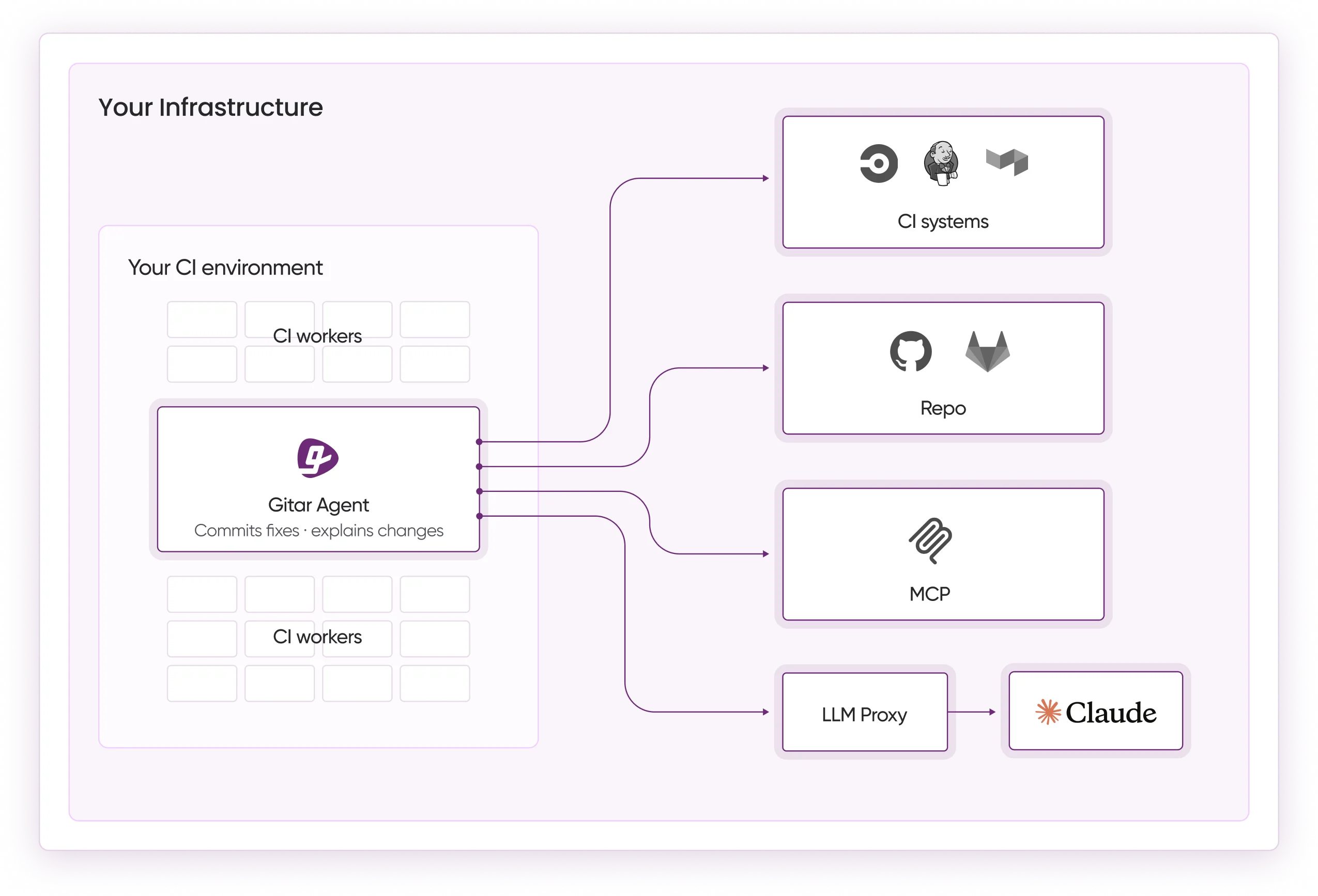
Gitar stands out as the only platform in this list that fixes code instead of only suggesting changes. When CI fails because of lint errors, test failures, or build breaks, Gitar analyzes failure logs, generates validated fixes, and commits them automatically. Gitar’s CI agent keeps full context from the moment a pull request opens until it merges, works in the background to keep CI green, finds root causes, applies fixes, and verifies results inside the team’s own CI environment.
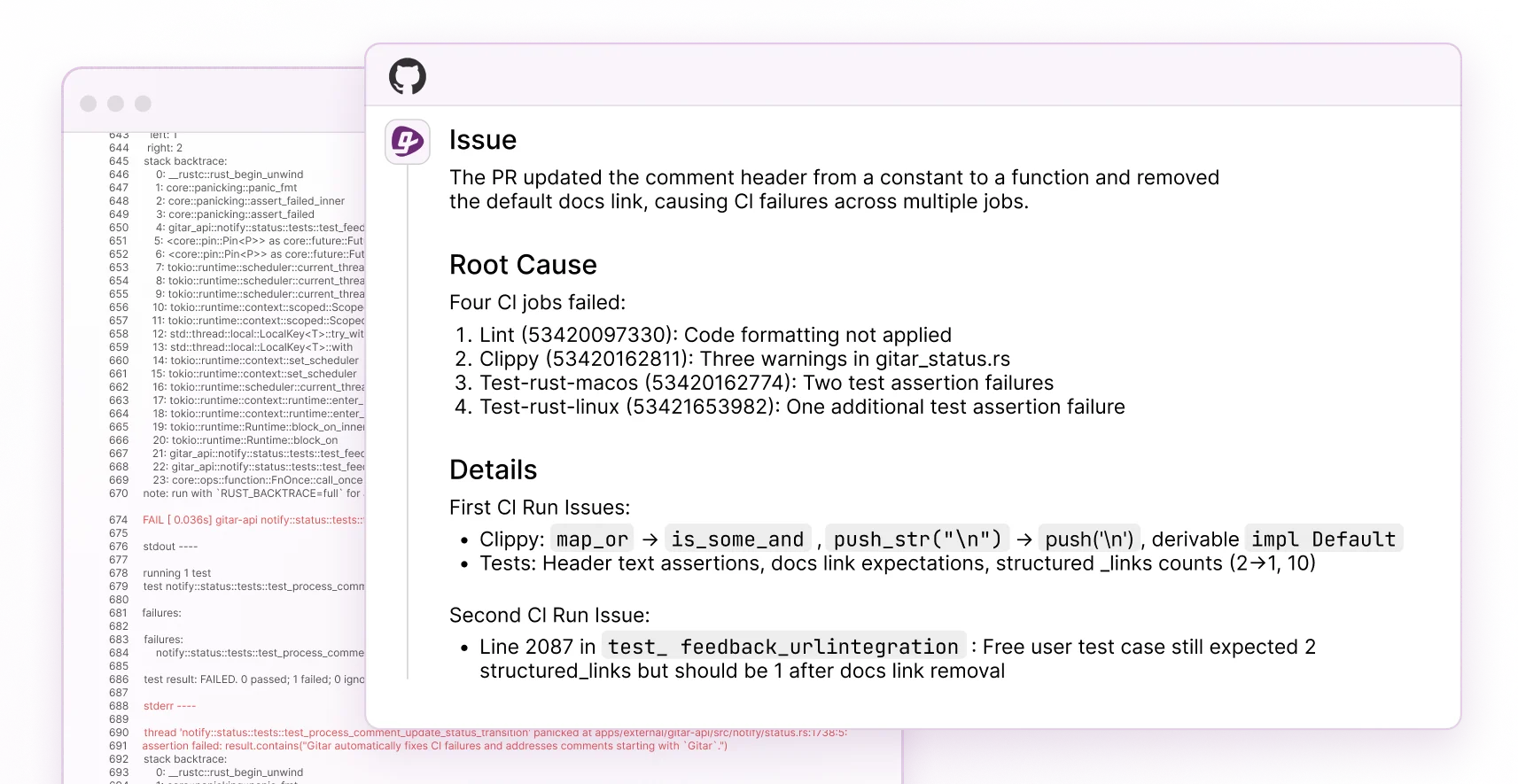
This healing approach reduces notification spam by consolidating feedback into a single dashboard comment instead of dozens of inline notes. Teams then encode their review standards using natural language repository rules (release notes) that automate workflow decisions without complex YAML. The platform supports public and private repositories across GitHub, GitLab, CircleCI, and Buildkite, with enterprise deployment options that run agents inside existing CI infrastructure.
Pros: Auto-commits validated fixes, keeps builds green, handles large repository fleets, supports natural language automation rules, and integrates with major platforms.
Pricing: 14-day free Team Plan trial, with enterprise pricing based on team size.
Ideal for: Engineering teams managing many repositories or monorepos that need automated fixes and reliable CI success.
Install Gitar now to automatically fix broken builds and experience the difference between suggestions and working solutions.
#2 CodeRabbit – High-Volume Suggestion Engine
CodeRabbit handles large volumes of pull requests across more than 1 million repositories and over 5 million processed PRs. The platform integrates with GitHub, GitLab, Bitbucket, and Azure DevOps, and supports more than 40 linters and SAST scanners. However, CodeRabbit reaches 46% bug detection accuracy and only provides suggestions, without auto-fix or CI healing.
Pros: Proven scale, multi-platform support, and many integrations.
Cons: Suggestion-only feedback, noisy inline comments, and no CI healing.
Pricing: $12 to $24 per developer per month.
Ideal for: Teams that want basic review automation and can accept manual fixes.
#3 Greptile – Codebase Context Specialist
Greptile builds a knowledge graph of the entire codebase to provide architectural context during review, and teams report 4 times faster merges. The platform excels at understanding complex codebases but still offers suggestion-only feedback without auto-fix.
Pros: Deep codebase analysis and strong architectural context.
Cons: No auto-fix and suggestion-only output.
Pricing: $20 to $30 per developer per month.
Ideal for: Large codebases that need architectural insight more than CI healing.
#4 CodeAnt AI – Multi-Repository Dependency Analysis
CodeAnt AI focuses on enterprise analysis with awareness of dependencies across multiple repositories and services. The platform emphasizes security and compliance scanning and offers some auto-fix suggestions, but it does not provide full CI healing.
Pros: Cross-repo dependency analysis and strong security focus.
Cons: Limited CI integration and no comprehensive auto-fix.
Pricing: Enterprise pricing on request.
Ideal for: Security-focused teams that need cross-repo visibility.
#5 Augment Code – Enterprise Review Platform
Augment Code supports multi-repository analysis with custom guideline integration. Jawahar Prasad, Senior Director of Engineering at Tekion (1,400 engineers), reported that after adopting Augment Code Review, average time to merge dropped from 3 days 4 hours to 1 day 7 hours, a 60% improvement.
Pros: Demonstrated enterprise impact and support for custom guidelines.
Cons: No CI auto-fix.
Pricing: Enterprise pricing based on team size.
Ideal for: Large enterprises that prioritize custom review policies.
#6 SonarQube – Static Analysis and Security Baseline
SonarQube delivers broad static analysis and security scanning with AI-powered CodeFix suggestions. The platform integrates into CI and CD pipelines for pull request scanning, but teams must configure it carefully for multi-repo environments.
Pros: Mature static analysis and strong security scanning.
Cons: Complex setup for multi-repo architectures.
Pricing: Free Community Edition, with paid tiers for enterprises.
Ideal for: Teams that need traditional static analysis and security checks.
#7 Cursor Bugbot – Editor-Integrated Reviews
Cursor Bugbot helps teams save about 40% of time spent on code reviews by analyzing how changes interact with the rest of the codebase and offering Autofix. The tool runs inside the Cursor editor and connects to GitHub, which creates a tight but narrow workflow.
Pros: Deep editor integration and some Autofix capabilities.
Cons: Requires a Cursor subscription and supports only GitHub.
Pricing: $40 per month plus a Cursor Pro subscription.
Ideal for: Small teams that already use Cursor as their primary editor.
Start shipping higher quality software, faster with Gitar’s automation across CI, repositories, and review workflows.
Decision Matrix and Benchmarks for Enterprise Teams
The following table compares how each tool performs across four practical dimensions for enterprise teams: multi-repo scale, auto-fix and CI healing, platform coverage, and estimated ROI for a typical 20-developer team.
|
Tool |
Multi-Repo Scale |
Auto-Fix CI/Review |
Platforms |
ROI (20-dev team) |
|
Gitar |
Unlimited |
Yes |
GitHub/GitLab/CircleCI/Buildkite |
$750K savings/year |
|
CodeRabbit |
1M+ repos |
Suggestions only |
GitHub/GitLab/Bitbucket/Azure |
$3,600–5,760/year cost |
|
Greptile |
Limited |
Suggestions only |
GitHub/GitLab |
$4,800–7,200/year cost |
|
Others |
Varies |
No |
Limited |
Marginal improvement |
Gitar’s healing engine delivers measurable ROI through reduced idle time that costs about $23,780 per developer per year, while competitors mainly add subscription costs and still rely on manual fixes.
Key Architectural Considerations for Monorepos and Multi-Repos
Effective code review automation at scale depends on solving several architectural challenges that affect both monorepos and multi-repo systems.
- Cross-repo dependencies: Gitar pulls product context from Jira and Linear to understand changes across repositories and services, which helps reviewers see real impact.
- CI failure cascades: Automated healing stops failures from spreading across dependent services, so one broken component does not stall multiple teams.
- Governance at scale: Natural language rules in .gitar/rules/*.md enable consistent policies across many repositories without repeating complex configuration.
- Team coordination: Single dashboard comments keep everyone informed while reducing notification spam and fragmented conversations.
Common concerns include trust in automated fixes, complex CI environments, and integration effort. Teams can start Gitar in suggestion mode, rely on its ability to emulate full CI environments, and complete setup in about 30 seconds. Experience automated fixes risk-free with a 14-day trial.
Conclusion and Practical Next Steps
Gitar emerges as the leading choice for teams that need real fixes at enterprise scale instead of more comments. Competitors often charge premium prices for commentary, while Gitar offers a full 14-day trial so teams can measure impact through automated CI healing and consistently green builds. Start your free trial today to remove review bottlenecks and increase development velocity across your repository ecosystem.
Frequently Asked Questions
Which tool supports large monorepos with complex dependencies?
Gitar supports large monorepos through its ability to handle many repositories and its healing engine that resolves CI failures and applies review feedback. This approach suits complex monorepo environments where manual fixes slow every release. Natural language repository rules also keep governance consistent across large codebases without heavy YAML configuration.
Do these tools offer free trials for evaluation?
Gitar provides a 14-day free Team Plan trial that includes full access to auto-fix, custom rules, and all integrations. Teams can track changes in sprint velocity before choosing a paid plan. Most competitors, including CodeRabbit and Greptile, offer limited free tiers or shorter trials that make ROI harder to measure in real workflows.
How does Gitar compare to CodeRabbit for multi-repo environments?
CodeRabbit focuses on suggestions, while Gitar delivers solutions. CodeRabbit analyzes code and leaves comments that engineers must implement. Gitar automatically fixes CI failures, applies review feedback, and commits validated changes. For multi-repo environments, Gitar’s cross-repository context and large-scale support make it more effective than CodeRabbit’s per-pull-request analysis.
What is involved in setting up code review automation for multiple repositories?
Gitar setup takes about 30 seconds through a GitHub App installation or GitLab integration and immediately starts posting dashboard comments on pull requests. The platform scales across many repositories without per-repo configuration. Teams can add repository rules incrementally using natural language files, and the system learns patterns over time. Enterprise deployments can run agents inside existing CI infrastructure for maximum security and context.
What ROI can teams expect from automated code review?
For a 20-developer team, the productivity impact becomes clear when comparing time spent before and after implementation. The table below shows time spent on CI and review issues before Gitar versus after implementation.
|
Metric |
Before Gitar |
After Gitar |
|
Time on CI/review issues |
1 hour/day/dev |
~15 min/day/dev |
|
Annual productivity cost |
$1M |
$250K |
Gitar’s automated fixing capabilities shorten development cycles and keep builds green, which saves about $750K in productivity for a 20-developer team.