
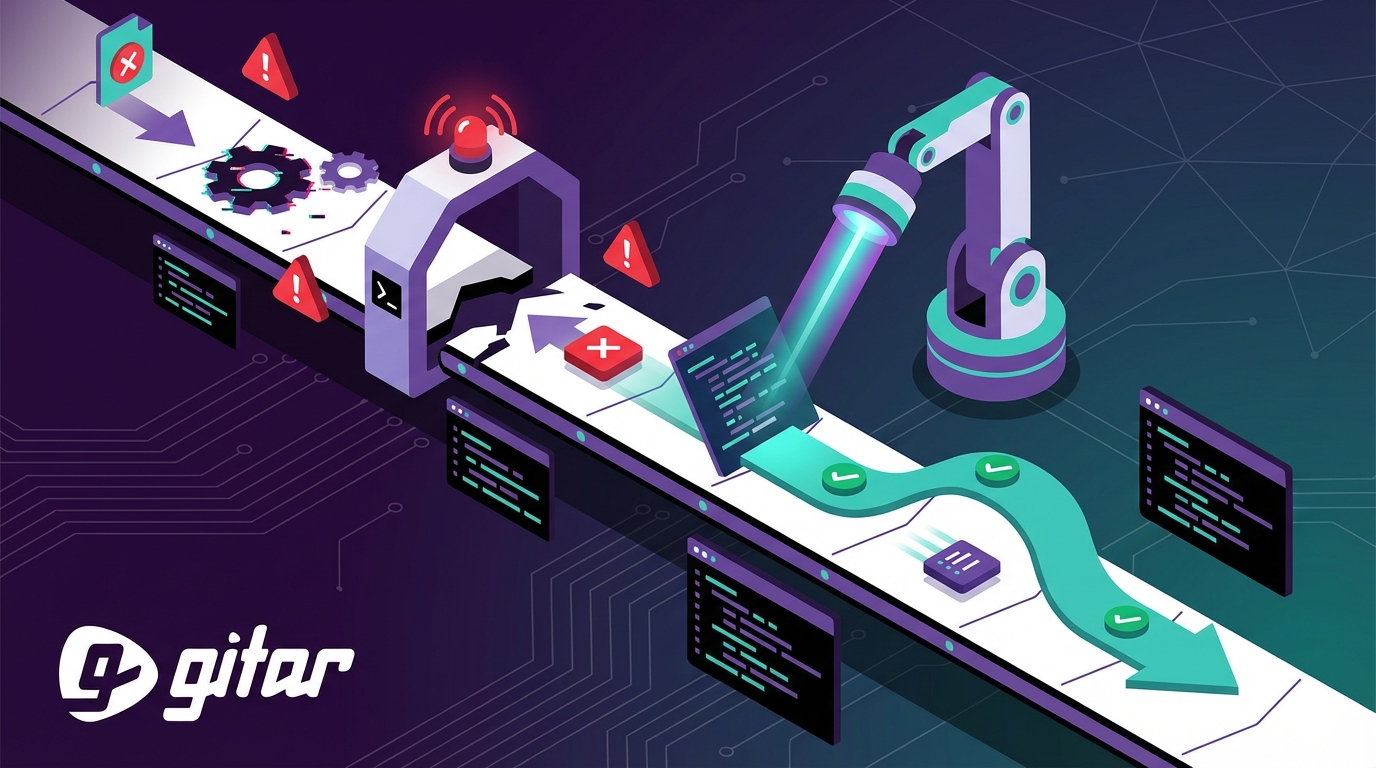
Key Takeaways
- AI coding tools have increased PR review time by 91%, which creates bottlenecks in CI failures and code reviews that delay 60% of projects.
- Gitar leads with a healing engine that auto-analyzes CI logs, generates validated fixes, and commits working solutions across GitHub Actions, GitLab CI, CircleCI, and Buildkite.
- Unlike suggestion-only tools like CodeRabbit and Greptile ($15-30/seat), Gitar offers free unlimited PR reviews with autofix via a 14-day trial, which can save teams about $1M annually for 20 developers.
- Enterprise features include SOC 2 compliance, zero data retention, and integrations with Jira and Slack, proven at scale by Pinterest with more than 50M lines of code.
- Teams can start automating CI fixes today with Gitar’s free tier to ship higher quality software faster without manual intervention.
Top 7 Automated CI Fix & Code Review Tools Compared
Our evaluation criteria focus on auto-fix capabilities, CI platform support, pricing models, and enterprise scalability. The tools below represent different approaches to automated code review and CI failure resolution.
| Tool | Auto-Fix Level | CI Support | Pricing/Best For |
|---|---|---|---|
| Gitar (#1) | Auto-commit, validated (14-day free trial) | GitHub, GitLab, CircleCI, Buildkite | Free review + 14-day trial, unlimited repos |
| CodeRabbit | Suggest-only | GitHub | $15-30/seat, PR summaries |
| Greptile | Suggestions | GitHub, GitLab | $30/seat, code context |
| DeepSource | Static, no auto-fix | GitHub+ | Paid, lint rules |
| SonarQube | Static, no auto-fix | Multi | Enterprise, static analysis |
| GitLab CI/CD | Diagnose, suggest | GitLab | Included, fix pipelines |
| Harness | Partial | Multi | Expensive, enterprise |
Gitar stands out by providing free code review and autofix features through a 14-day trial that go beyond suggestions. The platform delivers comprehensive CI log analysis with automatic fix capabilities across all major CI platforms.
Learn more about implementation at Gitar’s documentation.
#1 Gitar: Healing Engine for CI Auto-Fix & PR Reviews
Gitar delivers unlimited free PR analysis and security scanning with a healing engine that automatically resolves CI failures through autofix features available in a 14-day free trial. When lint errors, test failures, or build breaks occur, Gitar analyzes failure logs, generates context-aware fixes, validates solutions against the full CI environment, and commits working code directly to pull requests. See the Gitar documentation for implementation details.
The platform supports GitHub Actions, GitLab CI, CircleCI, and Buildkite, and it includes native integrations for Jira, Slack, and Linear. Instead of scattering inline comments across diffs, Gitar consolidates all findings into a single dashboard comment that updates in place, which reduces notification noise.
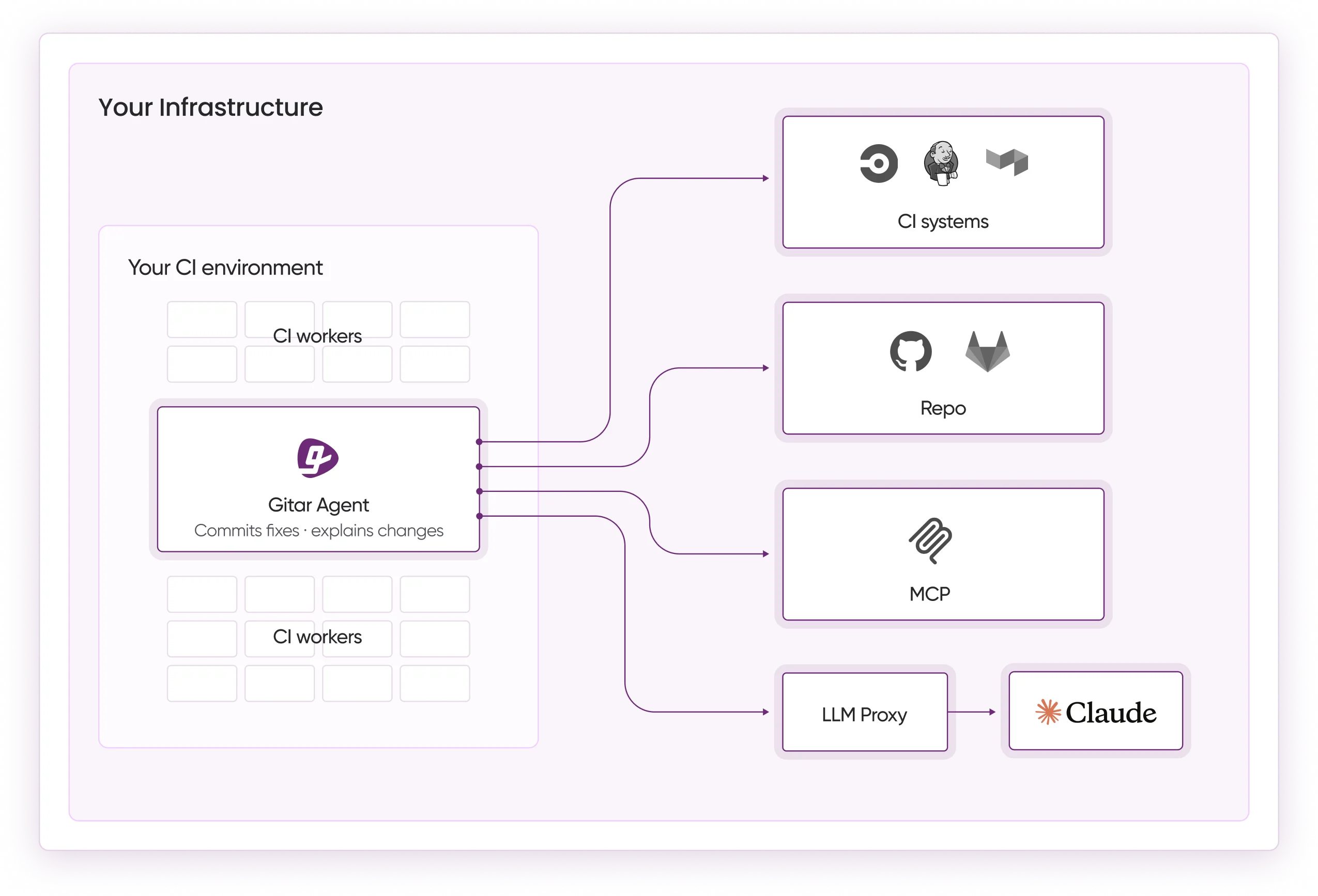
Enterprise customers including Pinterest validate Gitar at scale with more than 50 million lines of code and thousands of daily PRs. The platform’s ROI calculation shows teams achieving significant savings through automated CI resolution, with 20-developer teams saving about $1M annually by cutting manual fix time from 1 hour to 15 minutes per developer each day.
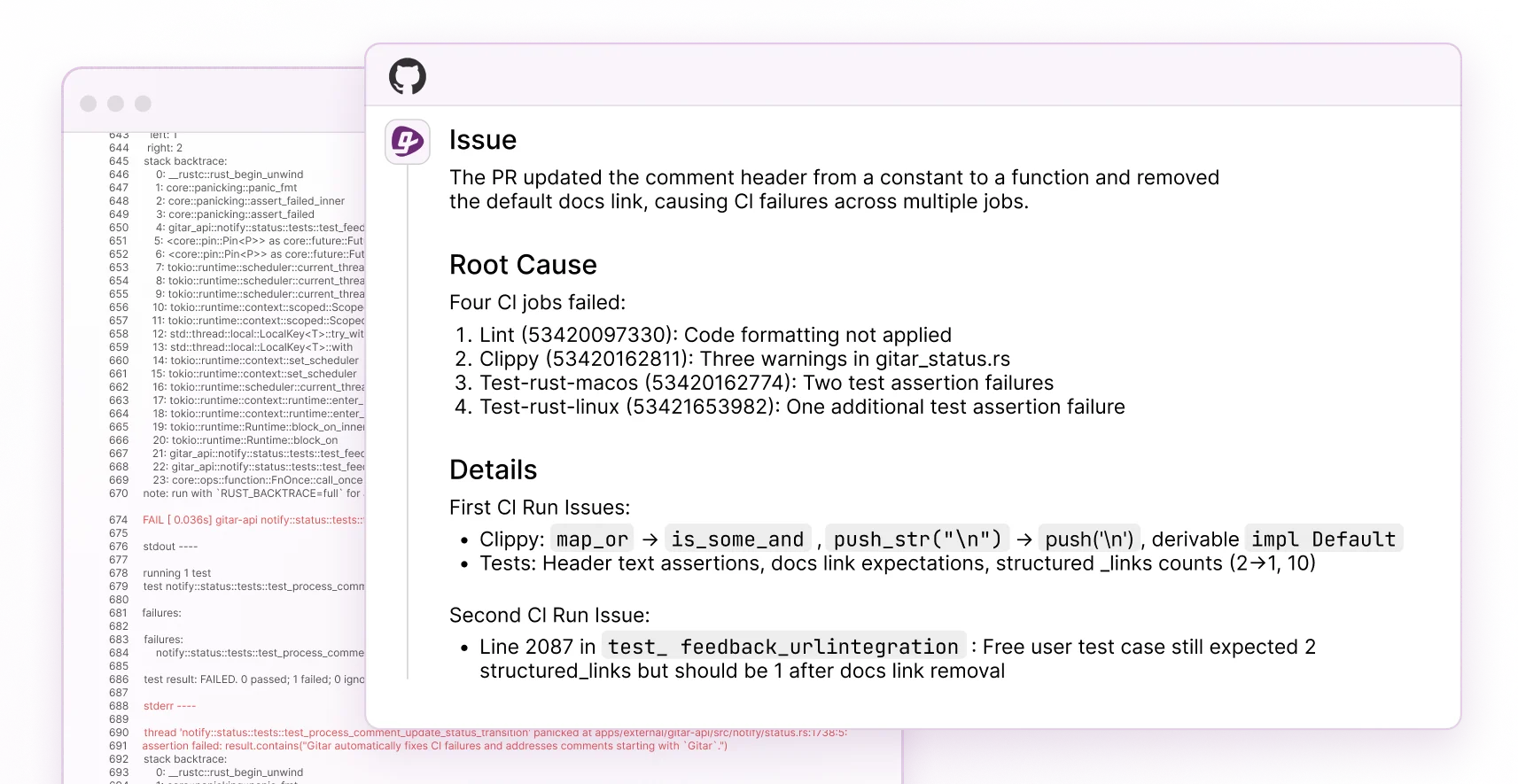
Gitar uses a security-first architecture that includes SOC 2 Type II compliance with zero data retention for free tier users. The 30-second installation process requires no credit card or seat limits, so teams of any size can start quickly.
Testimonials from Pinterest and Tigris highlight Gitar’s concise PR summaries and unrelated failure detection capabilities that save significant engineering time. The platform’s hierarchical memory system learns team patterns and maintains context across repositories, unlike competitors that start fresh on every PR.
| Capability | Gitar | Competitors | Result |
|---|---|---|---|
| CI Analysis | Full log analysis | No CI context | Gitar advantage |
| Auto-Apply | Validated commits (14-day trial) | Suggestions only | Gitar advantage |
| Pricing | Free tier | $15-30/seat | Gitar advantage |
| Platform Support | GitHub, GitLab, CircleCI, Buildkite | Limited | Gitar advantage |
Additional setup guidance is available at docs.gitar.ai.
Alternatives for PR Summaries, Context, and Static Analysis
CodeRabbit excels at PR summaries and inline suggestions for GitHub-focused teams. Strengths include comprehensive diff analysis and integration with existing GitHub workflows. Limitations include $15-30 per seat pricing, a suggestion-only approach that requires manual implementation, and a lack of CI failure context or auto-fix capabilities.
Greptile provides strong codebase context understanding with advanced semantic analysis that supports GitHub and GitLab. The tool offers detailed explanations of code changes and their implications. However, it uses a suggestion-only model at $30 per seat, lacks fix validation against CI, and provides limited integration options.
DeepSource focuses on static analysis and lint detection with comprehensive rule coverage. The platform identifies code quality issues and security vulnerabilities effectively. Drawbacks include manual fix implementation, no automated CI integration, and enterprise-focused pricing that excludes smaller teams.
SonarQube offers enterprise-grade static analysis with extensive compliance reporting. The tool provides detailed code quality metrics and security scanning. Limitations include high enterprise costs, no automatic fix application, and complex setup requirements that demand dedicated DevOps resources.
Auto-Fix vs Suggestion Tools: Direct Comparison
The core difference between healing engines and suggestion tools appears clearly when you compare capabilities side by side.
| Capability | Gitar | Competitors | Winner |
|---|---|---|---|
| CI Analysis | Yes | No | Gitar |
| Auto-Apply, Validate | Yes (guarantee) | Suggest-only | Gitar |
| Pricing | Free tier | $15-30/seat | Gitar |
| Integrations | Full, including Buildkite | Limited | Gitar |
Suggestion engines leave teams paying premium prices for incremental improvements that still require manual work. Healing engines guarantee working fixes through validated auto-commits, which removes the hope-and-retry cycle that characterizes traditional code review tools.
Rolling Out Gitar and Measuring ROI
Gitar implementation follows a phased approach. Phase 1 covers installation and suggestion mode operation to build team trust. Phase 2 enables auto-commit for specific failure types such as lint errors and simple test fixes through the 14-day free trial of autofix features. Teams usually see ROI within the first sprint as manual fix time drops from 1 hour to 15 minutes per developer each day. Detailed implementation steps appear in the Gitar documentation.
ROI calculation for a 20-developer team shows more than $750K in annual savings through reduced context switching and faster CI resolution. Organizations achieve 3.7x ROI through automated pipeline efficiency, and self-healing CI prevents costly reruns while reducing QA overhead.
Best practices include starting with low-risk auto-fixes, monitoring success rates through Gitar’s analytics dashboard, and then expanding automation scope based on team confidence and measured outcomes.
Frequently Asked Questions
What tools automatically fix CI failures without manual intervention?
Gitar provides comprehensive auto-fix capabilities through its healing engine and a 14-day free trial that automatically analyzes CI logs, generates validated fixes, and commits working solutions for lint errors, test failures, and build breaks across GitHub Actions, GitLab CI, CircleCI, and Buildkite.
How do free automated code review tools compare to paid alternatives?
Gitar’s free tier provides unlimited PR analysis, security scanning, and code review that matches or exceeds paid competitors like CodeRabbit and Greptile. The key advantage is Gitar’s healing engine approach that fixes code rather than leaving suggestions, which removes the $15-30 per seat costs while delivering stronger outcomes.
Which AI tool works best for GitHub Actions CI fixes?
Gitar offers a comprehensive GitHub Actions integration with cross-platform support that extends to GitLab CI, CircleCI, and Buildkite. The platform’s CI log analysis and auto-fix capabilities specifically target GitHub Actions workflows while maintaining compatibility with enterprise CI environments.
What ROI can teams expect from self-healing CI tools?
Teams typically achieve more than 50% reductions in CI-related manual work, with 20-developer teams saving about $1M annually. 80% enterprise adoption of AI-augmented testing by 2026 is driven by measurable improvements in velocity, reliability, and cost efficiency.
How do automated CI tools handle security and compliance requirements?
Gitar maintains SOC 2 Type II compliance with zero data retention for free tier users. Enterprise deployments run agents within customer CI environments, so code never leaves internal infrastructure. The platform also provides audit trails for all automated fixes.
Conclusion: Healing Engines Deliver Reliable CI Fixes
Gitar’s healing engine approach outperforms suggestion-based competitors by guaranteeing working fixes rather than hoping manual implementations succeed. The combination of free unlimited code review, validated auto-commits, and cross-platform CI support makes Gitar a strong choice for teams that want measurable velocity improvements.