
Key Takeaways
- AI code generation speeds delivery 3 to 5 times but creates PR bottlenecks with 75% more logic errors that swamp review capacity.
- True automated PR tools like Gitar fix CI failures directly by generating, validating, and committing solutions, while suggestion-only tools stop at comments.
- Gitar ranks #1 as a free tool offering unlimited code review with a 14-day autofix trial that supports enterprise-scale deployments.
- Teams save $750K annually by automating 45 minutes per developer per day on CI and review fixes, while avoiding $15-30 per developer monthly fees.
- Install Gitar now for free automated PR reviews that keep builds green and help teams ship faster.
How We Ranked These AI PR Review Tools
Our evaluation criteria focus on tools that autonomously resolve CI failures and implement review feedback, not tools that only suggest edits. We tested each platform on real scenarios such as lint errors, test failures, and broken builds across GitHub, GitLab, and CircleCI. Rankings weigh fix automation, validation accuracy, pricing, platform coverage, and proven ROI from enterprise deployments. Benchmarks include Pinterest-scale rollouts handling thousands of daily PRs and GitClear data showing 4x code duplication increases that demand intelligent fix validation.
Ranked Tool Reviews
1. Gitar: Free AI Pull Request Reviews That Actually Fix Code
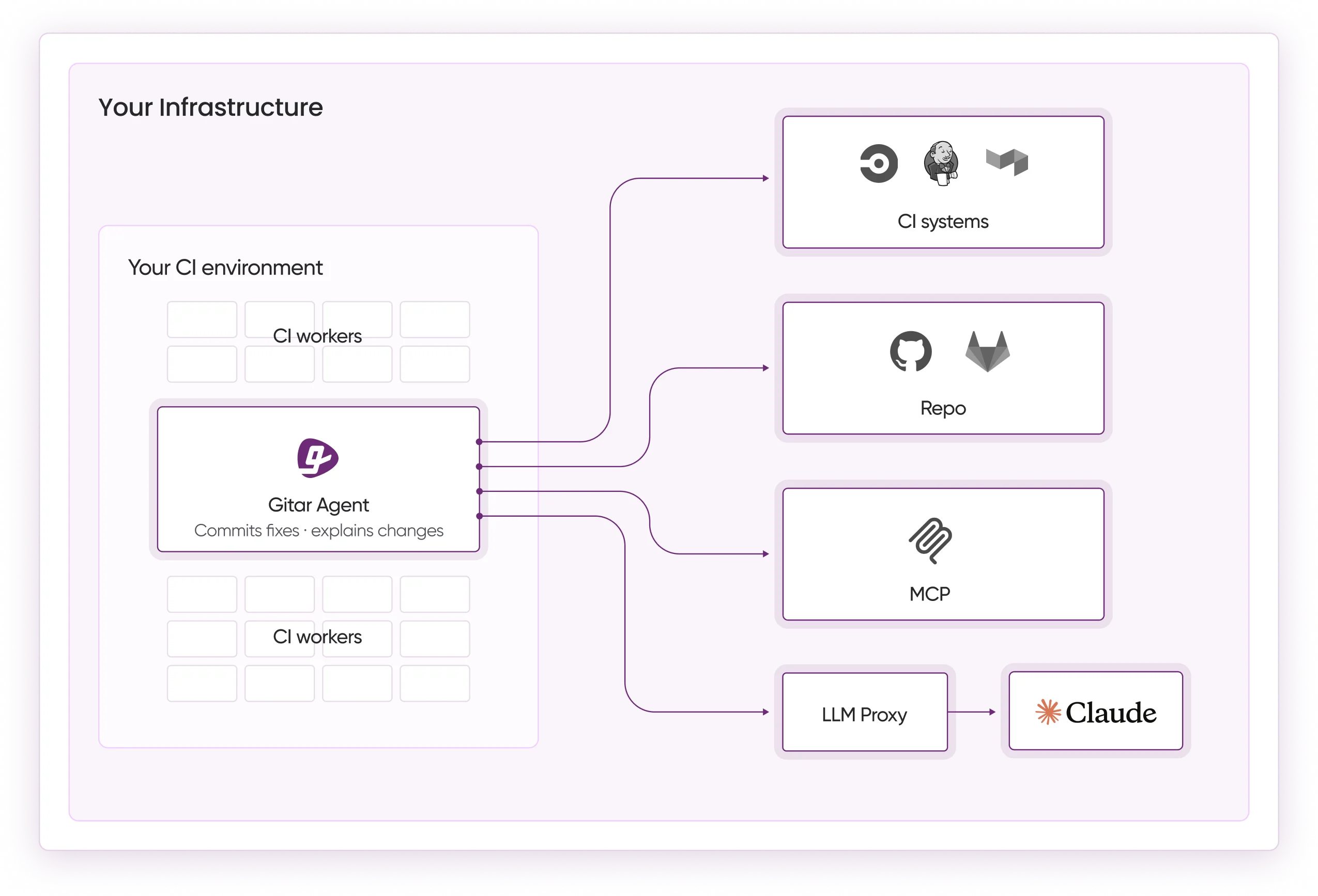
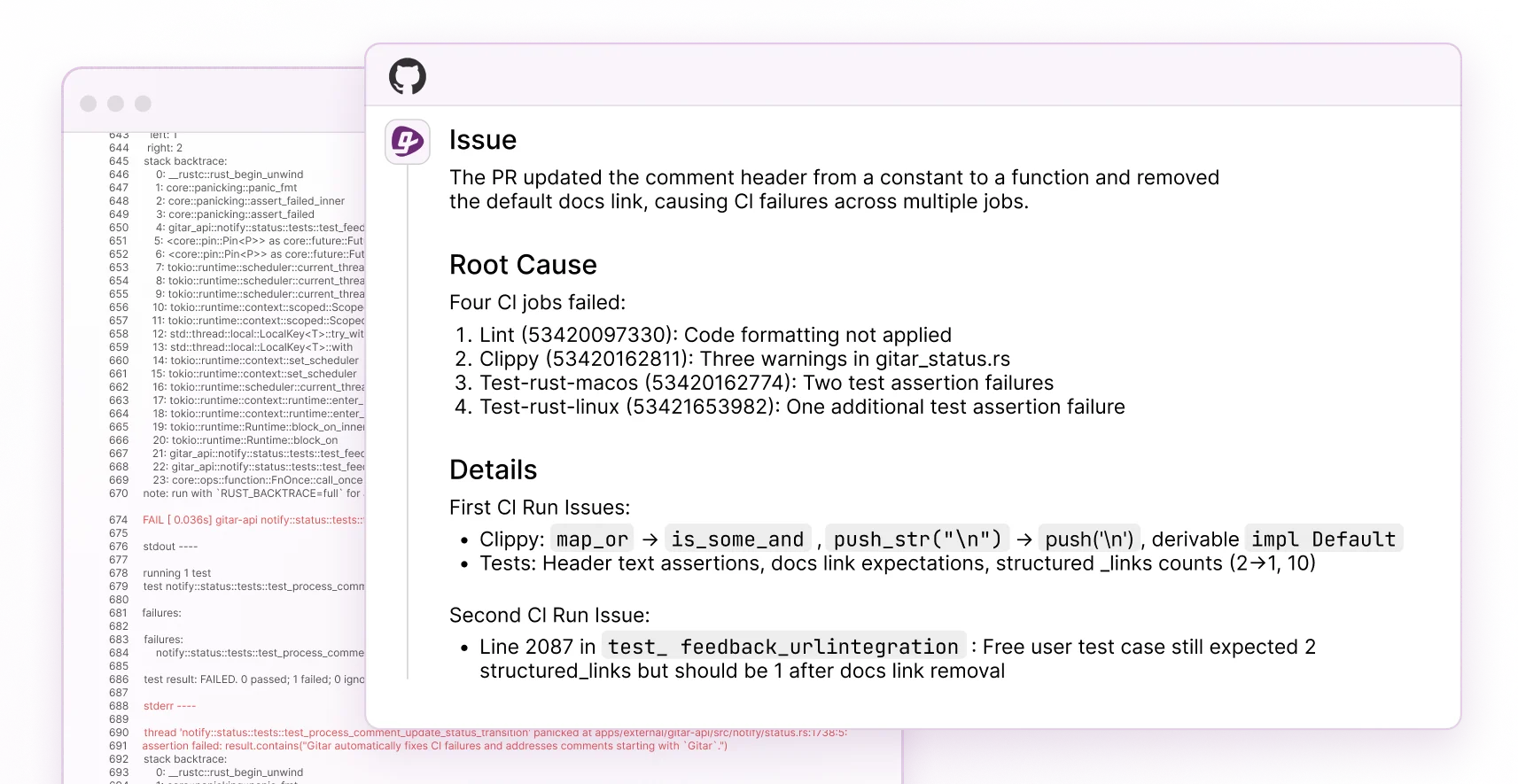
Gitar delivers free, comprehensive AI code review that analyzes CI failures, generates validated fixes, and commits working solutions, with autofix features available in a 14-day free trial. Competing tools charge $15-30 per developer for suggestions, while Gitar’s healing engine supports enterprise workloads across more than 50 million lines of code. Setup finishes in about 30 seconds through a GitHub app installation, and teams get unlimited repositories and users without a credit card. Gitar consolidates findings into a single updating comment, which reduces notification noise while still providing CI analysis, review feedback implementation, and natural language workflow rules.
Install Gitar now for free code review and a 14-day autofix trial that keeps builds green through automated CI healing.
2. CodeRabbit: AI Code Review with One-Click Suggestions
CodeRabbit offers detailed PR analysis with line-by-line comments, severity rankings, and one-click fixes. The platform integrates more than 40 linters and supports GitHub, GitLab, Bitbucket, and Azure DevOps. Fixes still require manual validation and do not automatically resolve CI failures. At $15 per developer each month, CodeRabbit emphasizes suggestion quality and suits teams that want human review on every change.
3. Greptile: Codebase-Aware AI Review Suggestions
Greptile plugs into GitHub PRs, flags authorization issues, explains risks, and suggests minimal fixes using full codebase context. The platform learns from feedback and supports natural language questions about code changes. Pricing starts at $30 per developer, positioning Greptile as a premium suggestion engine without autonomous fix validation or deep CI integration.
4. Tembo: Separate Pull Requests for Automated Fixes
Tembo opens separate PRs for automated fixes, which keeps changes isolated from the original pull request. The platform connects with Jira and Slack and offers a limited free tier. Tembo supports GitHub, GitLab, and Bitbucket, and it integrates with CI/CD pipelines while validating fixes through tests and signed commits. Automation remains more constrained than comprehensive enterprise solutions that handle full CI healing.
5. Ellipsis: Turn Natural Language Feedback into Code
Ellipsis converts natural language review feedback into code changes and generates matching tests. The platform helps teams maintain consistent coding conventions across repositories. Paid tiers power the service, and Ellipsis does not fully resolve CI failures on its own. Its core strength lies in implementing review feedback rather than delivering end-to-end CI healing.
Install Gitar now for CI auto-fixing that goes far beyond basic review suggestions.
6. DeepSource: Targeted Security and Anti-Pattern Fixes
DeepSource automatically fixes security vulnerabilities and code anti-patterns with one-click application. The platform excels at static analysis and targeted remediation but offers limited free tier options. Its fix scope stays narrow compared with full CI failure resolution, since it focuses on code quality issues instead of broader build and test failures.
7. SonarQube: Enterprise-Grade Static Analysis
SonarQube runs static analysis, detects duplication and security flaws, and adds PR comments with suggested fixes through pull request decoration. Enterprise pricing reflects its deep analysis capabilities. The platform primarily suggests changes and still relies on developers to implement fixes, so teams must handle resolution manually.
8. GitHub Copilot Workspace: Native GitHub Fix Workflows
GitHub Copilot Workspace offers workspace-level fixes with native GitHub integration at $10 or more per user monthly. The platform benefits from tight alignment with the GitHub ecosystem. It lacks broad CI platform coverage and does not match the specialized failure analysis and automated fixing depth of dedicated CI healing tools.
9. Bugbot: Budget-Friendly Inline Fix Suggestions
Bugbot provides inline fix suggestions at competitive prices, with CI integration and autonomous features such as one-click fixes and background agents. The platform delivers cost-effective PR analysis for smaller teams. Its CI integration depth can lag behind leading automated fixing tools that focus on complex, multi-step failure resolution.
10. Qodo: Focused Test Generation and QA Support
Qodo specializes in test generation and test-related fixes that support quality assurance workflows. The platform runs on paid tiers and targets teams that prioritize test coverage. It does not aim to cover full CI failure resolution or broad automated fixing across all build and runtime issues.
Agentic vs Suggestion-Only Reviewers
| Tool | Auto-Fix CI Fails | Validate Fixes | Pricing/Dev |
|---|---|---|---|
| Gitar | Yes (14-day free trial) | Yes | Free code review |
| CodeRabbit | No | No | $15 |
| Greptile | Partial | No | $30 |
| Tembo | Limited | Partial | Paid |
The core difference between these tools lies in execution capability. Agentic tools encode principles for predictable workflows that combine tools into self-correcting processes, while suggestion-based reviewers lack automated enforcement. Agentic coding enables autonomous task execution, including breaking down work, making decisions, and iterating through builds and fixes. Traditional reviewers remain limited to suggestions that still require manual follow-through.
CI Healing Results and ROI
Enterprise CI Auto-Fix in Production
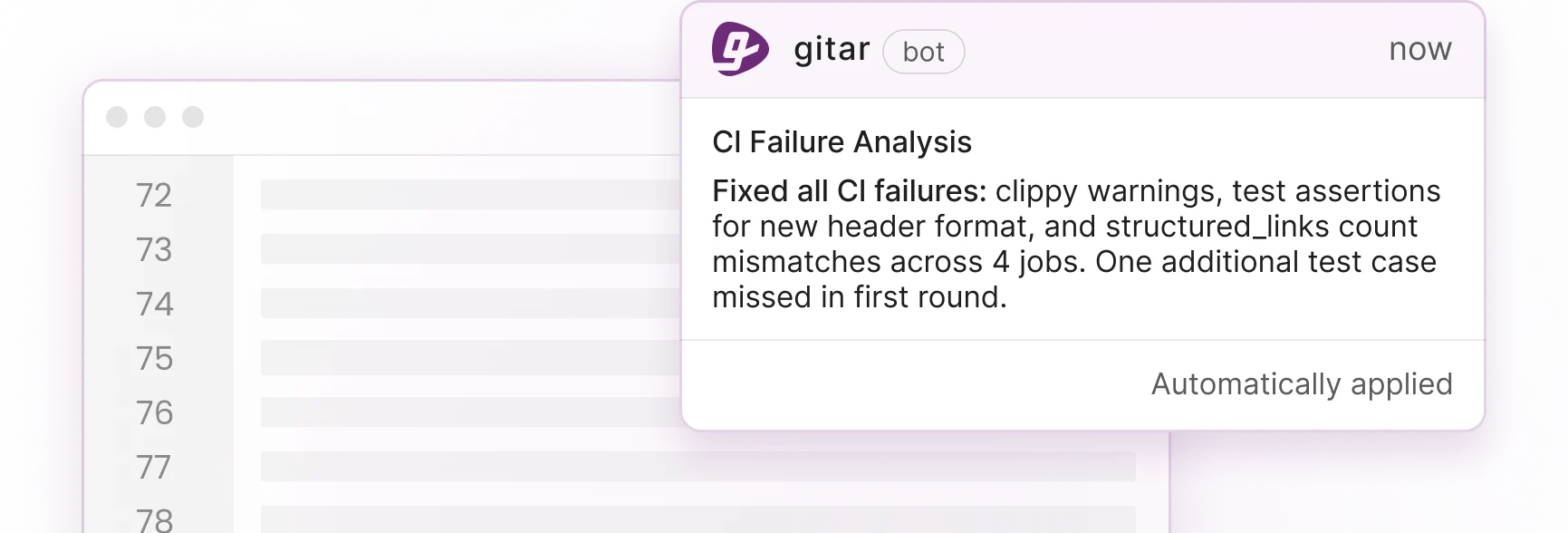
Gitar supports Pinterest-scale deployments, which demonstrates its enterprise-grade automated fixing capabilities. The healing engine resolves lint errors, test failures, and build breaks without human intervention. Success rates stay high across varied codebases and CI environments, even as teams grow and PR volume spikes.
How to Calculate Autofix ROI
A 20-developer team that spends 1 hour daily on CI and review issues can save $750,000 each year with automated fixing. Savings come from cutting resolution time from 60 minutes to 15 minutes per developer per day. Codex users submit 60% more pull requests weekly, which increases the pressure on CI and review workflows. Free tools like Gitar remove the $450-900 monthly cost of paid suggestion engines while delivering stronger autonomous fixing.
Install Gitar now to automatically repair broken builds and ship higher quality software faster.
Frequently Asked Questions
What are AI tools for PR reviews that fix code?
AI tools for PR reviews that fix code act as agentic platforms that analyze CI failures, generate validated solutions, and commit working fixes directly to pull requests. Traditional suggestion-based reviewers only identify issues and leave the rest to developers. Agentic tools execute full fix workflows that cover code generation, testing, and validation. Gitar follows this model by providing free automated CI healing that keeps builds green through autonomous failure resolution.
What is the best free CodeRabbit alternative?
Gitar stands out as the best free CodeRabbit alternative for code review because it removes per-developer fees while adding automation. CodeRabbit charges $15 per developer each month for suggestions that still need manual implementation. Gitar offers free unlimited code review with CI failure analysis, fix validation, and commit automation during the 14-day autofix trial. The platform supports enterprise scale and removes subscription costs for core review workflows.
Can PR reviews be fully automated?
PR reviews can be largely automated when teams use agentic tools that combine analysis, fixing, and validation. Gitar provides free code review with a 14-day autofix trial that handles lint errors, test failures, and build breaks without human input. Complex architectural decisions still benefit from human judgment. Routine CI issues and standard review feedback can be fully automated through intelligent healing engines.
How does Gitar compare to Greptile?
Gitar offers free automated fixing with CI validation, while Greptile focuses on paid, codebase-aware suggestions without autonomous resolution. Gitar’s healing engine analyzes failures, generates fixes, validates solutions against CI, and commits working code automatically. Greptile delivers contextual suggestions at $30 per developer monthly but requires developers to implement every change manually. It lacks the autonomous execution that defines true automated fixing tools.
How do you measure autofix ROI?
Teams measure autofix ROI by tracking time savings, reduced context switching, and fewer manual fix loops. Start by comparing developer hours spent on CI issues before automation with hours spent after rollout. For teams that spend 1 hour daily on CI problems, automation that cuts this to 15 minutes yields $37,500 in annual savings per developer. Additional gains include faster deployments, fewer build reruns, and higher developer satisfaction from removing repetitive fix work.
Conclusion: Why Gitar Leads Automated PR Reviews
Gitar leads 2026 automated pull request review tools by delivering free, comprehensive CI healing that fixes code instead of only suggesting edits. Competing platforms often charge premium prices for basic commentary, while Gitar provides autonomous failure resolution with enterprise-proven success. Install Gitar now, the leading automated pull request review tool that fixes code with 30-second setup and no credit card required.