
Written by: Ali-Reza Adl-Tabatabai, Founder and CEO, Gitar
Key Takeaways for Engineering Teams
- AI coding tools now appear in 84% of developer workflows in 2026, yet PR review times have increased 91% because reviewers must validate AI-generated code.
- Gitar leads with a Healing Engine that autonomously resolves CI failures and implements review feedback, which removes most manual fix work.
- Tools like GitHub Copilot and Cursor excel at code generation for individuals, but they do not provide automated CI healing for team-wide workflows.
- Teams with 20 or more developers often face annual losses above $1 million from review bottlenecks, so autonomous tools create the strongest financial return.
- Start with Gitar’s 14-day free trial with unlimited seats to automate fixes and increase team velocity — try Gitar free for 14 days.
How We Tested These AI Coding Tools
We evaluated each tool across six criteria that directly affect team productivity. These criteria included PR velocity improvements, auto-fix validation with CI integration across GitHub Actions, GitLab CI, and CircleCI, and collaboration features such as noise reduction and single-comment interfaces. We also reviewed enterprise security compliance for SOC 2 and data sovereignty, scalability with clear ROI metrics, and integrations with tools like Jira and Slack.
Testing data comes from vendor documentation, Gitar’s technical specifications, developer community feedback, and real-world case studies from teams like Tigris and Collate.
Using this methodology, we evaluated nine leading AI coding tools. Here is how they compare.
9 AI Coding Tools for Teams: Comprehensive Analysis
1. Gitar (Best Overall: Auto-CI Healing Engine)
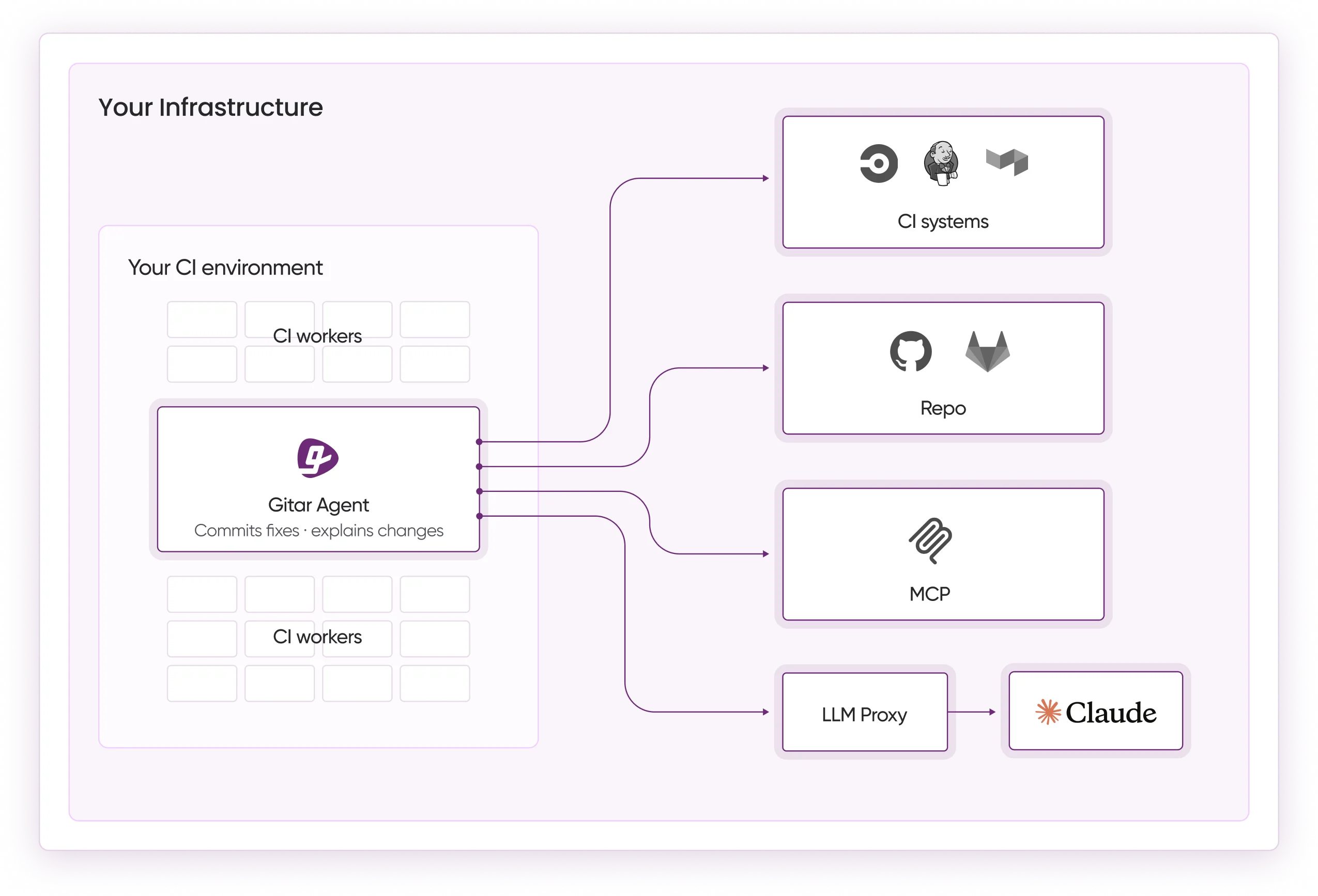
Gitar turns code review from a suggestion engine into an autonomous healing system. When CI fails or reviewers leave feedback, Gitar’s agent maintains full context from PR creation to merge and works continuously to keep CI green by finding root causes, fixing them, and verifying results. The platform delivers validated auto-fixes instead of untested suggestions.
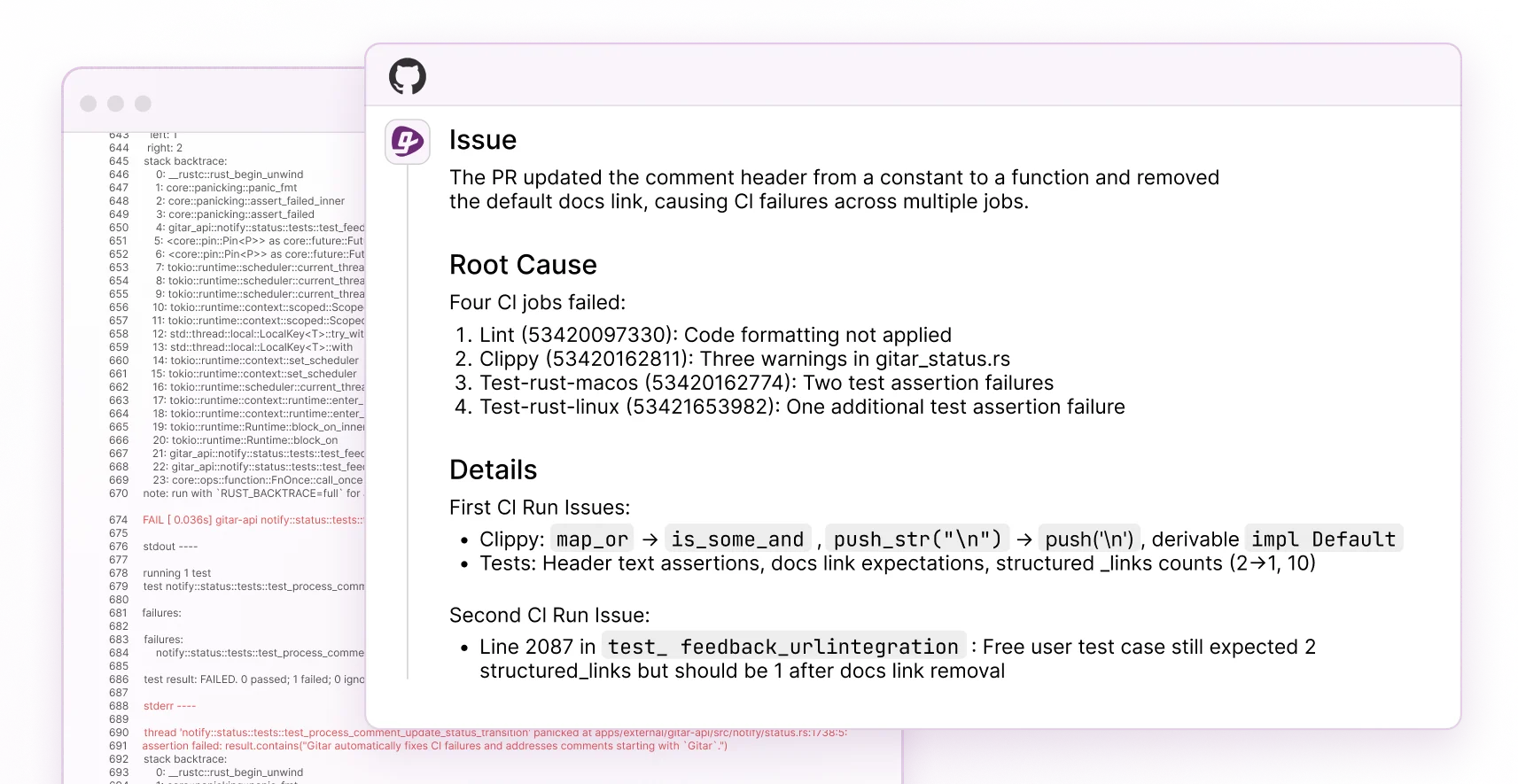
Key features include automatic CI failure resolution, review feedback implementation through single comment mentions, and a consolidated Dashboard comment that updates in real time instead of flooding PRs with notification spam. Setup takes about 30 seconds through a GitHub or GitLab app installation.
Pricing starts with a risk-reducing model: try Gitar free for 14 days with unlimited seats and full feature access. For teams that prioritize compliance, Gitar is SOC 2 Type 2 certified for enterprise security.
Strengths include significant productivity gains for 20-developer teams through automated fixes. No material limitations appeared during testing.
Gitar works best for teams with 20 or more developers that face PR bottlenecks and run multi-CI environments where reliable auto-fixes matter.
2. GitHub Copilot
GitHub Copilot remains the most widely adopted AI coding assistant, with inline suggestions and chat-based code generation. The Business tier costs $19 per user each month and includes IP indemnity, while the Enterprise tier at $39 per user each month adds advanced security features.
Copilot shines for individual productivity through context-aware autocomplete and repository integration, including coding agents for autonomous implementation. It does not, however, include dedicated CI healing capabilities that match team review workflows. Pull requests with heavy Copilot-generated code take 26% longer to review, which increases team-wide review time.
Copilot fits individual developers who want faster coding, while teams still need separate tools for CI automation and review workflow improvements.
3. Cursor
Cursor delivers an AI-native IDE experience with fast autocomplete and strong agentic capabilities. The platform reached $2 billion ARR in 2026 with Supermaven-powered autocomplete. The Teams tier costs $40 per user each month and includes shared chats and SSO.
Cursor’s Agent mode handles multi-file changes effectively with auto-apply features, yet it does not integrate with CI for automated failure resolution. This gap forces teams to manage CI fixes manually. The credit-based pricing model also creates unpredictable costs for heavy usage teams.
For teams that want CI automation alongside their IDE experience, consider pairing Cursor with Gitar and use Gitar’s 14-day free trial to cover CI healing.
Cursor suits teams that prioritize IDE experience and real-time collaboration, while CI workflow automation still requires additional tools.
4. Augment Code
Augment Code focuses on enterprise security with deep repository context analysis. The Standard tier costs $49 per user each month and includes coding agents, which positions it as a premium option for security-conscious teams.
The platform offers strong codebase understanding and security scanning. It provides fewer auto-fix capabilities than autonomous healing systems, so teams still implement most suggestions manually.
Augment Code works best for enterprise teams with strict security requirements and budgets that support premium pricing.
5. Tabnine
Tabnine emphasizes enterprise compliance with zero data retention policies and flexible deployment. The platform supports SaaS, VPC, on-premises, and air-gapped deployments and holds GDPR, SOC 2, and ISO 27001 certifications. Code Assistant costs about $39 per user each month.
Strong privacy controls make Tabnine attractive for regulated industries. The suggestion-only model, however, does not provide automated CI healing, so teams still perform manual fix implementation and validation.
Tabnine fits organizations that require strict data sovereignty but still want solid AI assistance.
6. CodeRabbit
CodeRabbit offers AI-powered code review with inline comments and PR summaries. Pricing ranges from $15 to $30 per seat each month, which keeps it accessible for smaller teams that want review automation.
The platform delivers useful review insights but creates notification noise through scattered inline comments. It does not integrate with CI, so failures move into separate resolution workflows and consume extra time. For teams that want to remove manual CI fixes instead of just surfacing comments, eliminate manual CI fixes entirely and start a Gitar trial.
CodeRabbit suits teams that want basic review automation without full CI workflow integration.
7. Greptile
Greptile specializes in codebase context understanding with repository-wide analysis. Pricing at $30 per seat supports comprehensive context awareness for large codebases.
Greptile works well for understanding complex architectures but does not validate suggested fixes. Teams cannot confirm solutions before implementation, which increases the risk of failed CI runs.
Greptile fits teams that need deep codebase analysis and accept manual fix validation.
8. Snyk
Snyk focuses on security vulnerability detection and remediation. The DeepCode AI engine combines symbolic and generative AI for context-aware static analysis with auto-fix suggestions.
Snyk delivers strong security scanning but remains limited to vulnerability management. Teams still need other tools for general CI failures and broader review workflow automation.
Snyk works best for security-focused teams that need specialized vulnerability detection and compliance reporting.
9. JetBrains AI
JetBrains AI integrates into IntelliJ-based IDEs with context-aware suggestions and refactoring support. Pricing varies by IDE license and usage patterns.
The tool delivers excellent IDE integration for JetBrains users but lacks team collaboration features and CI automation. Its focus on individual productivity limits team-wide workflow improvements.
JetBrains AI suits teams already standardized on JetBrains IDEs that want integrated AI assistance without major workflow changes.
Top 5 Recommendations at a Glance
1. Gitar – Autonomous healing engine with green-build guarantees and a 14-day free trial.
2. GitHub Copilot – Widely adopted assistant with strong IDE integration at $19 per user each month.
3. Cursor – AI-native IDE with fast autocomplete at $40 per user each month.
4. Augment Code – Enterprise security focus with repository context at $60 per user each month.
5. Tabnine – Privacy-first assistant with flexible deployment at $39 per user each month.
Feature Comparison: Autonomous Fixing vs Suggestions
The most important difference between these tools is whether they autonomously fix issues or only suggest changes. The table below highlights four capabilities that separate autonomous healing systems from traditional suggestion engines.
|
Capability |
Gitar |
Copilot |
Cursor |
Others |
|
PR Summaries |
Yes |
Limited |
No |
Varies |
|
Auto-Apply Fixes |
Yes |
No |
No |
No |
|
CI Auto-Fix |
Yes |
No |
No |
No |
|
Green Build Guarantee |
Yes |
No |
No |
No |
How Gitar Reduces Collaboration Noise
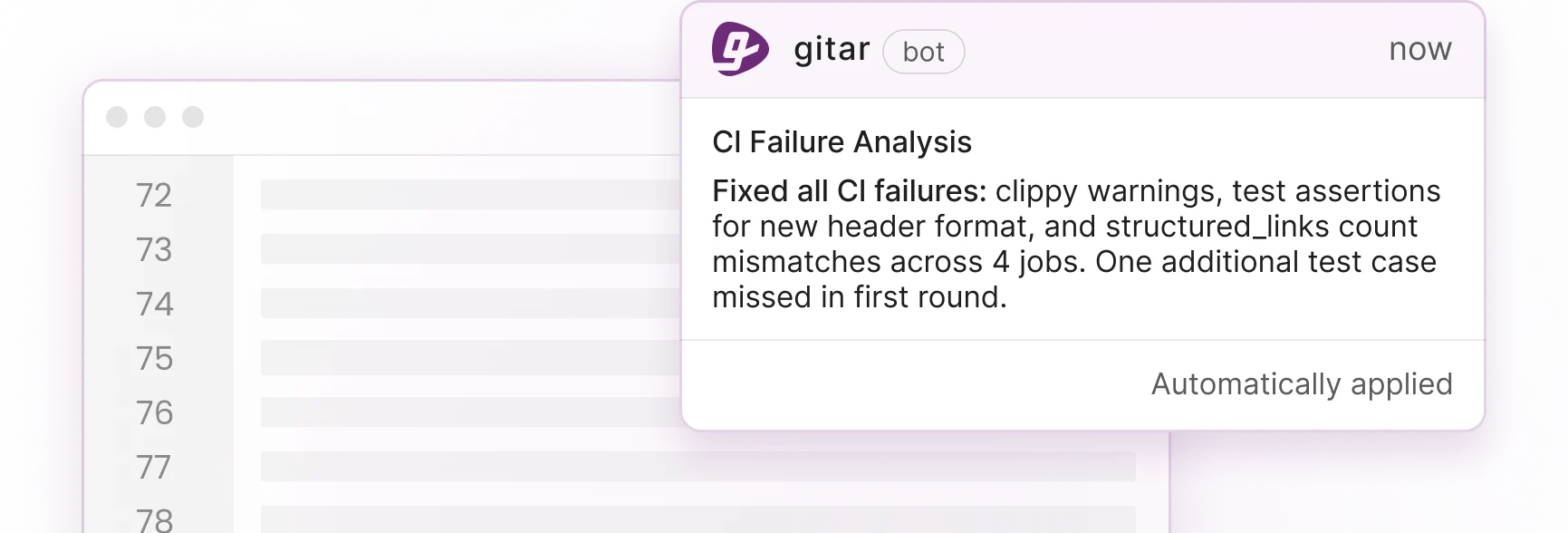
Teams using six or more AI tools experience context blindness 38% of the time, and notification fatigue from chatty AI reviewers disrupts developer focus. Gitar addresses these problems with a single updating comment and configurable auto-commit settings that build trust gradually. Teams report major noise reduction compared to tools that scatter inline comments across diffs.
Key Considerations for Engineering Leads
Engineering leaders must balance velocity gains against tool costs and team adoption friction. This balance becomes more critical when leaders consider long-term productivity patterns. Teams see early productivity boosts from suggestion-only tools, but after six months, features take longer to complete and regressions increase.
This degradation pattern explains why ROI calculations favor tools with proven automation, such as Gitar, over suggestion engines that keep manual work in place. To capture these ROI benefits while managing adoption risk, teams should follow a phased rollout. Start in suggestion mode, build trust through validated fixes, then enable auto-commit for failure types that the team considers reliable.
Frequently Asked Questions
How can teams test AI coding tools risk-free?
Gitar offers a 14-day trial with unlimited seats and full feature access, which the earlier sections describe in detail. This trial lets teams measure actual velocity improvements before they commit to paid plans. Engineering leaders can validate ROI claims with real sprint data instead of relying only on vendor promises.
Which tool best addresses PR review bottlenecks?
Tools that automatically implement fixes, rather than only suggesting them, provide the strongest relief for PR bottlenecks. Gitar’s Healing Engine resolves CI failures and review feedback autonomously, while suggestion-only tools like Copilot and CodeRabbit still require manual implementation and keep the bottleneck in place.
What security features matter most for team AI coding tools?
Teams should prioritize SOC 2 Type 2 certification, configurable data retention policies, and flexible deployment options. Gitar supports enterprise-grade security with SOC 2 Type 2 certification.
How should teams measure ROI from AI coding tools?
Track CI failure resolution time, PR review cycle duration, and developer context switching frequency. Teams that adopt autonomous fixing tools report a 91% reduction in manual CI troubleshooting time compared to suggestion-only tools that preserve existing manual workflows.
What is the best approach for switching from suggestion-only tools?
Teams should run parallel evaluations during trial periods and compare actual fix success rates. Many teams discover that suggestion tools require heavy manual validation and implementation effort, while autonomous tools remove that work and reveal a clear productivity gap.
Conclusion: Auto-Fix Beats Suggestions, So Start With Gitar
The AI coding tool landscape has moved beyond suggestion engines toward autonomous healing systems that resolve issues instead of just pointing at them. Traditional tools often charge premium prices for comments that still demand manual work. Gitar’s approach, with green-build guarantees and validated auto-fixes, delivers measurable ROI for development teams. Ready to move beyond suggestions to autonomous healing? Install Gitar now and start shipping higher quality software, faster.