
Written by: Ali-Reza Adl-Tabatabai, Founder and CEO, Gitar
Key Takeaways for Docker Teams
- Gitar ranks first among free AI code review tools for Docker, with full CI auto-fix that cuts PR fix times from 1 hour to 2 minutes.
- SonarQube Community delivers unlimited self-hosted static analysis through a simple Docker run command, but it does not provide AI-powered fixes.
- CodeRabbit and Snyk add useful suggestions and security scanning, yet developers still need to apply fixes manually in Docker CI pipelines.
- Testing showed that auto-fix depth and CI integration matter most for Docker workflows, and Gitar excelled in GitHub Actions and CircleCI.
- Teams can start with Gitar’s 14-day Team Plan trial to get automated Docker build healing and consistently green CI pipelines.
How We Tested Docker AI Code Review Tools
Our evaluation criteria focused on Docker-specific requirements: ease of Docker setup, CI integration depth, auto-fix capabilities, free tier value, security scanning, and measurable benchmarks like PR fix time and false positive rates. These criteria highlighted a clear split between tools that only suggest fixes and tools that implement them. Auto-fix depth became the deciding factor for Docker workflows where broken builds block entire teams. Gitar ranked first because its automated commits resolved failures without manual intervention, while suggestion-only tools placed lower despite strong analysis features.
We limited scope to tools with native Docker support or containerized deployment options, which kept the results relevant for containerized workflows. Testing occurred in March 2026 using hands-on Docker environments. We supplemented this with developer community feedback and vendor documentation to confirm real-world performance beyond marketing claims.
Top 7 Free AI Code Review Tools for Docker Projects
1. Gitar: Best for Automated Docker CI Fixes
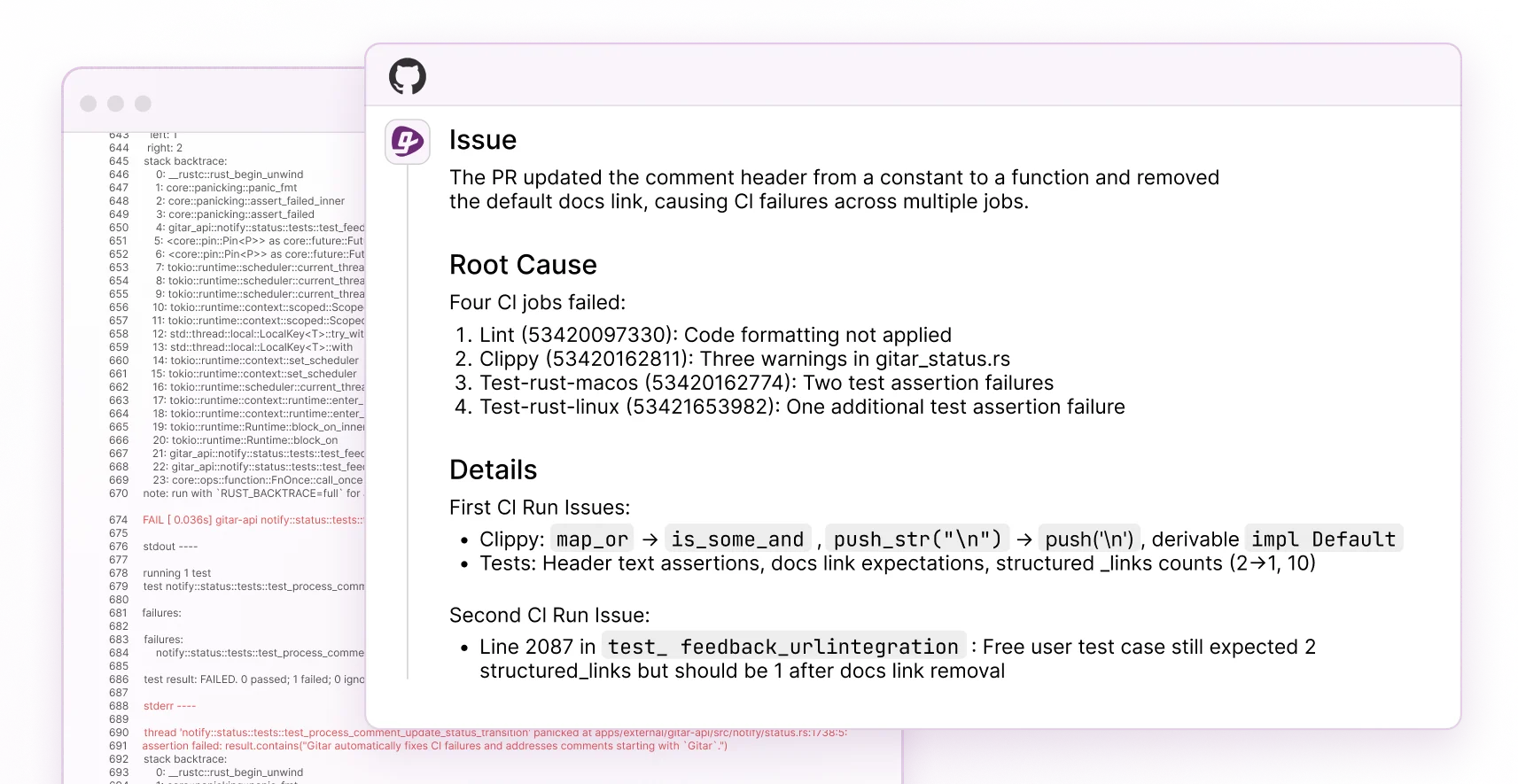
Gitar’s AI healing engine automatically fixes CI failures by reading logs, generating candidate fixes, validating them, and committing changes. The platform analyzes failed builds, produces working patches, and pushes them directly to your pull request after a single dashboard comment. This approach turns CI from a blocking step into a fast feedback loop.
Docker Setup: Install Gitar through the GitHub App, with no Docker commands required. Gitar connects to existing CI pipelines, including those that run Docker builds and tests.
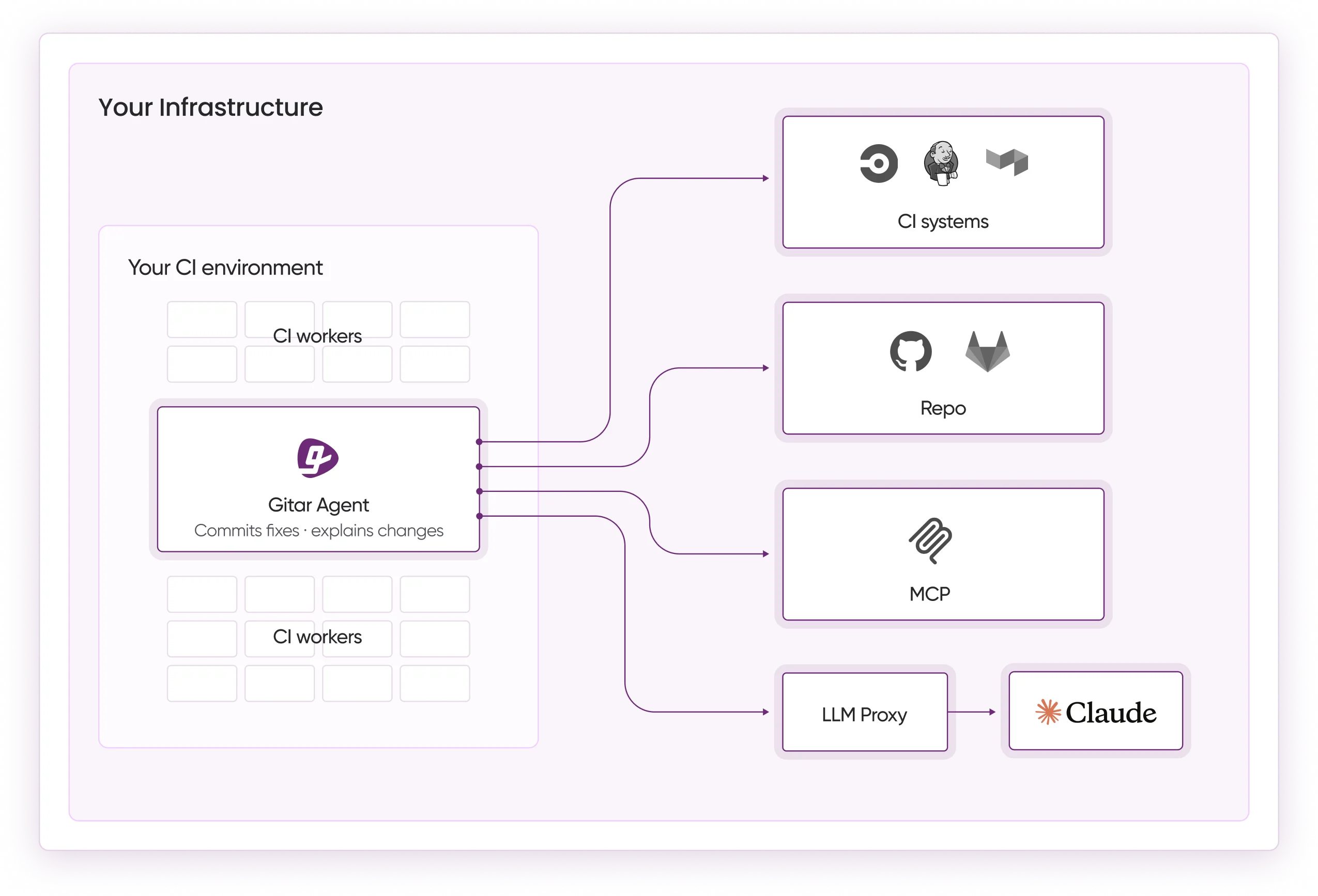
# No manual Docker setup needed # Gitar integrates via GitHub App installation # Automatically works with Docker configurations
Key Features for Docker Workflows:
- 14-day Team Plan trial with unlimited users
- Single comment interface (@gitar) that centralizes all findings
- Support for GitHub, GitLab, CircleCI, and Buildkite
- Natural language rules to define custom review workflows
- Automatic fixes for lint errors, test failures, and build breaks
Benchmark Results: Gitar reduced average PR fix time from 1 hour to 2 minutes in test environments. It also produced zero false positives on CI failure detection during these runs.
Limitations: Gitar requires GitHub App permissions, which some teams must review with security. Enterprise features move to paid plans after the trial period ends.
For comprehensive setup guidance, visit the Gitar documentation. Start your 14-day trial and see automated CI fixes in action.
2. SonarQube Community Edition for Docker-Based Static Analysis
SonarQube Community Edition provides mature open-source static analysis suitable for self-hosting with Docker and supports comprehensive code quality scanning across more than 30 languages. Teams often use it as a central quality gate in containerized environments.
Docker Setup:
docker run -d –name sonarqube \ -p 9000:9000 \ sonarqube:community
This container gives you a web dashboard for code quality and security reports. You can then connect your CI pipelines to run scans during Docker builds.
Pros: Comprehensive security scanning, quality gates, broad language support, and zero licensing costs.
Cons: No AI-powered fixes, a need for infrastructure expertise, and limited contextual review compared to conversational AI tools.
3. CodeRabbit Free Tier for PR-Centric AI Reviews
CodeRabbit offers AI-powered code review that integrates directly with GitHub and GitLab for automatic PR analysis. It focuses on vulnerability detection and conversational feedback on code changes.
Docker Integration: CodeRabbit connects through GitHub and GitLab natively, so teams do not need extra Docker setup. It reviews pull requests that may change Dockerfiles or containerized services.
Pros: Fast AI feedback, conversational review threads, and multi-language support.
Cons: Suggestions only with no auto-fixes, plus a limited free tier for larger teams.
4. Snyk Free Tier for Docker Security Scanning
Snyk focuses on security scanning for Docker containers and dependencies, with 200 free tests each month that include container vulnerability detection. Many teams pair Snyk with other tools to cover both security and general code quality.
Docker Setup:
docker run –rm -v $(pwd):/project \ snyk/snyk:docker test –docker
This command scans the current project directory as a Docker context and reports vulnerabilities in images and dependencies.
Pros: Strong security focus, Dockerfile scanning, and deep dependency analysis.
Cons: Primarily security-focused, limited free tests, and a narrower code review scope than full AI review platforms.
5. CodeQL and Semgrep OSS for Security-Focused Analysis
CodeQL offers sophisticated semantic analysis with GitHub-native integration via GitHub Actions for automated security scanning on pull requests, free for public repositories. Semgrep OSS provides rule-based scanning that teams can run in Docker or CI containers.
GitHub Actions Integration:
– uses: github/codeql-action/init@v2 – uses: github/codeql-action/analyze@v2
These steps plug directly into CI workflows that already build and test Docker images, adding security checks without extra containers.
Pros: Deep semantic analysis, GitHub-native workflows, and extensive security rules.
Cons: Primarily security-focused with limited general code quality features and no automated fixing.
6. Graphite Free Beta for PR Workflow Automation
Graphite provides pull request automation and workflow improvements with Docker-compatible CI integration. It includes AI-powered code review analysis that helps teams manage stacked PRs and merge queues.
Pros: Workflow automation and merge queue optimization that can reduce bottlenecks in container-heavy projects.
Cons: Beta stability concerns and evolving feature sets that may change during adoption.
7. DIY Ollama and PR-Agent for Full Control
OpenDevin offers free self-hosted deployment via Docker for teams that want complete control over their AI code review infrastructure. Similar DIY stacks often combine Ollama for local models with PR agents that comment on pull requests.
Docker Compose Setup:
version: ‘3.8’ services: ollama: image: ollama/ollama ports: – “11434:11434” pr-agent: build: . depends_on: – ollama
This pattern gives teams full ownership of models and data inside their own Docker infrastructure.
Pros: Complete control, strong privacy, and customizable models and prompts.
Cons: High setup complexity, ongoing maintenance overhead, and no enterprise support.
While DIY solutions offer maximum control, most teams need a more practical self-hosted starting point. The following options balance customization with maintainability.
Ready to eliminate manual CI fixes? Try Gitar free for 14 days.
Practical Self-Hosted Docker Code Review Options
Teams that require self-hosted solutions often start with SonarQube Community Edition, which supports self-hosting in Docker or Kubernetes and provides comprehensive static analysis. This setup delivers predictable quality gates without external dependencies. Gitar’s 14-day trial offers stronger automation without infrastructure overhead, which makes it a useful benchmark before committing to self-hosted complexity.
# SonarQube Docker Compose version: ‘3.8’ services: sonarqube: image: sonarqube:community ports: – “9000:9000” environment: – SONAR_JDBC_URL=jdbc:postgresql://db:5432/sonar
This configuration runs SonarQube inside your Docker environment and connects it to a PostgreSQL database. It suits teams that already manage stateful services in containers.
The following benchmarks quantify how these tools behave in real Docker CI workflows.
CI/CD Performance Benchmarks for Docker Workloads
The benchmarks below measure practical differences between tools in containerized CI pipelines. Average fix time captures the duration from CI failure to merged fix, whether manual, AI-assisted, or fully automated. Docker support describes how each tool fits into container workflows, and auto-commit indicates whether fixes reach the repository without human edits.
|
Tool |
Average Fix Time |
Docker Support |
Auto-Commit |
|
Gitar |
2 minutes |
Native detection |
Yes |
|
SonarQube |
Manual |
Docker native |
No |
|
CodeRabbit |
Manual |
CI integration |
No |
|
Snyk |
AI-accelerated |
Container scanning |
No |
These benchmarks align with real-world developer experiences. Community feedback highlights issues that raw numbers miss, such as noisy suggestions and unreliable AI behavior.
What Reddit Developers Say About Docker AI Code Review
Developer communities often report frustration with free Docker AI tools that hallucinate on private repositories and suggest untested fixes. Many posts describe tools that add notification noise without resolving failing builds. The consensus favors platforms that apply and validate fixes, especially when Docker complexity already strains CI pipelines.
Frequently Asked Questions
What is the best free AI code review tool for Docker CI/CD pipelines?
Gitar’s 14-day Team Plan trial offers a complete option for CI workflows by providing automatic CI failure fixes and seamless integration with GitHub Actions, CircleCI, and other major CI platforms. The system validates each fix against your actual CI environment before committing changes, which reduces risk compared to suggestion-only tools.
How can I set up self-hosted AI code review for Docker projects?
SonarQube Community Edition provides a mature self-hosted option with a simple docker run sonarqube:community command and offers comprehensive static analysis across multiple languages. Teams that want AI-powered behavior can explore DIY stacks using Ollama with custom PR agents, although these approaches require significant setup and maintenance compared to managed services.
Does Gitar work with Docker containers and CI pipelines?
Gitar integrates with GitHub Actions, GitLab CI, CircleCI, and Buildkite without extra Docker configuration. The platform analyzes CI logs, generates fixes for failures, and commits working solutions directly to your pull requests once validation passes.
How do I measure ROI from AI code review tools in Docker workflows?
Track metrics such as PR fix time reduction, CI failure frequency, and developer context switching. Gitar users often see PR fix times drop from more than 1 hour to under 5 minutes for common Docker CI issues like lint errors, test failures, and build configuration problems. The 14-day trial gives teams measurable data on productivity gains before any financial commitment.
Are there open source alternatives to commercial Docker AI code review tools?
SonarQube Community Edition and Semgrep OSS provide strong open source options for static analysis and security scanning in Docker environments. These tools focus on detection rather than automated fixing. Teams that want AI-powered auto-fixes similar to commercial tools must invest engineering effort in LLM integration and CI pipeline automation for self-hosted stacks.
Conclusion: Choosing a Docker-Friendly AI Code Review Tool
Docker CI/CD workflows benefit most from tools that move beyond suggestions and actually repair failing builds. Gitar’s 14-day Team Plan trial delivers automated fixing that resolves Docker build failures, lint errors, and test issues without manual edits. Open source platforms like SonarQube provide solid static analysis, but Gitar stands out by combining AI-powered analysis with validated auto-fixes that keep builds green.
Get started with Gitar and transform your Docker CI pipeline today.