
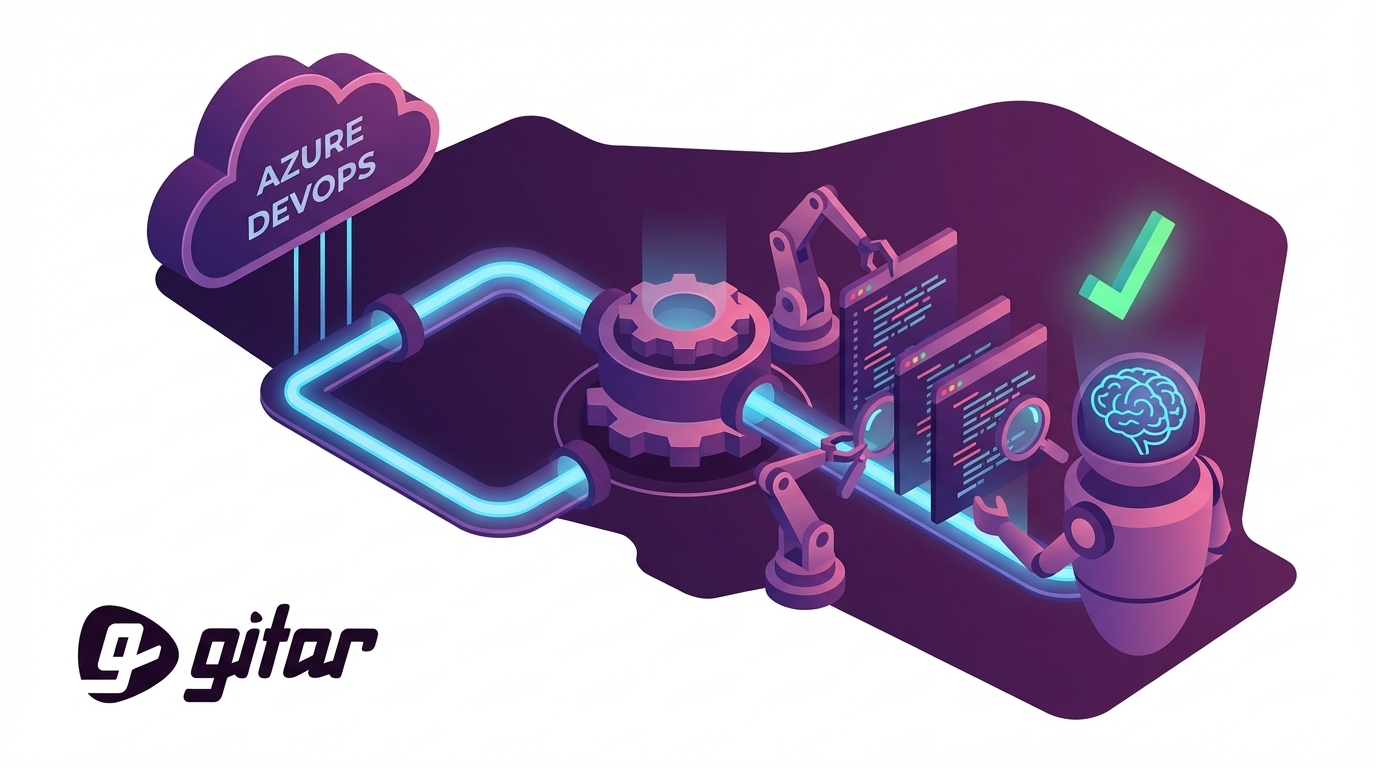
Written by: Ali-Reza Adl-Tabatabai, Founder and CEO, Gitar
Key Takeaways
- AI coding tools like GitHub Copilot increase code velocity 3–5x but also create massive PR review and CI backlogs, costing teams $1M+ annually in productivity losses.
- Azure DevOps built-in branch policies and extensions like Panto add review gates and suggestions but still require engineers to fix CI failures and review feedback manually.
- Pipeline-based AI reviews with SonarQube or PR-Agent provide strong analysis yet stop at recommendations, so human reviewers remain the main bottleneck.
- Gitar’s healing engine automatically fixes CI failures, implements reviewer comments, and delivers consistently green builds through validated pipeline integration.
- Teams using Gitar achieve 55% MTTR reduction and $500K+ annual savings. Start your 14-day free trial with Gitar today to conquer AI PR backlogs.
Azure DevOps Branch Policies That Set the Stage for Automation
Azure DevOps provides several native branch policies that form the foundation of code review automation. Azure DevOps’ “Require a minimum number of reviewers” branch policy enforces code quality by mandating approvals from a specified minimum number of reviewers before pull request (PR) merge, with configurable options for creator approval and vote reset behaviors.
The build validation policy becomes especially powerful when it runs a reliable pipeline on every PR. The YAML snippet below shows a simple configuration that builds and tests a .NET application for each change.
trigger: – main pool: vmImage: ‘ubuntu-latest’ steps: – task: UseDotNet@2 inputs: packageType: ‘sdk’ version: ‘8.x’ – script: dotnet build –configuration Release displayName: ‘Build application’ – script: dotnet test –configuration Release –logger trx displayName: ‘Run tests’
Azure DevOps’ “Build validation” branch policy requires pull request (PR) changes to successfully build using a specified build pipeline before PR completion, with automatic triggering on source branch updates. Additional policies include comment resolution requirements and linked work item validation.
These built-in policies create strong quality gates, but they stop at detection. They do not fix issues when builds fail or comments need resolution. Teams still handle every CI failure manually, which creates the bottleneck that Gitar’s auto-fix capabilities remove.
Pipeline-Based AI Code Review with SonarQube and PR-Agent
Advanced teams embed AI-powered code review directly into Azure Pipelines. Azure DevOps’s built-in Build Validation branch policy enables code review automation by requiring an azure-pipelines.yml pipeline integrated with PR-Agent and Azure OpenAI.
A typical AI review pipeline configuration looks like this:
trigger: none pool: vmImage: ‘ubuntu-latest’ variables: – group: pr-agent-config steps: – checkout: self persistCredentials: true fetchDepth: 0 – task: Docker@2 inputs: command: ‘run’ image: ‘codiumai/pr-agent:latest’ envVars: | AZURE_DEVOPS_TOKEN=$(AZURE_DEVOPS_TOKEN) AZURE_OPENAI_KEY=$(AZURE_OPENAI_KEY) AZURE_OPENAI_ENDPOINT=$(AZURE_OPENAI_ENDPOINT)
John Lokerse’s Azure Pipeline for code review automation uses the AzurePowerShell@5 task in InlineScript mode with pwsh: true, leveraging predefined Azure DevOps variables to invoke LLM review and post comments.
These pipeline-based approaches deliver rich AI analysis and detailed suggestions. They still share one critical limitation, because they only suggest fixes without implementing them. Engineers must apply recommendations, push new commits, and wait for another pipeline run, so the core bottleneck remains.
Top Azure DevOps Extensions like Panto and CodeAnt for AI Review
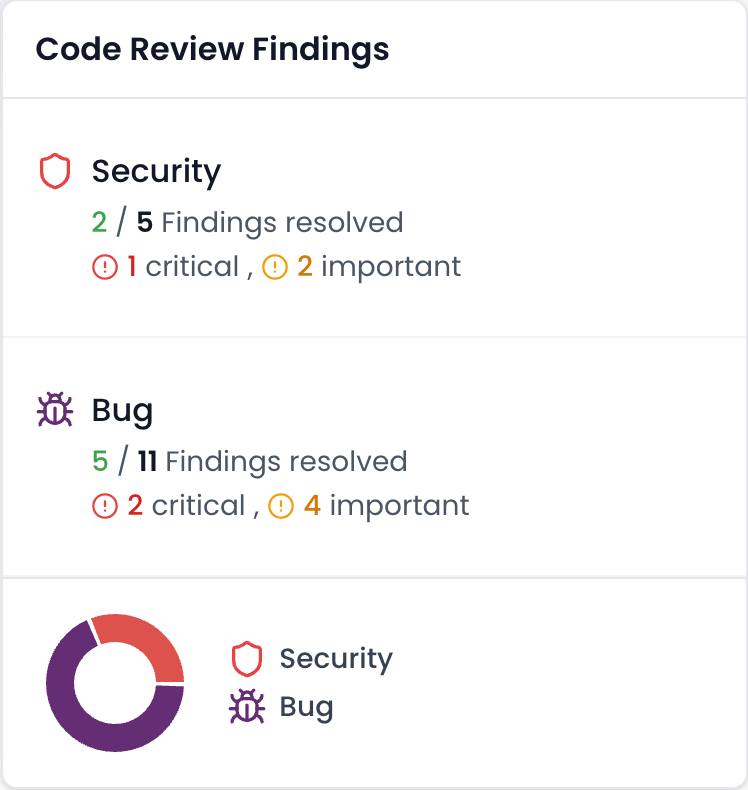
Third-party extensions now fill many of Azure DevOps’ AI code review gaps. Tools like Panto AI and CodeAnt provide inline feedback and security scanning capabilities. Native code review features work well for small teams with straightforward requirements, while extensions promise more sophisticated analysis.
These extensions typically offer:
- Automated PR summaries and inline comments
- Security vulnerability detection
- Code quality scoring
- Integration with popular CI/CD tools
Most extensions still share the same fundamental weakness as built-in tools. They analyze and suggest but do not apply fixes on their own. Teams must implement recommendations manually, which keeps human reviewers in the critical path. This analyze-but-don’t-fix approach fails to address the core problem of AI-generated PR volume overwhelming human review capacity.
However, most extensions share the same fundamental weakness as built-in tools: they analyze and suggest but don’t auto-apply fixes. Teams still require manual implementation of recommendations. The suggestion-only approach doesn’t address the core problem of AI-generated PR volume overwhelming human review capacity.
Gitar: Auto-Fix Healing Engine for Real CI Relief
Where traditional extensions stop at suggestions, Gitar transforms code review from a suggestion engine into a healing platform. Start your 14-day Team Plan trial to experience the full power. See the Gitar documentation for details:
- Install the Gitar app – Connect to your GitHub or GitLab organization to establish the foundation.
- Enable CI auto-fix – Once connected, configure automatic failure resolution so Gitar can start healing broken builds.
- Create natural language rules – With auto-fix active, define custom workflows in the .gitar/rules/ directory to match your team’s patterns.
- Connect integrations – Finally, link Jira, Slack, and other tools to complete a seamless workflow.
The key differentiator lies in Gitar’s capabilities compared to suggestion-only tools. The following comparison shows how Gitar’s auto-apply functionality separates it from suggestion-focused competitors.
|
Capability |
CodeRabbit/Greptile |
Gitar |
Notes |
|
PR summaries |
Yes |
Yes |
Concise, single comment |
|
Inline suggestions |
Yes |
Yes |
Plus auto-apply capability |
|
Auto-apply fixes/CI auto-fix |
No |
Yes |
Green build guarantee |
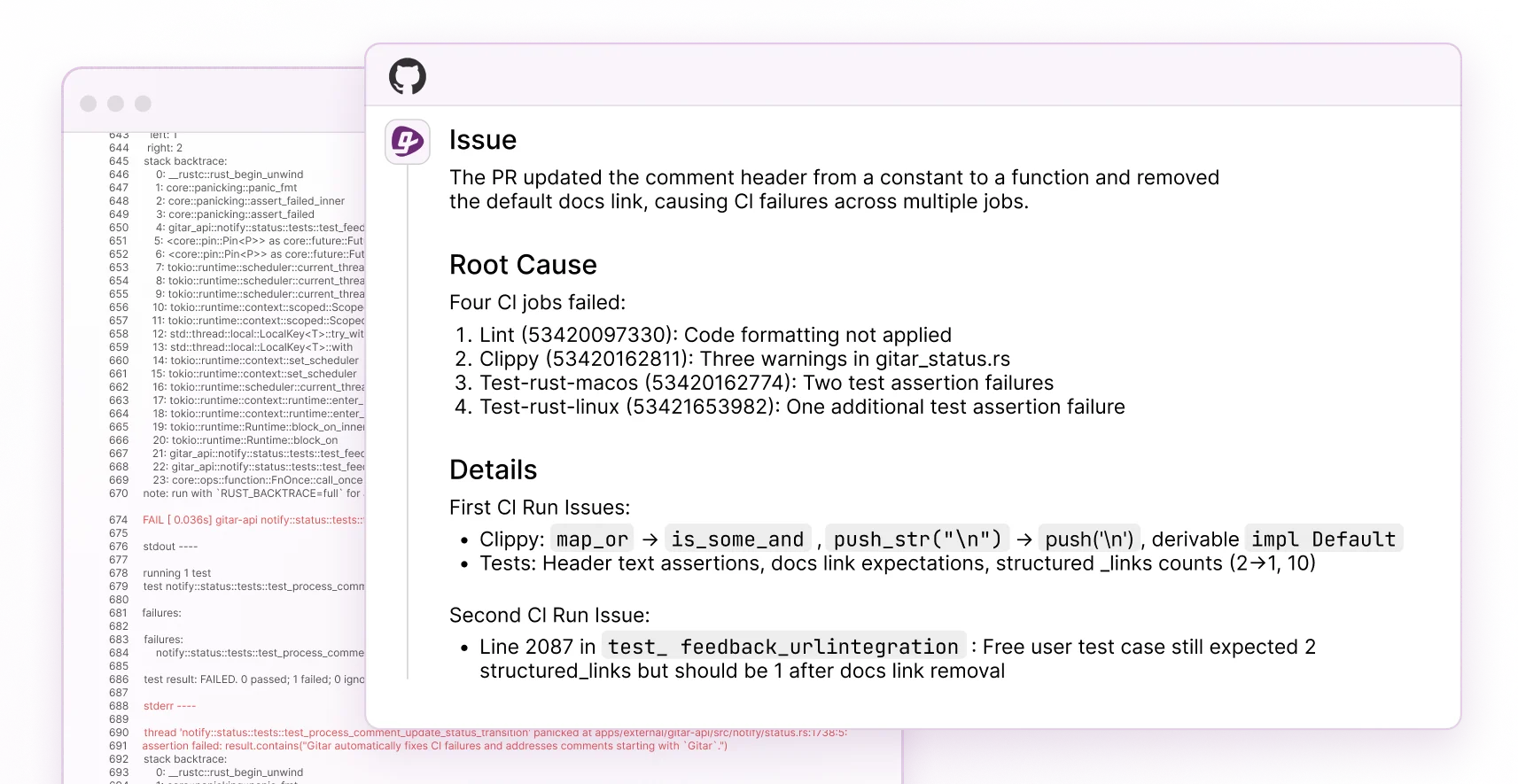
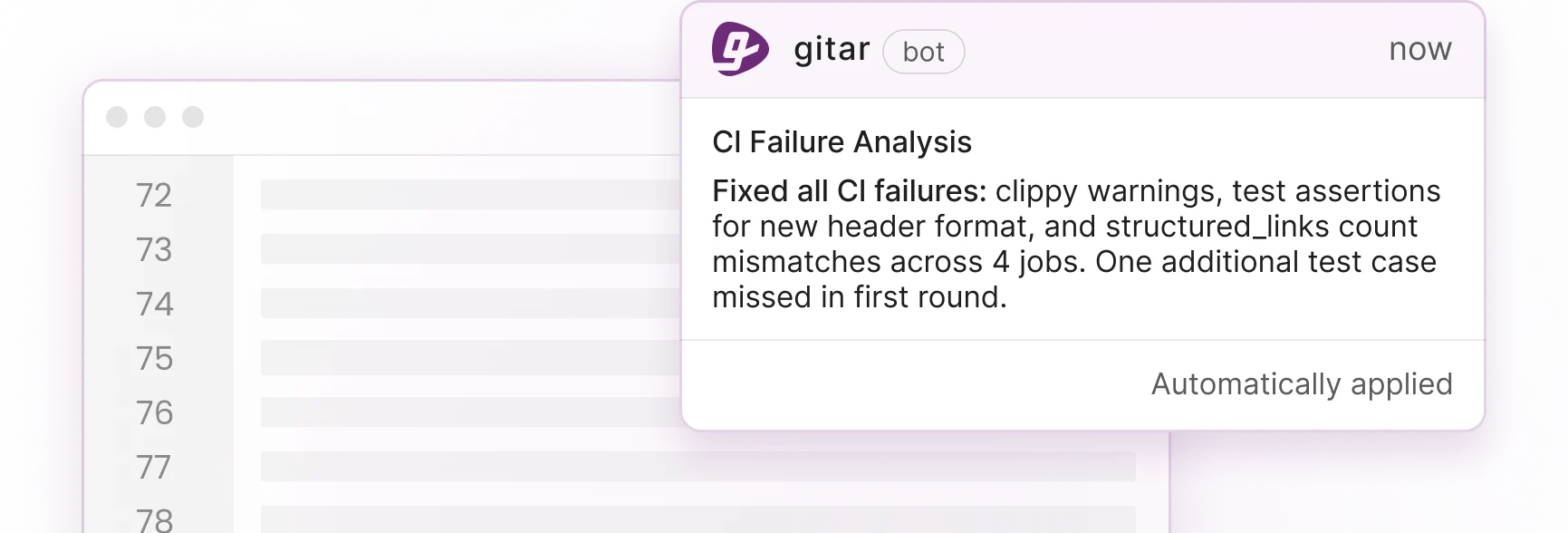
Teams using Gitar report that summaries are “more concise than Greptile/Bugbot” because the platform consolidates all findings into a single, updating comment instead of scattering notifications across the PR. When CI fails, Gitar automatically analyzes failure logs, generates contextual fixes, validates them against your pipeline, and commits working solutions, all without human intervention.
Handling Copilot-Generated PRs with Gitar
GitHub Copilot integration has evolved significantly in 2026. Microsoft’s Azure Boards integration with GitHub Copilot Coding Agent supports custom agents defined at the GitHub repository or organization level, enabling automated PR generation from work items.
AI-generated code introduces unique challenges for reviewers. Logic and correctness issues are 75% more common in AI PRs, and code duplication has increased 4x with AI adoption. Microsoft’s Azure Boards integration with GitHub Copilot coding agent enables teams to send work items directly to the agent to generate code changes, track progress with status updates on work items and Kanban boards, and create automatically linked draft pull requests.
Gitar addresses Copilot PR challenges through five key capabilities that directly counter the logic errors, duplication, and quality issues inherent in AI-generated code:
- Context-aware analysis – Understands the relationship between work items and generated code.
- Automatic bug detection – Identifies logic errors that Copilot itself missed.
- Zero context switching – Fixes issues without forcing developers to leave their environment.
- Reduced pipeline reruns – Cuts failed builds through validated auto-fixes.
- Intelligent notification management – Uses single comment updates instead of notification spam.
Copilot generates code faster, and Gitar ensures that code actually works in your specific environment with validated fixes and green build guarantees.
ROI of Azure DevOps Code Review Automation with Gitar
Automated code review delivers financial impact that reaches far beyond raw time savings. StackGen’s AI remediation agent provides automated incident response with rollback capability, with teams reporting up to 55% MTTR reduction and 70% lower alert volume.
For Azure DevOps teams, the ROI calculation is straightforward. The table below shows three key metrics where automation delivers measurable savings, based on a 20-developer team with an average fully loaded cost of $150K per developer.
|
Metric |
Before Automation |
After Gitar |
Annual Savings |
|
Time on CI/review issues |
1 hour/day/dev |
15 min/day/dev |
$750K (20-dev team) |
|
Context switching interrupts |
Multiple/day |
Near-zero |
Improved focus |
|
Failed deployment rate |
15-20% |
5-8% |
Reduced incident costs |
The productivity gains compound over time. The 55% MTTR reduction noted earlier combines with 70% fewer alerts when automated fixing replaces manual intervention. Even accounting for tool costs, the net savings for a 20-developer team reach the $500K+ threshold outlined in the key takeaways.
See the ROI impact firsthand with a 14-day free trial and measure the effect on your team’s velocity.
Frequently Asked Questions
Does Gitar work with Azure Pipelines?
Gitar supports GitHub Actions, GitLab Pipelines, CircleCI, Buildkite, and other major CI systems. Check the official Gitar documentation for the latest integration details and compatibility information.
How does Gitar beat CodeRabbit and other tools in Azure DevOps?
The fundamental difference is auto-fixing versus analyze-and-suggest approaches. While CodeRabbit, Greptile, and similar tools analyze code and leave comments that require manual implementation, Gitar automatically applies fixes and validates them against your actual CI pipeline. When a lint error occurs, Gitar fixes it before you even see the failure. When a reviewer requests changes, Gitar implements them directly. The result is guaranteed green builds instead of hope-based suggestions.
What does the free trial include?
The 14-day Team Plan trial provides full access to all Gitar features including unlimited repositories, auto-fix capabilities, custom rule creation, CI failure resolution, review feedback implementation, and integrations with Jira, Slack, and Linear. The trial has no seat limits, so your entire team can experience the complete platform before making any commitment.
Can Gitar handle complex CI environments?
Yes, Gitar excels with complex CI setups by emulating your complete pipeline environment including specific SDK versions, multi-dependency builds, and third-party security scans. The platform validates fixes against your actual pipeline configuration rather than isolated environments. For enterprise teams, Gitar can run agents directly within your CI infrastructure with full access to secrets and caches, which ensures fixes work in your production environment.
How does Gitar integrate with existing workflows?
Gitar integrates with GitHub, GitLab, and supported CI systems including GitHub Actions, GitLab CI, CircleCI, and Buildkite. The platform respects your current governance while adding automated fixing capabilities. You can start in suggestion mode to build trust, then gradually enable auto-commit for specific failure types. See the Gitar documentation for natural language rules in .gitar/rules/ directories that allow workflow customization without complex YAML configuration.
Conclusion: Move Beyond Suggestions to True Automation
The AI coding revolution has created an unprecedented bottleneck in code review and CI management. Tools like GitHub Copilot accelerate code generation by 3–5x, while traditional review processes have not scaled to match. Teams face 91% increases in PR review time, the million-dollar productivity losses mentioned earlier, and constant manual intervention for CI failures.
Built-in policies and third-party extensions provide basic gates but fall short of true automation. Tools that merely recommend fixes and charge $15–30 per developer monthly still require manual implementation of every recommendation, so they do not solve the core bottleneck.
Gitar’s healing engine changes this dynamic by automatically fixing CI failures, implementing review feedback, and guaranteeing green builds through validated pipeline integration. The platform goes beyond code review to provide development intelligence with workflow automation, deep analytics, and seamless integrations.
Experience true automation with a 14-day free trial and feel the difference between suggestions and actual fixes. Your team’s velocity depends on moving beyond the suggestion engine trap to automation that truly works.