
Key Takeaways
- AI code assistants boost productivity 3-5x but increase PR review time by 91%, creating bottlenecks that cost teams about $1M annually.
- Gitar leads with auto-fix capabilities for CI failures and consistently delivers green builds, unlike suggestion-only competitors.
- Top tools like CodeRabbit, SonarQube, and Snyk integrate with Azure DevOps but still lack full auto-healing for broken pipelines.
- Teams that implement AI code review correctly cut manual review time by 60-80% and save more than $750K per year.
- Start a free 14-day trial at Gitar to experience automated CI resolution and higher code quality.
How We Evaluated Azure DevOps AI Code Review Tools
Our assessment focuses on Azure DevOps YAML setup, auto-fix depth compared to suggestion-only tools, PR analysis quality, pricing clarity, enterprise security, and team scalability. Industry benchmarks show up to 80% reduction in manual review effort when teams deploy AI code review correctly. We used 2026 vendor documentation, hands-on YAML tests, and real Azure DevOps case studies as primary sources. You can review Gitar’s specific integration steps in the official documentation.
Top 5 AI Code Review Tools for Azure DevOps Pipelines
|
Tool |
Auto-Fix |
Azure YAML |
CI Healing |
Pricing |
|
Gitar |
Yes |
Cross-platform |
Yes |
14-day trial |
|
CodeRabbit |
No |
Yes |
No |
$15-30/seat |
|
SonarQube AI |
No |
Plugin |
No |
Free + Enterprise |
|
Snyk Code |
No |
Integration |
Yes |
Free + Enterprise |
|
GitHub Copilot |
Limited |
Via Actions |
No |
$10-20/user |
Detailed Reviews of Azure DevOps AI Code Review Tools
1. Gitar: Healing Engine for Broken Azure Pipelines
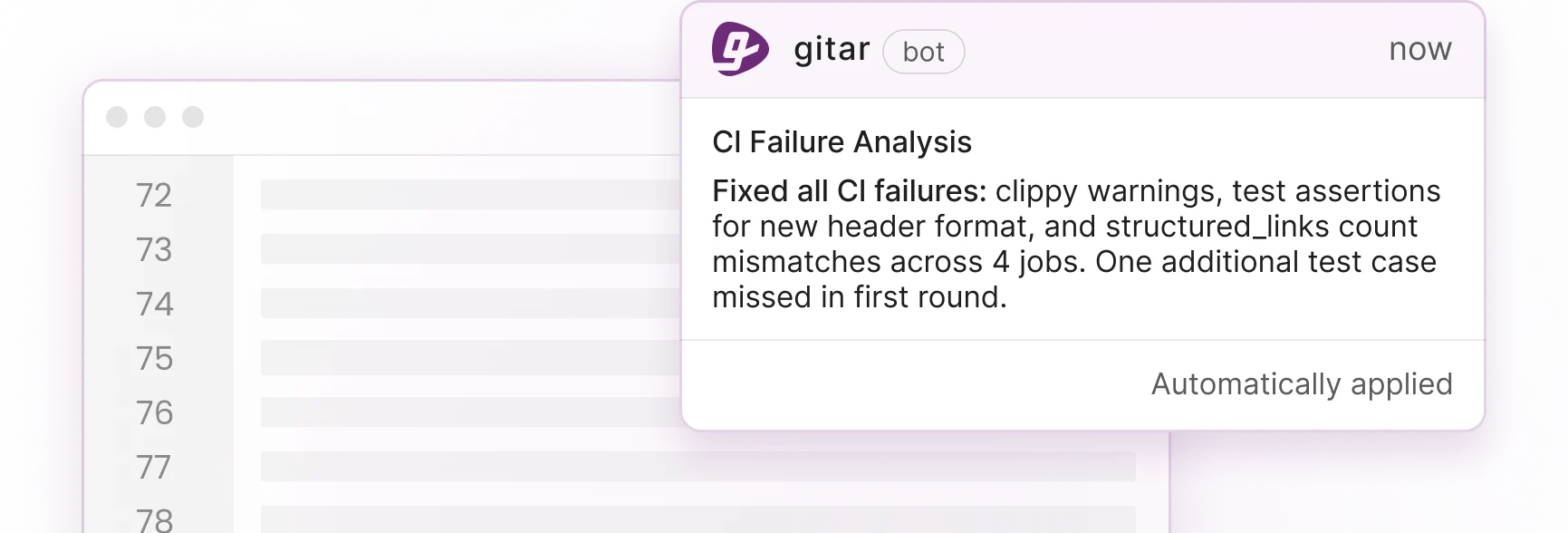
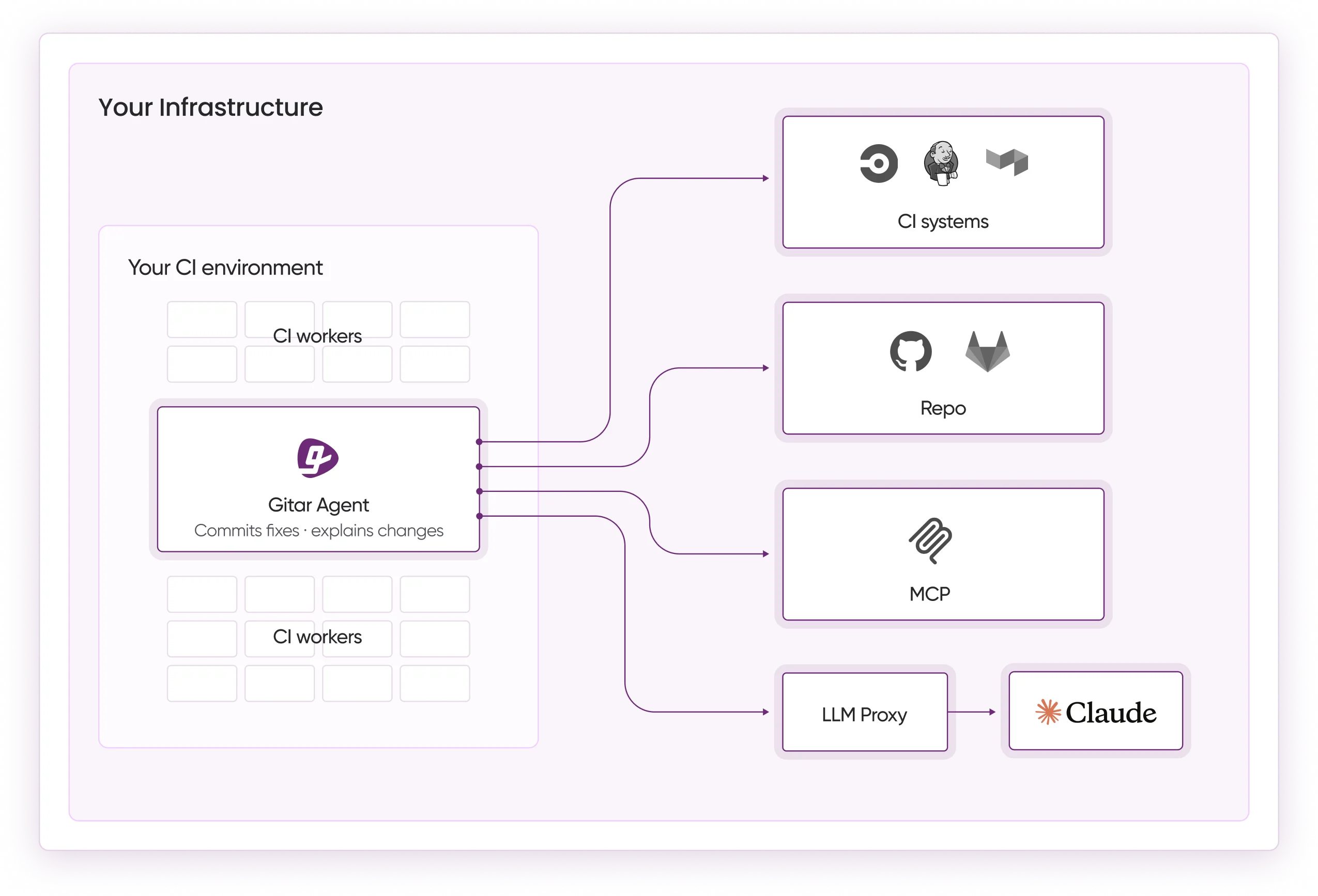
Gitar stands out as the only platform in this list that fixes CI failures automatically instead of only suggesting changes. When lint errors, test failures, or build breaks appear in CI pipelines, Gitar reads the logs, generates validated fixes, and commits corrections on its own. The platform integrates with GitHub, GitLab, CircleCI, Buildkite, and other major CI systems through dedicated connectors. For setup details, see the Gitar documentation.

Core capabilities include auto-applied fixes with CI validation, a single PR summary comment that updates in place, natural language workflow rules, and deep Jira and Slack integrations. You can start a 14-day Team Plan trial to test the full platform in your own pipelines.
Pros: Guaranteed green builds, broad auto-fix coverage, clean single-comment interface, 14-day full trial, and cross-platform CI support.
Cons: Newer platform with enterprise features that continue to expand.
ROI: Cuts developer time on CI and review issues from about 1 hour per day to roughly 15 minutes.
Install Gitar now to fix broken builds automatically and ship higher quality software faster.
2. GitHub Copilot Code Review in Azure DevOps
GitHub Copilot now supports AI-assisted code review inside pull requests in addition to code generation. Teams connect it to Azure DevOps through GitHub Actions and webhook workflows. The tool reviews code changes and offers contextual suggestions, and developers then apply or reject those suggestions manually.
Pros: Familiar GitHub interface, wide language coverage, and strong fit with the Microsoft ecosystem.
Cons: Suggestion-only workflow, limited native Azure DevOps features, and no automatic CI failure resolution.
Pricing: $10-20 per user each month.
3. SonarQube AI for Quality and Security
SonarQube uses AI-enhanced static analysis to flag code quality issues, security vulnerabilities, and maintainability problems. Azure DevOps integration relies on a plugin plus YAML pipeline configuration that runs scans during builds.
Pros: Deep security scanning, strong enterprise adoption, and broad language support.
Cons: No auto-fix features and a primary focus on detection instead of repair.
Pricing: Free Community Edition with paid Enterprise licensing.
4. Snyk Code for Security-Focused Reviews
Snyk Code delivers AI-powered, security-first code analysis with real-time vulnerability detection. The platform offers free and enterprise tiers with high-accuracy SAST capabilities for many languages and supports Azure DevOps integration.
Pros: Strong security coverage with code quality checks, developer-friendly UX, and solid Azure DevOps marketplace presence.
Cons: No broad code quality fixes and suggestion-only results.
5. CodeRabbit as an Automated Reviewer
CodeRabbit integrates with GitHub, GitLab, Bitbucket, and Azure DevOps and acts as an automated reviewer triggered by webhooks. It performs line-by-line analysis and posts contextual comments but does not apply fixes on its own.
Pros: Multi-platform support, detailed inline analysis, and an active development community.
Cons: Higher per-seat pricing, noisy notification streams from many inline comments, and no CI healing.
Pricing: $15-30 per developer each month.
Start Gitar’s 14-day Team Plan trial to replace manual suggestions with automatic CI fixes.
6. Greptile for Deep Codebase Context
Greptile focuses on codebase-aware AI review with strong understanding of repository context. It produces detailed analysis and insights but keeps fixes as suggestions that developers must apply.
Pros: Rich codebase context and thorough analysis reports.
Cons: Premium pricing at $30 per seat and no validation of applied fixes.
7. Custom Claude or GPT Azure DevOps Integration
Teams can build custom AI reviewers with Claude or GPT APIs connected through Azure DevOps webhooks. This approach offers flexibility but demands significant engineering work to design, secure, and maintain.
Pros: Full control over prompts, policies, and workflows with direct API access.
Cons: High setup and maintenance overhead, no native CI integration, and manual infrastructure management.
8. CodeAnt.ai Marketplace Integration
CodeAnt.ai delivers context-aware AI reviews through an Azure DevOps Marketplace extension. It supports more than 30 languages and flags issues quickly while suggesting fixes.
Pros: Native Azure DevOps marketplace presence, broad language coverage, and auto-fix capabilities for selected issues.
Cons: Suggestion-only handling for part of the issue set.
9. Semgrep AI Open Source Rules
Semgrep provides open-source static analysis with AI-assisted rule creation and custom policy enforcement for Azure DevOps pipelines.
Pros: Open-source flexibility, custom rule support, and attractive economics for large teams.
Cons: Limited auto-fix capabilities.
Feature Comparison Matrix for Azure DevOps Teams
|
Capability |
Gitar |
CodeRabbit |
SonarQube |
Snyk Code |
|
PR Summaries |
Yes |
Yes |
Limited |
Limited |
|
Auto-Apply Fixes |
Yes |
No |
No |
No |
|
CI Auto-Fix |
Yes |
No |
No |
No |
|
Multi-CI Integration |
Yes |
Limited |
Plugin |
Integration |
Practical Steps to Add AI to Your Azure DevOps Pipeline
Teams get the most value from AI code review when they choose tools carefully and plan integrations. Effective setups trigger reviews on pull request creation, validate fixes automatically in CI, and follow clear approval workflows. You can follow Gitar’s Azure DevOps integration steps in the Gitar documentation. The Gitar 14-day Team Plan trial unlocks full auto-fix and cross-platform CI support so you can evaluate results quickly.
AI Agents for Autonomous Code Review in Azure DevOps
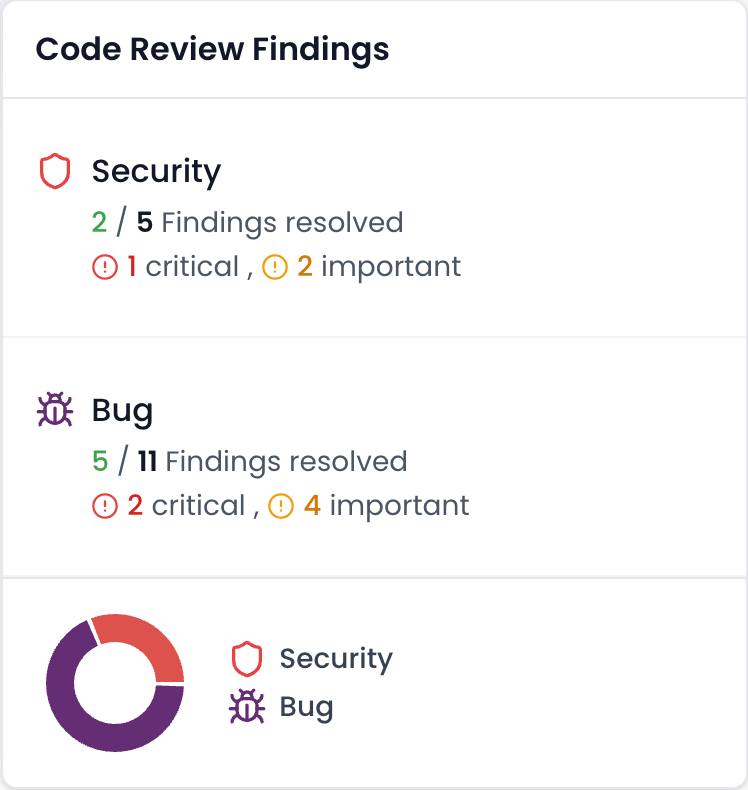
AI agents in Azure DevOps act as autonomous reviewers that scan code changes, detect issues, and apply fixes with minimal human input. Modern AI agents identify edge cases, race conditions, and security gaps that many traditional tools overlook. Gitar functions as a full AI agent, catching bugs introduced by generators like Copilot and delivering validated fixes that keep builds green.
Frequently Asked Questions
Best Free AI Code Review Option for Azure DevOps
Gitar provides a 14-day free Team Plan trial with full access to auto-fix, CI healing, and cross-platform CI support without seat limits. This window gives teams enough time to measure productivity gains and compare them with existing tools.
Available Azure DevOps AI Code Review Extensions
Multiple AI tools connect to Azure DevOps through marketplace extensions and direct integrations. Gitar supports cross-platform workflows that include GitHub and GitLab while working with many CI systems, and CodeAnt.ai offers a marketplace extension that teams can install quickly.
Using Claude with Azure DevOps for Code Review
Claude connects to Azure DevOps through custom API calls and webhook triggers that send code or diffs for review. This custom approach demands more engineering effort and still lacks automatic fix application and CI validation, which tools like Gitar provide out of the box.
Expected ROI from AI Code Review in Azure DevOps
Industry data shows strong productivity gains when teams adopt AI code review. Most teams cut manual review time by 60-80%, and developers spend about 15 minutes per day on CI and review issues instead of 1 hour. A 20-developer team typically saves around $750,000 per year in productivity costs.
Switching from CodeRabbit to a More Complete Platform
Teams moving away from suggestion-only tools like CodeRabbit should compare auto-fix depth, CI integration quality, and total cost of ownership. Gitar’s 14-day trial lets teams test automated fixing against manual suggestion handling and usually reveals clear ROI within the trial period.
Conclusion: Why Gitar Fits Modern Azure DevOps Pipelines
The 2026 Azure DevOps ecosystem favors AI platforms that repair code automatically instead of only commenting on it. Many traditional tools still charge premium prices for basic suggestions, while Gitar leads with a Healing Engine that delivers green builds through validated auto-fixes. Its strong Azure DevOps integration and risk-free trial make it a practical choice for teams that want measurable productivity gains.
Try Gitar free for 14 days and keep your Azure DevOps pipelines consistently green.