
Key Takeaways
- Manual CI remediation slows deployment cycles through context switching, delayed fixes, and repeated failed runs.
- Autonomous CI tools keep pipelines green by diagnosing and fixing issues automatically inside your existing workflows.
- Developer focus and flow improve when an autonomous system handles routine CI failures, test fixes, and lint issues.
- Engineering leaders can measure clear ROI from reduced mean time to remediation, lower CI costs, and faster release cadence.
- Teams can use Gitar to automatically fix CI failures, keep builds passing, and ship production-ready code more quickly.
Why Traditional CI Processes Slow Deployments
Most CI pipelines still rely on developers to diagnose failures, craft fixes, and rerun builds. Each interruption pulls engineers away from feature work, stretches review cycles, and increases the time between commit and production.
The Cost of Manual CI Remediation
Manual remediation affects both throughput and budget. High-performing DevOps teams deploy 208 times more frequently than low performers, yet CI failures still stall pipelines in many organizations.
Typical costs for a 20-developer team include:
- Up to 30% of engineering time lost to context switching from CI failures and triage work.
- Roughly 5,000 hours per year spent on fixing broken builds, tests, and policy violations.
- About $1 million in annual productivity waste at $200 per hour per developer.
How Autonomous CI Tools Change the Model
Autonomous CI tools shift pipelines from reactive to proactive. Instead of only flagging failures, they identify root causes, generate fixes, and validate changes in the same CI environment. Teams reduce time waiting on green builds and see more predictable deploy-ready branches.
How Gitar Supports Faster Deployments with Self-Healing CI
Gitar is an autonomous AI agent that fixes CI issues directly in your pull requests. It analyzes failures, proposes or commits code changes, and reruns checks so pipelines return to a healthy state with minimal developer involvement.
Key capabilities that support faster deployments include:
- End-to-end autonomous fixing for CI and CD issues, from lint errors to test failures.
- Full CI environment replication for realistic, context-aware validation.
- Configurable trust levels, from suggestion-only to auto-commit with rollback controls.
- Support for diverse CI/CD systems and language ecosystems.
- Built-in assistance for code review and policy enforcement.
1. Automate CI Failure Remediation for Self-Healing Pipelines
Traditional remediation requires a chain of steps: detect the failure, assign a developer, reproduce the issue, write a fix, and rerun CI. Each step adds queue time and more context switching.
Autonomous CI tools shorten this chain. The system inspects logs, identifies the likely cause, generates a patch, validates the patch in CI, and applies it if checks pass. Pipelines return to green without manual triage for many routine issues.
How Gitar Fixes CI Failures Automatically
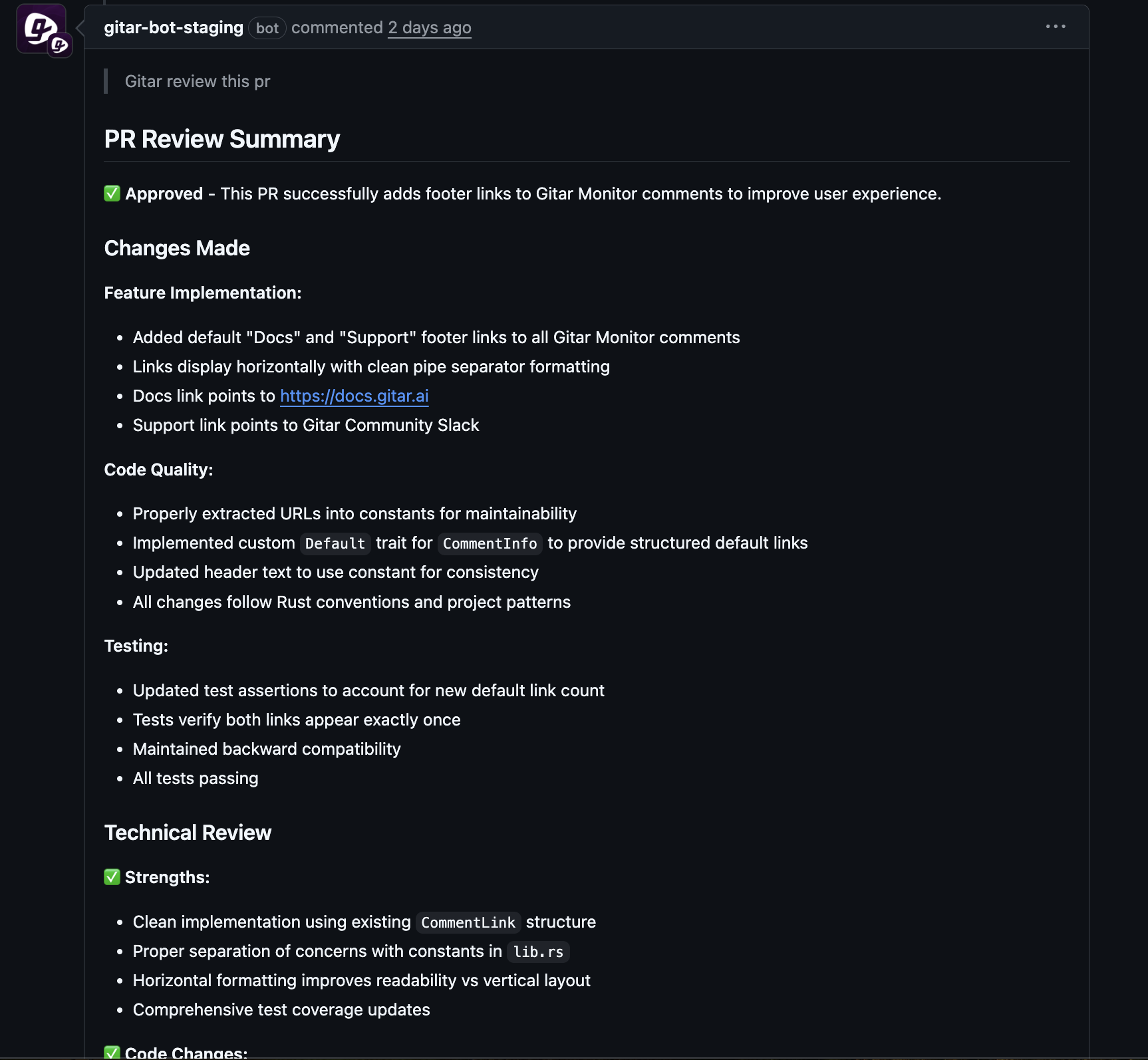
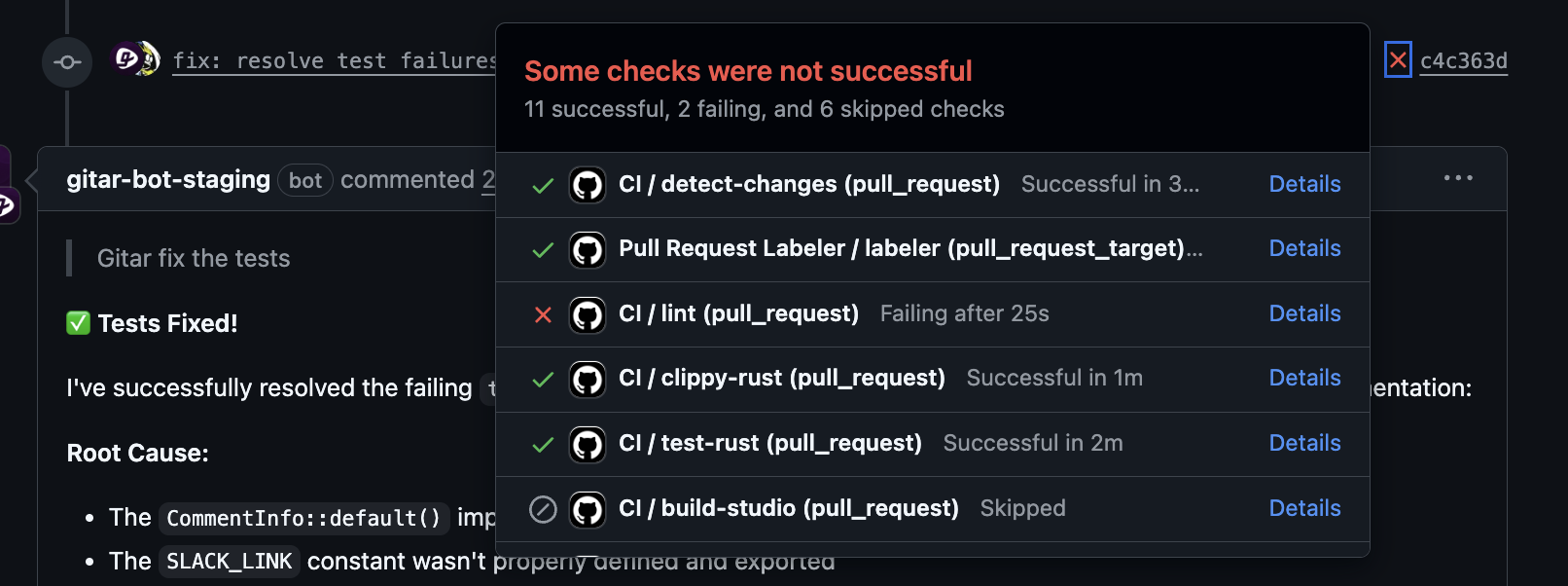
Gitar monitors CI runs, analyzes failing jobs, and pushes fixes back into the pull request. It then triggers another CI run to confirm the fix. Many failures resolve before a developer opens the job details.
Example: a build fails because of a missing dependency. Instead of a developer stopping work to research the package, update versions, and wait on another build, Gitar updates the dependency, tests compatibility in the replicated environment, and restarts the pipeline within minutes.
2. Streamline Code Review and Policy Enforcement with Automated Fixes
Policy checks and style enforcement often delay merges. Reviewers spend time pointing out formatting issues or minor violations that do not require business context.
Autonomous CI tools can encode these expectations as rules and apply corrections directly to the codebase. When violations appear, the system updates code or configuration files so pull requests meet standards before review completes.
How Gitar Handles Reviews and Policies
Gitar lets teams express workflows and policies as prompts and rules. If a repository requires specific formatting, security checks, or naming standards, Gitar detects deviations and adjusts the code automatically.
Policy failures can add weeks to deployment cycles, yet many fixes relate to straightforward configuration or style details. Gitar reduces that delay to minutes by resolving these issues inside the pull request.

3. Reduce Developer Context Switching and Protect Flow State
Context switching is one of the largest hidden costs of CI failures. Each red build pulls developers away from focused work toward log reading, test reruns, and minor fixes.
Autonomous CI reduces those interruptions. Engineers stay on their main tasks while the system handles routine lint, test, and dependency issues in the background.
How Gitar Preserves Focus
Gitar responds to failed checks, writes fixes, and updates pull requests without forcing the original author to stop their work. Many issues resolve with no additional action from the developer beyond reviewing the final diff if desired.
Teams often see practical results such as:
- Shorter time from failure to green build, moving from hours of manual work toward minutes of automated remediation.
- Fewer Slack pings and ticket handoffs related to routine CI breakage.
- Higher throughput per engineer as flow state interruptions decline.
4. Improve CI/CD Pipeline Efficiency with Self-Healing Mechanisms
Failed builds consume compute resources and create queues for other teams waiting to run their pipelines. When the same issue causes repeated failures, costs rise quickly.
Self-healing CI keeps pipelines healthier for longer. Autonomous tools address issues closer to the moment they appear, so fewer runs fail for the same reason and fewer jobs stay red for extended periods.
How Gitar Optimizes CI/CD Runs
Gitar aims to keep pipelines green by resolving failures quickly. This reduces the number of retries and shortens queue times for all branches sharing the same infrastructure.
Its environment replication feature validates fixes against the same dependencies, services, and configuration that your CI system uses. This approach avoids “works on my machine” scenarios and supports a more predictable, reliable release process.
5. Measure the ROI of Autonomous CI Tools
Engineering leaders need clear data to justify changes to delivery workflows. Manual CI remediation carries both direct and indirect costs that are often hard to quantify.
Autonomous CI tools help reveal these costs by tracking time saved on remediation, reduction in failed runs, and improvements in deployment frequency. These metrics support data-backed decisions on automation investments.
Estimated Impact of Gitar on Productivity and Cost
For a 20-developer team, Gitar can automate thousands of small CI and review tasks each year. A typical scenario includes:
- Roughly 5,000 hours saved annually from automated CI fixes and routine review changes.
- About $1 million in regained productive time at $200 per hour.
- Higher deployment frequency as fewer pull requests wait on manual remediation.
Traditional vs Autonomous CI Approaches
|
Area |
Traditional CI + Manual Fixes |
AI Suggestion Tools |
Gitar (Autonomous Fixer) |
|
Failure remediation |
Diagnosed and fixed by developers |
Suggests changes, developers apply |
Generates, validates, and commits fixes |
|
Deployment speed |
Slows when failures occur |
Improves code quality, limited CI impact |
Improves time from failure to green build |
|
Context switching |
Frequent interruptions |
Some reduction, still manual |
Minimized for routine CI issues |
|
CI/CD efficiency |
More retries and longer queues |
Focuses on review, not pipelines |
Fewer failed runs and lower CI costs |
Frequently Asked Questions (FAQ) about CI Tools for Faster Deployments in 2026
How is Gitar different from other AI code reviewers?
Most AI reviewers act as suggestion engines. They add comments or sample patches, but developers still need to apply changes and verify builds. Gitar acts as a healing engine that applies fixes, validates them in your CI pipeline, and updates the pull request so builds pass with less manual work.
Can Gitar work with complex or custom CI setups?
Gitar is designed to emulate the specifics of your CI environment, including language versions, dependencies, and custom scripts. It adapts to existing infrastructure so teams do not need to redesign pipelines to use autonomous remediation.
How do teams control trust and safety with automated fixes?
Gitar supports multiple trust levels. Teams can begin in a conservative mode where it posts suggested changes for review. As confidence grows, they can enable auto-commit for certain repositories or issue types, always with version control history and rollback options in place.
What kinds of CI issues can Gitar handle?
Gitar can address common CI failures such as lint violations, unit test failures, dependency and build errors, and many script-related issues. Complex changes that require deep product knowledge can stay with human reviewers, while Gitar handles repetitive, well-scoped problems.
Conclusion: Use Autonomous CI to Ship Faster in 2026
Manual CI remediation and policy enforcement slow down otherwise modern delivery pipelines. Autonomous CI tools address this gap by fixing routine issues automatically, reducing context switching, and improving the reliability of each run.
Gitar brings this approach into everyday pull requests by diagnosing failures, proposing or committing fixes, and validating them inside your CI system. Teams see faster deployments, fewer red builds, and clearer ROI from their automation investments.
Install Gitar to automatically fix CI failures, keep pipelines green, and ship high-quality software faster in 2026.