
Software development today faces a persistent issue: developers spend too much time fixing broken builds, navigating failed CI pipelines, and managing lengthy code reviews. What should be a smooth journey from code commit to production often turns into manual troubleshooting and lost productivity. Automation offers a way forward, turning CI/CD pipelines into self-healing systems. Tools like Gitar lead this change by automatically handling CI failures and code review feedback, cutting downtime, and helping teams deliver software faster.
Why Manual CI/CD Recovery Hurts Teams
Developer Frustration from Constant Interruptions
Many developers experience a familiar cycle. You submit a pull request, expecting success, only to watch it fail due to a missing dependency, a flaky test, or a minor style issue. This forces you to stop your current work, dive into logs, make a fix in your local setup, commit changes, and wait for the pipeline to rerun.
Such interruptions drain productivity. A quick fix can steal an hour of your time, adding up to $1M in yearly losses for a 20-developer team. CI failures and review feedback disrupt the ideal of submitting a PR and moving on, pulling you away from focused work.
The mental cost of switching tasks adds to the problem. Jumping from coding to debugging a CI issue doesn’t just waste time on the fix itself, it also delays your return to a productive state. Limited insight into pipeline issues often means relying on manual solutions, slowing recovery further.
How Slow Pipelines Impact Business Goals
For organizations, manual CI/CD recovery affects more than just individual developers. Delays from outdated pipelines, deployment hiccups, and unreliable tests impact project timelines for 60% of companies.
Engineering leaders face added pressure in an era of AI-driven coding tools like GitHub Copilot. These tools increase the volume of pull requests, which means more tests and higher chances of CI failures, putting extra strain on validation and merging steps.
The costs are substantial. When developers dedicate up to 30% of their time to CI and review issues, the financial loss for a 20-developer team can reach $1M annually, a figure that grows with larger teams.
Challenges in Managing Complex CI/CD Setups
DevOps and platform engineers encounter specific hurdles in enterprise CI/CD environments. Overseeing intricate workflows means dealing with dependencies, SDK versions, third-party tools, and environment mismatches that create frequent failure points.
Issues like build errors, dependency clashes, and misconfigured settings are common. Other problems include inconsistent test results in shared setups, deployment failures from missing keys or variables, and build issues tied to small YAML errors.
Onboarding new engineers adds another layer of difficulty. They must learn complex CI/CD processes and adapt to development environments that may not match production, slowing progress and raising the risk of mistakes.
How Automation Fixes CI/CD Pain Points
Automation shifts CI/CD from reactive fixes to proactive management. Rather than waiting for failures and addressing them by hand, it builds self-healing features into the process.
This approach focuses on detecting issues instantly, analyzing logs for root causes, and applying fixes without human input. The result is a pipeline that handles many common errors on its own.
Manual fixes take time and often introduce errors. Human intervention slows recovery and risks new issues, while automated systems cut errors and speed up resolution.
Start solving CI issues with less effort. Install Gitar today to improve software delivery speed.
Meet Gitar: Your AI Partner for Self-Healing CI/CD
Gitar brings a new level of automation to CI/CD as an AI agent that fixes CI failures and responds to code review feedback. When a pull request fails or gets comments, Gitar steps in to analyze the problem, create a solution, and update the PR, making development smoother.

Gitar stands out with features designed for real impact:
- Complete issue resolution by applying and testing fixes against full CI workflows for reliable results.
- Support for complex enterprise setups, handling specific SDKs and multi-platform dependencies.
- Response to code review comments by making requested changes automatically.
- Flexible trust options with a ‘Conservative’ mode for suggested fixes and an ‘Aggressive’ mode for automatic commits with rollback ability.
- Compatibility with platforms like GitHub Actions, GitLab CI, CircleCI, and BuildKite for broad usability.
Boost your team’s efficiency. Schedule a demo to see Gitar in action.
What Gitar Does to Streamline CI/CD
Spotting and Diagnosing Failures Fast
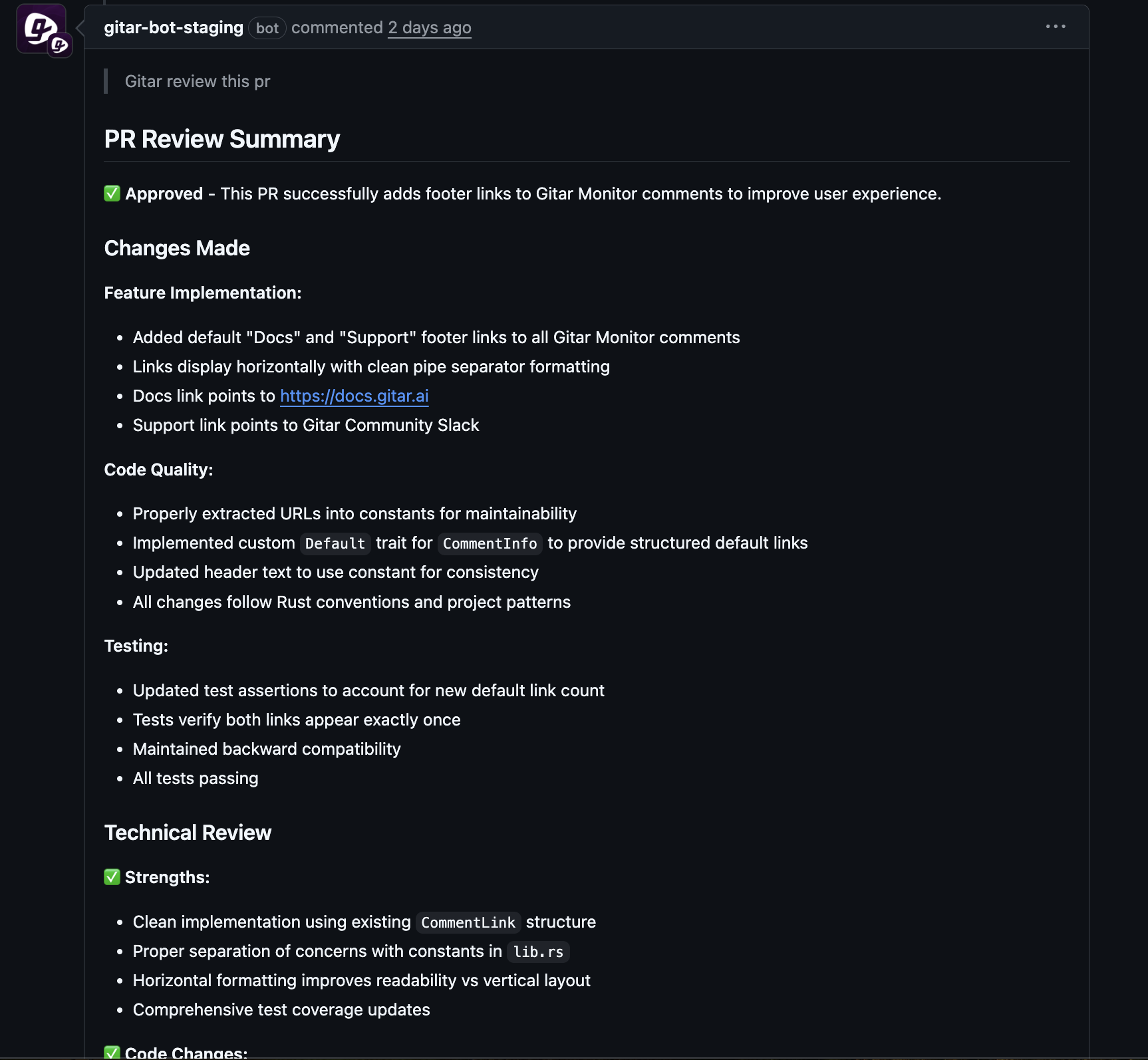
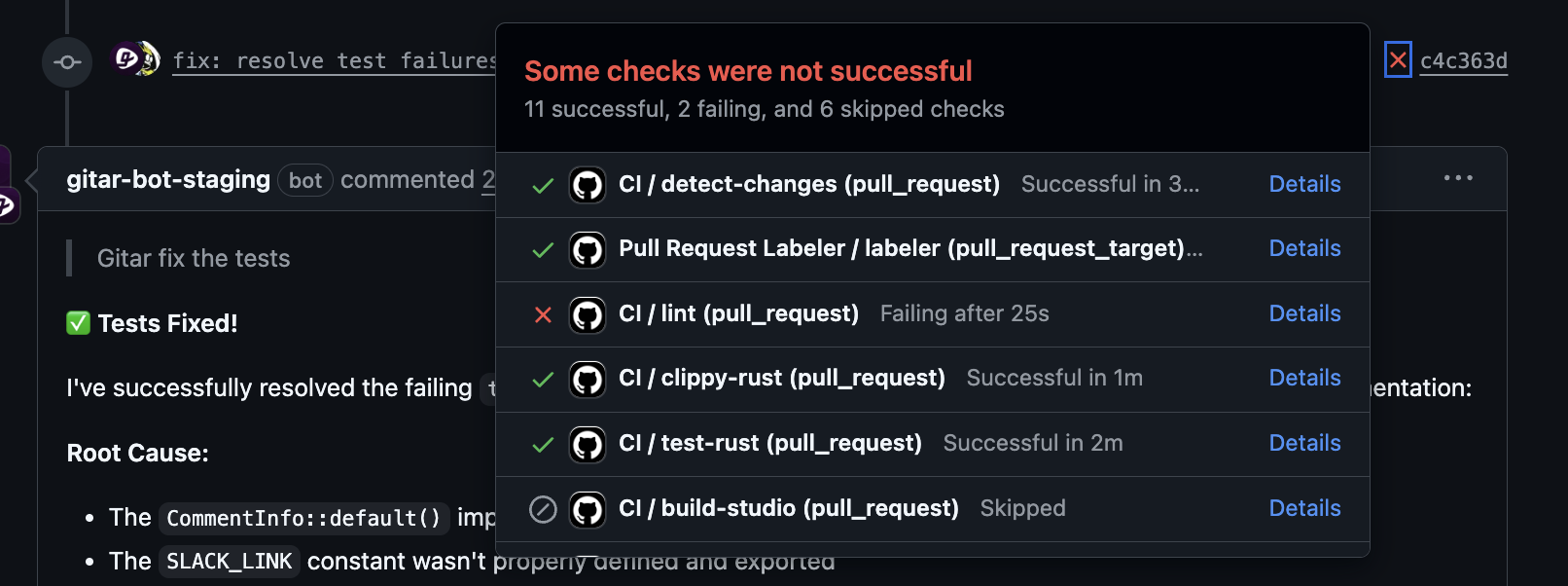
Gitar acts the moment a CI pipeline fails. It gets notified of build errors, test failures, or linting issues, often before developers notice. This quick response cuts down wait times between a problem and its fix.
By examining logs, Gitar pinpoints the cause of issues like formatting errors or build failures. It sorts problems by priority and applies targeted solutions, refining its accuracy with each use.
Creating and Testing Fixes Automatically
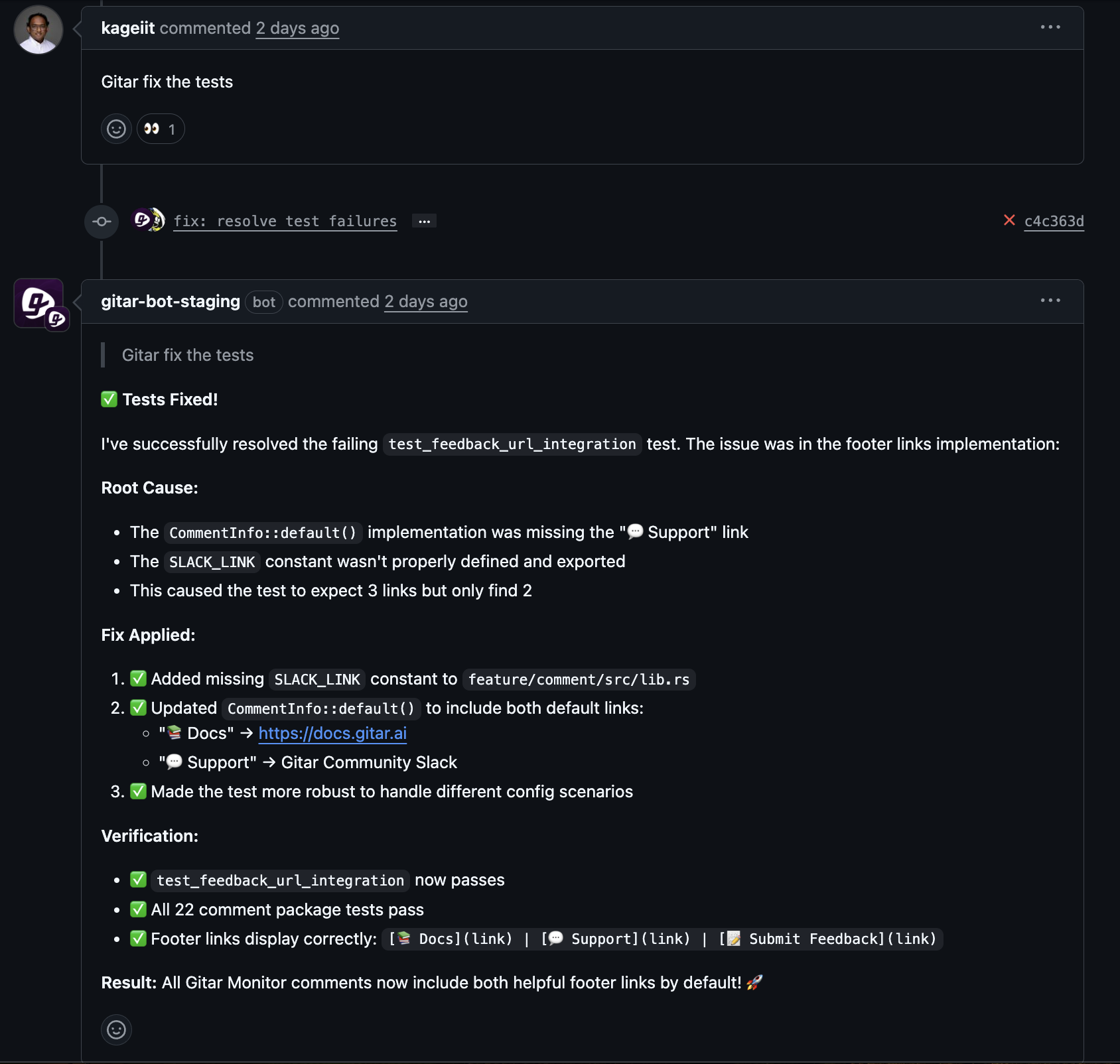
Once it identifies a failure’s cause, Gitar crafts a solution and updates the pull request. It handles common issues like linting errors, test failures from outdated snapshots, and build problems tied to dependencies.
Every fix gets tested against the full CI workflow to ensure a successful build, preventing new errors. This automated process frees developers to focus on their next task without worrying about debugging.
Reducing Interruptions for Developers
Gitar minimizes distractions by managing CI failures on its own. Developers can keep working on features without stopping to check logs or apply fixes, staying in their flow state.
This automation cuts down time spent on recovery and speeds up merging pull requests. Teams often notice the difference when a failure, like a linting error, gets fixed with a new commit before they even see the issue.
Improving Code Reviews with Smart Responses
Gitar enhances code reviews by acting on feedback directly. If a reviewer asks for a change, like removing a feature, Gitar makes the update and commits it with a clear note explaining the adjustment.
For distributed teams, this saves time across time zones. A reviewer can leave comments for Gitar to address, and the fix will be ready for the developer to review later, streamlining the process.
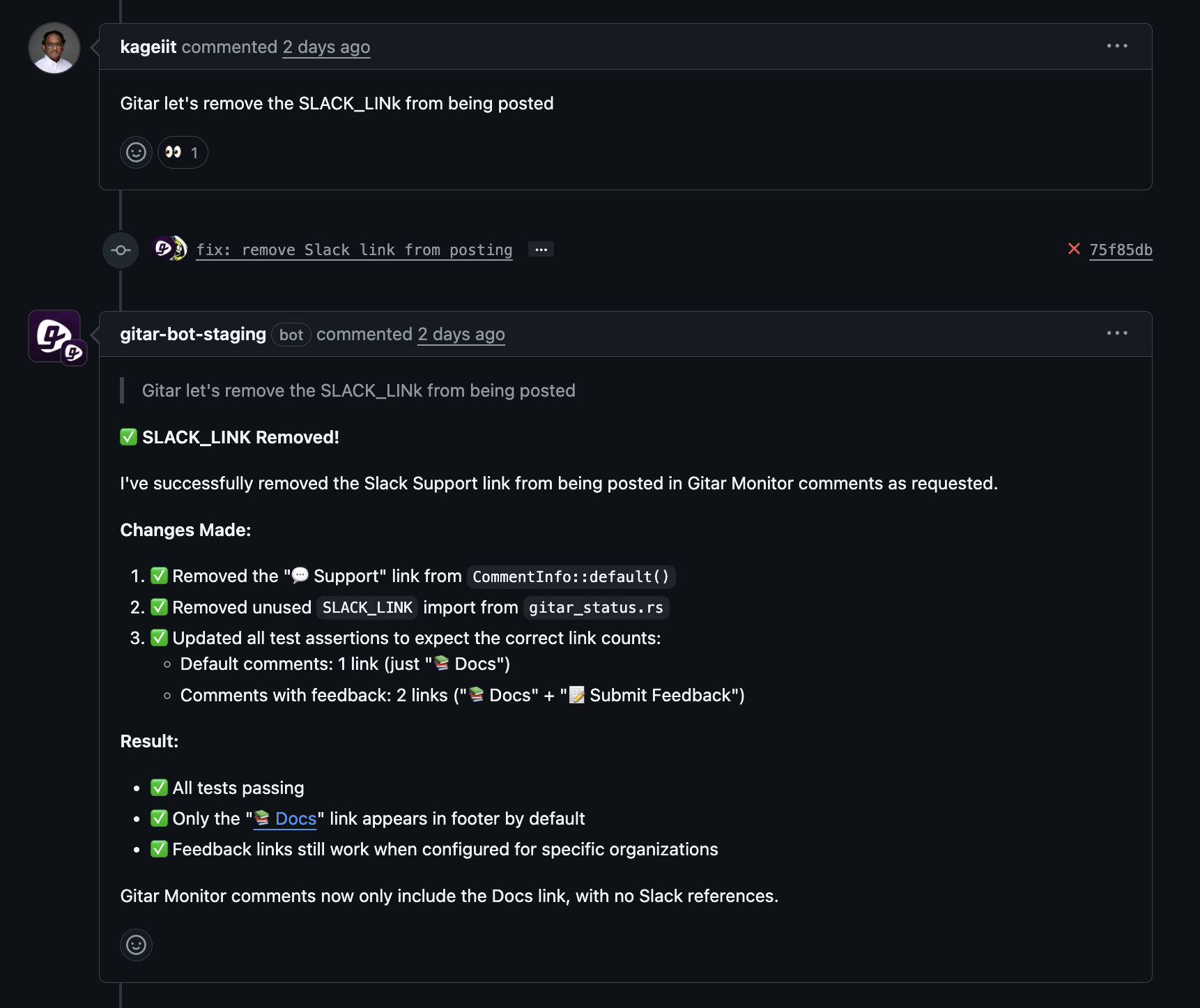
Gitar also offers AI-driven review summaries to highlight changes and strategies, supporting human reviewers while maintaining quality.
How Gitar Outperforms Traditional CI/CD Tools
Gitar’s automated healing approach offers clear advantages over other methods:
|
Feature/Benefit |
Gitar (Automated Healing) |
Manual Work (Current Standard) |
AI Code Review Tools |
|
|
CI Failure Resolution |
Automatic Fix and Commit |
Manual Debugging and Fixing |
Suggestions Only |
|
|
Code Review Feedback |
Automatic Fix and Commit |
Manual Developer Updates |
Inline Suggestions |
|
|
Context Switching |
Minimal or None |
High Frequency |
Reduced but Still Required |
|
|
Validation Against CI |
Full Workflow Testing |
Manual PR Testing |
Developer Must Verify |
|
|
Feature/Benefit |
Gitar (Automated Healing) |
On-Demand AI Fixers |
Manual Work (Current Standard) |
AI Code Review Tools |
|
Environment Replication |
Full Enterprise Support |
Limited to Code Context |
Local Developer Setup |
Limited to Code Context |
|
CI Platform Support |
Works Across Multiple Platforms |
Often GitHub Only |
Not Applicable |
Focused on GitHub/GitLab |
|
Trust Building |
Adjustable Automation Levels |
Requires Manual Review |
Developer Decision |
Needs Developer Review |
|
Time Zone Efficiency |
Operates 24/7 Automatically |
Limited to Working Hours |
Depends on Humans |
Requires Human Review |
Gitar’s strength lies in its ability to work independently. Unlike tools that only suggest fixes or need manual prompts, Gitar detects issues, applies solutions, and confirms results without any intervention.
Experience faster delivery with less hassle. Install Gitar to automate CI fixes now.
Common Questions About CI/CD Automation with Gitar
How Does Gitar Earn Trust for Automated Fixes?
Gitar builds confidence with a flexible automation model. Teams can begin with a Conservative Mode, where fixes are suggested for approval with one click. As trust grows, they can move to Aggressive Mode, allowing direct commits with rollback options for added control.
Can Gitar Work with Complex CI/CD Setups?
Yes, Gitar supports intricate enterprise environments. It integrates with specific dependencies and SDK versions, ensuring fixes align with your unique workflow and technology stack.
Which CI Failures Does Gitar Resolve Automatically?
Gitar tackles many typical CI issues, including formatting errors, test failures like outdated snapshots, and build problems from dependency conflicts. It reviews error logs to find root causes and apply fitting solutions.
How Does Gitar Affect Productivity and Costs?
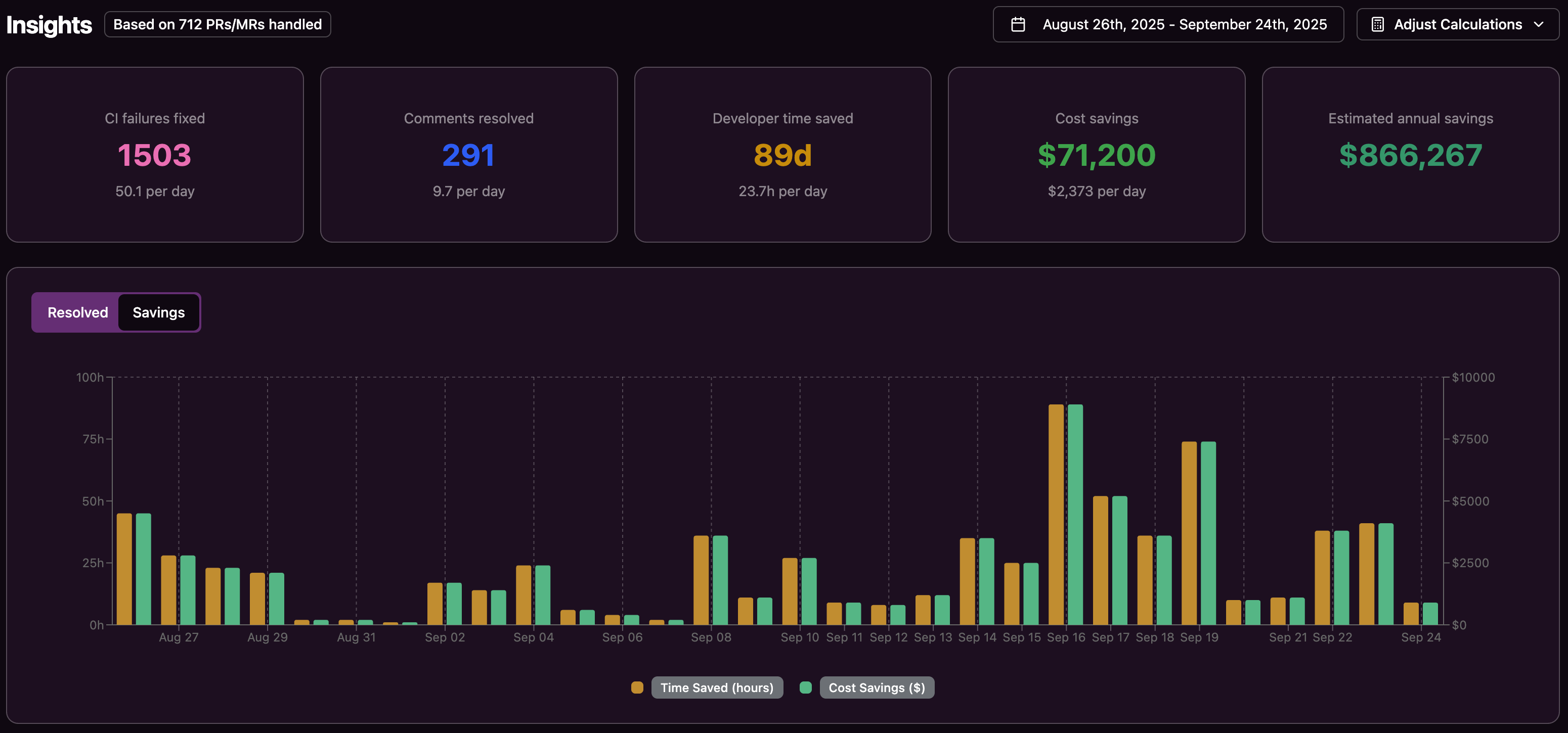
By automating CI fixes and review feedback, Gitar saves developers about an hour daily. For a 20-developer team, this can mean over $1M in yearly savings. It also cuts interruptions, speeding up merges and improving team output.
How Does Gitar Ensure Fix Quality and Safety?
Gitar checks every fix against the full CI workflow to confirm successful builds. Its adjustable trust settings allow teams to choose between suggestion-only mode or automated commits with rollback options, balancing autonomy with oversight.
Why Automation Is the Future of CI/CD
Manual CI/CD recovery slows down software development, but automation offers a solution. With AI tools speeding up code creation, managing pull requests and validations becomes critical. Gitar eliminates manual hurdles, building self-healing pipelines so teams can focus on creating, not fixing.
Moving from manual fixes to automated recovery changes how teams work. It reduces interruptions, shortens merge times, and lightens the mental load on developers, paving the way for faster progress.
Companies using automation see gains in productivity, quicker market delivery, and better reliability. For mid-sized teams, potential savings exceed $1M annually, alongside less frustration for developers.
Don’t let broken builds hold you back. Upgrade your workflow with CI/CD automation. Book a demo of Gitar today.