
Key takeaways
- Manual CI failure resolution creates significant hidden costs by consuming developer time, increasing context switching, and delaying releases.
- Context switching around failed builds lowers focus and can turn short fixes into long interruptions across entire engineering teams.
- Autonomous CI failure fixing reduces this burden by diagnosing failures, applying changes, and validating them against full pipelines.
- Gitar extends beyond error fixing by implementing code review feedback, handling complex CI environments, and neutralizing time zone delays.
- Teams can adopt automation gradually and reduce manual CI work by installing Gitar for autonomous CI failure fixing.
Cut hidden costs from manual CI failures
Developer productivity loss from context switching
In 2026, merge conflicts and CI failures still erode engineering capacity. Each failed build forces developers to stop deep work, inspect logs, and recall context around earlier changes. This context switching tax often doubles the time required to apply a simple fix because developers must rebuild their mental model after every interruption.
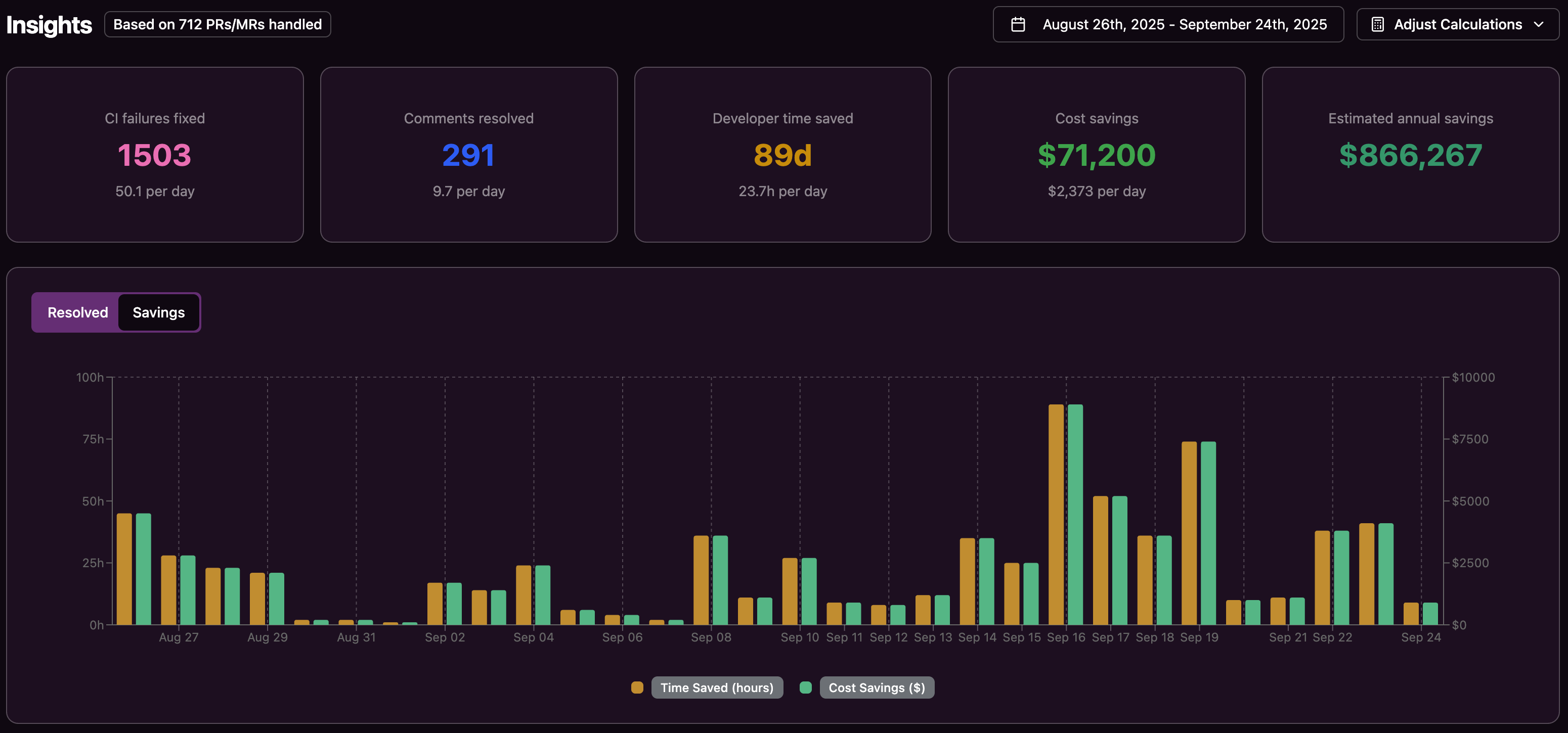
For a 20-person engineering team, losing even one hour per developer each workday to CI failures adds up quickly. Over a year, that pattern can reach roughly 5,000 hours of lost time and approach $1 million in productivity costs at typical salary levels. These interruptions do not just slow individual contributors; they slow projects, introduce schedule risk, and increase burnout.
Frequent CI failures slow distributed teams
CI issues occur frequently in modern pipelines. Teams report spending a substantial share of development time on CI noise, flaky tests, and code review-related issues that block merges. These failures often become a primary cause of delivery delays for many organizations.
Distributed teams feel this impact most. A developer in San Francisco might push a pull request that fails CI or requires review comments to be addressed, while the reviewer in Bangalore has already signed off for the day. A fix that should take minutes stretches across days of back-and-forth, with CI reruns and re-approvals repeating across time zones.
Why traditional tools do not fully solve CI failure fixing
Manual triage and many AI suggestion tools still place the final burden on developers. Engineers must interpret error logs, track down the root cause, update code, and rerun the pipeline. Some AI code reviewers offer helpful hints or generate patches, but validation against the full CI workflow often remains a human task.
This partial automation leaves teams with a gap between suggestions and guaranteed green builds. Developers still lose time on rework and verification, and leaders still face schedule risk from unpredictable failures.
Use autonomous CI failure fixing with Gitar
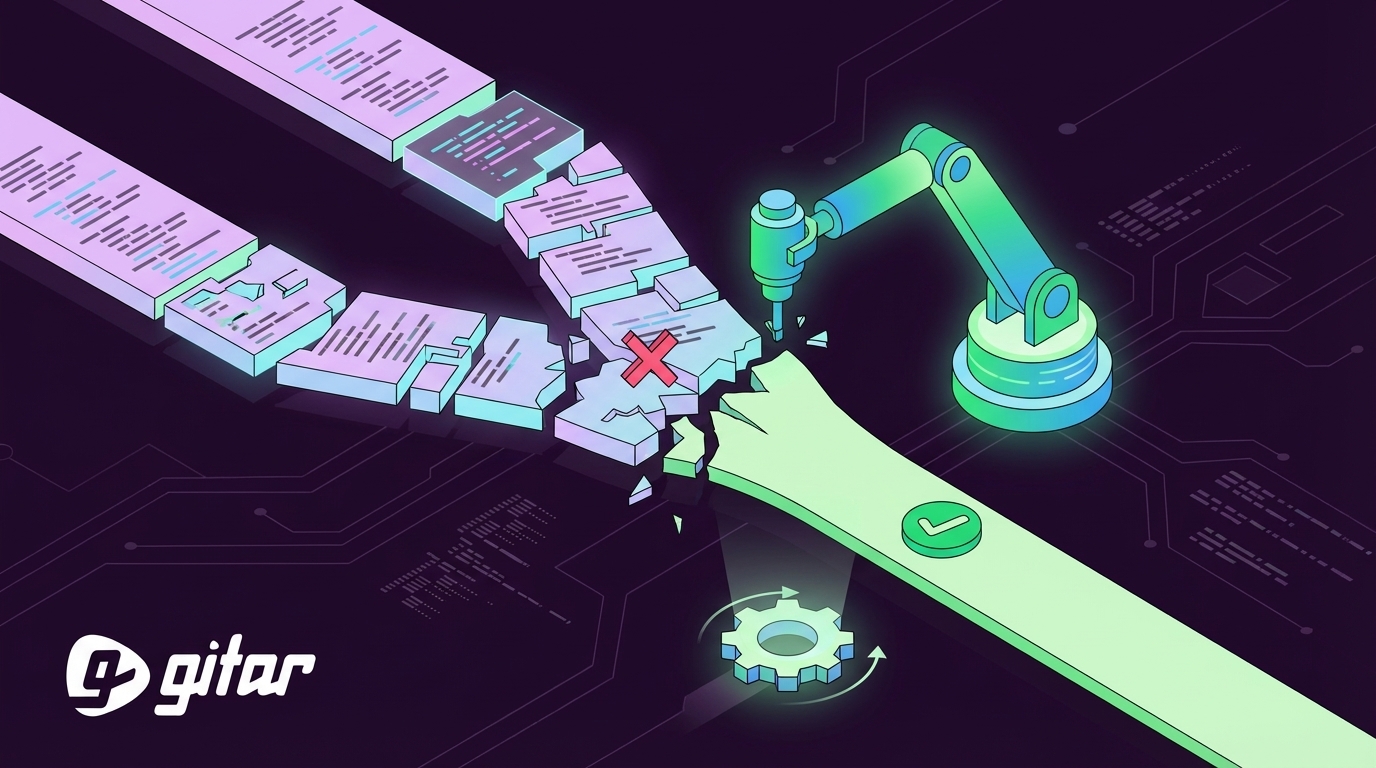
Gitar shifts CI failure resolution from suggestion to execution. Instead of only pointing out issues, Gitar acts as a self-healing engine that applies fixes, runs the same workflows your team already trusts, and works to return pull requests to a passing state before developers need to intervene.
Key capabilities of Gitar’s autonomous CI failure fixing include:
- End-to-end fixing that diagnoses CI failures, updates code, and validates changes across the full pipeline.
- Environment replication that mirrors enterprise workflows, including specific SDK or JDK versions, multi-language builds, and integrations such as SonarQube or Snyk.
- A configurable trust model that ranges from suggestion-only to automatic commits with rollback options.
- An intelligent code review assistant that translates reviewer comments into concrete code changes.
- Support for major platforms, including GitHub Actions, GitLab CI, CircleCI, BuildKite, and others.
Install Gitar to reduce manual CI failure work and keep pull requests moving.
Speed up CI resolution and reviews with Gitar
Self-healing CI in your existing pipeline
Gitar addresses the familiar “sea of red” on pull requests by taking action directly in the repository. After a CI failure, Gitar reads logs, identifies the cause, edits code, and commits a fix back to the branch. Developers often return to a green build and a clear commit message instead of a failing pipeline.
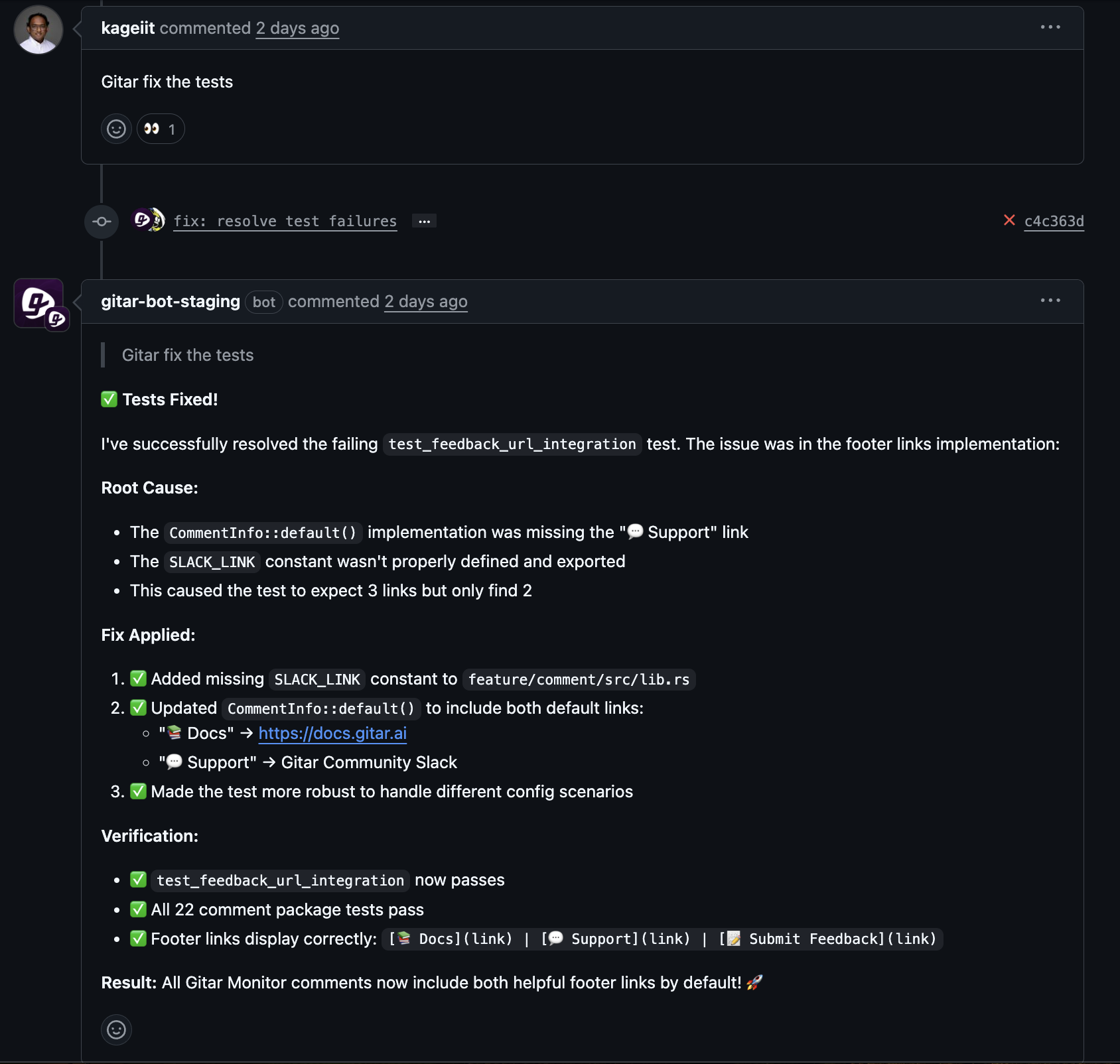
Developers can stay focused on feature work instead of pausing to fix linting violations, flaky tests, or simple build errors. That change reduces context switching and creates more predictable progress on planned tasks.
Faster review cycles through automated feedback implementation
Gitar also accelerates code reviews by acting on reviewer feedback. A comment such as “remove this feature from the pull request” becomes a direct instruction. Gitar updates the relevant files, removes the requested logic, and posts a commit with an explanation of what changed.
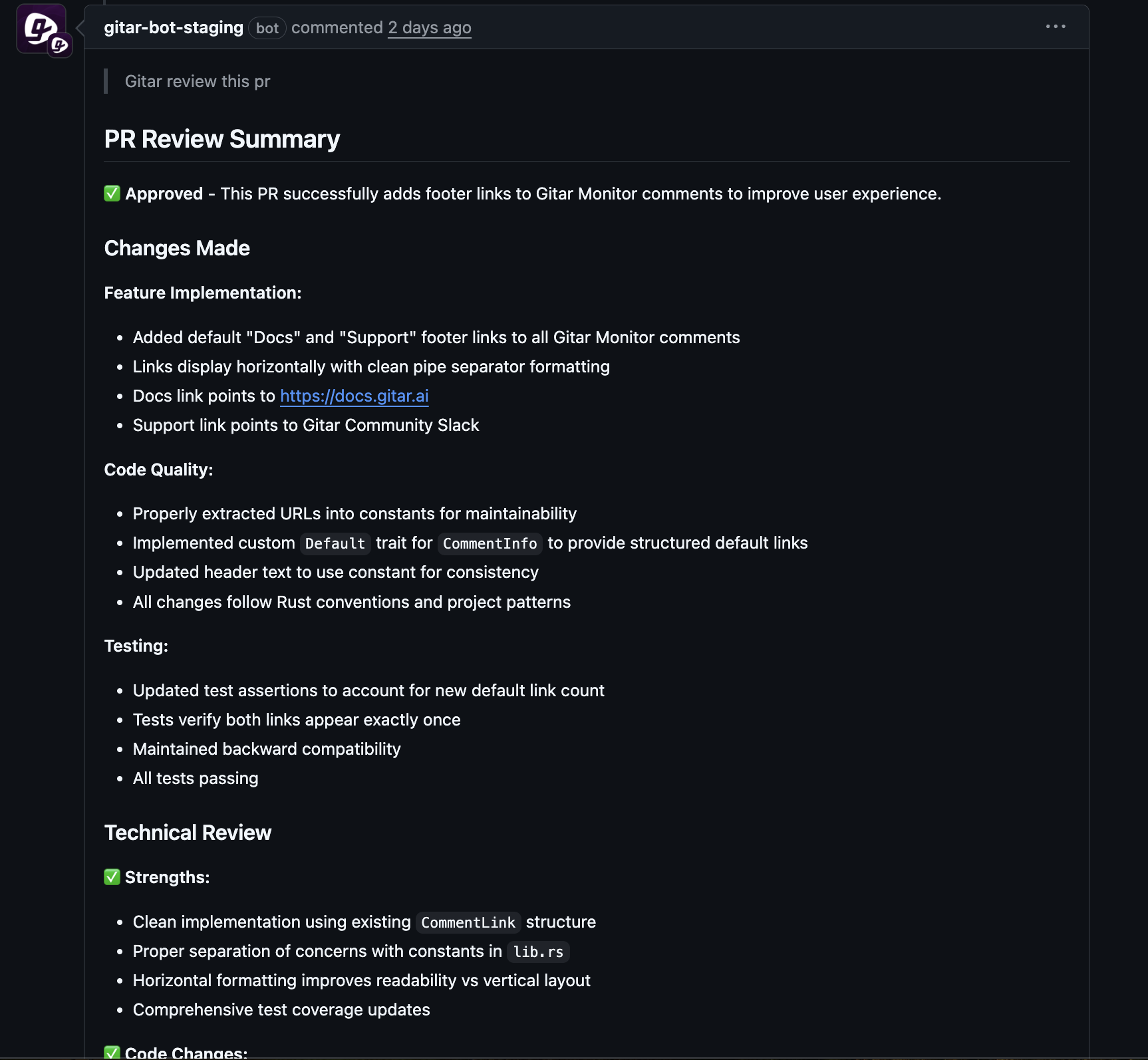
Distributed teams benefit from this behavior. A reviewer can leave feedback at the end of the day, and Gitar can apply the requested changes overnight. The original author then starts the next day with an updated pull request that is ready for final review instead of a backlog of manual edits.
Guaranteed green builds through validation
Gitar differentiates itself through full CI validation. Suggestion-only tools produce recommendations that still require manual confirmation. Gitar executes the pipeline, verifies that jobs pass, and works to reach a green state before handing control back to developers.
The trust model allows teams to move at a comfortable pace. Many teams start with a conservative setting where Gitar posts proposed changes for human review, then choose to enable auto-commit modes for low-risk fixes as confidence grows.
|
Aspect |
Gitar (autonomous CI fixes) |
Traditional manual resolution |
General AI code reviewers |
|
Failure resolution |
Autonomous diagnosis and fixes |
Manual investigation and coding |
Suggestions and partial assistance |
|
Validation against CI |
Runs full workflows and targets green builds |
Manual reruns and checks |
Often requires manual validation |
|
Context switching |
Minimal, fixes arrive automatically |
Frequent and disruptive |
Reduced but still present |
|
Time zone impact |
Neutralized through autonomous actions |
Significant for distributed teams |
Still a factor where humans must approve or rerun |
Request access to Gitar to add autonomous healing to your CI pipelines.
Key considerations about automated CI failure fixing
Gitar versus existing AI reviewers
Many teams already use AI reviewers that add comments or suggest patches. Those tools can reduce some effort but usually rely on developers to apply changes and confirm that CI passes. Gitar instead takes responsibility for both implementation and validation, aiming to return a passing build rather than just a suggestion.
Building trust in automated CI fixes
Trust grows when teams keep visibility and control. Gitar supports this through its configurable modes. Teams can begin with suggestion-only behavior, review every change, and then selectively enable automatic commits where the risk is low. Rollback options remain available, and automation levels can be tuned per repository or team.
Handling complex and unique CI setups
Enterprise CI environments often use custom images, multiple languages, and specialized tools. Gitar focuses on reproducing these environments accurately, including specific dependency versions, environment variables, and security or quality gates. That focus makes it suitable for complex pipelines where manual debugging is most time-consuming.
Types of CI failures Gitar resolves
Gitar targets recurring issues that absorb daily developer time. Common categories include linting and formatting violations, unit and integration test failures, snapshot updates, broken assertions, and build errors caused by dependency or script issues. Gitar also applies code review feedback for refactors, style improvements, and scoped feature removals.
Fit within existing development workflows
Gitar connects through GitHub or GitLab installation and interacts with pull requests through comments and commits. The tool works alongside existing CI configurations rather than replacing them, so teams can keep their current workflows while automating much of the manual effort around failures and review feedback.
Move away from manual CI failure resolution
Manual CI failure fixing imposes a quiet but heavy tax on modern software teams. Time lost to context switching, log reading, and repetitive fixes reduces capacity for feature work and stretches release timelines. For many teams, those hidden costs reach hundreds of thousands of dollars each year.
Gitar offers a way to reclaim that time by treating CI failures and routine review feedback as work that automation can safely handle. Autonomous diagnosis, code changes, and validation against real pipelines help teams ship more reliably while reserving human effort for higher-value engineering problems.