
Key Takeaways
- Engineering teams lose significant time to CI failures, manual debugging, and review back-and-forth, which slows delivery and inflates costs.
- GitHub Actions provides a strong CI/CD foundation but introduces scaling challenges such as complex workflows, fragile checks, and slow iteration cycles.
- Automated developer workflow solutions create self-healing CI by diagnosing failures, applying fixes, and re-running pipelines without manual intervention.
- Gitar turns GitHub Actions into an autonomous healing engine that handles CI failures, implements review feedback, and preserves developer flow state.
- Teams can reduce broken builds and speed up reviews by installing Gitar for GitHub Actions at https://gitar.ai/fix.
Why Automated Developer Workflow Solutions Matter for GitHub Actions at Scale
Many teams face a productivity gap where developers spend as much as 30% of their time handling CI failures and review feedback, which can cost a 20-person team close to $1 million per year in lost productivity. This creates a business bottleneck that delays releases and weakens competitiveness.
GitHub Actions works well for individual repositories but introduces scaling challenges in larger environments. Organizations face fragmented visibility, policy drift, and audit gaps across repositories, which complicate governance and slow approvals.
The bottleneck has moved from writing code to managing it. Tools like GitHub Copilot speed up code creation, which produces more pull requests, more tests, and more potential CI failures. Modern CI/CD pipelines now include security scanning, rollbacks, and observability tasks, often powered by additional services that increase complexity.
Install Gitar for GitHub Actions to reduce CI toil and regain developer time.
How GitHub Actions Limits Automation at Scale
GitHub Actions offers a straightforward path into CI/CD, but several limitations appear as workflows and teams grow.
Monorepos and multi-workflow setups become hard to manage because GitHub ties branch protection to specific check names. Small workflow changes can break protections and require manual updates, which interrupts development.
Developers describe the push-wait-debug cycle as slow and frustrating. Each YAML or environment change often needs a full CI run, which stretches feedback loops and interrupts flow.
Enterprise teams face further friction. Weak secrets management, inconsistent policies, and limited audit trails create risk when workflows bypass reviews or deploy non-compliant changes.
Pipelines with more than 10 jobs become harder to stabilize and maintain. Minor edits can trigger cascading failures, which pushes teams toward custom tooling or heavy manual intervention.
Introducing Gitar: Autonomous Workflow Solutions for GitHub Actions
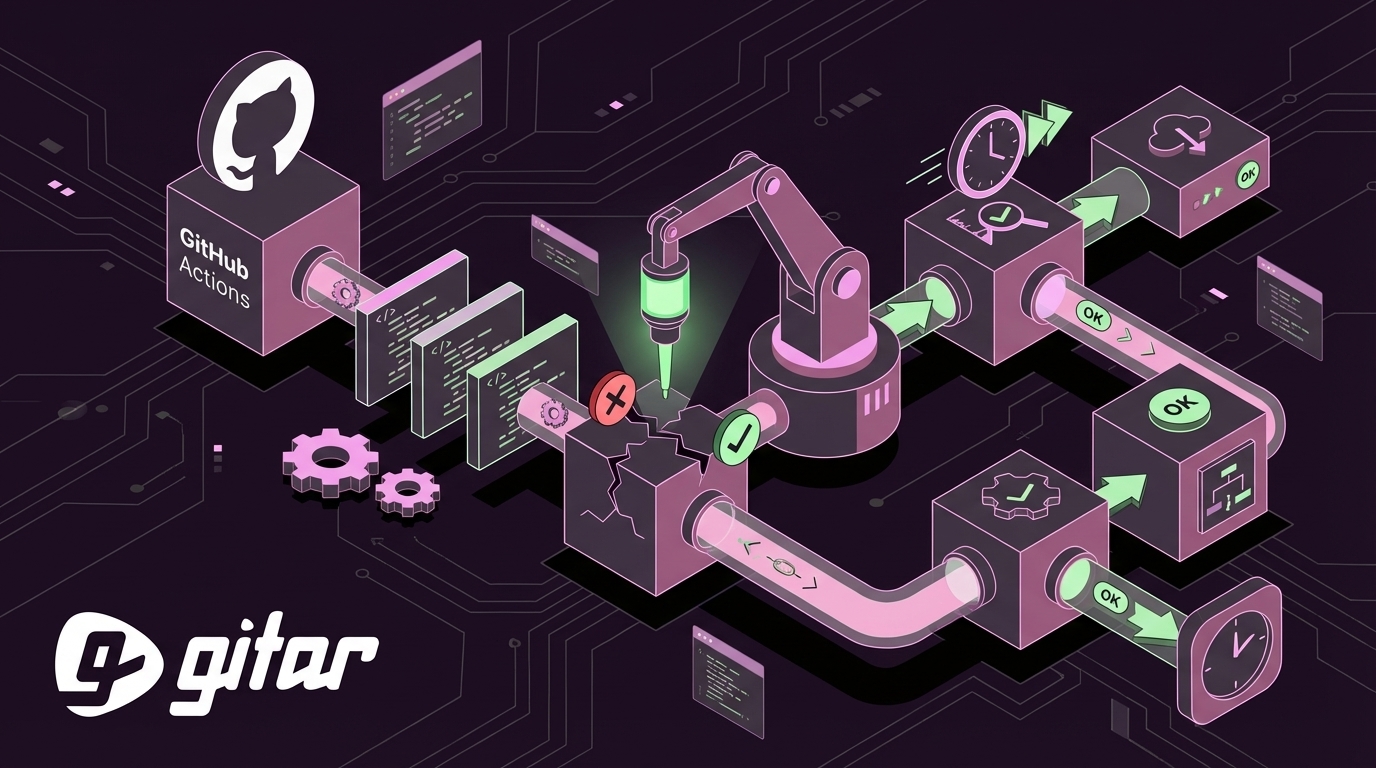
Gitar extends GitHub Actions with a self-healing layer that focuses on resolving workflow bottlenecks, not just flagging them. The system detects failures, proposes fixes, applies changes, and validates them in CI, so developers can stay focused on product work.
Key capabilities that position Gitar as an effective automated developer workflow solution include:
- End-to-end fixing that applies and validates changes for CI failures and review feedback within GitHub Actions before updating pull requests.
- Full environment replication for complex enterprise stacks, including language runtimes, SDK versions, and integrations with tools such as SonarQube and Snyk.
- A configurable trust model that ranges from suggestion-only mode to auto-commit with rollback, so teams can control how aggressively Gitar edits code.
- Support for distributed teams by implementing review comments between time zones, which shortens review cycles.
- Context-aware intelligence that pairs with local developer agents to improve the quality and relevance of fixes.
Book a Gitar demo to see autonomous fixes inside your GitHub Actions workflows.
How Gitar Creates Self-Healing CI in GitHub Actions
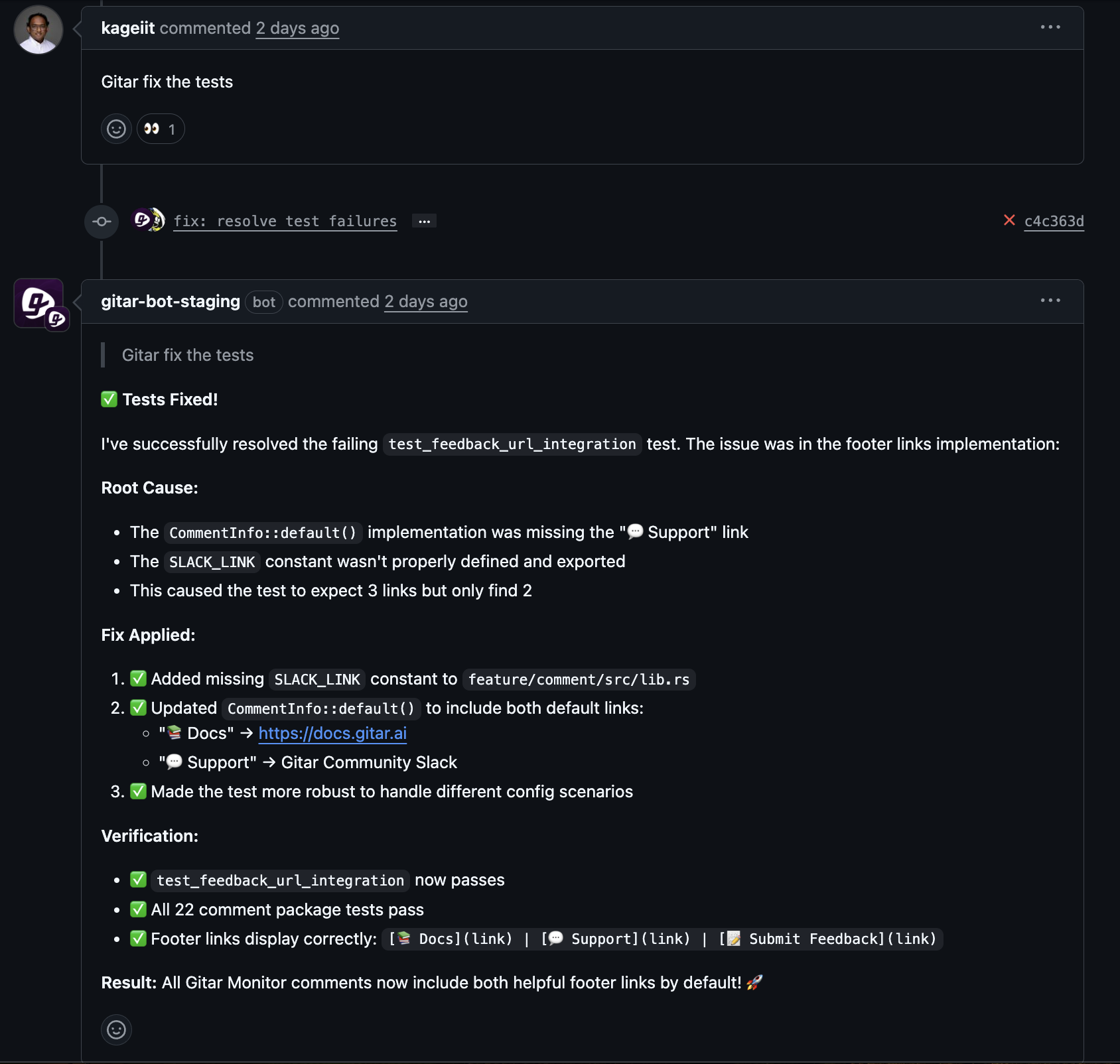
Gitar acts as a healing engine rather than a suggestion engine. Many AI review tools surface recommendations that developers still need to implement and debug. Gitar closes this gap by executing the full cycle.
When a workflow fails, Gitar analyzes CI logs, identifies the root cause, edits the code or configuration, and re-runs the workflow. The pull request then updates with new commits and an explanation of what changed.
Typical issues Gitar resolves include:
- Linting and formatting violations.
- Simple test failures, such as snapshot updates or flaky assertions.
- Build failures tied to dependency or configuration problems.
Each fix includes a clear summary so developers understand the change while avoiding manual rework.
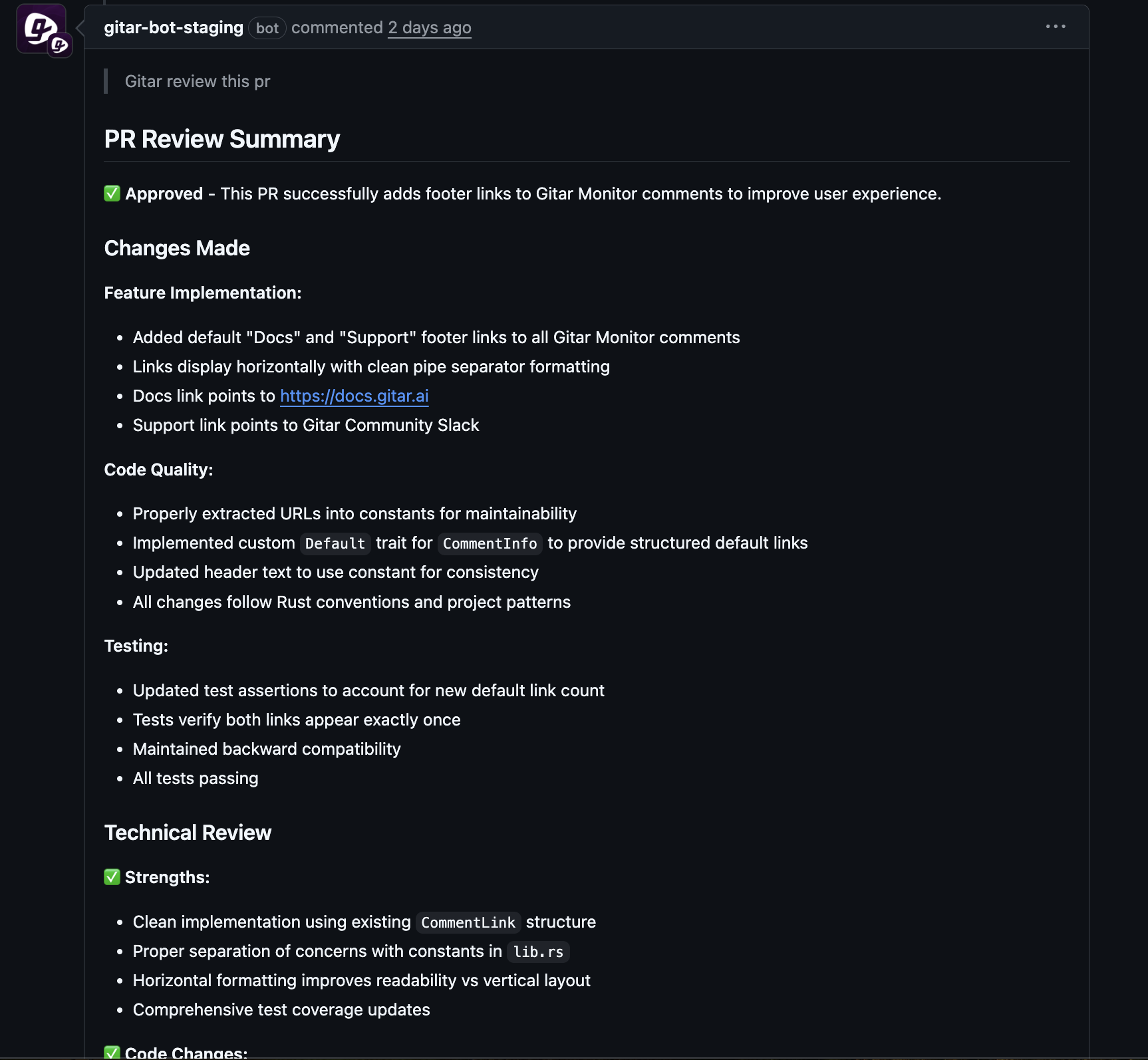
The pull request experience reinforces this workflow. Gitar posts a persistent comment that acts as a status panel, tracking progress from failure detection through to resolution. Developers often see CI fixed and commits added before they return to the PR.
Strategic Implementation: Integrating Gitar with GitHub Actions
Phase 1: Installation and Initial Trust
Teams install Gitar as a GitHub App and configure it through a simple web dashboard. Most organizations begin in suggestion-only mode so that Gitar proposes fixes as comments or suggestions, while developers retain full control over what gets merged.
Phase 2: Expanding Trust and Automation
Trust grows as teams accept Gitar suggestions for low-risk fixes such as lint errors or test snapshots and see them pass CI. Consistent accuracy encourages teams to increase automation levels, move to auto-apply for certain issue types, and reduce manual edits.
Phase 3: Advanced Workflows and Review Collaboration
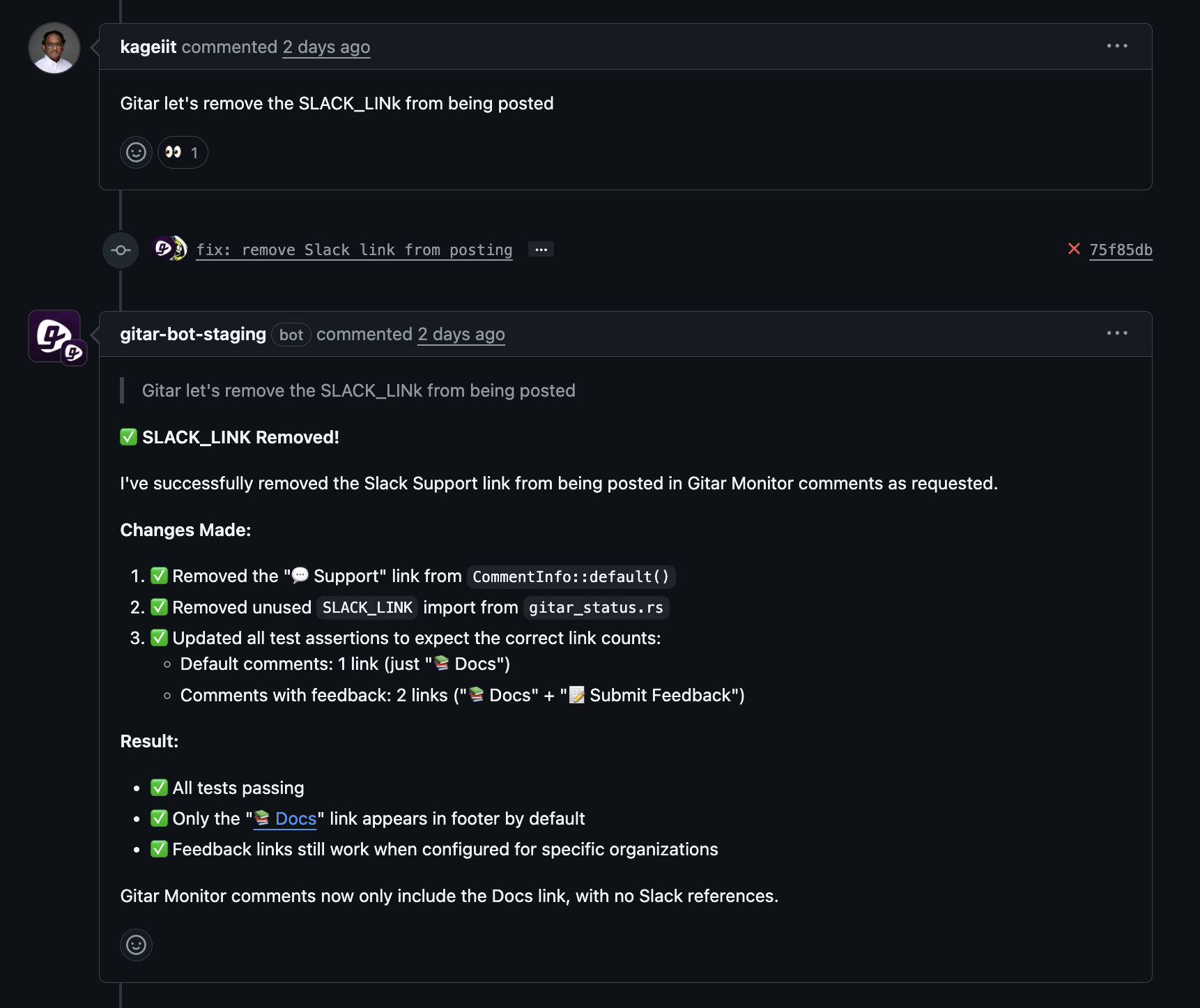
Mature users delegate more complex work to Gitar, including implementation of detailed review feedback and larger refactors guided by reviewers. Senior engineers can leave natural language instructions in pull requests, and Gitar turns those into concrete commits that pass CI.
How Gitar Addresses Common GitHub Actions Obstacles
|
GitHub Actions Challenge |
Traditional Manual Approach |
Gitar Automated Solution |
|
CI failure resolution |
Manual log inspection, context switching, and repeated commits |
Automated analysis, fix generation, validation, and commit |
|
Code review feedback implementation |
Developers apply feedback by hand, often across time zones |
AI-driven implementation that shortens review cycles |
|
Complex workflow management |
Fragile YAML files, slow debugging, and policy drift |
Automated updates that aim to keep workflows consistent and maintainable |
|
Developer focus and flow state |
Frequent interruptions for CI triage and review edits |
Background healing that preserves focus on core development work |
Install Gitar to turn recurring CI and review tasks into automated background work.
Frequently Asked Questions about Automated Developer Workflow Solutions
Q: How does Gitar support complex enterprise GitHub Actions environments?
Gitar uses a custom agent architecture that mirrors real CI environments, including specific SDK versions, multi-language stacks, and integrations with scanners such as SonarQube and Snyk. This allows Gitar to propose and validate fixes in conditions that match production pipelines.
Q: How is Gitar different from other AI code review tools in GitHub Actions?
Most AI tools act as suggestion engines that leave implementation and validation to developers. Gitar functions as a healing engine that implements fixes, re-runs pipelines, and updates pull requests once builds pass, which reduces manual effort and repeated CI runs.
Q: How does Gitar manage trust and safety when editing code?
Teams configure Gitar with an aggression model that defines how it behaves. Conservative modes restrict Gitar to suggestions that require explicit approval. More aggressive modes allow auto-commits with full visibility into diffs and easy rollback paths.
Q: Does Gitar replace human reviewers?
Gitar augments human reviewers by handling repetitive changes and mechanical fixes. Reviewers remain responsible for architecture, security, and product decisions, while Gitar takes on the tedious implementation details and follow-up edits.
Q: How does Gitar improve slow iteration cycles in GitHub Actions?
Gitar shortens the push-wait-debug loop by fixing common pipeline failures automatically. Developers can keep working locally while Gitar investigates logs, applies changes, and re-runs workflows until the CI pipeline passes.
Conclusion: How Autonomous Automation Shapes the Future of GitHub Actions
Manual CI debugging and review-driven rework no longer scale with modern development demands. GitHub Actions offers a strong CI/CD foundation, but large teams need automation that not only highlights problems but also resolves them.
Gitar provides that layer of autonomous healing for GitHub Actions. By reducing time lost to CI failures, review edits, and context switching, automated developer workflow solutions help engineering teams ship reliable software faster and with less friction.
Teams that adopt autonomous automation will be better positioned to handle growing codebases and complex pipelines in 2026 and beyond. Request a Gitar demo to see self-healing CI in your GitHub Actions workflows.