
Written by: Ali-Reza Adl-Tabatabai, Founder and CEO, Gitar
Key Takeaways for Secure, Fast PR Workflows
- Automated code review security scanning brings SAST, SCA, secrets detection, and IaC checks directly into GitHub PRs to block vulnerabilities early.
- AI-generated PRs introduce significantly more security issues, so teams need autonomous fixes to keep development velocity steady.
- Gitar.ai outperforms tools like Snyk and SonarQube with validated auto-fixes, CI failure analysis, and a green build guarantee.
- Teams cut CI and review time by about 75% and shrink vulnerability MTTR from days to minutes with Gitar’s healing engine.
- Implement comprehensive AI code review security scanning by installing Gitar’s 14-day Team Plan trial for instant GitHub integration and autonomous remediation.
Core Capabilities of PR Security Scanning in GitHub
Modern automated code review security scanning for pull requests integrates multiple security analysis types directly into GitHub workflows. SAST engines analyze source code for vulnerabilities like SQL injection and cross-site scripting. Beyond the code itself, SCA tools scan dependencies for known CVEs, while secrets detection prevents API keys and credentials from entering repositories. For teams deploying to cloud infrastructure, IaC scanning validates cloud configurations before they reach production. AI-powered AutoFix agents evaluate code changes in real time and generate targeted fixes that developers can accept with one click, so remediation happens inside the development workflow instead of as a separate security task.
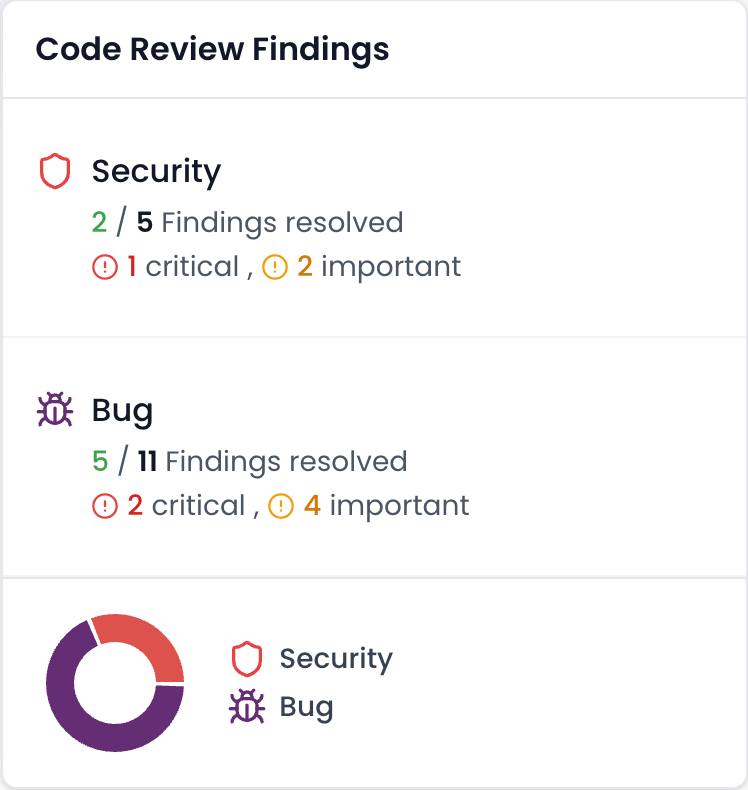
2026 Industry Landscape: Security Tools and AI-Generated PR Risk
The security scanning landscape includes established players like SonarQube, Snyk, and GitHub Advanced Security, which provide advanced scanning with remediation capabilities through AI integrations. 40% of AI-generated applications contain vulnerabilities, with the elevated security issues in AI-generated PRs mentioned earlier becoming a critical concern for teams adopting AI coding tools. Traditional tools charge $15-30 per developer monthly for suggestions that still require manual implementation, which creates expensive toil without real velocity gains. The shift-left security pull requests approach now requires tools that detect and autonomously remediate issues. Cross-site scripting remained the top vulnerability type in GitHub’s 2025 advisories, so teams need reliable automated detection and fixing across every PR.
Strategic Considerations for Automated Code Review Security Scanning for Pull Requests
Given the rising security issues in AI-generated code and the limits of scan-only tools, organizations face build-versus-buy decisions when implementing PR security scanning. ROI calculations consistently favor automated remediation over manual processes. A 20-developer team spending one hour daily on CI and review issues loses approximately $750,000 annually in productivity costs, and the 75% time savings from autonomous remediation translates directly to recovered developer capacity. Even with improved tooling, GitHub data shows average fix time for critical vulnerabilities decreased 30% in 2025 to 26 days, so manual remediation still creates delays that autonomous tools can remove. Key metrics include green build rates, mean time to remediation (MTTR) reduction, and developer velocity maintenance. To achieve these metrics without disrupting development, PR security scanning tools must integrate seamlessly with existing GitHub workflows while providing measurable security improvements without development friction.
Why Gitar.ai Wins: Healing Engine and Green Build Guarantee
Gitar.ai stands out through its healing engine, which goes beyond suggestions and delivers autonomous fixes with validation. Competitors provide scanning with AI-powered remediation options, but Gitar validates fixes so they work before any commit lands in the repository. The following comparison highlights how Gitar’s green build guarantee and validated auto-fixes differ from tools that only suggest changes:
|
Capability |
CodeRabbit/Greptile/Snyk/SonarQube |
Gitar |
|
PR summaries |
Yes |
Yes |
|
Inline suggestions |
Yes |
Yes |
|
Security scanning |
Yes |
Yes (Trial/Team) |
|
Auto-apply fixes |
Via AI integrations |
Yes |
|
CI failure analysis+fix |
Via integrations |
Yes |
|
Green build guarantee |
No |
Yes |
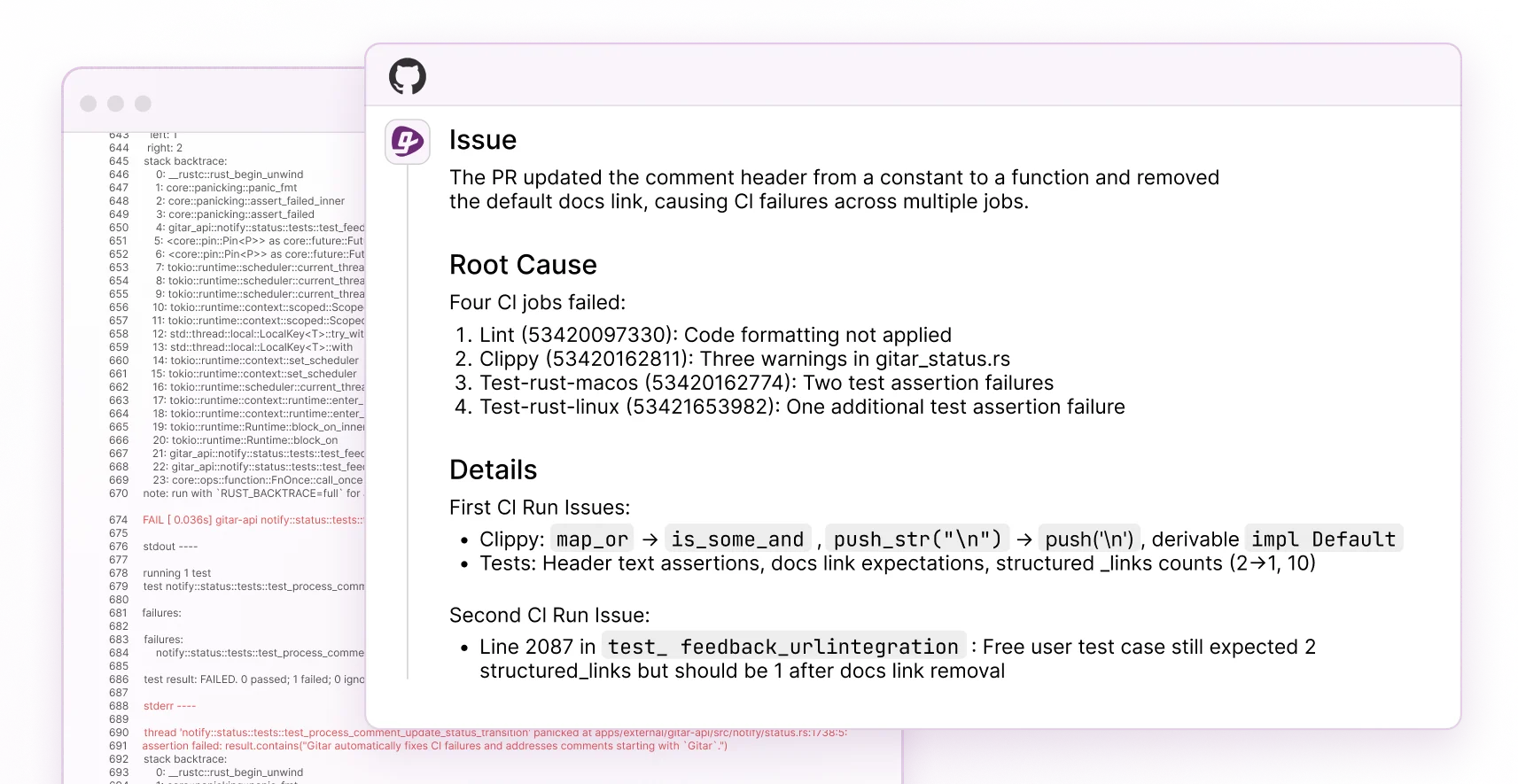
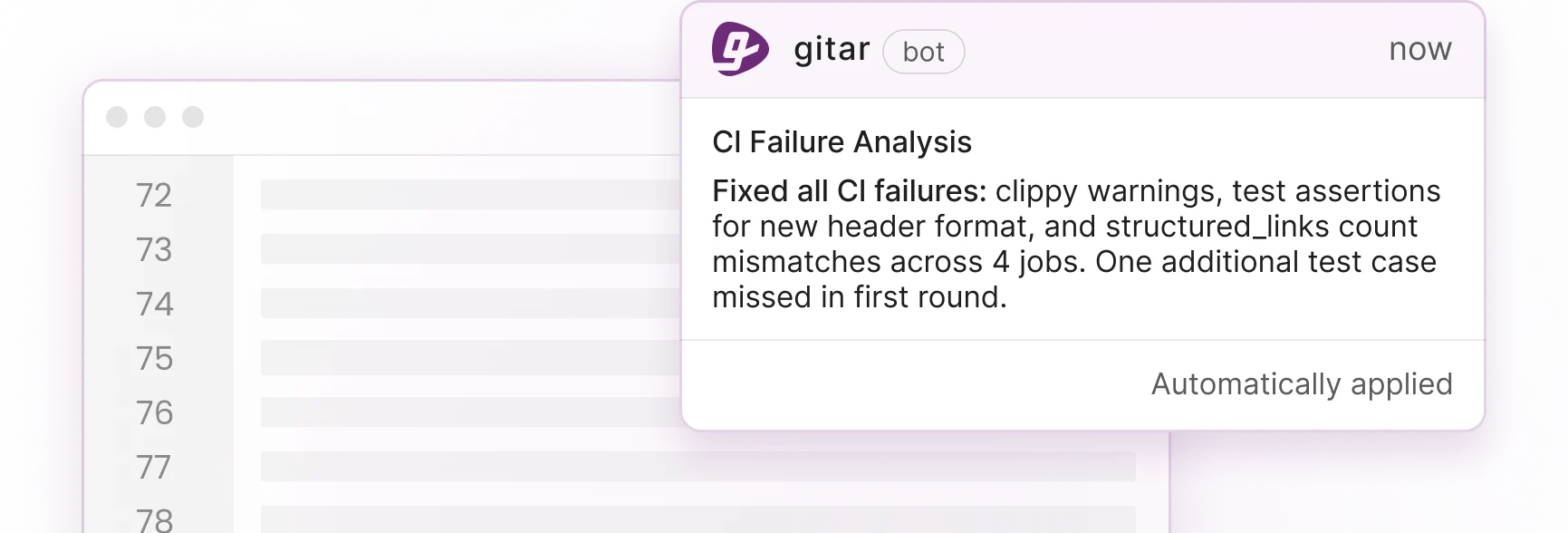
The healing engine analyzes failures, generates contextually appropriate fixes, validates them against the full codebase, and then commits working solutions in a single comment instead of noisy notification threads. This AI code review approach removes the manual toil that makes traditional tools expensive compared to their actual value. Start your 14-day Gitar Team Plan trial, full features in 30 seconds.
5-Step GitHub Implementation with Gitar
Teams can set up Gitar with GitHub in minutes and gain comprehensive AI code review coverage. See Gitar documentation for deeper configuration details:
1. Install Gitar GitHub App
Navigate to the GitHub Marketplace and install the Gitar application with the required repository access permissions.
2. Start 14-day trial
Activate the Team Plan trial to unlock full auto-fix capabilities and all code review features.
3. Let Gitar activate automatically
Gitar posts its dashboard comment on PRs immediately, and no additional workflow files are required.
4. Configure rules
Add .gitar/rules/*.md with natural language policies such as “Assign security team for authentication changes.” These rules shape how Gitar responds before you turn on full automation.
5. Enable auto-commit
Configure Gitar merge blocking settings to automatically apply validated fixes while still respecting existing approval workflows.
This setup delivers immediate feedback with autonomous remediation, which reduces manual review overhead while keeping code quality standards high.
Handling AI-Generated PRs and Avoiding Common Pitfalls
AI-powered PR security reviews must handle AI-generated code that often shows different vulnerability patterns than human-written code. Cross-site scripting vulnerabilities appear in 86% of AI-generated web application code, while log injection affects 88% of AI-generated code. Gitar’s contextual analysis detects these AI-specific patterns and delivers targeted fixes that keep AI-assisted development safe.
Common pitfalls include scan-only tool bias that creates review bottlenecks, YAML maintenance overhead for complex workflows, and trust issues with automated commits. Gitar addresses the trust barrier first through configurable suggestion modes that build confidence before teams enable full automation. Once teams trust the fixes, comprehensive CI integration removes YAML complexity, while validated fixes prove reliability through testing before any code reaches production.
Best Practices and ROI: Before and After Gitar
Organizations using Gitar’s automated security scanning see measurable improvements across key development metrics. The data below shows how teams achieve roughly 75% time savings and cut annual productivity costs by about $750K through autonomous remediation:
|
Metric |
Before |
After |
|
Daily CI/review time per developer |
1 hour |
15 minutes |
|
Security vulnerability MTTR |
2-5 days |
Minutes |
|
False positive rate |
50-85% |
<5% |
|
Annual productivity cost (20 devs) |
$1M |
$250K |
Best results come from starting with suggestion mode to build team confidence, focusing on high-severity vulnerabilities first, and embedding security scanning into existing GitHub workflows instead of creating parallel processes. See these ROI improvements in your own workflow, start your 14-day trial.
FAQ
What’s the best automated code review security scanning for GitHub pull requests?
Gitar.ai provides comprehensive AI code review that includes security scanning, bug detection, and performance review through its healing engine, which automatically generates and validates fixes. Unlike scan-only tools that charge $15-30 per developer for suggestions, Gitar focuses on autonomous remediation that delivers green builds and faster delivery. You can try the full Team Plan capabilities with a 14-day trial and see the impact on your own PRs.
How does Gitar handle AI-generated PR security vulnerabilities?
Gitar’s contextual analysis targets vulnerabilities in AI-generated code. The platform provides fixes for issues such as logic flaws and security misconfigurations while preserving the development velocity that AI coding tools create.
How does Gitar compare to Snyk for pull request security scanning?
Snyk provides broad vulnerability detection across code, dependencies, and more, along with AI-powered fix automation. Gitar goes further with autonomous remediation that validates fixes against your actual CI environment. Snyk offers automated patching options, while Gitar automatically applies, tests, and commits working solutions. Gitar also delivers comprehensive CI failure analysis beyond security scanning alone.
How does Gitar compare to SonarQube for GitHub workflows?
SonarQube offers detailed code quality metrics, security scanning including SAST, SCA, and secrets detection, and supports autonomous remediation through AI integrations. Gitar provides a more seamless experience with full CI integration, automatic failure analysis and fixing, natural language rule configuration, and cross-platform support beyond GitHub. SonarQube often requires significant configuration and maintenance, while Gitar runs out-of-the-box with minimal setup.
How quickly can I set up GitHub security scanning with Gitar?
Gitar’s GitHub integration takes about 30 seconds to install and configure. The GitHub App installation and trial activation require minimal technical expertise. Teams can configure advanced features such as custom rules and auto-commit settings incrementally as they build confidence with the platform.
Can I trust Gitar’s automated commits for security fixes?
Gitar provides configurable trust levels that start with suggestion mode, where every fix requires approval. The platform validates each fix against your full CI environment before committing, so changes do not break builds or introduce new issues. Teams can gradually enable auto-commit for specific failure types as they gain confidence in the system’s reliability.
Automated code review security scanning for pull requests shifts teams from reactive security to proactive, autonomous protection. Traditional tools leave organizations with expensive manual work, while Gitar’s healing engine delivers the autonomous remediation that modern development velocity requires. The combination of comprehensive code review, validated fixes, and seamless GitHub integration makes Gitar a practical choice for teams that want strong quality without sacrificing speed. Experience autonomous remediation with Gitar’s 14-day trial.