
Written by: Ali-Reza Adl-Tabatabai, Founder and CEO, Gitar
Key Takeaways
- Automated code review tools like SonarQube often add 10-30% to CI pipeline duration through full repository scans, which creates bottlenecks as AI-driven code generation increases change volume.
- Incremental analysis, caching, and parallel processing can cut review times from 5-20 minutes to under 30 seconds in well-tuned setups.
- AI coding assistants increase PR volume by 60%, overwhelming traditional review processes and driving developer burnout from constant review pressure.
- Gitar’s autonomous fixing removes re-run cycles, applies fixes for CI failures automatically, and delivers green builds that suggestion-only tools cannot guarantee.
- Teams using Gitar save up to $1M annually in productivity; calculate your own savings with a free 14-day Team Plan trial on your existing pipelines.
How Automated Code Review Affects CI Performance
Automated code review can either slow CI pipelines or accelerate them, depending on how teams configure scan depth and analysis scope. Over 60% of QA pipelines experienced delays from full-scan approaches, particularly in monorepo environments where comprehensive analysis can add 5-20 minutes to build times. The following comparison shows how different optimization strategies reduce these delays by up to 97%.
|
Scan Depth |
Time Addition |
Primary Mitigation |
Optimized Result |
|
Full Repository |
5-20 minutes |
Incremental analysis |
<2 minutes |
|
Changed Files Only |
1-5 minutes |
Parallel processing |
<1 minute |
|
Cached Analysis |
30 seconds-2 minutes |
Smart invalidation |
<30 seconds |
The most significant CI/CD pipeline slowdowns appear when teams enable automated code review without any optimization strategy. Incremental compilation achieves greater than 5x speedup over full builds by processing only changed components. Caching mechanisms then reduce subsequent analysis times to under 2 minutes, even for large codebases, by avoiding repeated work on unchanged code.
Real-World CI Slowdowns From Developer Forums
Developer discussions across forums show consistent frustration with traditional code review tools in high-volume environments. AI-native teams report that PRs arrive faster due to AI coding tools, which increases review pressure and leads to burnout as reviewers spend longer inspecting for subtle inconsistencies.
Common complaints include notification fatigue from chatty AI tools that scatter dozens of inline comments across diffs, context switching overhead from multiple review cycles, and the limitation that suggestion-only tools still require manual implementation. Slow tests in growing UI suites drag down CI pipelines with execution times ranging 20-30 minutes unoptimized, which compounds the review bottleneck and extends feedback loops.
The contrast between 2024 and 2026 realities is stark. Daily AI users merge approximately 60% more PRs than light users. This surge in PR volume, the 60% increase mentioned earlier, creates bottlenecks that traditional review processes cannot handle efficiently, as teams report spending more time reviewing than coding.
Why Automated Code Review Slows CI Pipelines (And 5 Proven Fixes)
These forum complaints reveal three root causes of CI slowdown. Full-repository scanning processes unchanged code, sequential execution wastes parallelization opportunities, and suggestion-only tools require manual fix implementation with repeated re-runs. Each of the following five strategies targets one of these causes and together they form a coherent acceleration plan.
- Implement Incremental Analysis: Process only changed files and dependencies to achieve the speedup discussed earlier, which delivers over 5x faster performance than full repository scans. This step removes the most obvious waste by avoiding analysis of code that has not changed.
- Enable Task Trace Caching: Cache analysis results and restore traces to run only impacted checks in subsequent builds. Once incremental analysis reduces the scope, caching prevents re-analyzing the same code across multiple builds.
- Parallelize Review Processes: Run static analysis, security scans, and code quality checks concurrently rather than sequentially. With scope reduced and caching in place, parallelization accelerates the remaining work and shortens total CI duration.
- Optimize Review Timing: Execute lightweight checks pre-commit and comprehensive analysis post-merge to balance speed with thoroughness. This timing strategy keeps feedback fast during active development while reserving deeper checks for stable branches.
- Deploy AI Auto-Fixing: Eliminate re-run cycles by automatically fixing detected issues rather than just flagging them. Autonomous fixing removes the manual patch-and-rerun loop that consumes most CI processing time in busy teams.
Ready to eliminate CI slowdowns entirely? Install Gitar now to see autonomous fixing in action on your next PR.
Enter Gitar: Autonomous Fixing That Speeds Up CI
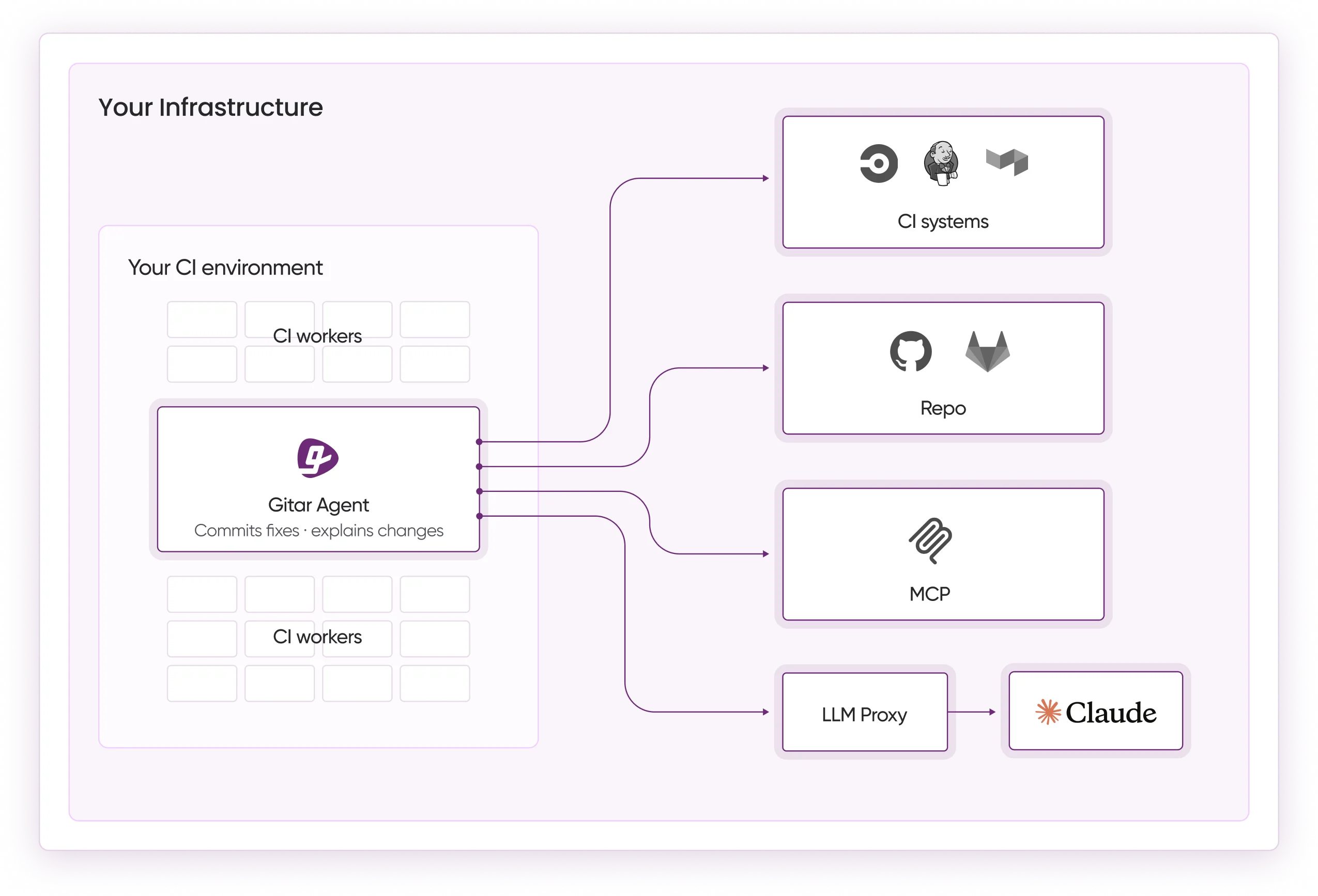
Gitar introduces a shift from suggestion-based code review to autonomous fixing that directly shortens CI cycles. Unlike traditional tools that add overhead through analysis-only approaches, Gitar’s healing engine resolves issues automatically and reduces total pipeline time by cutting out re-run cycles. For more details on Gitar’s capabilities, see the Gitar documentation.
This fundamental difference in capabilities explains why Gitar accelerates pipelines while other tools slow them down. The comparison below highlights how Gitar’s behavior diverges from traditional tools and AI suggestors.
|
Capability |
Traditional Tools |
AI Suggestors |
Gitar |
|
Auto-apply fixes |
No |
No |
Yes |
|
CI failure auto-fix |
No |
No |
Yes |
|
Green build guarantee |
No |
No |
Yes |
|
Single comment interface |
No |
No |
Yes |
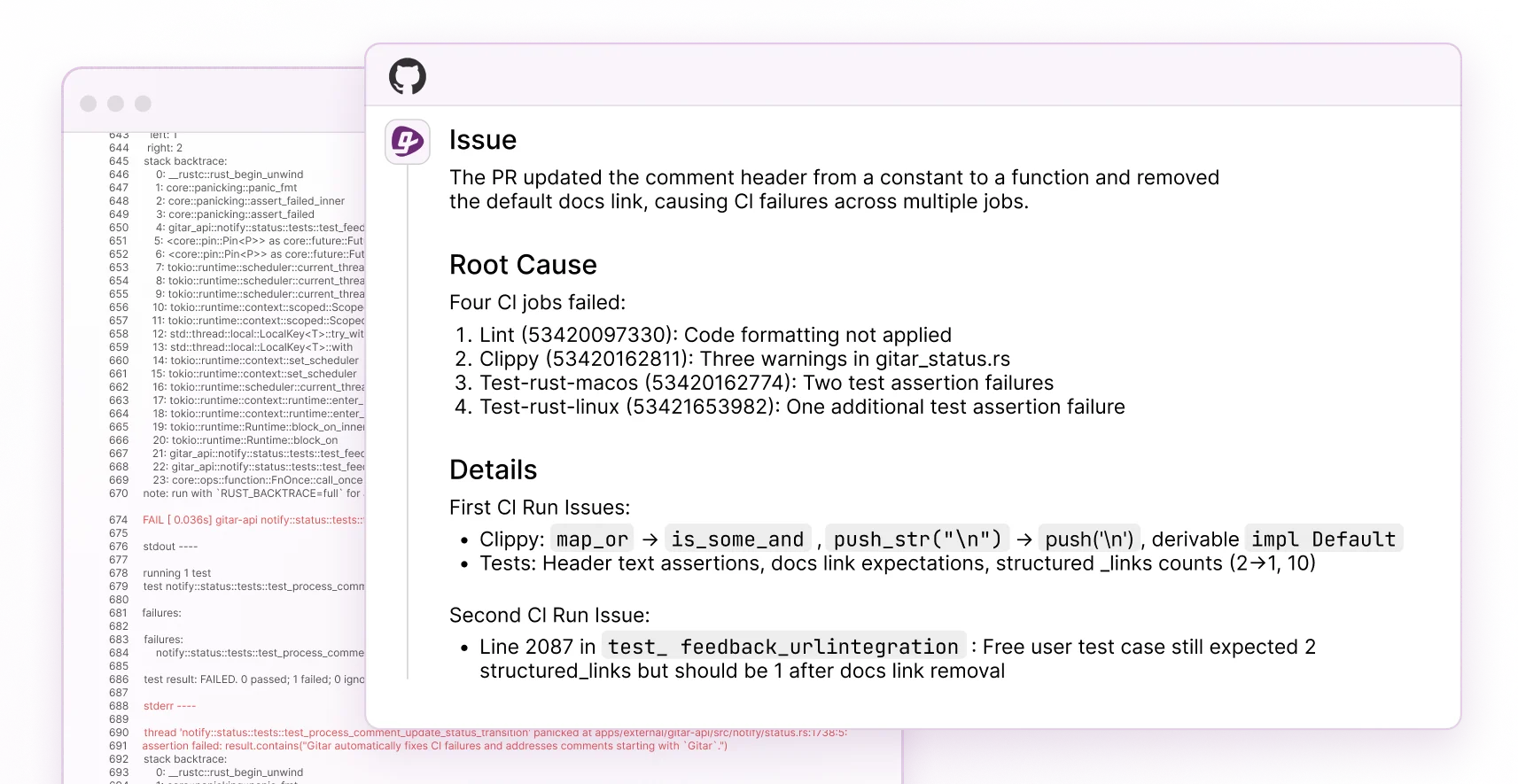
When CI checks fail, such as lint errors, test failures, or build breaks, Gitar analyzes failure logs, generates validated fixes, and commits corrections automatically. This approach removes the traditional overhead of manual fix implementation and repeated runs that consume 75% of CI processing time in high-volume environments.
The platform integrates natively with GitHub, GitLab, CircleCI, and Buildkite, which provides broad coverage across modern development toolchains. Start a free trial to test these integrations with your existing workflows.
Gitar Benchmarks & Case Studies
The capabilities outlined above translate into measurable time savings and workflow improvements. Teams report Gitar’s PR summaries are “more concise than Greptile/Bugbot,” which highlights the single updating comment approach that reduces cognitive load compared with competitor notification spam. This cleaner interface becomes even more valuable when combined with intelligent failure analysis.
Collate’s engineering lead emphasized how “unrelated PR failure detection” saves “significant time” by distinguishing infrastructure flakiness from code bugs, which prevents developers from chasing issues that are not their fault. Traditional code reviewers lack this capability because they do not have access to CI context and failure history.
The productivity savings outlined earlier, up to $1M annually, come from reducing each developer’s daily CI and review time from 1 hour to approximately 15 minutes while removing the manual toil associated with suggestion-only tools. These gains compound across teams as PR volume grows with AI-assisted development.
Timing Code Reviews in Continuous Integration
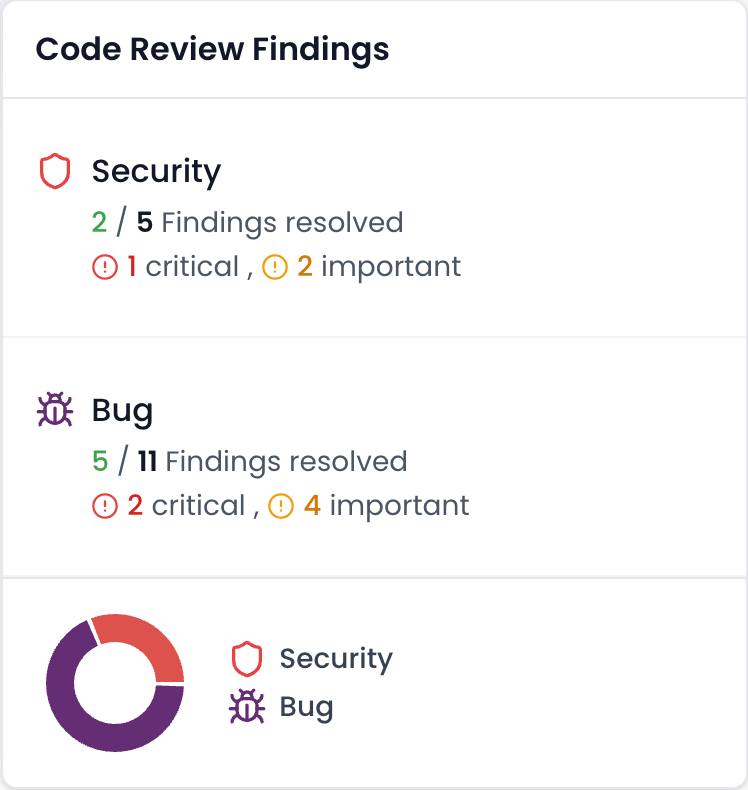
AI code review patterns like Flow-to-Fix measure findings addressed per PR and time from finding to resolution. These patterns enable teams to maintain velocity at scale through consistent, systematized review processes that match review effort to risk.
The most effective approach combines pre-commit lightweight checks for immediate feedback with comprehensive post-commit analysis and automatic resolution. This structure keeps developers moving quickly while still enforcing strong quality gates on shared branches.
This timing strategy maximizes developer productivity by providing fast feedback loops and thorough checks at the right stage. Gitar’s healing engine operates continuously within this model, fixing issues as they are detected instead of batching corrections, which maintains pipeline momentum and reduces overall processing time.
Transform your CI pipeline efficiency today. Install Gitar now and let it handle your next CI failure automatically, with no manual fixes required.
FAQ
Does Gitar add time to CI pipelines?
Gitar reduces total CI time by removing re-run cycles through automatic fixing of CI failures and review feedback. You can use the 14-day free Team Plan trial to benchmark pipeline duration before and after enabling autonomous fixes.
How does Gitar handle large monorepos efficiently?
Gitar applies its AI code review across full PR context, including security scanning, bug detection, performance review, and auto-fix capabilities. During the 14-day Team Plan trial you can validate how this behavior scales on your largest repositories.
When should code reviews happen in CI with Gitar?
Gitar’s healing engine automatically analyzes CI failures, generates fixes, and commits them to your PRs as they occur. Teams typically pair this continuous fixing with lightweight pre-commit checks and deeper post-merge analysis to keep feedback fast and quality high.
Can I test Gitar’s impact before committing?
Yes. Gitar offers a 14-day free trial of the Team Plan with full access to auto-fix capabilities, custom rules, and all integrations. This access lets you measure the actual impact on sprint velocity and CI performance before making any financial commitment.
What if I do not trust automated commits initially?
Gitar is fully configurable. You can start in suggestion mode where you review and approve every fix to build trust in the system. Once comfortable, you can enable auto-commit for specific failure types such as lint errors or formatting issues, while keeping manual control for higher-risk changes.
Conclusion
The CI pipeline slowdown problem has intensified as AI coding assistants increase PR volume by 60%, which overwhelms traditional review processes that only suggest fixes. The five optimization strategies outlined here, incremental analysis, caching, parallelization, timing optimization, and auto-fixing, address different aspects of this bottleneck and work best in combination.
Only autonomous fixing tools like Gitar remove the fundamental problem, the re-run cycles that consume 75% of CI processing time. By automatically applying validated fixes instead of generating suggestions that require manual implementation, Gitar turns code review from a pipeline bottleneck into an acceleration mechanism.
Install Gitar now to experience the difference between suggestion-only tools and autonomous fixes in your own workflow.