
Key Takeaways
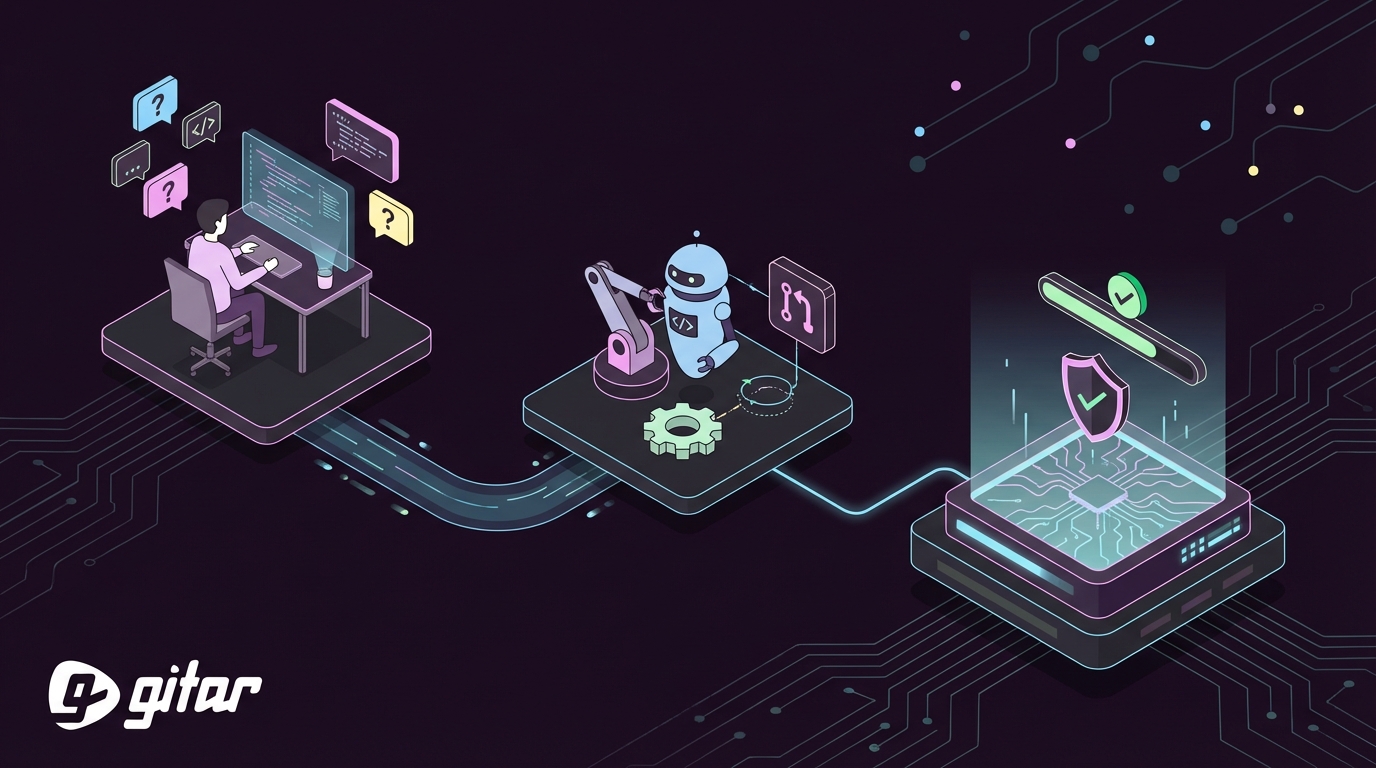
- Automated code remediation in 2026 reduces the high cost of manual CI failure fixes, context switching, and time zone delays.
- AI suggestion engines, on-demand fixers, and healing engines serve different needs, with healing engines providing autonomous, validated fixes.
- Successful adoption depends on CI/CD maturity, clear ROI expectations, and alignment with security, compliance, and governance standards.
- Common pitfalls include over-reliance on suggestion tools, underestimating environmental complexity, and neglecting change management.
- Gitar automates CI failure remediation and code review feedback, helping teams ship reliable software faster; you can get started at Gitar.
Why Automated Code Remediation is a Strategic Imperative
The High Cost of Manual Remediation: Beyond Developer Time
Manual remediation of CI failures and code review feedback can consume up to 30% of developer time, and the impact extends across the organization. Teams lose focus, delay feature delivery, and spend more time firefighting than building.
The context switching tax increases these losses. When a pull request fails CI checks, developers stop feature work, analyze logs, and reconfigure environments. For a 20-developer team, this cycle can add up to roughly $1M per year in lost productivity.
Distributed teams add more friction. Review delays across time zones stretch feedback cycles from hours to days, especially when reviewers give suggestions that still require manual implementation and validation.
The Right-Shift Bottleneck: Prioritizing Validation and Shipping Speed
AI tools such as GitHub Copilot and Cursor have accelerated code generation, so the bottleneck has moved to validation and deployment. The hardest work now happens after the code is written.
Traditional CI/CD pipelines often struggle with the increased load of tests, quality checks, and security scans. Validation and remediation steps sit on the critical path to production, and manual fixes slow everything down.
Teams reduce this bottleneck by using autonomous remediation that fixes broken builds, re-runs checks, and reports back without waiting on human intervention. You can add this capability directly in your pipeline with Gitar.
Understanding Automated Code Remediation Solutions: Categories and Capabilities
Suggestion Engine Paradigm: AI Code Reviewers and IDE Assistants
AI code reviewers such as CodeRabbit and GitHub Copilot act as suggestion engines. These tools surface issues, propose code changes, and highlight potential risks, often inside pull requests or IDEs.
They still rely on developers to apply fixes, run tests, interpret failures, and keep builds green. Suggestion engines improve code quality but do not fully remove the manual work of CI failure remediation.
On-Demand AI Fixers: LLM-Based GitHub Actions
On-demand AI fixers, including some Claude Code integrations and custom GitHub Actions, offer a middle ground. They can generate patches for specific failures when triggered by a workflow or a developer.
These tools often lack a full environmental context and continuous operation. Many depend on manual triggering, handle limited scopes, or struggle with complex dependency graphs in large enterprise pipelines.
Healing Engine Paradigm: Autonomous, Validated Fixes
Healing engines aim for true autonomous remediation. These platforms detect failures, diagnose root causes, apply fixes, validate them in CI, and commit changes once checks pass.
This end-to-end flow reduces context switching and manual overhead. CI failures become background events that the system resolves, while developers stay focused on product work.
Strategic Comparison of Leading Automated Code Remediation Platforms
Gitar: Autonomous CI Fixer and Healing Engine
Gitar operates as a healing engine focused on CI failures and code review feedback. The platform replicates enterprise environments with specific language versions, multi-SDK builds, and integrations such as SonarQube and Snyk, so fixes run in realistic conditions.
A configurable trust model supports gradual adoption. Teams can start in a conservative mode, where Gitar suggests changes for manual review, then move to more autonomous modes that allow auto-commits with safe rollback. This approach lets organizations build confidence without losing control.
Gitar supports major CI providers, including GitHub Actions, GitLab CI, CircleCI, and Buildkite, which makes it suitable for mixed or evolving stacks. Distributed teams benefit from Gitar handling reviews and fixes while teammates are offline.
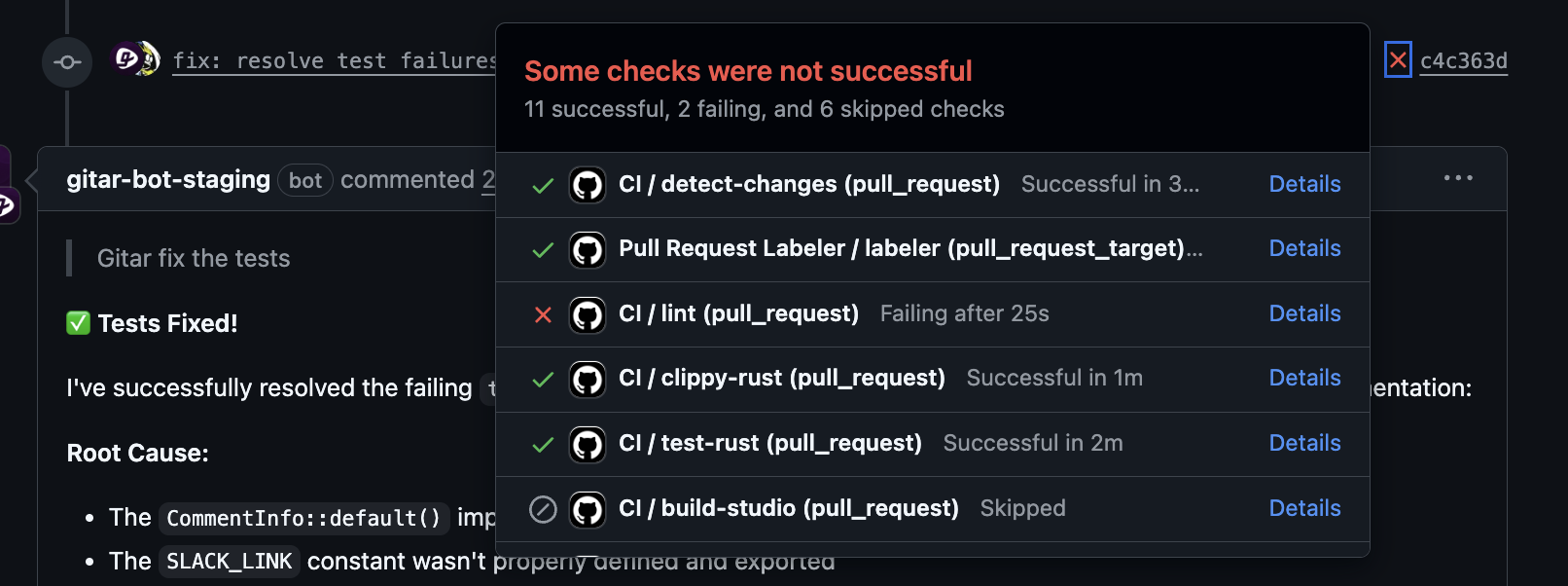
You can see how this fits into your pipeline by installing Gitar in your GitHub organization.
SAST and AppSec Platforms with Remediation Features
Enterprise SAST platforms now bundle remediation alongside detection. Many vendors position AI-driven remediation as part of broader code risk management. Products such as Snyk Code, Mend.io, SonarQube, Veracode, Checkmarx, and Cycode focus on security vulnerabilities and compliance issues.
These tools often propose or apply fixes for security findings and policy violations. Their primary value lies in application security, not in handling general CI failures, flaky tests, or code review comments.
Policy and Governance-Focused Remediation Tools
Platforms like Qodo use codebase intelligence to understand patterns across repositories and enforce policies. These systems generate remediation patches that align with naming standards, architectural rules, and style guides.
They help maintain consistency and governance across large codebases, while platforms like Gitar focus on real-time CI health and daily development flow.
Comparison Table: Autonomous Remediation Capabilities
|
Feature/Platform |
Gitar |
SAST/AppSec Platforms |
Suggestion Engines |
|
Autonomy Level |
Fully autonomous for CI failures |
Semi-autonomous, often rule-based |
Suggestion-based |
|
Fix Validation |
Validated in CI before commit |
Security-focused validation |
The developer runs tests |
|
Environmental Context |
Full CI environment replication |
Security context, partial environment |
Primarily code diffs |
|
Scope of Remediation |
CI failures, code review feedback |
Security, compliance, quality gates |
Style issues, minor bugs |
Strategic Considerations for Adopting Intelligent Automation in Code Remediation
Assessing Your Organization’s Readiness and CI/CD Maturity
Effective adoption starts with understanding your current pipelines, test coverage, and tooling. Complex, multi-step CI workflows benefit most from healing engines that can mirror real environments and run full suites of checks.
Many teams consider building their own agents, then decide to buy instead. The operational cost of long-running agents and ongoing model tuning usually exceeds the cost of a specialized platform.
Quantifying ROI: Beyond Developer Time Savings
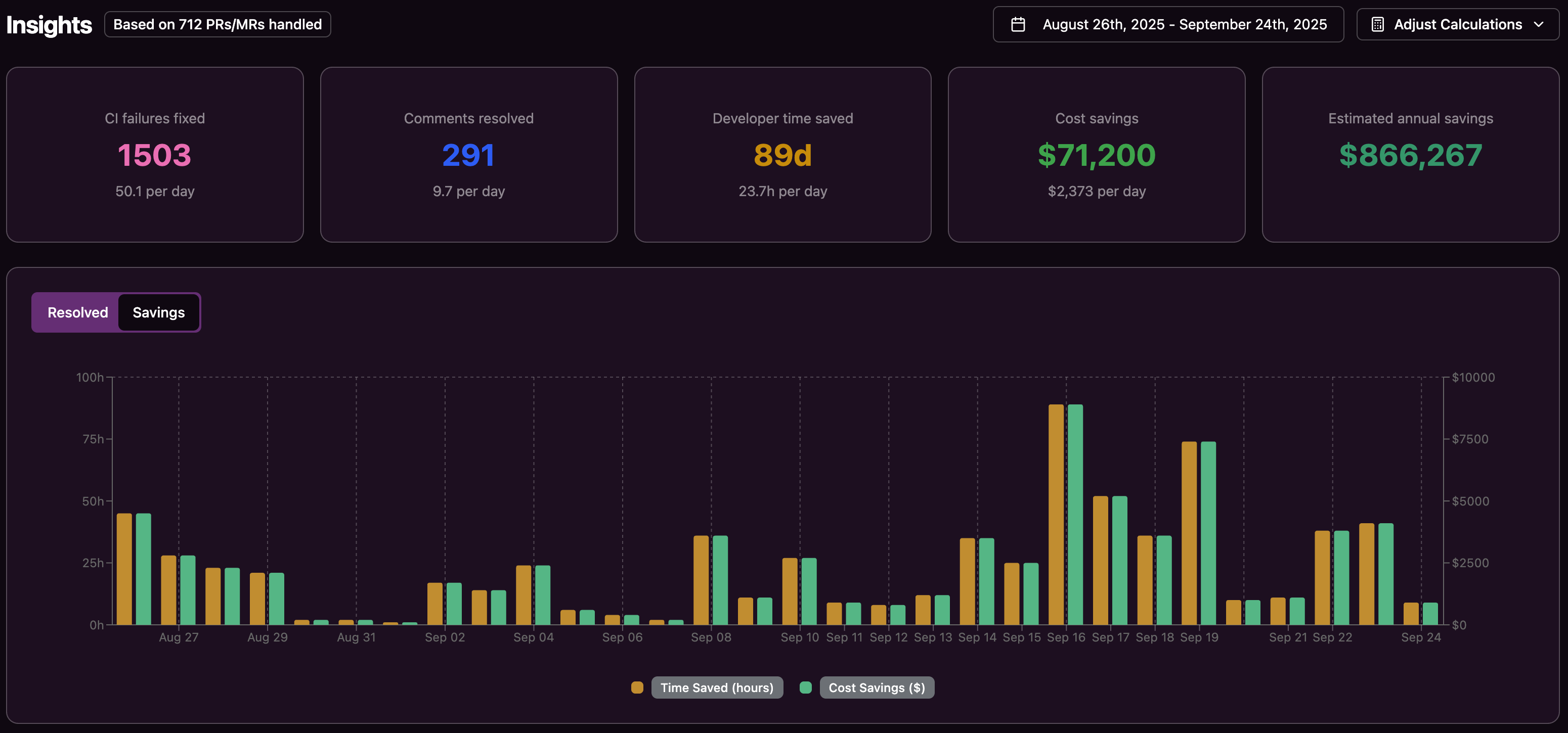
ROI for automated remediation includes faster time-to-market, fewer failed deployments, and better developer experience. AI remediation also reduces research time and mean time to resolve issues.
Leaders can model impact by combining saved developer hours, reduced incident costs, and improved delivery predictability. This view makes business cases clearer than focusing on time savings alone.
Overcoming Trust Barriers and Driving Adoption
Trust remains the main barrier to autonomous remediation. Well-designed systems support both semi-autonomous and fully automated modes, so teams can phase in automation.
A common pattern starts with Gitar posting suggested fixes as comments, then moving to auto-generated branches, and finally to auto-commits for specific, low-risk categories such as linting or documentation.
You can start this journey by installing Gitar in conservative mode and expanding coverage as trust grows.
Strategic Pitfalls in Automated Remediation Adoption
Over-Reliance on Suggestion Engines for Critical Workflows
Teams that rely only on suggestion engines still carry the burden of implementation and validation. Tools that show contextual AI fixes in pull requests help reviewers, but do not resolve the last mile of keeping CI green.
Underestimating Environmental Complexity
Generic AI models often fail in complex CI setups with multiple SDKs, private dependencies, and custom checks. Effective platforms must replicate enterprise workflows and integrate with the same tools that run in production pipelines.
Neglecting Policy, Governance, and Compliance in Automated Fixes
Automated fixes need to align with security and governance policies. Leading platforms integrate with ticketing and SOAR systems so that changes remain auditable and traceable.
Ignoring Organizational Change Management
Automation without clear communication often meets resistance. Successful programs include pilot projects, transparent metrics, training, and feedback loops so developers understand what the system changes and why.
Frequently Asked Questions about Automated Code Remediation
Are AI-powered code remediation tools trustworthy?
Trust depends on architecture and process. Gitar validates fixes in full CI environments and supports modes where developers approve changes before auto-commit. Over time, teams can promote proven fix categories to fully autonomous operation.
How do these platforms handle unique and complex CI/CD setups?
Advanced platforms such as Gitar replicate language versions, dependencies, and third-party tools to match your pipeline. This approach reduces the risk of “it worked in the agent but failed in CI” issues.
Can automated remediation tools improve developer experience and reduce burnout?
Automated remediation reduces repetitive debugging, log reading, and re-running of tests. Developers spend more time building features and less time chasing failures, which supports better focus and lowers burnout risk.
How do healing engines like Gitar differ from other AI code review tools?
Healing engines not only suggest changes but also apply them, run the pipeline, and confirm that checks pass before updating pull requests. This workflow removes the manual last mile that suggestion tools leave to developers.
What is the ROI of implementing an autonomous code remediation platform?
Teams often see value through fewer blocked pull requests, faster merges, and lower incident rates. These gains compound as codebases and teams grow, because the platform absorbs much of the operational noise.
Conclusion: The Autonomous Future of Software Development
Engineering leaders in 2026 increasingly treat automated remediation as core infrastructure rather than an optional add-on. Platforms that deliver autonomous, validated fixes help teams ship faster while keeping quality and compliance in check.
Gitar supports this shift by turning CI failures and review feedback into routine, automated tasks instead of disruptive events. The move from suggestion engines to healing engines marks a change in how teams manage software delivery, with more focus on building and less on unplanned remediation work.
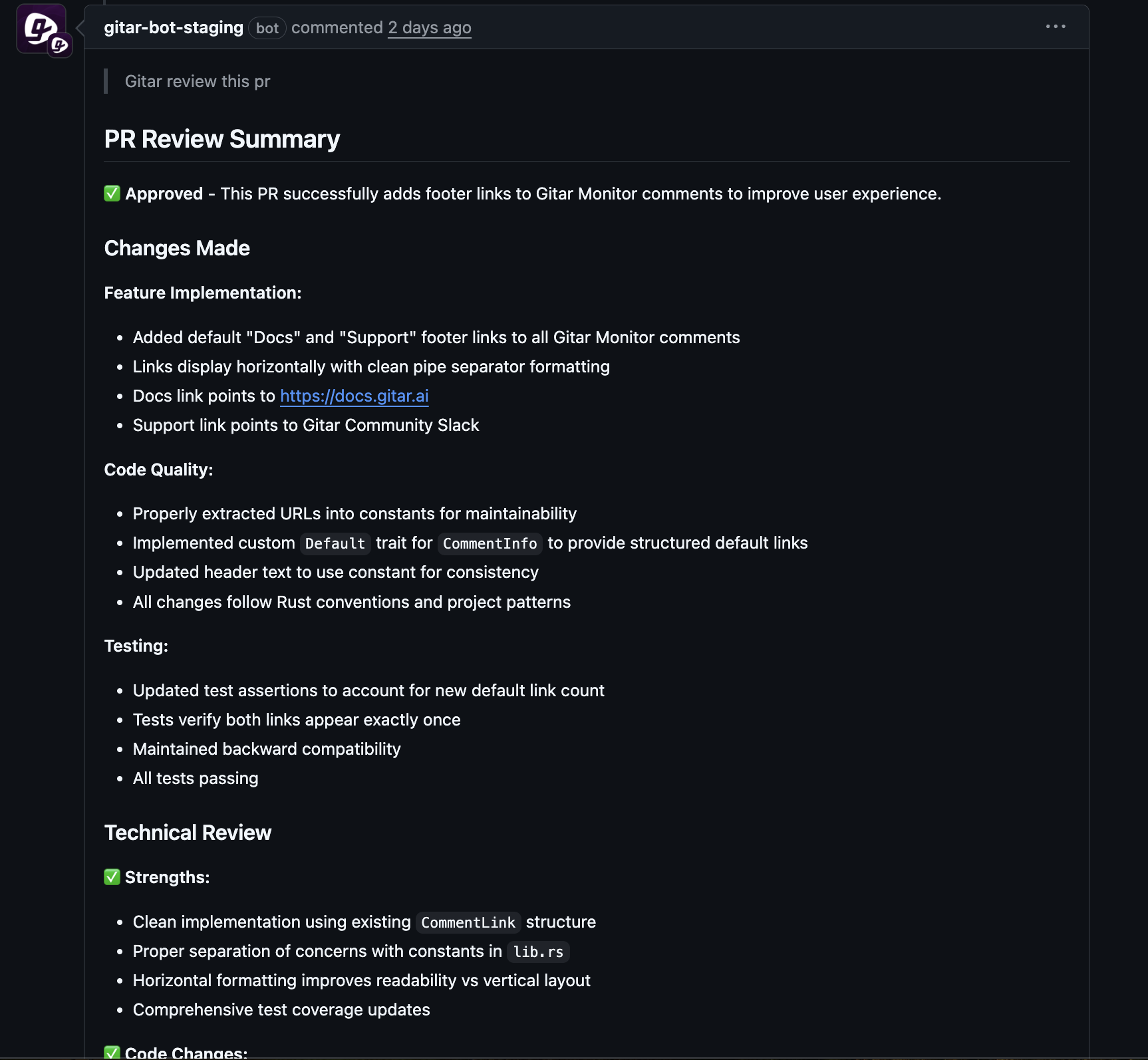
You can give your team this capability today by installing Gitar and letting it handle routine CI fixes and review chores while your developers focus on high-impact work.