
Key Takeaways
- AI coding tools speed up code generation by 3-5x but increase PR review time by 91%, creating $1M annual productivity losses for 20-developer teams.
- True automated code feedback resolution tools fix code automatically, validate against CI, and guarantee green builds, unlike suggestion-only platforms.
- Gitar leads as the free AI code review platform with a healing engine that analyzes CI failures, commits validated fixes, and handles 50M+ lines of code.
- Competitors like CodeRabbit, Greptile, and GitHub Copilot provide suggestions that require manual implementation and lack CI resolution and auto-commit features.
- Teams cut review effort by 50% and save $375K annually with effective automation; install Gitar now for free green builds and faster shipping.
How We Ranked Automated Code Feedback Resolution Tools
Our rankings focus on tools that actually resolve problems instead of only suggesting changes. We prioritize automatic fix application and validation, CI failure analysis and healing, free tier availability, and multi-platform support across GitHub, GitLab, and CircleCI. We also value noise reduction through consolidated feedback and proven scalability at enterprise levels handling 50M+ lines of code. 2026 benchmarks show that tools reaching 70% or higher accuracy versus human reviews create real productivity gains, while suggestion-only platforms add extra overhead.
The 9 Best Automated Code Feedback Resolution Tools for 2026
1. Gitar: Free AI Code Review With CI Healing
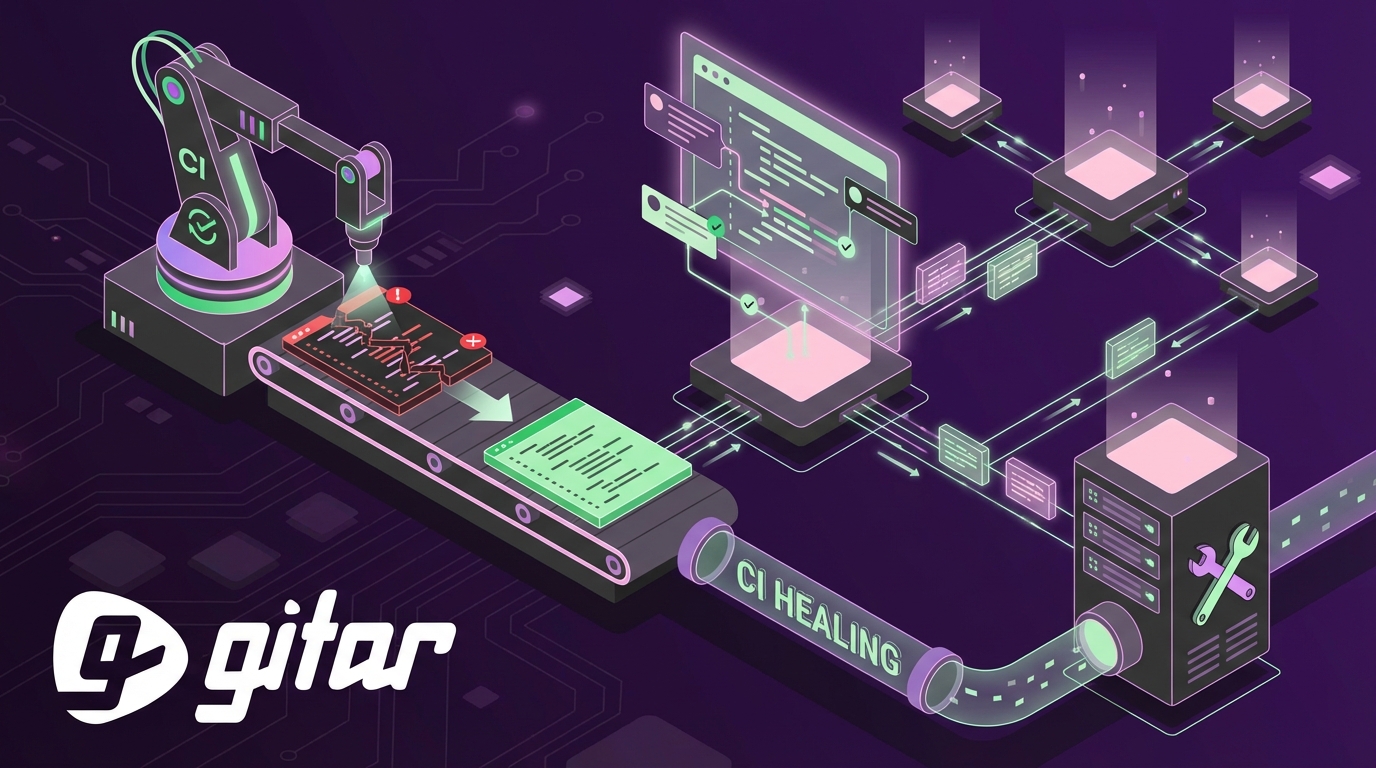
Gitar operates as a free AI code review platform with a built-in healing engine. When CI fails or reviewers leave feedback, Gitar analyzes failure logs, generates validated fixes, and commits solutions, which guarantees green builds during the 14-day auto-fix trial. The platform consolidates all findings into a single updating comment, which cuts notification spam and context switching. Free unlimited code review covers every repository with no seat limits. Enterprise deployments handle more than 50M lines of code and thousands of daily PRs. Natural language workflow rules replace complex YAML configurations and keep setup simple.
2. CodeRabbit: Strong Signal, Manual Fixes
CodeRabbit delivers automated PR analysis with inline suggestions and summaries at $15-30 per developer monthly. The platform excels in signal-to-noise ratio for GitHub enterprises and holds SOC 2 certification. CodeRabbit still functions as a suggestion engine that identifies issues but requires manual implementation. The tool does not provide CI failure analysis or auto-commit capabilities, so teams must apply recommended fixes and validate them against CI systems themselves.
3. Greptile: Deep Context, No Auto-Apply
Greptile builds semantic graphs of entire codebases for deep cross-file reasoning at $30 per developer monthly. The platform offers context-aware PR analysis that goes beyond simple diff review and highlights architectural impacts and inconsistencies. Greptile offers lightweight, context-aware PR analysis with automated summaries but still operates only in suggestion mode without auto-apply fixes or CI integration. Context window limits can affect analysis quality for extremely large codebases.
Install Gitar now to get free green builds with automatic CI healing.
4. Graphite: Stacked PRs With CI Insights
Graphite centers on stacked PR workflows with merge gating and CI log analysis. The platform provides conversational interfaces that help developers understand build failures and includes Diamond’s self-healing for failing CI along with one-click suggestion implementation. Graphite’s automatic commit capabilities may require additional configuration and tuning. Its opinionated stacked PR approach can feel restrictive for teams that prefer simpler branching strategies. The tool primarily targets GitHub environments.
5. Qodo: Code Intelligence and Test Generation
Qodo blends codebase intelligence with test generation and security scanning. The platform offers more than 15 automated PR workflows including standards enforcement and risk scoring with multi-repo context. Qodo stands out for test case generation and architectural analysis and validates fixes with full context in IDE reviews. It supports one-click automatic application of agent-generated fixes. Qodo integrates with CI pipelines through a CLI and GitHub Actions, and pricing scales per developer for enterprise capabilities.
6. SonarQube: Enterprise Static Analysis With AI CodeFix
SonarQube delivers enterprise-grade static analysis with quality gates and AI-powered prioritization. The platform supports more than 30 languages with over 6,500 security rules and includes AI CodeFix for vulnerability remediation. SonarQube integrates deeply with CI and CD pipelines but focuses on detection and gating instead of full automatic resolution. Enterprise licensing unlocks advanced features and broader auto-fix capabilities.
7. DeepSource: Pattern-Based Fixes With Limits
DeepSource offers automated fixes for common code quality issues across more than 16 programming languages. The platform provides AI-driven analysis with pattern-based detection and one-click fix application for specific issue types. DeepSource still lacks comprehensive CI failure analysis and usually requires manual approval for fixes. The tool mainly operates in suggestion mode with limited auto-commit support.
8. Snyk Code: Security-Focused Auto-Fix
Snyk Code specializes in security vulnerability detection and generates automatic fixes for many common security issues. It also addresses some code quality findings such as dead code and type mismatches. The platform integrates with CI pipelines for real-time scanning and offers auto-fix features specifically for security vulnerabilities. Enterprise implementations achieve 95% security vulnerability detection versus 60-65% manual review. Snyk Code remains security-centric and does not fully cover general code review feedback or non-security CI failures.
9. GitHub Copilot: Popular Assistant, Manual Review
GitHub Copilot offers inline code suggestions and PR summaries and serves more than 20 million users by mid-2025. The platform provides real-time coding assistance and basic PR analysis but does not apply fixes automatically or resolve CI failures. Copilot functions as a suggestion engine that requires manual implementation of every recommendation. It does not validate changes against CI systems or create automatic commits.
Tools That Automatically Fix Code Review Comments
| Tool | Auto-Apply Fixes | CI Resolution | Pricing | Validation |
|---|---|---|---|---|
| Gitar | Yes (14-day free trial) | Yes | Free code review | Guaranteed |
| CodeRabbit | No | No | $15-30/dev | None |
| Greptile | No | No | $30/dev | None |
| Qodo | Yes (1-click in IDE) | Yes (CI integration) | Paid | Full context |
Gitar dominates this comparison by delivering true auto-fix capabilities with CI validation during the 14-day trial while keeping code review free and unlimited. Competing tools charge premium prices for suggestion-only functionality that still depends on manual work.
AI That Actually Fixes Failing CI Logs
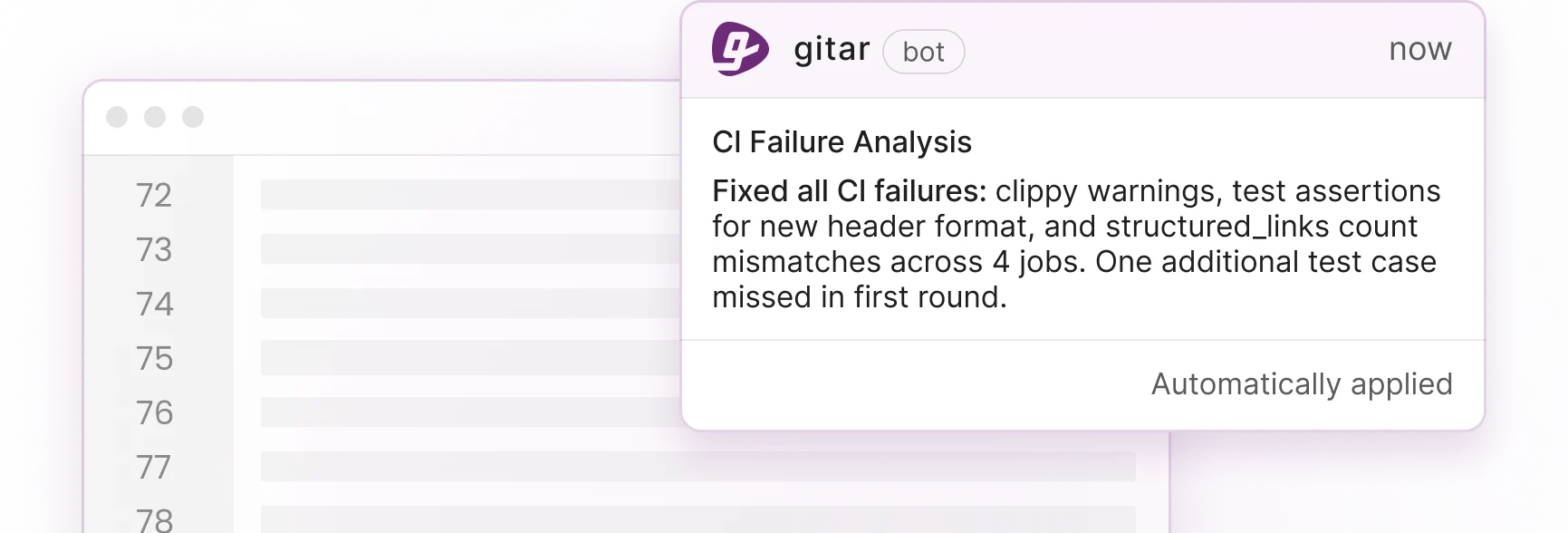
CI failure analysis remains the largest gap in most current tools. Self-healing CI pipelines automatically detect and recover from build failures without human intervention, yet many code review platforms still ignore this need. Gitar’s healing engine analyzes CI logs, identifies root causes, generates fixes with full codebase context, and validates solutions before committing. This approach cuts CI reruns and removes the manual debugging cycle that can cost teams hours for each failure.

Engineering leaders report that AI-powered self-healing reduces maintenance overhead while improving pipeline reliability. Traditional tools force developers to switch from feature work to CI debugging, which creates productivity losses that compound across large teams.
How to Evaluate Automated Code Review Tools
Different roles experience automated code review tools in different ways. Individual contributors need tools that reduce context switching and notification fatigue. Engineering leaders look for clear ROI metrics and measurable velocity improvements. DevOps teams care most about CI reliability and lower maintenance overhead.
ROI calculations for a 20-developer team highlight the impact clearly. Traditional productivity losses of $1M annually from CI and review friction can drop to $250K with effective automation, which creates $375K in yearly savings even at 50% tool effectiveness. Suggestion-only tools that charge $450-900 monthly usually deliver marginal improvements while keeping most manual overhead in place.
Trust still shapes how teams adopt auto-commit features. Configurable automation levels let teams begin in suggestion mode, build confidence with validated fixes, and then enable automatic commits for specific failure types. Enterprise implementations achieve 95% accuracy in security vulnerability detection, which shows how AI can outperform manual processes for focused use cases.
Frequently Asked Questions
What is the best free automated code feedback resolution tool?
Gitar offers the most complete free code review experience with unlimited PR analysis, security scanning, and bug detection across all repositories without seat limits. The 14-day free trial adds auto-fix capabilities that resolve CI failures and implement review feedback automatically. Unlike competitors that charge $15-30 per developer for suggestion-only features, Gitar’s free tier delivers core code review plus an autofix trial.
What is the difference between auto-fix and suggestion-only code review tools?
Suggestion-only tools analyze code and leave comments that still require manual implementation, validation, and resubmission. Auto-fix tools such as Gitar analyze issues, generate solutions, validate fixes against CI systems, and commit working code automatically. This workflow removes the manual cycle of reading suggestions, implementing changes, pushing commits, and hoping the fixes work. Auto-fix tools focus on resolution, while suggestion tools only highlight problems.
Which automated code review tools integrate with CI systems like GitHub Actions and GitLab?
Gitar supports broad CI integration across GitHub Actions, GitLab CI, CircleCI, and Buildkite with automatic failure analysis and healing. Most competitors limit themselves to PR-level review without CI context. Tools such as CodeRabbit and Greptile do not provide CI failure resolution, while SonarQube integrates with CI mainly for quality gating instead of automatic problem resolution.
How much can automated code review tools save in developer productivity costs?
Enterprise case studies show strong ROI from automated code review tools. A 20-developer team often loses $1M annually to CI failures and review friction. Effective automation can reduce this loss to $250K and create $375K in yearly savings. Teams also report a 50% reduction in manual review effort, 80% faster development cycles, and 35-38% improvement in code quality metrics across multiple industries.
Can automated tools handle enterprise-scale codebases with millions of lines of code?
Enterprise-grade tools such as Gitar handle more than 50M lines of code with thousands of daily PRs in production environments. The platform’s hierarchical memory system maintains context across massive codebases while processing many operations at once. Most suggestion-only competitors struggle at this scale because of context limits and missing CI integration, which makes them a poor fit for large development organizations.
Conclusion: Remove AI Bottlenecks With Automated Code Feedback Resolution
Modern teams now face bottlenecks in code validation rather than code generation, so they need tools that resolve problems instead of just flagging them. Suggestion-only platforms charge premium prices for incremental improvements, while Gitar’s healing engine delivers free code review with automatic fix application and CI failure resolution.
Teams overwhelmed by post-AI PR volume need solutions that cut manual overhead, not tools that add more comments that still require human effort. The gap between paying $450-900 monthly for suggestions and getting free automatic fixes with guaranteed green builds marks a major shift in how development teams manage code quality.