
Key Takeaways
- Frequent CI build failures, flaky tests, and manual code review changes create hidden costs in developer time, team morale, and release reliability.
- Silent and intermittent CI failures amplify infrastructure load and delay delivery, especially in complex, distributed environments.
- Security gaps in CI/CD pipelines can expose code and artifacts across the software supply chain if integrity checks and validations are incomplete.
- Autonomous, environment-aware AI agents can move beyond suggestions to apply, validate, and commit fixes that keep pipelines green.
- Teams can deploy Gitar to automatically fix broken builds and code review feedback directly in their CI/CD workflows by getting started at Gitar.
The Problem: The Hidden Costs of Build Failures in Deployment Automation
Developer Productivity Loss
CI failures absorb a large share of development time. Developers often lose about an hour per day debugging and fixing pipeline issues, which can reach close to 30% of total work time. This time loss creates context switching overhead that breaks focus and interrupts deep work. A 30-minute CI fix can easily turn into an hour of lost productive time once task switching and reorientation are included.
Delayed Time-to-Market and Financial Impact
CI pipeline failures slow down shipping. For many companies, CI problems are a leading cause of delayed projects and longer times from first commit to merge. On a team of 20 developers, these delays can add up to hundreds of thousands of dollars per year in lost productivity and missed opportunities. The impact extends beyond engineering, slowing feature delivery and reducing the predictability of releases.
Silent Failures and Intermittent Job Failures
Silent failures in CI/CD pipelines, where builds appear successful but include hidden issues, create a significant reliability risk. These issues trigger repeated, unnecessary reruns that consume CI server capacity and mask true failures. Reruns of jobs with silent failures account for nearly half of total server time spent on reruns. Intermittent job failures driven by environment instability, non-deterministic tests, networking problems, concurrency issues, or overload further slow teams and complicate debugging.
Security Risks in CI/CD
Weak software and data integrity controls in CI/CD pipelines open paths for unauthorized access to code and build artifacts. Integrity failures affect a measurable share of applications and coverage scenarios, which puts the broader software supply chain at risk if not addressed inside the pipeline itself.
Other Common CI/CD Challenges
Teams also face cultural resistance, skills gaps, mismatched environments, and slow failure diagnosis. These factors extend feedback loops, frustrate developers, and reduce confidence in automation.
Teams that want to reduce these productivity drains can integrate automated build failure fix solutions that remove repetitive CI work from developers and keep pipelines green by default.
The Solution: Gitar as an Autonomous CI/CD Healing Engine for Automated Build Failure Fixes
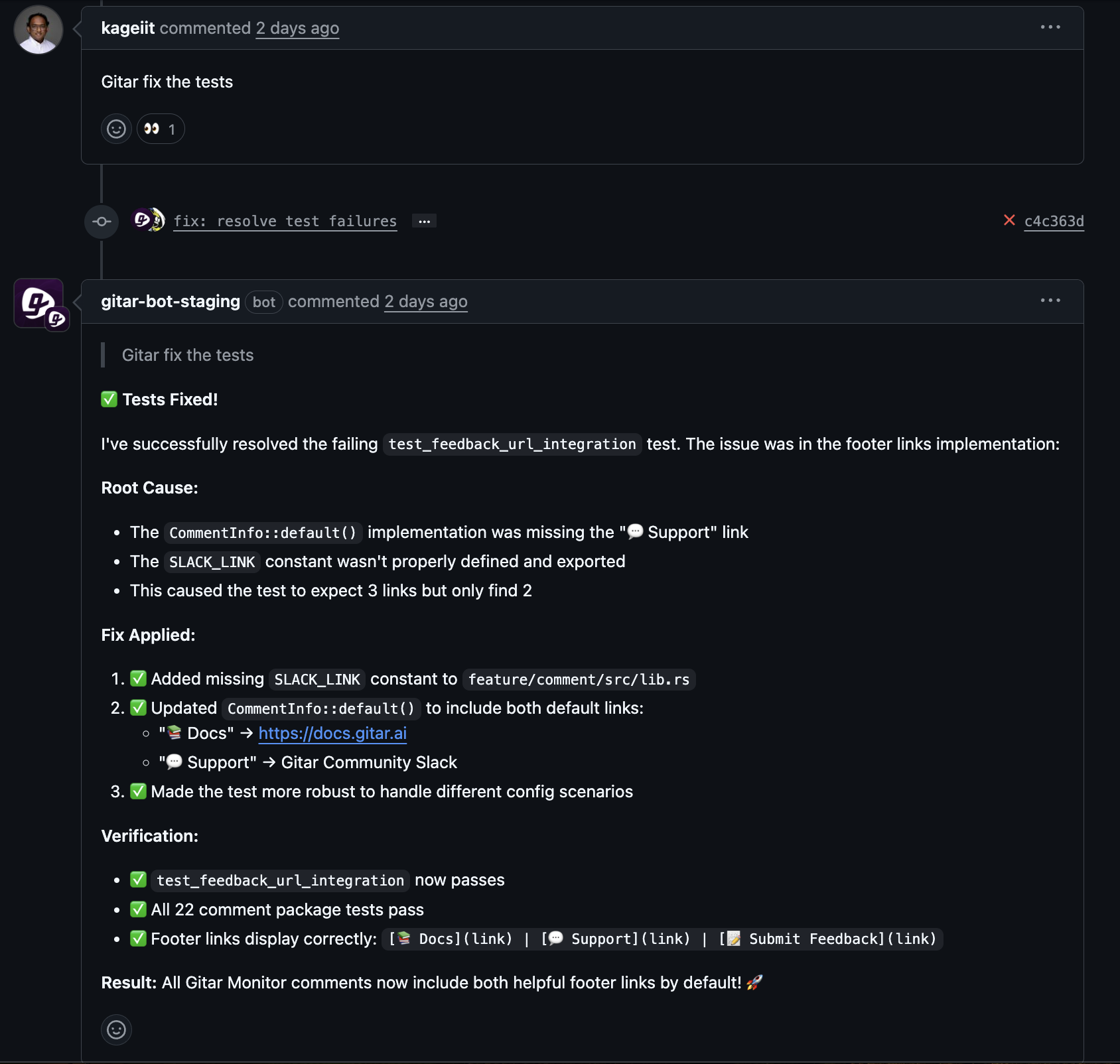
Gitar operates as an autonomous AI agent that resolves failing CI pipelines and code review feedback. The platform focuses on producing a self-healing CI experience that turns manual, multistep workflows into automated fixes that run inside the existing toolchain.
Gitar’s Core Capabilities
Gitar provides several core capabilities that support automated build failure fixes:
- End-to-end fixing that applies, validates, and lands changes for linting, test, and build failures without manual intervention for common issues.
- Full environment replication that mirrors complex enterprise CI setups, including specific SDK versions, multi-SDK matrices, and third-party tools.
- An intelligent code review assistant that applies review feedback and resolves comments, which reduces back-and-forth delays across time zones.
- A configurable trust model that lets teams move from suggestion-only changes to auto-commit with rollback, based on their risk and review needs.
- Cross-platform support that works with GitHub Actions, GitLab CI, CircleCI, BuildKite, and other CI providers instead of a single ecosystem.

Teams that want to see these capabilities in practice can explore Gitar in their own CI environment by starting at Gitar.
How Gitar Delivers Automated Build Failure Fix Solutions and Reduces CI/CD Bottlenecks
Reducing Manual Firefighting
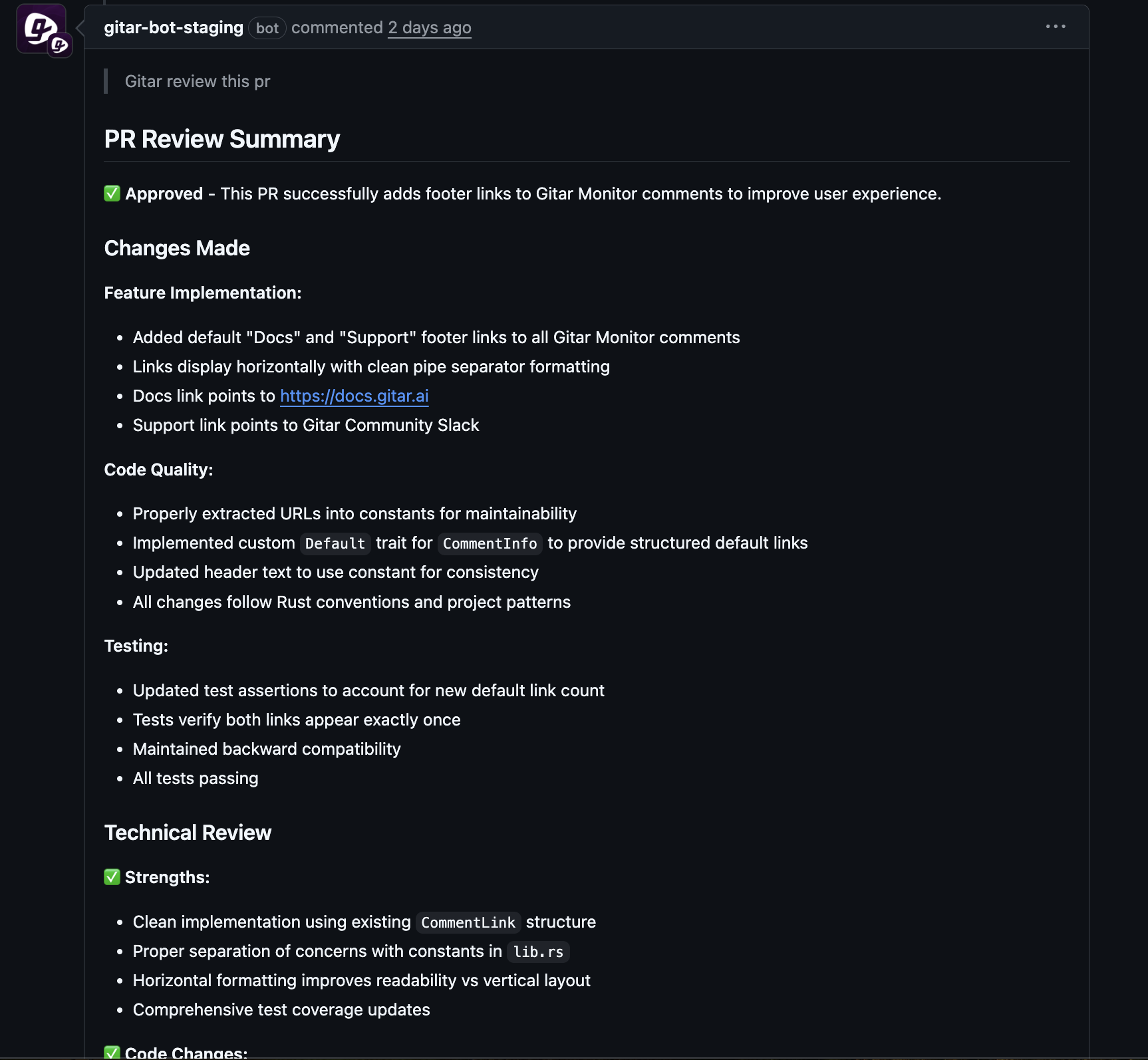
Gitar resolves common CI failures automatically, so developers spend less time chasing red builds. Instead of interrupting work to inspect logs, update configuration, or patch tests, developers can rely on an agent that proposes or commits validated fixes. This shift allows teams to keep their focus on feature work and design.
Accelerating Time-to-Merge
Automated and validated fixes shorten feedback loops. Gitar runs within the CI workflow and returns changes that are already checked against the pipeline, which reduces the number of failed attempts and rebuilds. Pull requests move from failing to merge-ready faster, which helps teams ship smaller, more frequent changes.
Improving Pipeline Reliability at Scale
Gitar’s self-healing behavior supports consistent green builds across many repositories and services. Because fixes are validated within the same CI environment that runs production builds, the risk of environment-specific regressions drops. This consistency is especially useful for organizations with many teams, languages, and deployment targets.
Supporting Developer Morale and Productivity
Developers benefit when repetitive CI work moves off their plate. Offloading CI failure triage and routine code review changes reduces interruptions and context switches, which protects time for higher-value engineering tasks. Over time, this shift can improve satisfaction and reduce burnout associated with constant firefighting.
Gitar vs. the Status Quo: Healing Engines Compared to Suggestion Engines
The table below outlines how Gitar’s healing engine approach differs from manual work and suggestion-only AI tools.
|
Feature / Solution |
Gitar (Healing Engine) |
Manual Work (Status Quo) |
AI Code Reviewers (for example, CodeRabbit) |
|
Autonomous fix application |
Applies, validates, and can commit fixes |
All fixes applied manually |
Provides suggestions and some one-click fixes that still need review |
|
Validation against full CI |
Runs against the full CI workflow to keep builds green |
Developer validates fixes through manual reruns |
May rely on static analysis or partial checks |
|
Environmental context |
Replicates complex enterprise CI environments |
Requires developer research and manual reproduction |
Focuses on code-level context more than full environment |
|
Impact on context switching |
Reduces context switching with automation |
Requires frequent task switching |
Partially reduces switching through inline suggestions |
This comparison highlights how a healing engine design focuses on complete workflows, from diagnosis through validated fixes, instead of only generating recommendations.
Frequently Asked Questions (FAQ) About Automated Build Failure Fix Solutions
How does Gitar handle CI/CD pipeline issues to deliver automated build failure fixes?
Gitar validates every fix against the full CI workflow. The agent inspects logs, proposes or applies code changes, and reruns the relevant jobs inside the existing pipeline. This process helps maintain build integrity while reducing the manual work developers need to perform.
How is Gitar different from AI reviewers like CodeRabbit?
AI reviewers excel at pointing out potential issues and suggesting edits inside pull requests. They often stop short of validating changes across the full CI pipeline. Gitar extends beyond suggestions by autonomously applying fixes, validating them against the entire workflow, and optionally committing the results. This approach reduces uncertainty around whether a given change will actually pass CI.
How does Gitar support CI/CD pipeline reliability?
Gitar runs inside the same CI environment that manages builds and tests, which allows it to generate fixes that align with real constraints such as tool versions, configuration, and dependencies. Consistent validation within that environment improves confidence that a green build in CI reflects a stable change.
Can Gitar support complex CI setups with unique dependencies?
Gitar was built to handle complex enterprise CI environments by replicating the full environment. That replication includes specific SDK versions, multi-SDK configurations, and integrations with tools like SonarQube. This level of context allows Gitar to produce fixes that respect project-specific requirements.
How does Gitar compare with on-demand AI fixers such as Claude Code GitHub Actions?
On-demand AI fixers typically require manual triggering, operate one request at a time, and may not fully reproduce the CI environment. Gitar runs continuously in the background, mirrors the build environment, and does not rely on customer CI resources for its own compute. It also supports multiple CI systems, including GitHub Actions, GitLab CI, CircleCI, and BuildKite.
Conclusion: Using Automated Build Failure Fix Solutions to Improve CI/CD in 2026
CI/CD friction continues to consume a large share of developer time and infrastructure budgets. Silent failures, flaky tests, manual review changes, and security gaps all contribute to slower, less predictable delivery. Automated build failure fix solutions that operate as autonomous agents can reduce these problems by applying and validating fixes directly in the pipeline.
Gitar offers a healing engine approach that focuses on environment-aware automation instead of suggestion-only reviews. By autonomously fixing, validating, and in many cases committing changes, Gitar helps teams improve release velocity, lower operational overhead, and support a more sustainable development pace.
Teams that want to explore automated build failure fix solutions in their own workflows can start with Gitar at https://gitar.ai/fix.