
Key Takeaways
- AI coding tools speed up development 3–5x but slow reviews, with PR review time up 91% in 2026.
- Traditional Gerrit AI plugins like ai-code-review and reviewai-gerrit-plugin add comments but still require manual fixes and complex setup.
- MCP servers enable deeper AI integrations but lack automatic CI failure fixes and require ongoing server management.
- Gitar provides zero-configuration deployment, automatic code fixes, and CI integration, saving about 45 minutes per developer daily compared to plugins.
- Install Gitar now for free, unlimited AI code review with auto-fixes on GitHub and GitLab.
Quickstart: Gerrit AI Code Review Plugin Setup
This method uses community plugins to add basic AI review to Gerrit. The ai-code-review plugin connects Gerrit to large language models for patch analysis.
Follow this 7-step installation process:
- Confirm JDK 11+ and Maven are installed on your Gerrit server.
- Clone the ai-code-review repository and build the JAR file with Maven.
- Copy the generated plugin JAR into your $GERRIT_SITE/plugins directory.
- SSH into your Gerrit server and run:
gerrit plugin install ai-code-review. - Edit gerrit.config and add the AI configuration:
[plugin "ai-code-review"] ai-endpoint = https://api.openai.com/v1/chat/completions api-key = your-openai-api-key model = gpt-4 - Restart the Gerrit service so the plugin loads correctly.
- Test with a sample patchset and confirm AI comments appear.
Teams often hit issues with API key security because credentials live in plain text configuration files. Community discussions describe problems with project configuration inheritance in large repository hierarchies, which complicates enterprise rollouts.
This plugin path delivers basic AI suggestions but no CI integration or automatic fix application. The AI writes comments, and developers still perform every change by hand.
Advanced Bridge: Gerrit Code Review MCP Server
Gerrit v3.13 introduced the Model Context Protocol (MCP) server for richer LLM integrations. This method lets AI tools interact directly with Gerrit’s REST API.
Setup requires Python 3.8+ and these steps:
- Clone the official Gerrit MCP server repository.
- Create a .env file with your Gerrit credentials:
GERRIT_HOST=https://your-gerrit-instance.com GERRIT_USER=your-username GERRIT_HTTP_PASSWORD=your-http-password - Install dependencies with
pip install -e .. - Run the MCP server using
python server.py. - Configure your AI client, such as Cursor or Claude Desktop, to connect to the MCP server.
The MCP server exposes functions like fetch_gerrit_change to pull detailed change data and submit_gerrit_review to post feedback with labels and inline comments. This pattern improves data privacy compared to SaaS tools but demands more technical effort.
Teams must handle TLS compatibility quirks with some AI clients and manage the server lifecycle. The MCP approach posts reviews and suggestions but still cannot auto-fix CI failures or confirm that proposed changes actually pass tests.
ChatGPT-Focused: reviewai Gerrit Plugin
Teams that standardize on OpenAI often choose the reviewai-gerrit-plugin. This plugin sends patches to ChatGPT and returns automated feedback as comments.
Installation involves building the plugin JAR and adding your OpenAI API key to gerrit.config. After setup, the plugin runs AI analysis whenever a patch set is submitted and posts suggested improvements.
However, like other traditional approaches, it only comments and never applies fixes. Developers still edit code manually.
Security risks include exposed API keys in configuration files and unpredictable costs from heavy API usage. The plugin also runs without CI context, so it cannot separate code defects from infrastructure or flaky test issues.
CI/CD Integration Practices for Gerrit AI
Strong CI/CD integration turns AI review from helpful comments into reliable automation. Gerrit 3.13 added HTTP Auth-Tokens, which replace long-lived passwords and support expiration and rotation for scripts.
Follow these best practices:
- Store API keys in secure secret managers instead of plain configuration files.
- Rotate Gerrit HTTP tokens regularly to reduce exposure risk.
- Use dedicated service accounts with the minimum permissions required.
- Track API usage so teams avoid surprise bills.
- Roll out AI review with pilot teams before scaling across the organization.
| Method | Pros | Cons |
|---|---|---|
| Plugins | Direct Gerrit integration | Complex configuration, suggestions only |
| MCP Server | Improved privacy, flexible | Manual setup, no auto-fixes |
| Manual Integration | Full control | High maintenance, limited features |
Agentic quality control becomes standard in 2026, yet traditional Gerrit plugins still stop at suggestions. They cannot implement or validate fixes on their own.
ROI studies show that plugins trim some review time but keep developers busy applying changes. Gitar’s model saves about 45 minutes per developer per day by generating and validating fixes instead of only pointing out problems.
Why Teams Pick Gitar Instead of Gerrit Plugins
Traditional Gerrit AI plugins demand intricate configuration and constant upkeep. Many teams abandon Gerrit after six months because of approval workflow gaps and maintenance overhead, especially with large volumes of AI-generated code.
Gitar removes this friction with a 30-second install on platforms like GitHub and GitLab. Teams simply install the app, with no credit card, no complex configuration files, and no servers to run. The platform offers free, unlimited code review for all repositories with no seat limits.
Onboarding follows three clear phases:
- Install: Add Gitar to your repositories with zero configuration.
- Suggestion Mode: Review and approve AI-generated fixes to build confidence.
- Auto-commit: Turn on automatic fix application for trusted issue types.
| Metric | Plugins | Competitors | Gitar |
|---|---|---|---|
| Time saved per day | 15 minutes | 15 minutes | 45 minutes |
| Monthly cost (20 devs) | $0 | $450 | $0 |
| CI failure fixes | No | No | Yes |
| Auto-implementation | No | No | Yes |
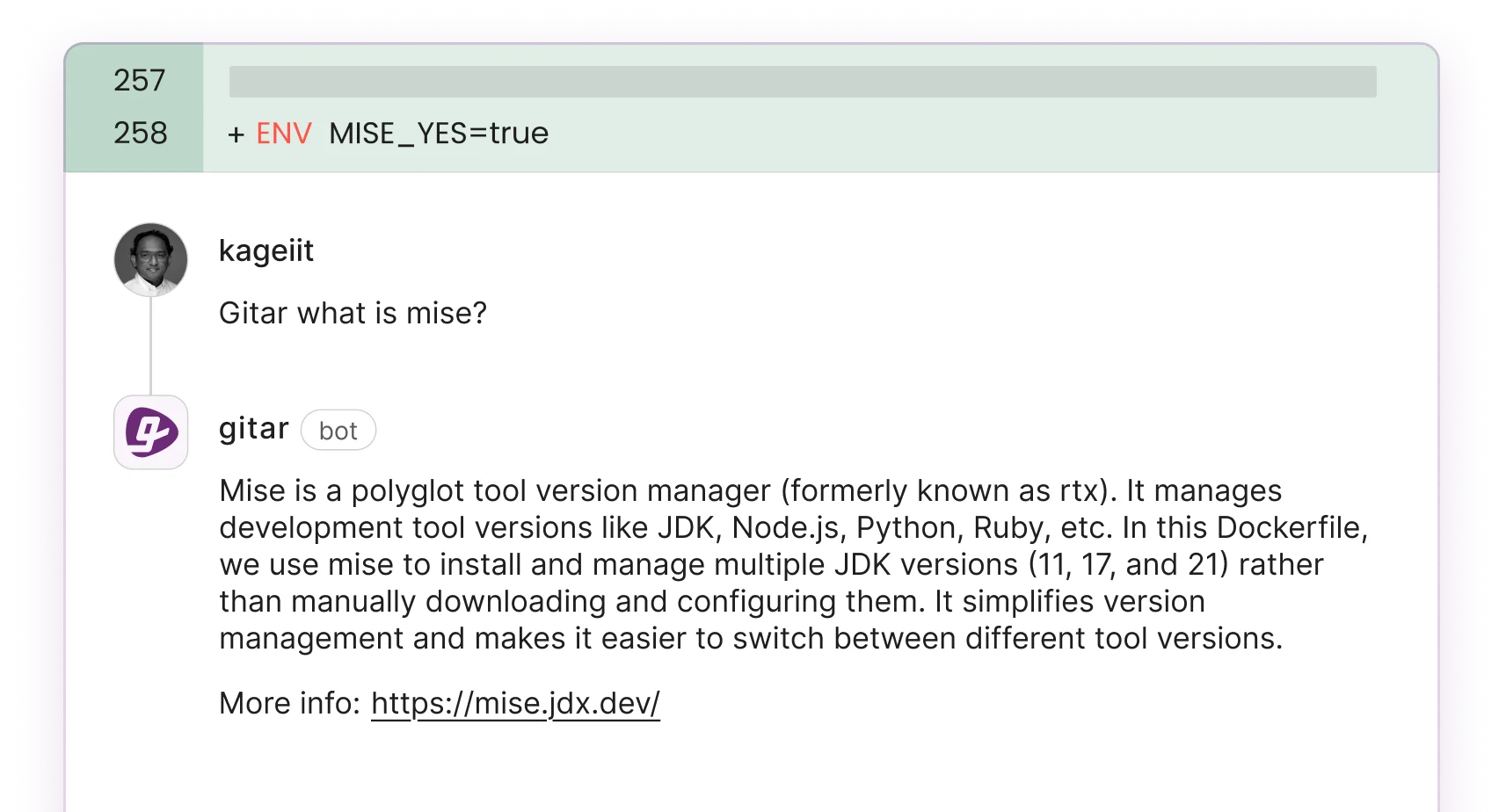
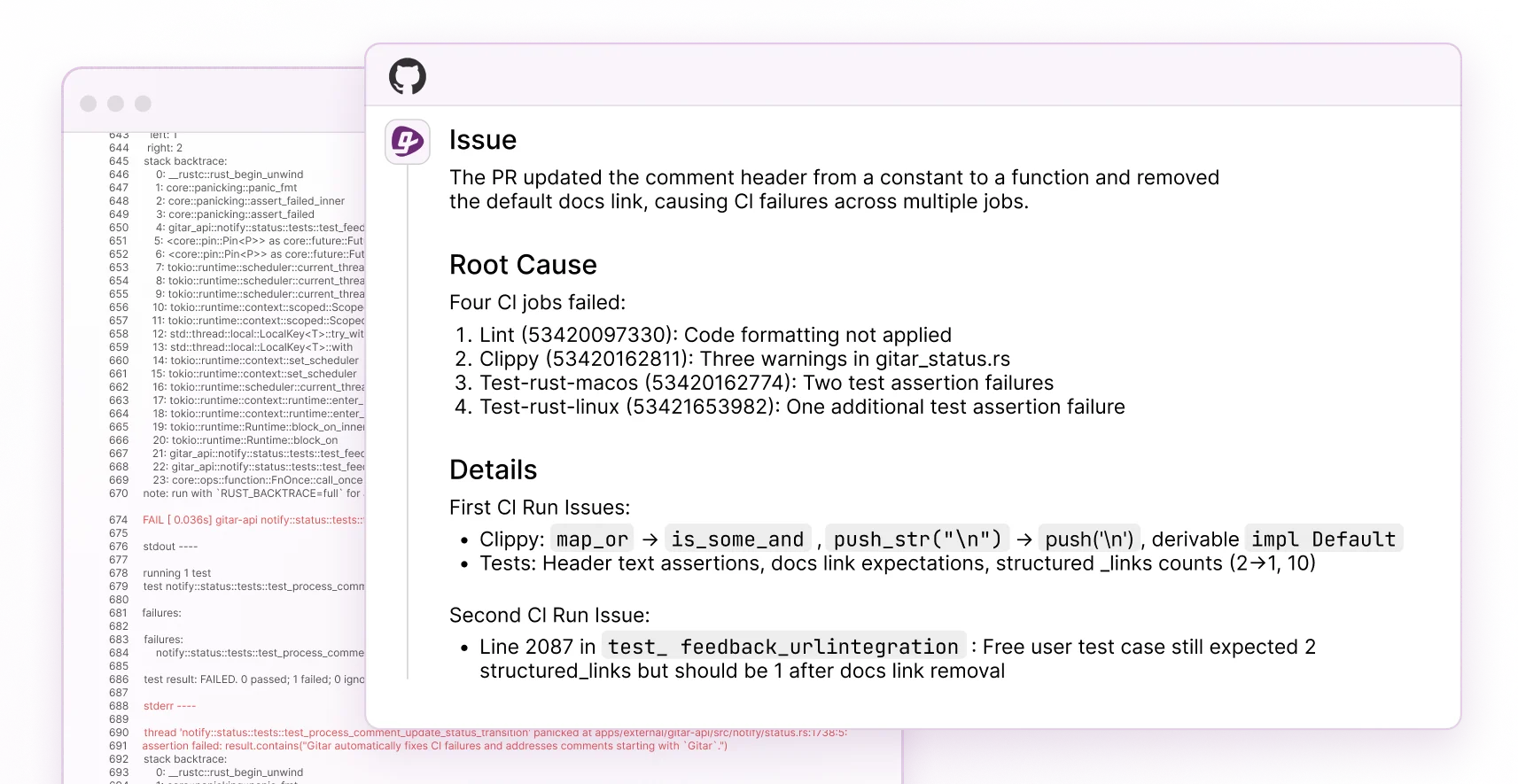
Gitar’s healing engine closes the loop by analyzing CI failures, generating fixes with full codebase context, validating them in your build environment, and committing working changes. This workflow already runs at Pinterest scale across more than 50 million lines of code and thousands of daily PRs.
Install Gitar now to experience the shift from suggestion-only tools to real automation that fixes code for you.
AI for Gerrit Reviews and Top Tools in 2026
AI now plays a major role in Gerrit code reviews, but the chosen approach defines the outcome. Plugins and MCP servers add helpful comments that still require manual edits. Modern platforms like Gitar extend further and apply fixes automatically.
By late 2026, AI code review is expected to remove most review bottlenecks. Teams shift effort from reading code to validating quality in agentic environments.
| Tool | Free Tier | Auto-fix | CI Integration |
|---|---|---|---|
| Gitar | Yes | Yes | Yes |
| CodeRabbit | No | No | Limited |
| Greptile | No | No | No |
The strongest AI tools for Gerrit-style workflows in 2026 pair deep analysis with automatic implementation. Traditional plugins demand ongoing maintenance and deliver limited gains, while platforms like Gitar provide measurable productivity improvements through automation that actually fixes code.
Frequently Asked Questions
What is the difference between Gerrit AI plugins and Gitar?
Gerrit AI plugins rely on complex configuration and only add suggestions as comments. Developers then implement every recommended change, which increases context switching and slows delivery. Gitar offers free code review with automatic fix implementation for supported platforms such as GitHub and GitLab. When CI fails or reviewers leave feedback, Gitar analyzes the issue, generates a working solution, validates it in your build environment, and commits the fix. This removes the manual implementation step that keeps traditional plugins inefficient.
How do you automate Gerrit reviews with generative AI?
Teams can automate reviews using plugins, MCP servers, or modern AI platforms. Plugins and MCP servers connect to LLMs, analyze patches, and return suggestions, but they still rely on humans to apply fixes. Advanced platforms like Gitar extend automation by implementing changes, repairing CI failures, and supporting natural language rules for workflow automation. The key shift moves from suggestion engines to healing engines that resolve issues end to end.
Is there free AI for Gerrit code review?
Gitar delivers completely free AI code review for unlimited repositories with no seat limits and no credit card on supported platforms like GitHub and GitLab. The free tier includes full PR analysis, security checks, bug detection, and performance review. Competing tools often charge $15–30 per developer each month for similar coverage. Auto-fix features come with a 14-day free trial so teams can test automatic code fixing before choosing a paid plan.
What are the best AI tools for Gerrit in 2026?
The leading tools combine thorough analysis with automatic implementation. Gitar stands out by offering free code review for supported platforms, automatic CI failure resolution, and simple setup without complex configuration. Traditional plugins such as ai-code-review and MCP servers cover basic commenting but do not auto-fix issues. Paid tools like CodeRabbit and Greptile charge premium prices for suggestion-only features that Gitar includes free with stronger automation.
What are the limitations of Gerrit AI plugins in 2026?
Current Gerrit AI plugins share several constraints. They only suggest changes without applying fixes, require complex server-side configuration and maintenance, lack CI integration for failure analysis, often store API keys insecurely in configuration files, and cannot confirm that suggested edits actually pass tests. These gaps make plugins a poor fit for teams handling large volumes of AI-generated code. Modern platforms close these gaps with automatic implementation, zero-configuration onboarding, and tight CI integration.
Conclusion: Moving Beyond Suggestion-Only Gerrit AI
Traditional Gerrit AI plugins and MCP servers marked the first wave of AI-assisted code review but no longer match 2026 expectations. They generate helpful comments yet leave implementation work on developers, which limits true automation.
Modern AI platforms like Gitar handle the full loop by fixing code, resolving CI failures, and removing the manual implementation bottleneck on supported platforms. With free, unlimited code review and automatic fixes, teams can avoid configuration headaches and maintenance work tied to older plugin-based approaches.
Install Gitar now, repair broken builds automatically, and ship higher quality software faster with consistently green pipelines.