
Written by: Ali-Reza Adl-Tabatabai, Founder and CEO, Gitar
Key Takeaways
- Flaky tests cause massive productivity losses, with teams wasting 150,000 developer hours annually and spending about $1M for a 20-developer team.
- Common causes include timing issues, race conditions, and external dependencies, while manual retries break down as test suites grow.
- Gitar’s healing engine analyzes CI failures, generates validated fixes, and commits them so teams consistently ship green builds.
- The 8-step blueprint walks through retry detection, quarantine, automated fixes, and preventive analytics for end-to-end automation.
- Teams can implement this blueprint with Gitar’s 14-day trial to stabilize CI/CD and increase developer velocity.
Why Flaky Tests Happen and Why Manual Fixes Do Not Scale
Teams need a clear view of flaky test root causes before they can automate fixes effectively. The main drivers include timing dependencies, race conditions, asynchronous operations, external service dependencies, test isolation failures, resource contention, and environment inconsistencies. Manual tactics like retries and quarantine offer short-term relief but rarely address the underlying code or infrastructure problems.
Traditional detection methods rely on basic retry logic or manual investigation after failures appear in CI. This reactive pattern creates mounting technical debt, and teams spend more time chasing flaky tests than building features. SHIFT ASIA recommends keeping test flakiness below 2% to preserve test suite reliability, yet many organizations sit well above that mark.
Teams break this cycle by moving from simple detection to automated code review that includes root cause analysis, intelligent quarantine, and automatic remediation. This shift replaces reactive firefighting with proactive healing and sets the foundation for reliable CI/CD at scale.
Inside Gitar’s Healing Engine for Flaky Test Auto-Fix
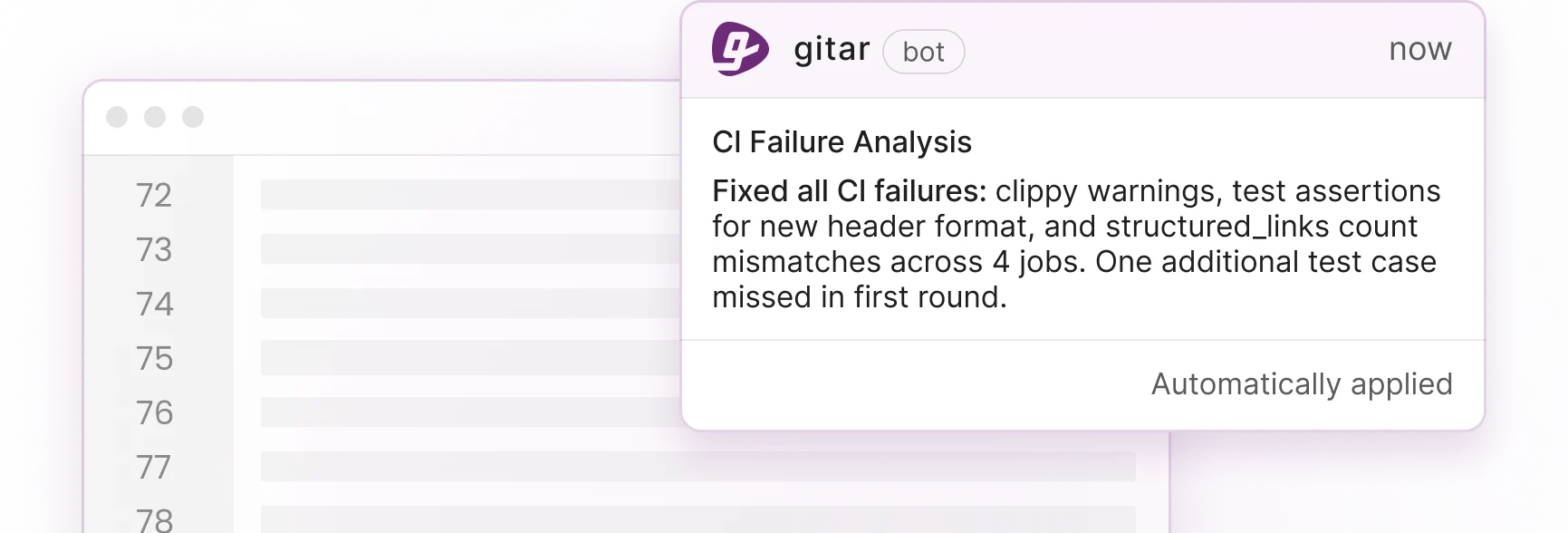
Gitar turns CI failure management from a manual chore into an automated workflow that closes the loop. Unlike traditional code review tools that stop at suggestions, Gitar analyzes CI logs, generates validated fixes, and commits working solutions directly to your repository. This healing engine model focuses on shipping green builds instead of hoping manual fixes were applied correctly.
The platform integrates with GitHub Actions, GitLab CI, CircleCI, and Buildkite, and it provides CI failure analysis that automatically inspects failures and posts insights in a single dashboard comment that updates with new commits. When CI failures appear, Gitar not only identifies the cause but also applies the fix, as documented in the Gitar documentation.
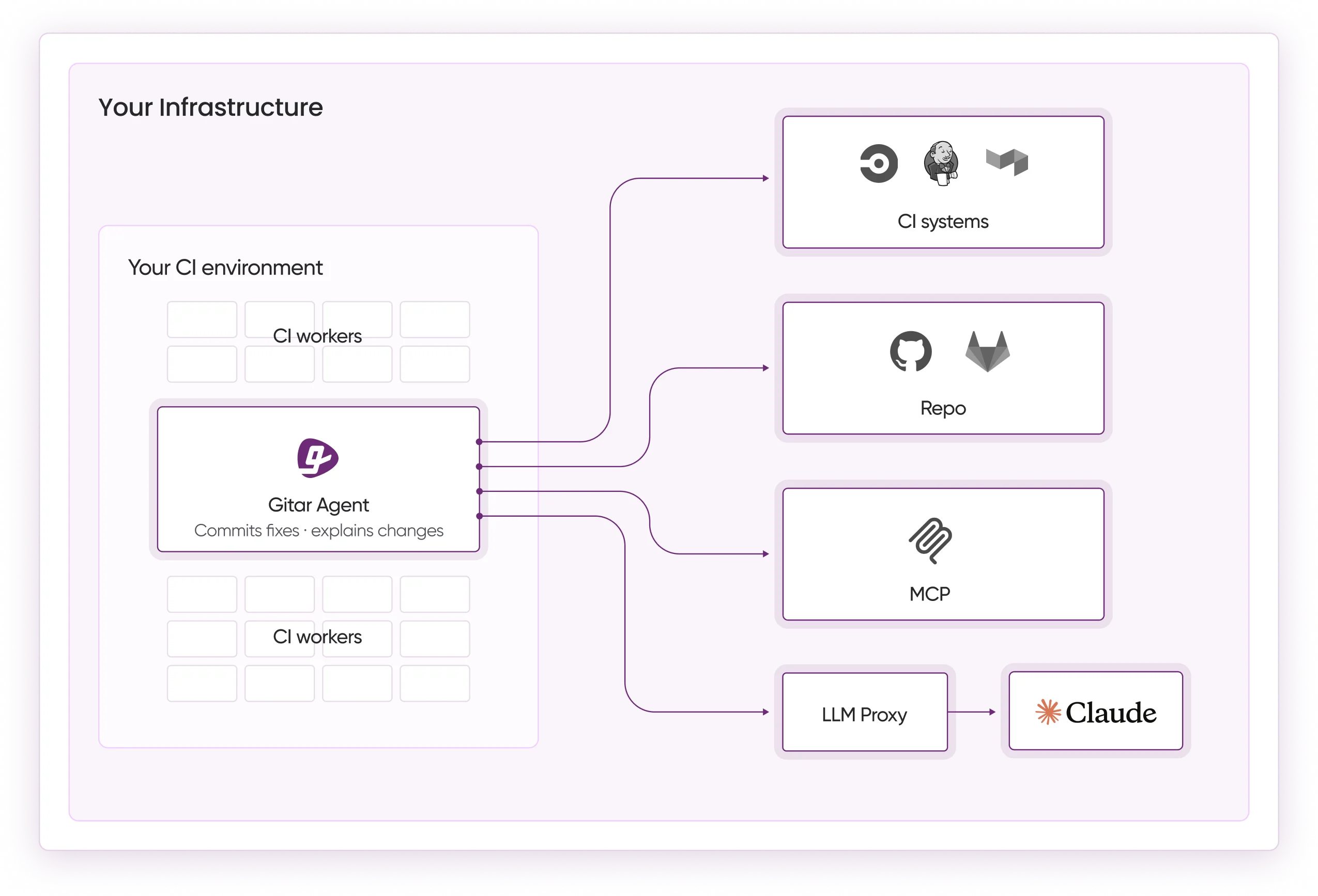
Key differentiators include single-comment consolidation that cuts notification noise, natural language repository rules that drive workflow automation, and hierarchical memory that learns your team’s patterns over time. The platform maintains full context from PR creation to merge, which supports more accurate decisions than tools that only see isolated runs.
|
Capability |
Traditional Tools |
Gitar |
|
Auto-apply fixes |
No |
Yes |
|
Guarantee green builds |
No |
Yes |
|
CI failure analysis |
Limited |
Comprehensive |
Start your 14-day Team Plan trial to see automated CI failure remediation working against your own pipelines.
8-Step Blueprint to Automate Code Review for Flaky Tests
This blueprint walks teams from basic detection to full automation so flaky tests stop blocking releases and distracting developers.
Step 1: Set Up Retry-Based Flaky Test Detection
Configure your CI system to retry failed tests and record patterns across runs. For GitHub Actions, use a retry action with clear timeout and attempt limits:
– name: Test with retry uses: nick-invision/retry@v2 with: timeout_minutes: 10 max_attempts: 3 retry_on: error command: npm test
Step 2: Capture Logs and Artifacts for Every Failure
Ensure your CI pipeline captures logs, screenshots, videos, and trace data whenever tests fail. These artifacts provide the evidence needed for accurate root cause analysis. Configure artifact collection with the always() condition so data is saved even when jobs fail.
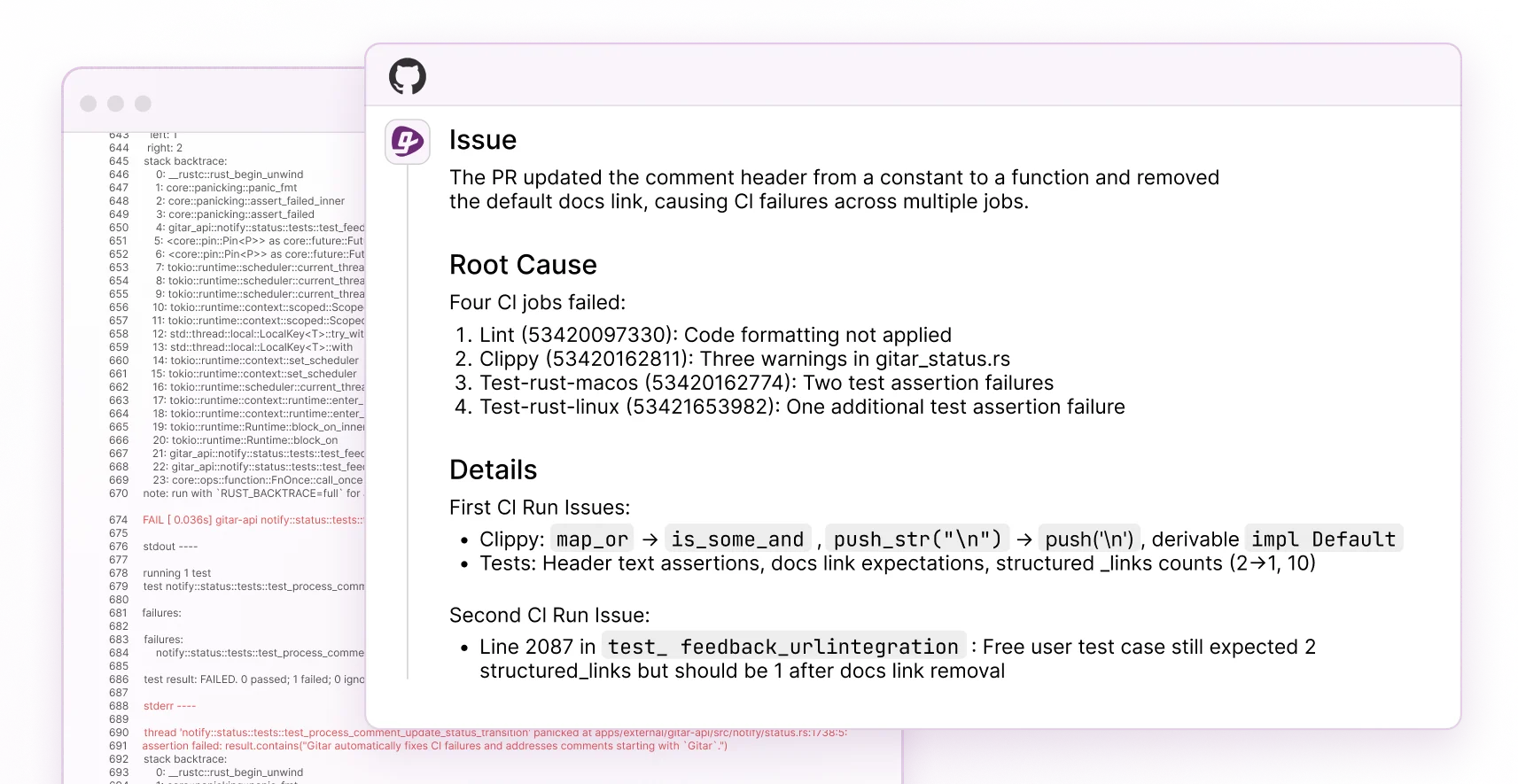
Step 3: Classify Failures with AI-Powered Analysis
Connect Gitar’s ML-powered analysis so CI failures are automatically classified and surfaced with clear explanations. Gitar’s CI Failure Analysis deduplicates failures across jobs and pipelines and highlights causes without manual log digging.
Step 4: Quarantine Confirmed Flaky Tests Intelligently
Introduce automated quarantine for tests confirmed as flaky while keeping their status visible to the team. Use conditional execution to isolate flaky tests without blocking the main pipeline:
– name: Quarantine flaky tests if: failure() run: npm test — –testPathPattern=”quarantine” || true
Step 5: Use the Healing Engine to Generate and Validate Fixes
At this stage, Gitar’s healing engine focuses on the specific failure patterns identified earlier and proposes targeted fixes. As described above, these fixes run against your actual CI environment before any commit occurs. This validation step confirms that changes work in real pipelines instead of only in isolated local runs.
Step 6: Automate Fix Implementation with Guardrails
Configure Gitar to commit validated fixes directly to your repository once you are comfortable with its accuracy. Teams usually begin in suggestion mode so they can review each proposed change and confirm that the system behaves reliably. After specific failure types prove consistent, enable auto-commit for those categories while the platform records full audit trails for every automated change.
Step 7: Enforce Flaky-Aware Review Standards
Define automated review rules that flag pull requests introducing new flaky tests or degrading reliability metrics. Use Gitar’s natural language rules to assign reviewers, add labels, and block merges when test stability drops below agreed thresholds.
Step 8: Apply Preventive Analytics to Stay Ahead of Flakiness
Enable continuous monitoring that spots flaky test trends before they slow down development. Building on the contextual awareness described earlier, Gitar’s CI agent tracks pull requests from creation to merge and works to keep CI green. This preventive layer shifts the team from reacting to failures to addressing emerging patterns early.
Try Gitar free for 14 days to put this full automation blueprint into practice across your own workflows.
Real ROI from Automating GitHub Actions Flaky Tests
Teams that adopt automated flaky test management report clear, measurable gains. Organizations that implement flaky test detection often fix issues within 1–2 weeks and cut re-runs by 60–80%, which directly reduces CI spend and recovers developer time.
The impact reaches beyond raw CI metrics. Teams report 84% AI adoption in development, yet logic and correctness issues appear 75% more often in AI-generated pull requests. Automated flaky test management becomes a safety net that preserves quality while teams scale AI-assisted coding.
Customer feedback highlights Gitar’s practical benefits. Engineering teams describe summaries as “more concise than Greptile,” and they prefer a single updating comment over streams of noisy notifications. Many teams see an effective 80% reduction in flaky test delays compared with manual remediation efforts.
FAQ
How do you handle flaky tests in Playwright?
Playwright flaky tests usually come from timing issues, race conditions, and asynchronous operations. Configure retries in playwright.config.ts with retries: process.env.CI ? 2 : 0 for CI environments so unstable tests get a second chance without hiding real failures. Use the –fail-on-flaky-tests flag to treat retried tests as failures during development and keep the suite honest. For production environments, Gitar analyzes test failures, identifies root causes, generates fixes, and validates those fixes against your actual Playwright setup before committing changes.
What is the best approach for GitHub Actions flaky tests?
GitHub Actions flaky test management works best with several layers working together. Add retry logic with actions like nick-invision/retry@v2, configure artifact uploads with actions/upload-artifact@v4, and use strategy: fail-fast: false so a single flaky test does not halt the entire workflow. Gitar builds on this foundation with intelligent failure analysis, automatic fix generation, and validated remediation that keeps workflows green. The platform integrates directly with GitHub Actions, reads workflow logs, and commits fixes that address the real causes of instability.
Can you trust automated commits for flaky test fixes?
Gitar offers configurable automation levels so trust grows over time instead of all at once. Teams begin in suggestion mode, review every fix, and approve only the ones that meet their standards. After specific failure types prove reliable, they enable auto-commit for those categories while Gitar continues to validate fixes against the live CI environment. Full audit trails record every automated change, and teams decide which classes of fixes qualify for automatic application.
How effective is AI for fixing flaky tests?
AI-driven CI failure remediation can be highly effective when paired with strong validation. Modern AI systems analyze complex failure patterns, correlate results across many runs, and propose fixes that address root causes instead of surface symptoms. Gitar combines pattern recognition with validation testing so only fixes that resolve failures move forward. The platform learns from your codebase over time, which improves accuracy and reduces false positives, and teams often see large drops in manual debugging time along with more reliable CI pipelines.
Conclusion: Move to Green CI with Gitar
Automated code review for flaky tests marks a major step forward for CI/CD reliability. Teams that move from manual firefighting to intelligent automation remove frequent interruptions while keeping build quality consistent. Organizations that adopt comprehensive flaky test automation report higher developer productivity, lower CI costs, and faster, more predictable releases.
The blueprint in this guide offers a structured path to those outcomes, and success depends on a platform that can close the loop. Gitar’s healing engine extends beyond detection and suggestions to deliver validated fixes that keep builds green.
Start your 14-day Team Plan trial to experience the difference between suggestion-only tools and true automation. Code generation is solved; now teams can focus on healing their CI.