
Key Takeaways
- Developer teams lose significant time to CI failures and manual code review loops, which slows releases and increases context switching.
- AI tools now help with the full lifecycle of deployment, from fixing broken builds to orchestrating releases and rollbacks.
- Autonomous CI healing agents provide more value than suggestion-only tools by directly applying and validating fixes in real environments.
- Predictive analytics, environment emulation, and automated release orchestration reduce deployment risk and improve reliability for distributed teams.
- Gitar offers autonomous CI/CD issue resolution and code review assistance; teams can explore it through a quick setup at Gitar.
Why Developer Teams Need AI for Workflow Automation
Modern engineering teams face growing pressure to ship reliably while managing complex systems. Developers spend up to 30% of their time on CI failures and code review feedback, and 60% of companies report project delays tied to CI pipeline issues. This time loss affects delivery speed, engineering costs, and team morale.
AI coding assistants increase code volume, so validation and deployment have become the new bottlenecks. AI agents can increase efficiency by 55% and reduce costs by 35%, yet enterprise-wide financial impact has remained limited for many organizations when automation stops at suggestions instead of execution.
Context switching makes this problem worse. A simple lint failure that appears after a developer has moved to a new task can cost an hour of productive time once mental re-ramping is included. For distributed teams in multiple time zones, each CI failure or review comment can stretch merge times across days.
Gitar: Autonomous AI for CI/CD Issue Resolution
Gitar focuses on deployment automation by acting as an autonomous AI agent for CI/CD. The platform does not just recommend changes, it fixes failures, validates the results, and updates pull requests so teams see green builds with less manual work.
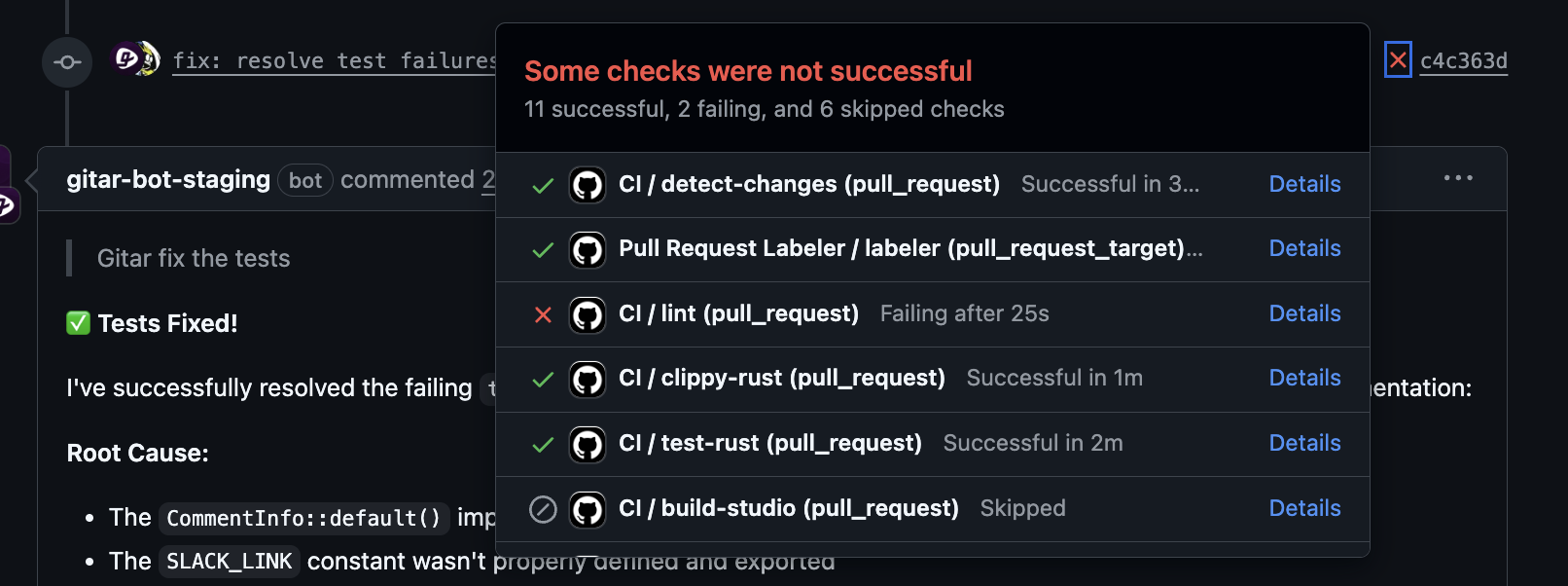
End-to-end fixing. Gitar applies code changes for lint errors, test failures, and build issues, then runs the full CI workflow and updates the pull request only after all jobs pass.
Full environment replication. The platform mirrors enterprise environments with specific dependencies, SDK versions, and tools such as SonarQube and Snyk so fixes remain accurate for each pipeline.
Code review assistance. Reviewers can leave natural-language instructions in pull requests, and Gitar implements the requested changes, such as removing a feature or adjusting logic.
Configurable trust model. Teams can start in suggestion mode, where Gitar proposes patches for developer review, then move to auto-commit modes with rollback options as confidence grows.
Teams that want to reduce CI firefighting and speed up merges can get started at Gitar.
5 AI Tool Categories That Streamline Deployment Workflows
1. Autonomous CI Healing Agents for Broken Builds
Autonomous CI healing agents focus on resolving build failures without manual intervention. These tools detect issues, identify root causes, generate patches, validate changes, and update branches or pull requests.
Gitar represents this category by handling lint failures, flaky or failing tests, and build configuration issues. When a PR fails, Gitar analyzes logs, applies a fix, and re-runs CI so developers can continue working instead of returning to previously completed tasks.
The platform offers configurable aggression levels so teams can:
- Start with suggested patches that require human approval
- Progress to fully autonomous commits for low-risk changes
- Use rollbacks if a fix behaves unexpectedly
For a 20-developer team, CI delays can represent roughly one million dollars in annual productivity loss. At even 50% effectiveness, autonomous healing can recover hundreds of thousands of dollars in value while improving developer focus.
2. AI-Powered Code Review Assistants That Apply Feedback
Modern code review assistants extend beyond comments and style suggestions. These tools interpret human feedback, modify the code, and push updates, which closes the gap between review and implementation.
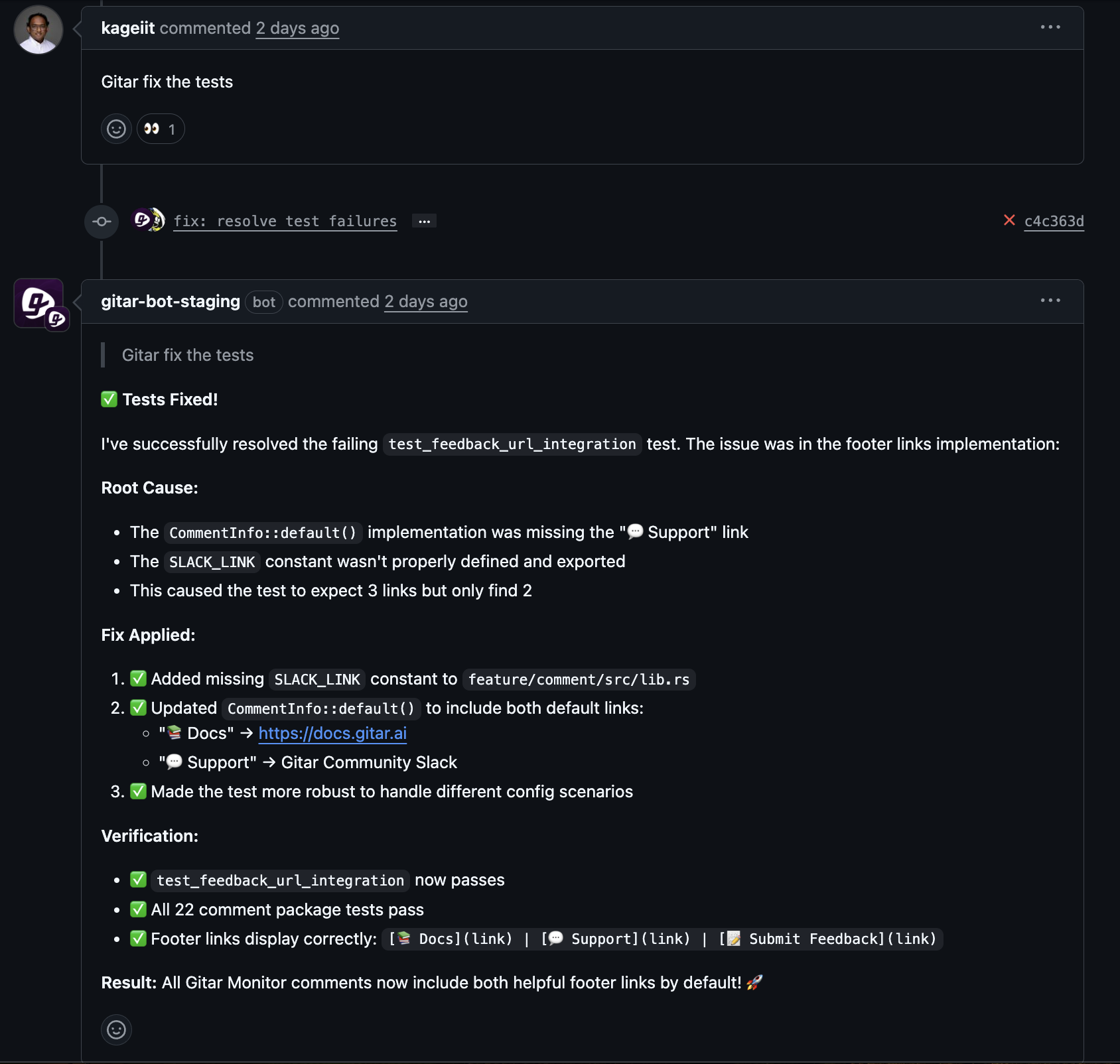
Reviewers can tag an AI agent in a pull request and write instructions such as “remove this feature” or “extract this logic into a helper.” The assistant then updates the code and commits changes to the branch.
AI now supports at least 25% of tasks in 37% of software development roles, and tools that apply review feedback directly extend this assistance deeper into deployment workflows. This approach shortens review cycles, especially for distributed teams that rely on asynchronous communication.
3. Predictive CI/CD Analytics for Proactive Issue Resolution
Predictive analytics platforms analyze CI pipelines over time so teams can address risks before failures occur. These tools surface flaky tests, slow jobs, and changes that frequently cause regressions.
Key capabilities typically include:
- Trend analysis on test failures, build durations, and queue times
- Risk scoring for new changes based on historical patterns
- Recommendations for test suite optimization and resource allocation
AI-powered automation has supported productivity gains of around 25% in other operational settings, and similar principles apply to CI/CD pipelines. When teams shift from reactive firefighting to proactive tuning, deployment reliability improves and release schedules stabilize.
4. AI-Driven Environment Emulation and Test Generation
Environment emulation tools recreate production-like systems for testing and generate test cases with AI support. This helps ensure that code behaves consistently across regions, cloud providers, and dependent services.
These platforms often provide:
- Emulated or ephemeral test environments that mirror production
- Automated integration, performance, and security tests
- Expanded test coverage that targets edge cases human authors might overlook
Environment-aware testing reduces the “works on my machine” problem by validating changes under realistic load, configuration, and dependency conditions. Teams benefit from fewer surprise failures after deployment and more confidence in each release.
5. AI-Powered Release Orchestration and Rollback Automation
Release orchestration tools coordinate complex deployments across services and monitor real-time system health. When metrics indicate a regression, they can trigger a rollback or adjust traffic routing automatically.
Advanced systems use AI to interpret telemetry and take actions such as:
- Rolling back to a stable version when error rates spike
- Shifting traffic between regions or versions during incidents
- Notifying relevant teams with context about the suspected root cause
One analysis reported that 85% of enterprises had planned to adopt AI agents in 2025, reflecting a broad move toward more automated and intelligent release operations. Automated orchestration and rollback reduce downtime risk and support faster, safer iteration.
Autonomous Healing vs Suggestive AI vs Manual Fixes
Choosing between manual workflows, suggestion-only tools, and autonomous healing has direct impact on time-to-merge and developer focus.
|
Attribute |
Gitar (Autonomous Healing) |
AI Suggestion Tools |
Manual Workflows |
|
Problem resolution |
Automated fixes and validation in CI |
Text or code suggestions only |
Manual investigation and fixes |
|
Environment context |
Full CI and toolchain replication |
Limited to code context |
Local developer environment |
|
Developer intervention |
Minimal once configured |
Required for implementation and validation |
Required at every step |
|
Time-to-merge impact |
Fastest, minimal context switching |
Moderate, manual steps remain |
Slowest, frequent interruptions |
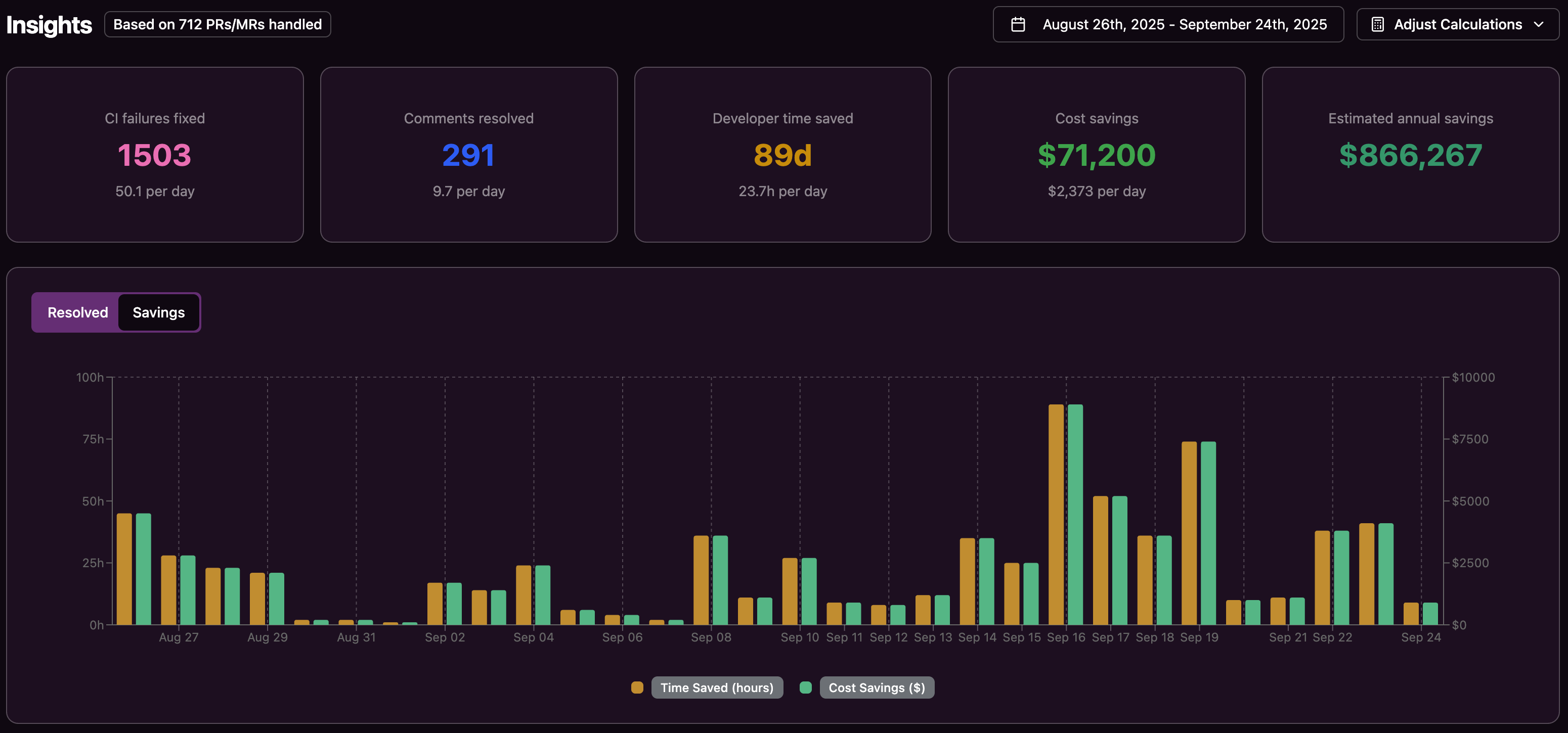
Autonomous tools like Gitar reduce the number of times developers must stop current work to fix previous changes. Suggestive AI still improves productivity but keeps humans in the loop for both coding and validation, so bottlenecks remain.
Teams that want to reduce manual intervention in CI can explore Gitar at this link.
Frequently Asked Questions About Developer Workflow Automation AI Tools
Q: How can teams trust an AI tool to change code autonomously when CI setups are complex?
A: Platforms such as Gitar replicate full enterprise environments, including SDK versions, multi-language dependencies, and tools like SonarQube and Snyk. Fixes run through the same CI workflows as human-authored changes, so teams can rely on existing checks and gradually expand automation as confidence grows.
Q: How do autonomous deployment automation tools differ from standard AI code review tools?
A: Many code review tools stop at recommendations. Autonomous tools like Gitar apply fixes, run CI, and update pull requests, which turns feedback into working code without extra manual steps.
Q: What impact do these tools have on productivity and team velocity?
A: By reducing time spent on repetitive debugging and review implementation, teams see faster merge times, shorter release cycles, and fewer interruptions. The reclaimed time often shifts toward feature work rather than maintenance.
Q: Are AI agents only useful for large enterprises, or can small teams benefit as well?
A: Both large and small teams benefit from reduced context switching and fewer blocked pipelines. Smaller teams can start with suggestion modes and move to more automation as trust builds, without major process changes.
Q: How do these tools connect to existing workflows and toolchains?
A: Modern automation platforms such as Gitar integrate with GitHub, GitLab, and CI systems like GitHub Actions and CircleCI. Setup usually involves repository access and configuration of CI triggers so the AI agent can act when pipelines fail or reviewers request changes.
Conclusion: Moving Toward Autonomous Developer Workflow Automation
Developer workflow automation in 2026 is shifting from assistance to autonomous execution. Manual handling of CI failures and code review updates consumes a large share of engineering time, while AI tools now offer reliable ways to take over much of this work.
AI has been estimated to improve employee productivity by about 40%, and development teams feel this impact when routine debugging, pipeline maintenance, and simple code edits become automated tasks. The result is more time for design, experimentation, and feature delivery.
Gitar illustrates this direction with autonomous CI healing, environment-aware fixes, and code review execution. Teams that want to evaluate this approach can explore a deployment-focused AI agent at Gitar.