
Key Takeaways
- CI/CD bottlenecks consume significant developer time and slow delivery, especially as AI-generated code increases pipeline load.
- AI tools for CI automation fall into two main categories: suggestion engines that assist humans and healing engines that autonomously fix failures.
- Teams can combine IDE assistants, CI-aware AI reviewers, and on-demand fixers to reduce toil, but only some tools fully own passing the build.
- Building custom LLM-based CI automation in-house offers flexibility but requires substantial engineering effort and ongoing maintenance.
- Gitar acts as an autonomous CI healing engine that fixes failing builds and applies code review feedback for you; install it at Gitar to reduce CI toil.
The Problem: Why Traditional CI/CD Falls Short in the AI Era
Modern CI/CD pipelines often pull developers back into old work with failing checks and review feedback. A pull request that looked done suddenly demands attention again, forcing context switching and breaking focus. The 30 minutes spent on a simple CI fix can easily consume an hour of productive time once mental overhead and task switching are included.
Developers can waste up to 30% of their time dealing with issues related to CI and code review. These delays create business bottlenecks for most companies and increase delivery costs.
AI now helps teams write more code, yet validation still depends on manual work. Traditional pipelines were not built for this volume and speed. CI automation with AI needs to move beyond hints and suggestions to systems that diagnose issues, apply fixes, and validate results with minimal human involvement.
1. Gitar: The Autonomous CI Healing Engine
Concept and Impact: Automating CI Fixes and Code Review Feedback
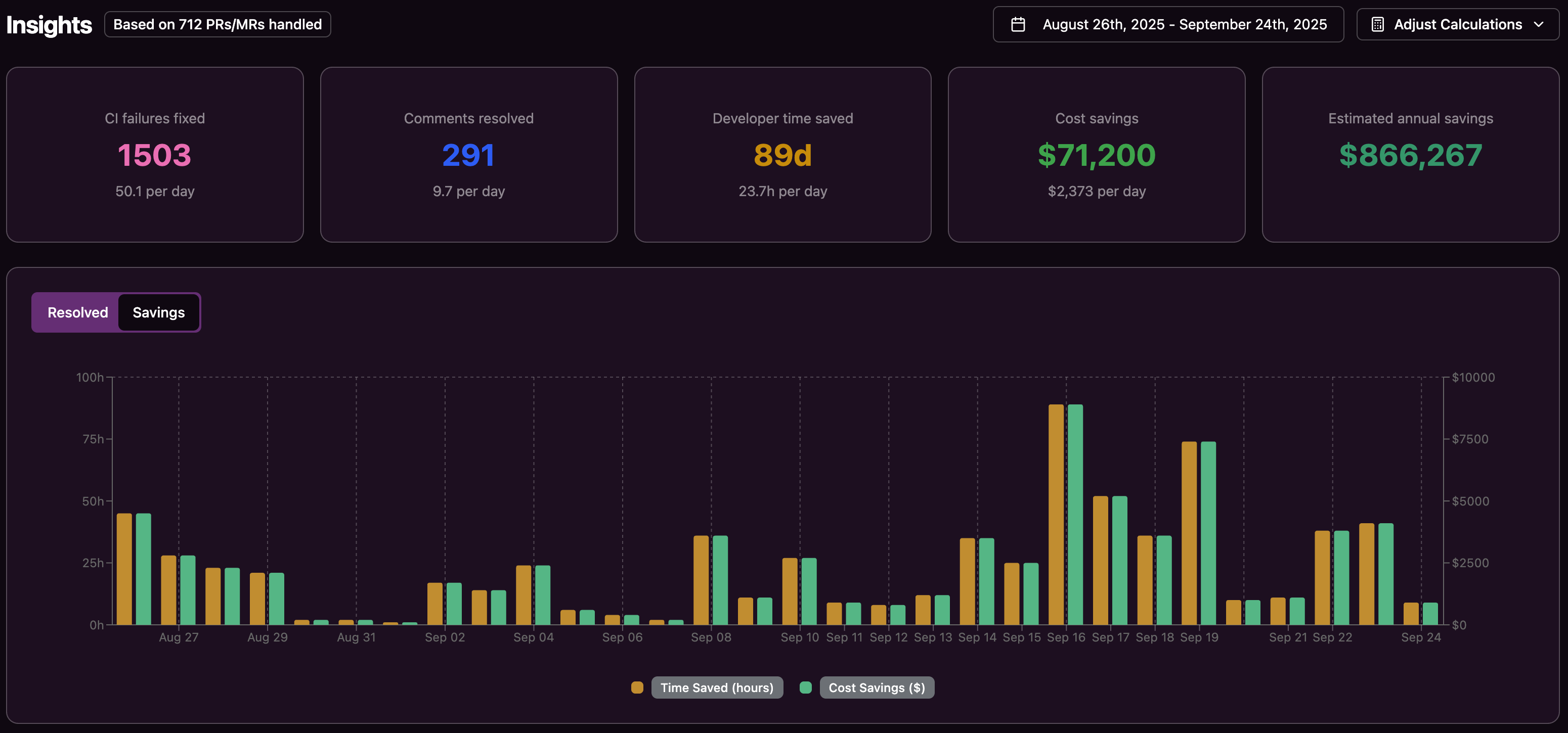
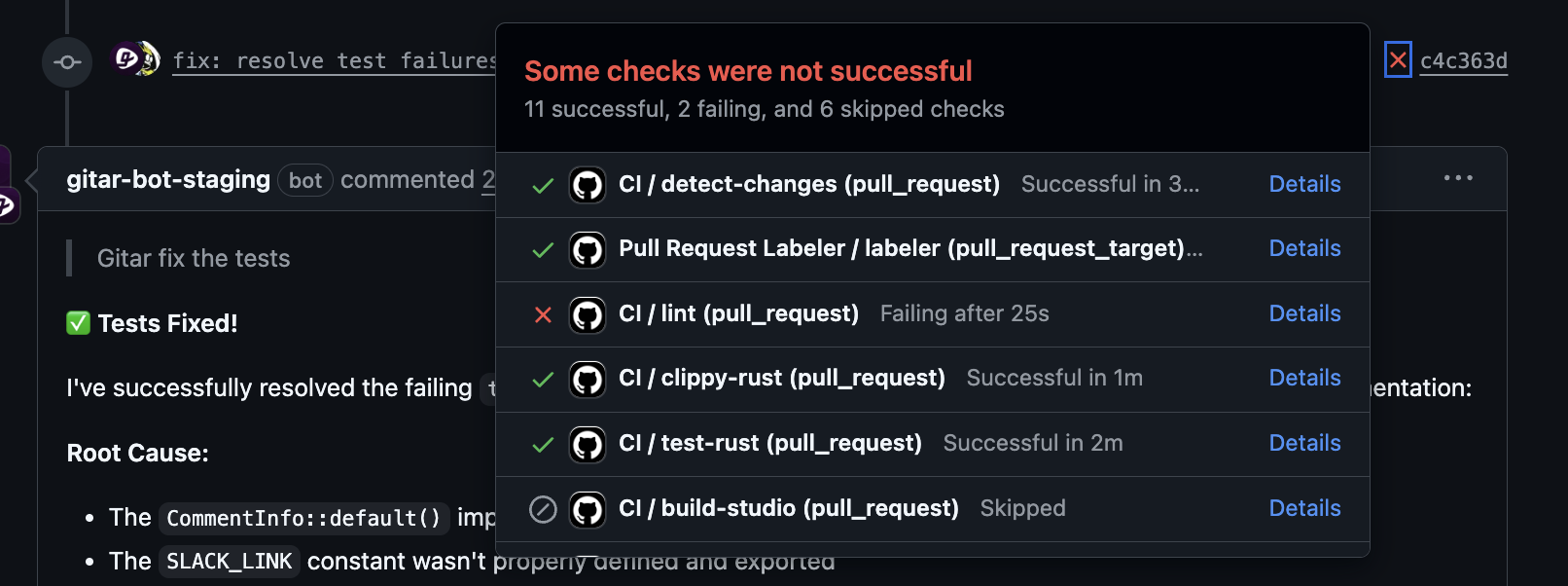
Gitar operates as an autonomous AI agent that fixes failing CI pipelines and applies code review feedback directly on pull requests. The tool does more than highlight problems. It analyzes failing jobs, identifies the root cause, edits the code, and pushes commits back to the branch. This approach reduces context switching, shortens feedback loops, and keeps developers focused on new work instead of rework.
When a CI check fails from a lint issue, test failure, or build error, Gitar reads the logs, updates the relevant files, and validates the fix. Reviewers can also leave comments that Gitar interprets as tasks, such as refactors or small feature adjustments, then implement those changes for the team.
How Gitar Works: Implementation Details and Trust Model
Gitar replicates your CI environment so fixes match real pipeline behavior. The system supports complex setups such as specific JDK or SDK versions, multi-language monorepos, and tools like SonarQube or Snyk. That context lets Gitar run targeted commands, interpret logs correctly, and adjust code in a way that passes your checks.
Teams control how aggressively Gitar commits changes through a trust model:
- Conservative mode posts proposed fixes as suggestions on the pull request so developers can review and accept them.
- Aggressive mode commits fixes automatically while preserving rollback options and a clear audit trail.
Many teams start with suggestions, monitor accuracy, then shift to automatic commits once they build confidence.
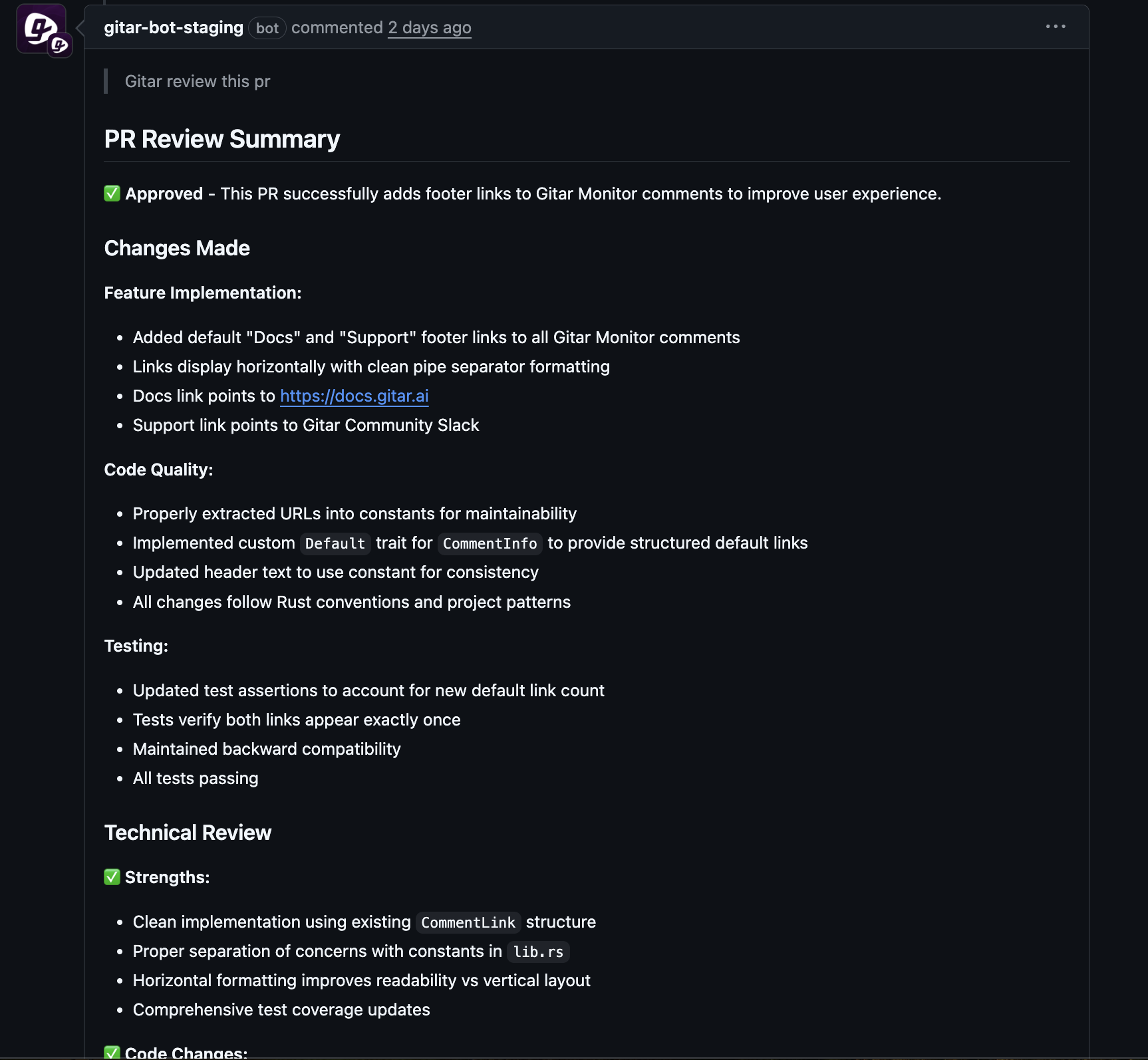
Teams that adopt Gitar reduce manual CI firefighting, shorten cycle times, and free engineers to focus on design, architecture, and new features.
Install Gitar to fix broken builds automatically and ship reliable software with less manual CI work.
2. CodeRabbit: AI-Powered Code Review Suggestions
Concept and Impact: Augmenting Human Code Review
CodeRabbit acts as an AI reviewer that summarizes pull requests, flags potential issues, and suggests improvements. The tool focuses on code style, patterns, and common bug risks. Teams use it to gain an extra pair of eyes on changes without increasing reviewer workload.
Implementation and Limitations: The Suggestion Engine Approach
CodeRabbit connects to Git providers and analyzes pull requests when opened or updated. It can run linters and static analyzers, suggest edits, and in some cases provide patches that developers apply with a click. These features reduce time spent on low-level review comments.
The system does not own the full CI outcome. Suggested fixes might not always pass the pipeline, so developers still resolve some failures themselves. Compared with a healing engine like Gitar, CodeRabbit stays closer to traditional review assistance rather than full automation.
3. Integrating Large Language Models for Custom CI Intelligence
Concept and Impact: Building Bespoke AI Solutions
Some teams build custom CI assistants on top of large language models such as Claude. These solutions can encode internal style guides, domain knowledge, and organization-specific practices. The result can match local needs closely, from specialized test suites to proprietary build systems.
Implementation Details: The DIY Engineering Effort
LLM-based CI automation requires significant engineering work. Teams must connect the model to CI events, manage secure access to repositories, design prompts for different failure types, and implement logic that applies changes safely. They also maintain these integrations as tooling, models, and pipelines evolve.
The Gitar Advantage: Pre-built End-to-End Solutions
Organizations that prefer not to own this infrastructure can use a platform like Gitar, which provides CI awareness, environment replication, and automated commits out of the box. This approach delivers many of the benefits of LLM-based automation without the upfront and ongoing engineering investment.
4. AI-Enhanced IDE Tools: Proactive Code Quality with Copilot-like Features
Concept and Impact: Catching Issues Early
IDE assistants such as GitHub Copilot and Cursor help developers catch issues before they reach CI. These tools suggest code, highlight potential bugs, and nudge developers toward consistent patterns while they work in the editor. Fewer mistakes at this stage can reduce CI failures later.
Implementation Details: Real-time Suggestions in the Editor
IDE-based tools analyze the local file or project and generate inline suggestions. They help with boilerplate, refactors, and quick fixes. However, these assistants do not see the full CI configuration or external services, so they cannot guarantee that a pull request will pass every check.
The Evolution: From Pre-commit to Autonomous Post-commit Fixes
IDE tools improve pre-commit quality. Gitar then takes over after code lands in a branch, handling post-commit CI failures and review feedback. Together, these tools cover the path from writing code to merging a green pull request.
5. On-Demand AI Fixers: Reactive Problem Solving in CI
Concept and Impact: Immediate Assistance on Tough Failures
On-demand AI fixers, including tools built around Anthropic GitHub Actions, give developers a way to request help for specific CI failures. A comment or manual action triggers the AI to inspect logs, propose changes, or generate patches for a particular problem.
Implementation Details and Limitations: Manual Triggering and Resource Use
These tools usually run inside your existing CI system and consume CI minutes. Developers must remember to invoke them when needed. They work well for isolated issues but do not provide continuous monitoring or automatic remediation across all pipelines.
Contrast with Gitar: Proactive, Autonomous, and Integrated
Gitar runs automatically whenever pipelines fail, without manual triggers. The system monitors CI runs, applies fixes, re-runs jobs as needed, and updates pull requests. This proactive behavior removes the need for ad hoc firefighting and reduces idle time while waiting on manual interventions.
Comparison: Healing Engines vs. Suggestion Engines
Understanding the Different Approaches to CI Automation
|
Feature / Tool |
Gitar (Healing Engine) |
CodeRabbit (Suggestion Engine) |
LLM Integrations (DIY) |
|
Action type |
Autonomous fixes and validation |
Suggestions and patches |
Custom logic with in-house build |
|
CI integration depth |
Full CI environment replication |
Pull request focus with some CI awareness |
Depends on internal implementation |
|
Automated commits |
Yes, configurable trust modes |
Limited, via patches |
Possible if implemented |
|
Impact on context switching |
Removes most CI rework |
Reduces review overhead |
Varies by design |
|
Feature / Tool |
IDE Assistants (Pre-commit) |
On-Demand Fixers (Reactive) |
Guaranteed green build |
|
Action type |
Real-time editor suggestions |
Manually invoked fixes |
Gitar focuses on passing CI; others assist only |
|
CI integration depth |
Local project view |
Specific CI workflows |
Cross-pipeline in supported systems |
|
Automated commits |
No |
Often no |
Gitar supports automatic commits |
|
Developer effort |
Prevents some issues early |
Still requires manual triggering |
Healing engines minimize repeated manual fixes |
Frequently Asked Questions about AI Tools for CI Pipeline Automation
How does an autonomous AI agent like Gitar build trust in its fixes?
Gitar starts in a conservative mode where it posts proposed edits as suggestions on pull requests. Developers review those suggestions, accept or reject them, and see the resulting CI status. Teams that observe accurate fixes over time often shift to a more aggressive mode that allows Gitar to commit directly, while still keeping rollback options and audit logs. This staged adoption lets each team choose its own comfort level.
Can AI handle complex CI setups with custom dependencies and third-party tools?
Advanced tools such as Gitar are built to work with complex environments, including specific language versions, polyglot repositories, and scanners like SonarQube or Snyk. Gitar mirrors the CI environment closely so generated fixes align with real builds, not just local assumptions.
What ROI can engineering teams expect from CI pipeline automation?
A 20-developer team that spends about an hour per person each day on CI or review issues can lose hundreds of thousands of dollars in productivity each year, based on typical fully loaded engineering costs. Automating even a portion of that work with a healing engine like Gitar reduces wasted time, improves developer experience, and helps features reach production faster.
Conclusion: Moving Toward Autonomous Engineering in 2026
CI/CD friction remains one of the largest drains on developer productivity, especially as AI-generated code increases workload. Suggestion engines help reviewers and authors, yet still rely on humans to carry fixes across the finish line. Healing engines like Gitar take the next step by detecting failures, updating code, and validating results.
Teams that adopt this model spend less time fixing broken builds and more time designing, building, and refining products. Pull requests move through pipelines with fewer stalls, review feedback turns into concrete changes faster, and developers gain back uninterrupted time for deep work.