
Written by: Ali-Reza Adl-Tabatabai, Founder and CEO, Gitar
Key Takeaways
- AI coding tools increase code generation 3 to 5 times, yet CI failures and PR reviews still consume 30% of developer time.
- Self-healing CI pipelines diagnose failures, generate fixes, and keep builds green without manual intervention.
- Gitar’s healing engine auto-applies validated fixes and outperforms suggestion-only tools like CodeRabbit with CI analysis and cross-platform coverage.
- The 5-step rollout starts with quick GitHub or GitLab installation, then moves from suggestions to auto-commit using natural language rules.
- Teams achieve 85% faster time-to-green and more than $750K in annual savings, and you can see these results in your own pipeline with a 14-day trial of Gitar.
The Problem: CI Failures Are Killing Post-AI Velocity
CI failures now block the gains from AI-accelerated coding. GitHub processes over 82 million pushes monthly, yet flaky tests and CI maintenance consume 30% of developer time. According to the Gitar documentation, teams drowning in AI-generated code face constant context switching between writing features and debugging pipeline failures. Notification spam from chatty review tools adds even more noise, creating cognitive overload that stalls sprint velocity.
For a 20-developer team, this drag translates to $1 million annually in lost productivity. Engineers report spending entire mornings fixing lint errors, dependency conflicts, and test failures that an automated system could resolve. AI accelerated code generation and created a flood of changes, and that volume now overwhelms traditional CI/CD processes.
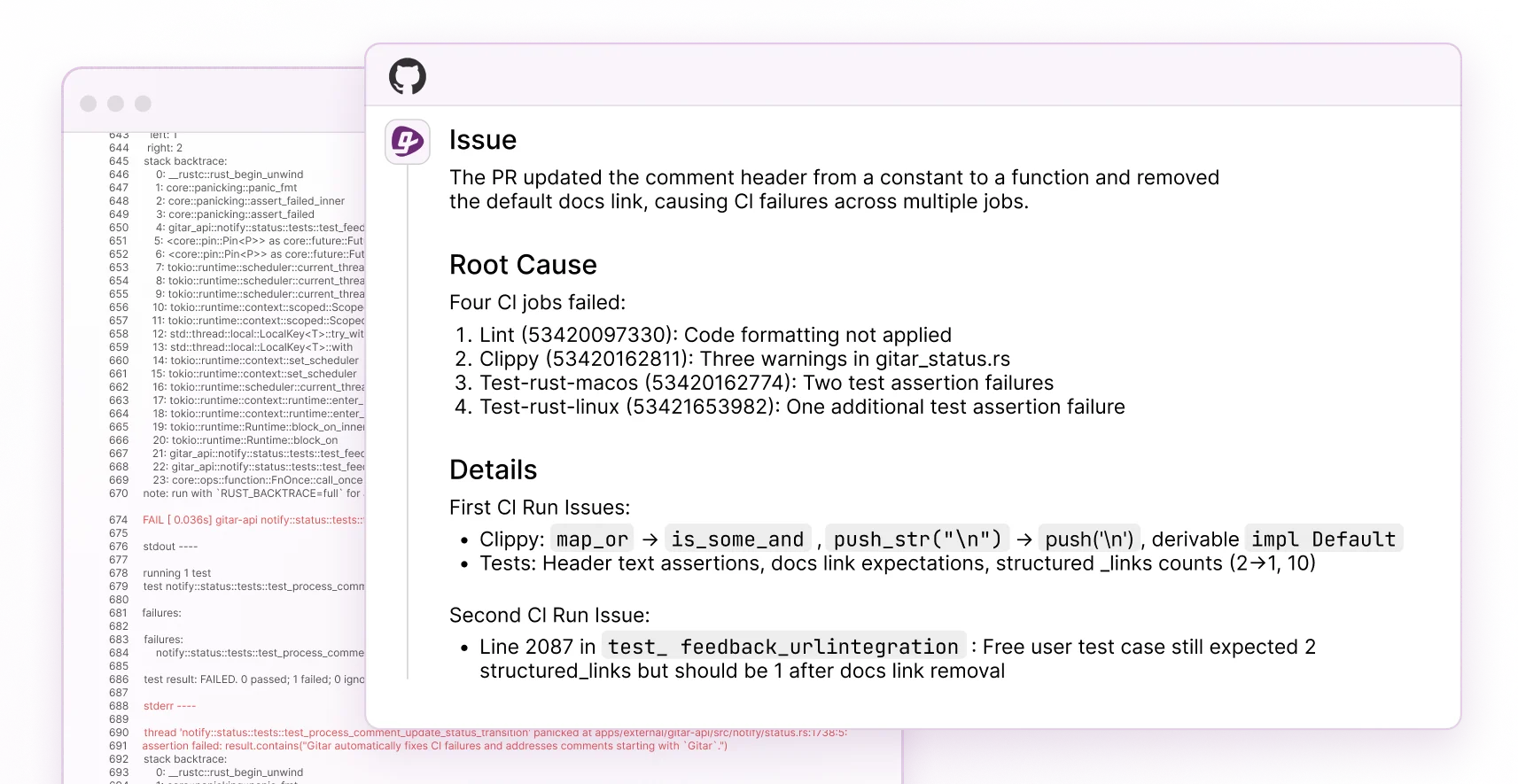
This gap between problem and solution is particularly frustrating because the technology already exists. Recent research shows AI-based fault detection achieving over 95% accuracy in identifying root causes, yet most teams still rely on manual debugging. The gap between AI capability and implementation represents the biggest opportunity in modern DevOps.
The Solution: Four Components of a Self-Healing CI Pipeline
Self-healing CI pipelines with automated AI code review comprise four essential components that work together to eliminate manual intervention. This table shows how each component builds on the previous one to create a complete healing cycle, with Gitar’s implementation going beyond basic automation to guarantee resolution.
|
Component |
Description |
Gitar Advantage |
|
Diagnosis |
AI log analysis and root cause identification |
Emulates full environment, detects unrelated failures |
|
Remediation |
Automated code fix generation |
Validates fixes before committing |
|
Validation |
CI re-run to confirm resolution |
Guarantees green builds |
|
PR Integration |
Seamless auto-merge workflow |
Single-comment updates, no spam |
The intelligence layer maintains full context from PR creation to merge and continuously works to keep CI green. This approach differs from suggestion-based tools that require manual implementation of feedback. Teams see clear gains, including faster time-to-green and a sharp reduction in the manual toil that consumes engineering hours.
Install Gitar now to automatically fix broken builds and start shipping higher quality software, faster and try the complete Team Plan free for 14 days.
Gitar vs Suggestion Tools: Why Healing Wins
Gitar replaces suggestion-only review tools with a healing engine that actually fixes code. Competitors like CodeRabbit and Greptile charge $15 to $30 per developer for suggestion engines that still require manual work. Gitar focuses on guaranteed resolution instead of comment volume.
|
Capability |
CodeRabbit/Greptile |
Gitar |
|
Auto-apply fixes |
No |
Yes |
|
CI failure analysis |
No |
Yes |
|
Guarantee green builds |
No |
Yes |
|
Cross-platform support |
Limited |
GitHub, GitLab, CircleCI, Buildkite |
Gitar’s configurable modes let teams start with suggestion-only reviews to build trust, then move to auto-commit for validated fix types. Natural language rules in .gitar/rules enable workflow automation without complex YAML. Native integrations with Jira and Slack keep context flowing into the tools where teams already work.
Build Self-Healing CI Pipelines with Gitar: 5-Step Implementation
Step 1: Install the Application
Add the Gitar GitHub App or GitLab integration to your repositories. Setup takes under 30 seconds and immediately starts analyzing PR patterns.
Self-Healing CI Pipelines on GitHub
GitHub users gain native Actions integration, automatic webhook configuration, and seamless permission management through the GitHub App model. This setup keeps security and access aligned with existing GitHub practices.
Step 2: Enable Suggestion Mode
Start with suggestion-only mode to build team confidence by letting developers see the quality of Gitar’s analysis before enabling auto-fixes. Gitar analyzes failures and proposes fixes in a single dashboard comment, which avoids notification spam that creates resistance to new tools and lets developers review suggestions without disruption.
Step 3: Activate Auto-Commit
After trust is established, enable auto-commit for specific failure types such as lint errors and simple test fixes. Gitar validates each fix against your CI environment before applying it.
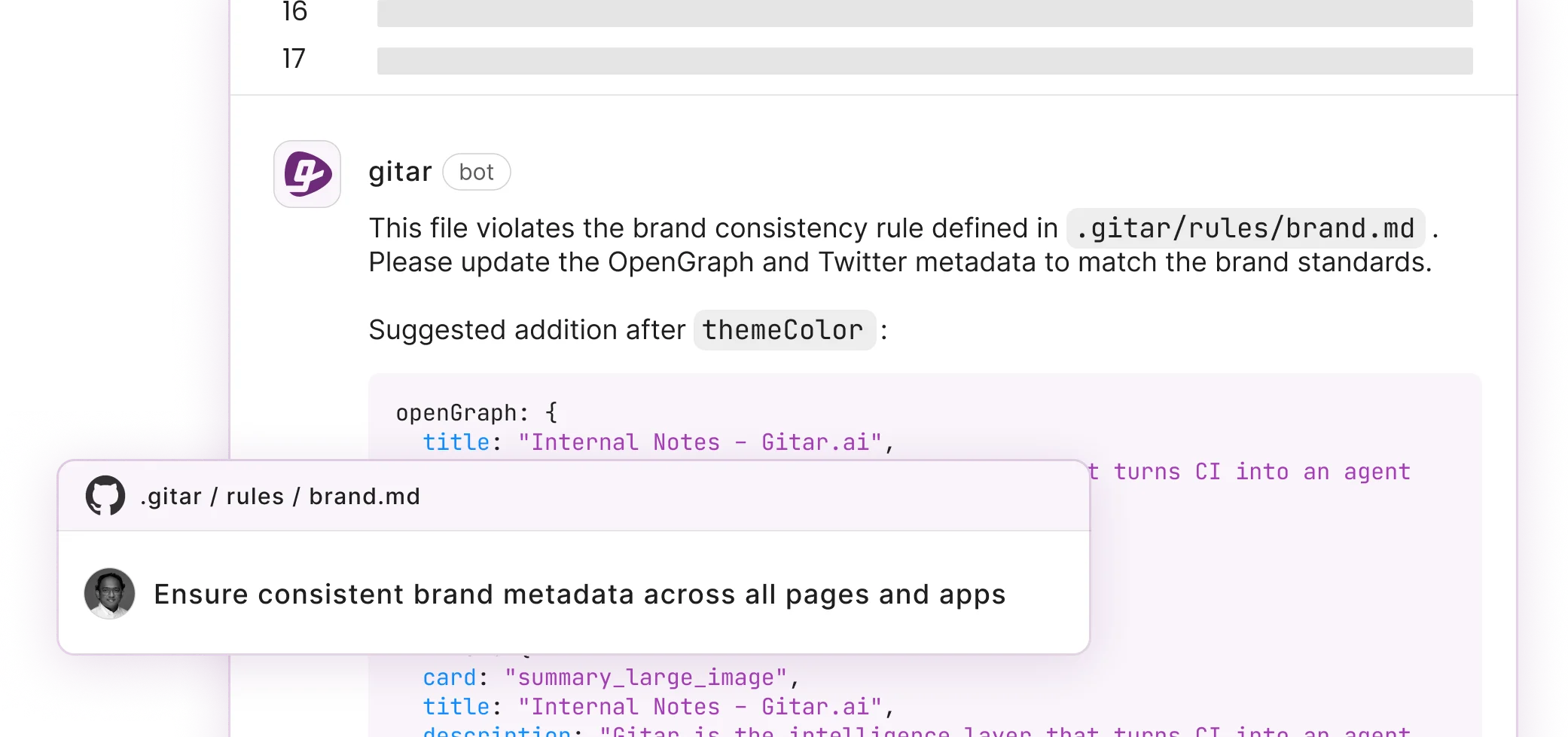
Step 4: Add Repository Rules
Create natural language automation rules that match your workflow:
Self-Healing CI Pipelines on GitLab
GitLab implementations use CI/CD components and pipeline inputs to deliver enhanced security and flexibility in enterprise environments. Teams keep existing pipeline structures while adding self-healing behavior.
Step 5: Integrate External Tools
Connect Jira for issue linking and Slack for team notifications. These integrations ensure the complete healing cycle, from detection through validation, happens in context with your team’s existing workflow.
Real-World ROI: Slash Toil and Costs
Production deployments show that self-healing CI delivers measurable impact. Tigris reported concise PR summaries that outperformed existing tools, and Collate highlighted the “unrelated PR failure detection” capability that saves significant debugging time by separating infrastructure issues from code problems. The following metrics from a typical 20-developer team show how these qualitative improvements translate into concrete time and cost savings.
|
Metric |
Before Gitar |
After Gitar |
|
Time-to-green |
1 hour |
12 minutes |
|
Annual productivity cost |
$1M |
$250K |
|
Context switching events |
Multiple daily |
Near zero |
Industry analysis shows autonomous validation reducing debugging time by 50% and review time by 30%, with mature implementations achieving even higher gains. Gitar’s approach includes automatic retry of flaky CI jobs, which removes a common source of false failures that waste developer time.
Trust concerns are addressed through configurable modes and validation steps that let teams verify fixes before enabling auto-commit. This validation becomes especially important in complex CI environments, where Gitar’s ability to emulate full build contexts, including specific SDK versions and dependency configurations, ensures fixes work in production, not just in isolation.
Experience these productivity gains firsthand by trying Gitar free for 14 days.
FAQ
Is auto-commit safe for production repositories?
Gitar offers fully configurable safety modes that match your risk tolerance. Start with suggestion-only reviews to build confidence, then enable auto-commit for specific failure types such as lint errors. Every fix is validated against your CI environment before application. You control the aggression level and can disable auto-commit for sensitive code paths.
Does Gitar work with GitHub, GitLab, and CircleCI?
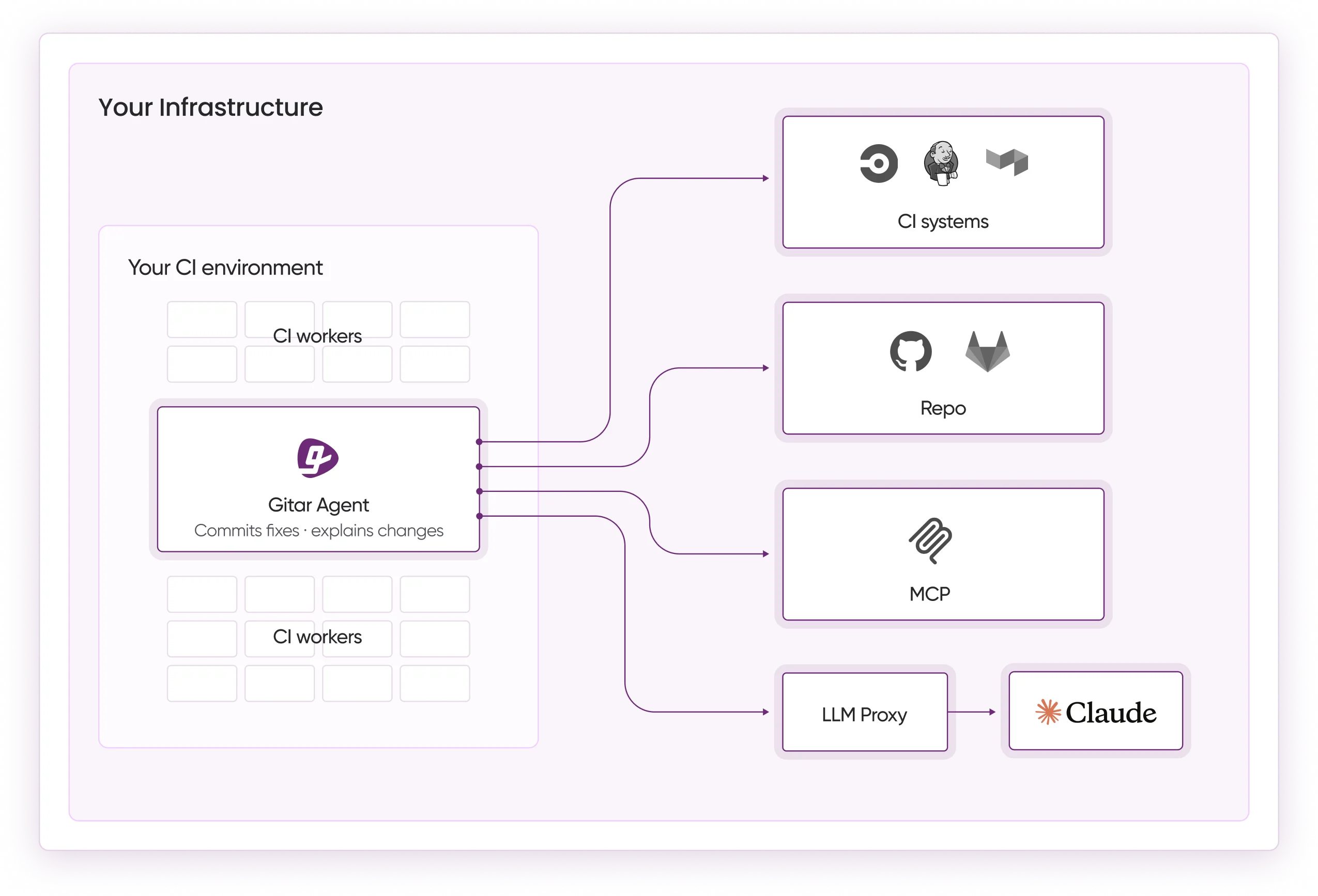
Gitar provides native support for GitHub, GitLab, CircleCI, and Buildkite. The platform adapts to your existing CI/CD setup without requiring workflow changes. Enterprise deployments can run the agent within your own CI pipeline for maximum security and context access.
How does Gitar compare to CodeRabbit and other review tools?
The core difference is healing versus suggesting. CodeRabbit and similar tools leave comments that still require manual implementation. Gitar fixes the code and validates that the solution works. A 14-day trial gives you a structured way to measure the impact on your team’s velocity and review workload.
What ROI can teams expect from self-healing CI pipelines?
Teams typically see significant reductions in time-to-green and a sharp drop in manual CI toil. The productivity savings mentioned earlier, from $1M to $250K for a typical 20-developer team, pay for the investment within the first month through reduced context switching and faster feature delivery.
Can Gitar handle complex or unique CI environments?
Complex environments are where Gitar excels. The system emulates your full build context, including specific SDK versions, multi-dependency builds, and third-party scanning tools. Enterprise tier deployments run the agent inside your own CI with access to secrets and caches, which ensures fixes work in production, not just in isolation.
Conclusion: Guarantee Green Builds Today
AI coding shifted the bottleneck from writing code to validating and merging it. Manual CI debugging and suggestion-only review tools cannot keep pace with the volume of AI-generated changes flowing through modern development pipelines.
Self-healing CI pipelines with automated AI code review represent the next evolution and deliver systems that not only identify problems but also solve them automatically. The technology exists, the ROI is proven, and the competitive advantage is clear.
Install Gitar now for self-healing CI pipelines with automated AI code review, and your first two weeks are on us so you can experience the difference between suggestions and solutions.