
Key Takeaways
- Persistent CI/CD failures, flaky tests, and manual code review loops consume a large share of developer time and slow every release.
- Teams can lose up to 30% of developer time to CI and review issues, while around 60% of companies report delayed projects due to pipeline failures.
- AI-powered deployment automation with autonomous “healing” shifts effort away from debugging and log reading toward validating changes and shipping features.
- Gitar replicates your CI environment, fixes broken builds, and implements review feedback so teams gain higher reliability, faster merges, and measurable cost savings.
- Teams that want a self-healing CI pipeline in 2026 can start quickly by using Gitar to automatically fix broken builds and reduce manual review toil.
The Problem: Why Traditional Deployment Automation Falls Short
Most deployment automation tools still expect humans to debug failures. Developers push a pull request, see a wall of red from a missing dependency or flaky test, then stop feature work to parse logs, fix a small issue, push again, and wait for another pipeline run.
This cycle can consume nearly a third of developer time. Each interruption breaks focus, and a quick 10-minute fix often expands into an hour once context switching and re-orienting to the work are included.
Hidden Cost: Slower Releases and Higher Spend
Pipeline failures contribute to delays for most software teams. For a 20-developer organization, lost time in CI and code review easily translates into hundreds of thousands of dollars per year in wasted engineering budget and slower time-to-market.
These delays affect more than engineering. Sales, product, and customer success all rely on predictable release schedules, so every blocked PR or broken build introduces risk and uncertainty for the broader business.
Code Review Bottlenecks, Especially for Distributed Teams
Manual reviews add further friction. A developer on the US West Coast might wait a full day for feedback from a teammate in Bangalore, then another cycle to implement requested changes and rerun CI. AI review tools help with suggestions, but they often leave implementation and validation work to the original author.
The result is a slow loop: feedback arrives, code changes are made, tests fail, and the process repeats across time zones.
More Code, More PRs, More Failures
Tools such as GitHub Copilot and Cursor increased coding speed, so the bottleneck shifted away from writing code to validating and merging it. Teams now face more pull requests, more tests, and more opportunities for CI to fail.
Traditional automation handles triggering pipelines, not fixing what goes wrong inside them. In 2026, this gap is where AI-powered deployment automation needs to focus.
The Solution: Gitar for AI-Powered Deployment Automation
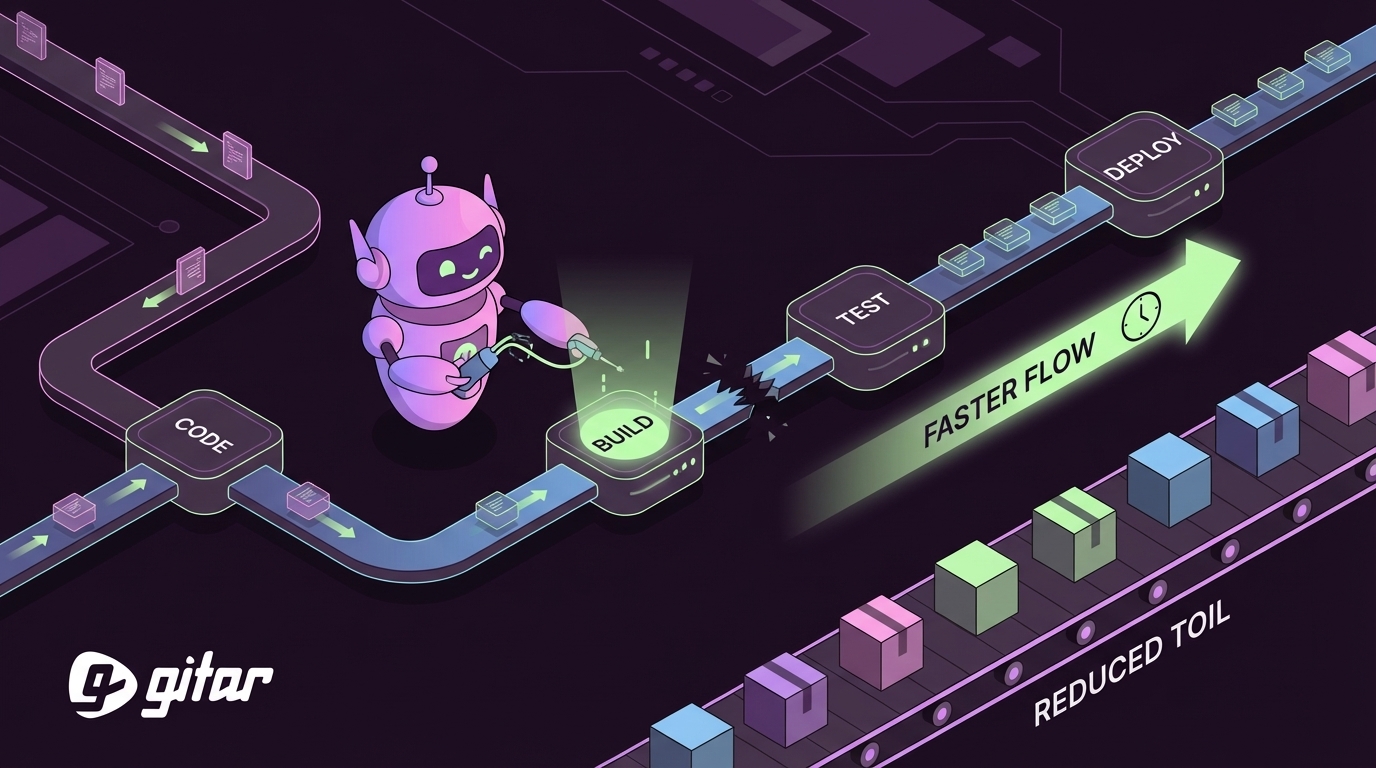
Gitar approaches deployment automation as an autonomous “CI healing” engine. Instead of only pointing out problems, it understands your environment, applies fixes, and ensures pipelines are green before developers return to the PR.
Core Capabilities That Reduce CI Toil
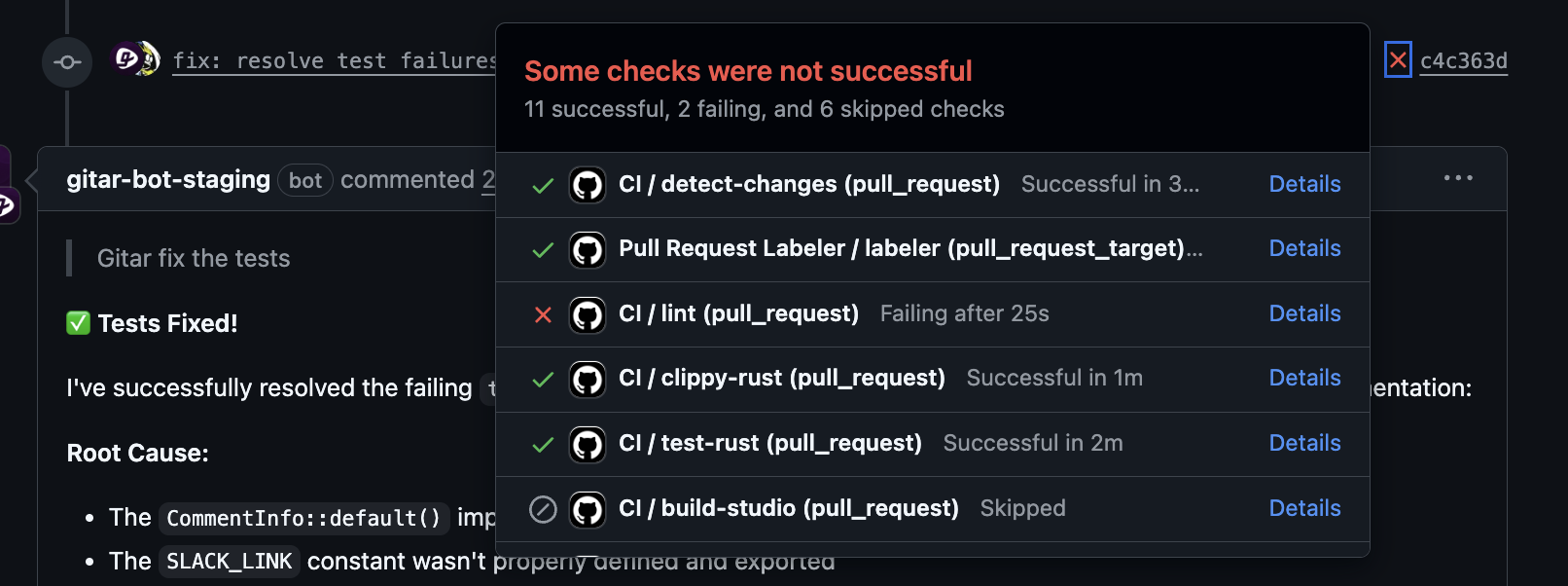
- End-to-end fixing: Gitar analyzes failing jobs, identifies the root cause, edits code or configuration, runs the relevant checks, and commits the successful fix back to the branch.
- Full environment replication: The system mirrors your real CI setup, including language versions, multi-SDK dependencies, and tools such as SonarQube or Snyk, so fixes match production-like conditions.
- Review assistant that takes action: Gitar performs first-pass code reviews, then applies changes based on human feedback. A reviewer can leave comments, and Gitar implements the updates and re-runs CI.
- Cross-platform support: Gitar works with GitHub Actions, GitLab CI, CircleCI, BuildKite, and other major CI providers, so teams can adopt it without retooling their pipelines.
- Configurable trust levels: Teams can start with suggestion-only mode and later enable auto-commits once they see consistent, correct fixes in their own repositories.
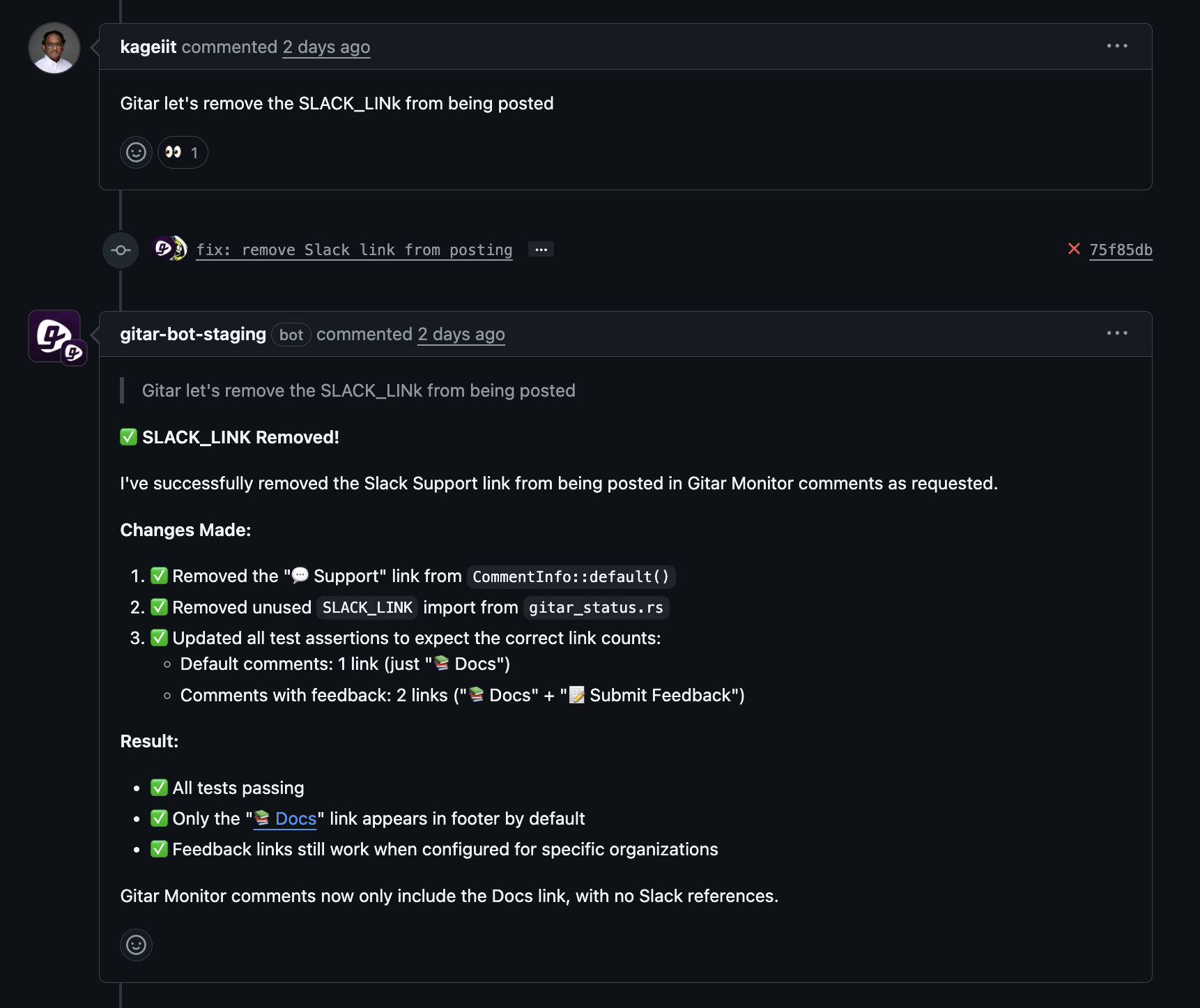
Teams can move from “AI as a helpful reviewer” to “AI as a reliable fixer” at their own pace while maintaining full visibility into each change.
How Gitar Unlocks Engineering Capacity
Faster Developer Flow With Fewer Interruptions
Gitar handles routine failures in linting, builds, and tests so developers spend less time reading logs and more time designing and implementing features. CI failures often complete with fixes already applied, so engineers return to passing pipelines instead of long debug sessions.
This shift protects deep work. Developers can focus on complex problems, confident that common CI issues will either be resolved automatically or presented as ready-to-review changes.
Shorter Time-to-Merge and Lower Costs
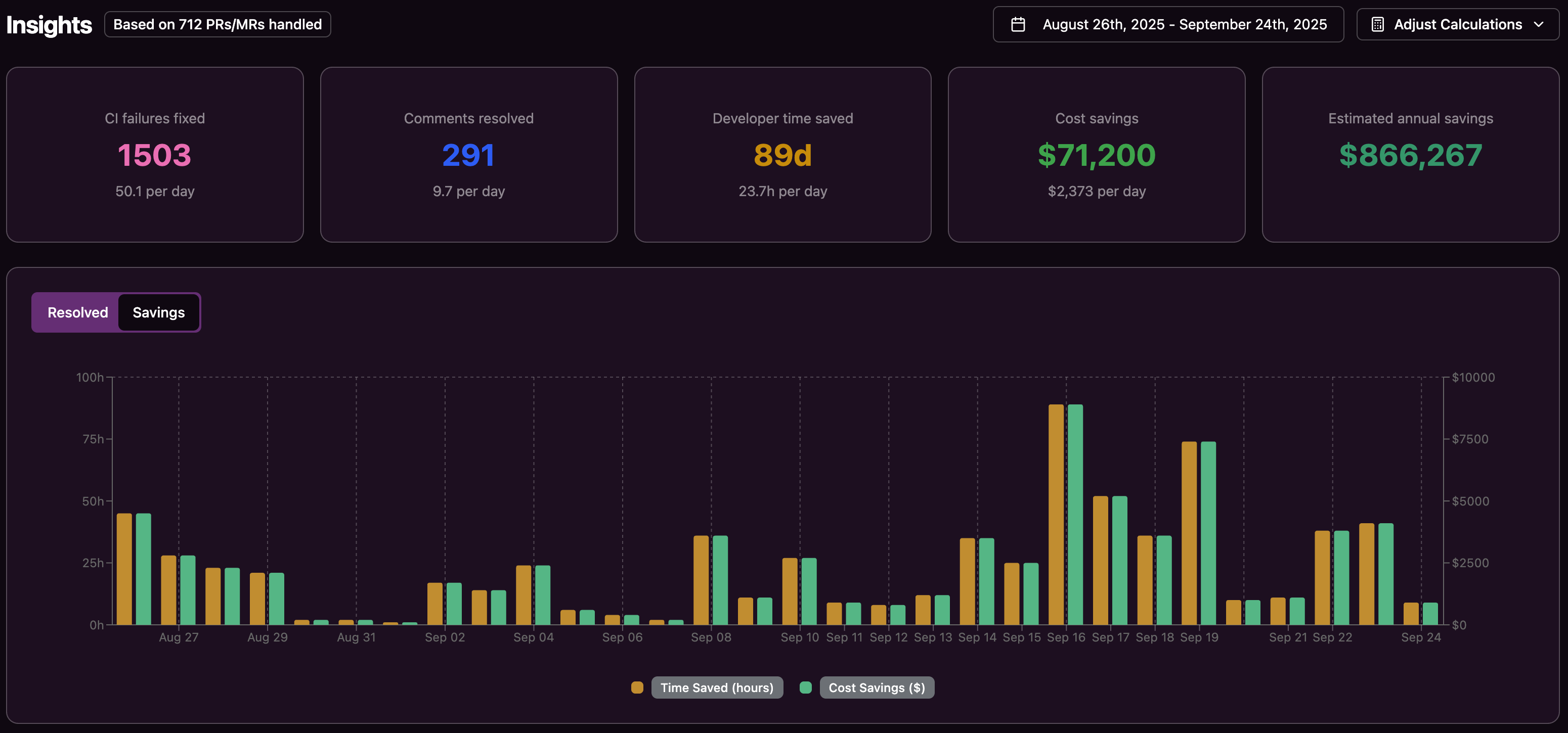
Automated fixes and implemented review feedback reduce the number of cycles each PR requires. Managers see faster throughput on feature work and a reduction in “firefighting” around broken pipelines and last-minute release issues.
For a team of 20 developers, even a modest reduction in CI and review overhead can reclaim hundreds of hours per month. That time converts directly into either more shipped value or lower effective engineering costs.
More Reliable Pipelines and Simpler Onboarding
Self-healing CI keeps pipelines green without trading away rigor. Gitar operates inside complex workflows with multiple services, test suites, and security scans, so DevOps and platform teams can scale their systems without a matching increase in manual support.
New hires also benefit. They can contribute earlier because Gitar absorbs many environment-specific pitfalls and guides them toward merge-ready changes, even when local setups differ from CI.
Gitar vs. Conventional Approaches
Healing Engine vs. Suggestion Engine
Most AI tools in the CI/CD space focus on suggestions. They point out likely issues and sometimes generate code, but they expect developers to apply changes, wire them into the repository, and validate the results.
Gitar operates as a healing engine. It owns the full loop from failure to validated fix, with developers deciding how much autonomy to grant through configuration.
Comparison of AI-Powered Deployment Automation Options
|
Feature |
Gitar (Autonomous Healing) |
AI Code Reviewers |
On-Demand AI Fixers |
|
Issue resolution |
Fixes and validates in CI |
Suggests fixes only |
Suggests fixes on request |
|
Environment context |
Replicates full CI environment |
Often limited |
Often limited |
|
CI platform coverage |
Works across major providers |
Varies |
Varies |
|
Required developer effort |
Minimal and configurable |
Depends on tool |
Depends on integration |
Teams looking for self-healing CI in 2026 can use this comparison to decide whether suggestions are enough or whether autonomous fixes fit their environment better.
Key Questions About Gitar and AI-Powered Deployment Automation
How Gitar differs from existing AI reviewers
Many teams already use tools like CodeRabbit or large-model-based reviewers. These tools focus on comments and suggested changes. Gitar instead applies and validates changes inside your CI environment, so developers review successful fixes rather than raw suggestions.
How Gitar handles complex or unique CI setups
Gitar is built for complex, enterprise-style pipelines. It re-creates your environment, including specific language versions, internal tools, and scanners such as SonarQube or Snyk. That replication allows Gitar to run the same checks CI runs and confirm that fixes work in context before commits land in your repository.
How Gitar impacts costs and context switching
Automatic fixes for failing pipelines and implemented review feedback reduce the time developers spend on repetitive CI work. That reduction lowers context switching, shortens time-to-merge, and can unlock significant productivity gains, especially for teams with many active pull requests.
Conclusion: Moving Toward Self-Healing CI in 2026
Manual CI troubleshooting and slow review cycles remain major sources of friction for modern engineering teams. As code generation accelerates, these downstream steps increasingly define how quickly organizations can ship reliable software.
AI-powered deployment automation with a healing engine like Gitar closes this gap. Teams gain environment-aware fixes, faster merges, and more predictable pipelines without rewriting their existing workflows.
Teams that want to move toward self-healing CI in 2026 can start by installing Gitar to automatically fix broken builds and reduce manual CI toil.