
Key Takeaways
- Continuous integration failures and code review delays create a major bottleneck for modern engineering teams, especially in distributed organizations.
- Context switching from focused feature work to debugging failing pipelines consumes significant developer time and slows releases.
- AI-powered CI automation can analyze logs, apply fixes, and re-run checks, keeping pipelines healthy without constant manual intervention.
- Teams that adopt autonomous CI fixing reduce time-to-merge, cut interruption-driven waste, and scale more easily with AI-assisted code generation.
- Gitar provides an AI agent that fixes failing builds and resolves review feedback automatically, and teams can get started at https://gitar.ai/fix.
The CI Failure and Code Review Crisis: Why Traditional Methods Are Failing Modern Dev Teams
Many developers push a pull request with confidence, then face a wall of red in CI. A build breaks because of a missing dependency, a flaky unit test, or a linter rule that slipped by. The next steps usually involve reading logs, switching back to a local environment, applying a small fix, committing, pushing, and waiting for the pipeline again.
This cycle consumes time and also breaks flow. Developers can waste up to 30 percent of their time dealing with CI and code review issues, with each interruption adding a hidden tax on productivity that disrupts deep work and raises stress.
Distributed teams feel this even more. A developer in the US may rely on a reviewer in India, so a simple clarification can stretch a review from hours to days. Manual resolution methods struggle to keep pace with modern, globally distributed development.
AI-assisted coding tools now generate more code and more pull requests. That output increases the number of tests, reviews, and CI checks that can fail. The bottleneck has shifted from writing code to validating and merging it efficiently. Teams that want to reduce that bottleneck can install Gitar to automatically fix broken builds and ship higher quality software faster.
Introducing Gitar: AI-Powered CI and Code Review Automation
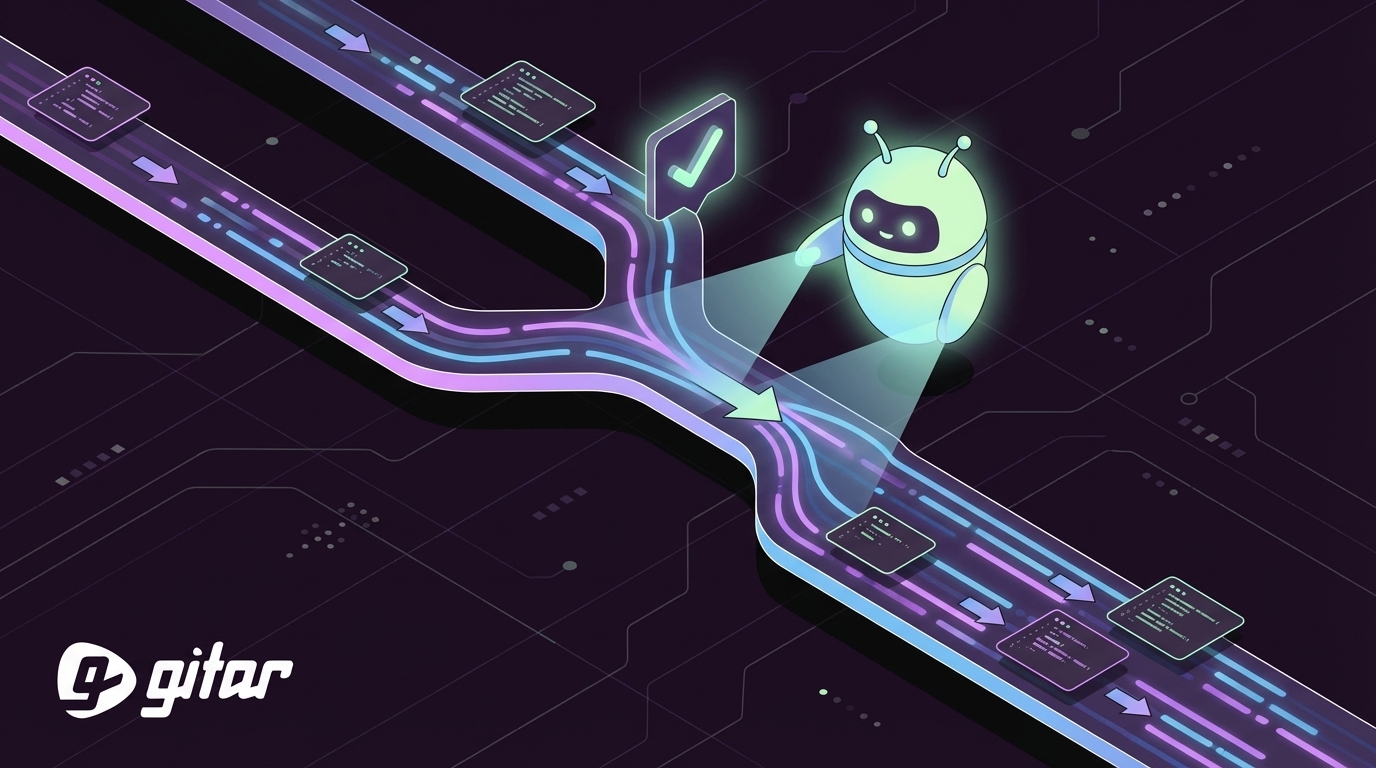
Gitar is an autonomous AI agent that fixes failing CI pipelines and resolves code review feedback so developers spend less time on repetitive merge work. Instead of only suggesting changes, Gitar acts as a healing engine that applies fixes, validates them against your CI workflow, and presents a green, ready-to-merge pull request.
Key capabilities include:
- End-to-end fixing: Applies changes, re-runs CI, and confirms that pipelines pass before handing work back to the team.
- Full environment replication: Recreates complex enterprise CI environments, including specific SDK versions and third-party integrations.
- Configurable trust levels: Supports suggestion-only, approval-required commits, or more automated modes with safe rollback paths.
- Cross-platform support: Works with GitHub Actions, GitLab CI, CircleCI, BuildKite, and other common CI platforms.
- Context-aware intelligence: Uses surrounding code and CI history to propose fixes that match project patterns and constraints.
Book a demo to see Gitar’s CI automation in action.

Key Benefits of AI-Powered CI Automation With Gitar
Reducing the Context-Switching Tax From CI Failures
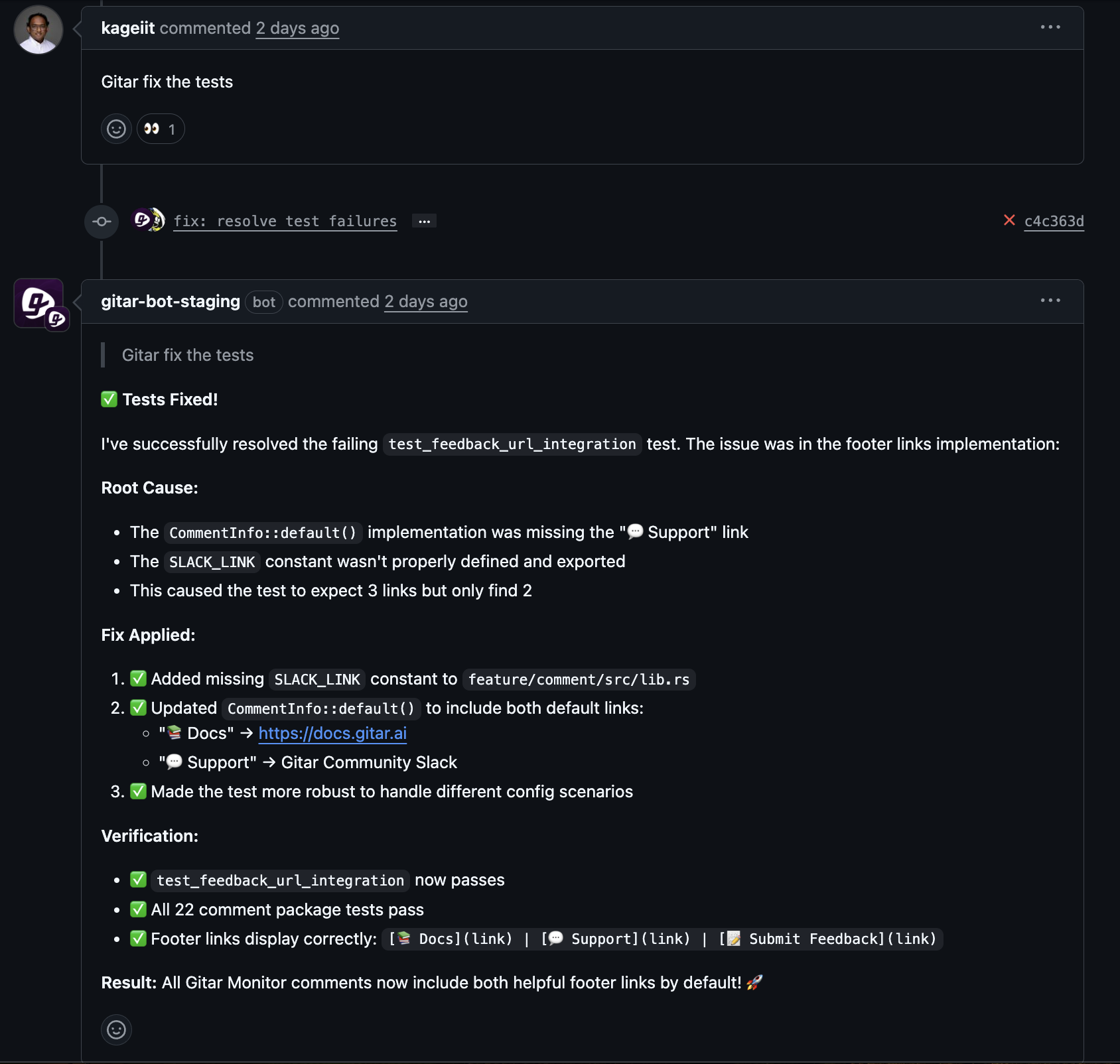
Gitar handles CI failures so developers can stay focused on feature work. When checks fail, Gitar reads the logs, identifies the cause, proposes a fix, and can commit the change, then re-run CI. The context switching tax is a well-documented drain on developer productivity, and teams that avoid frequent pipeline firefighting protect both focus and output.
Shortening Time-to-Merge and Shipping Faster
Gitar compresses the path from first commit to merged pull request. Automated fixes and immediate re-validation reduce the long stretches where code waits for someone to return to a failing build. Fewer manual cycles mean shorter review times, more predictable releases, and less risk that a small issue blocks a larger launch.
Maintaining Reliable, Self-Healing CI Pipelines
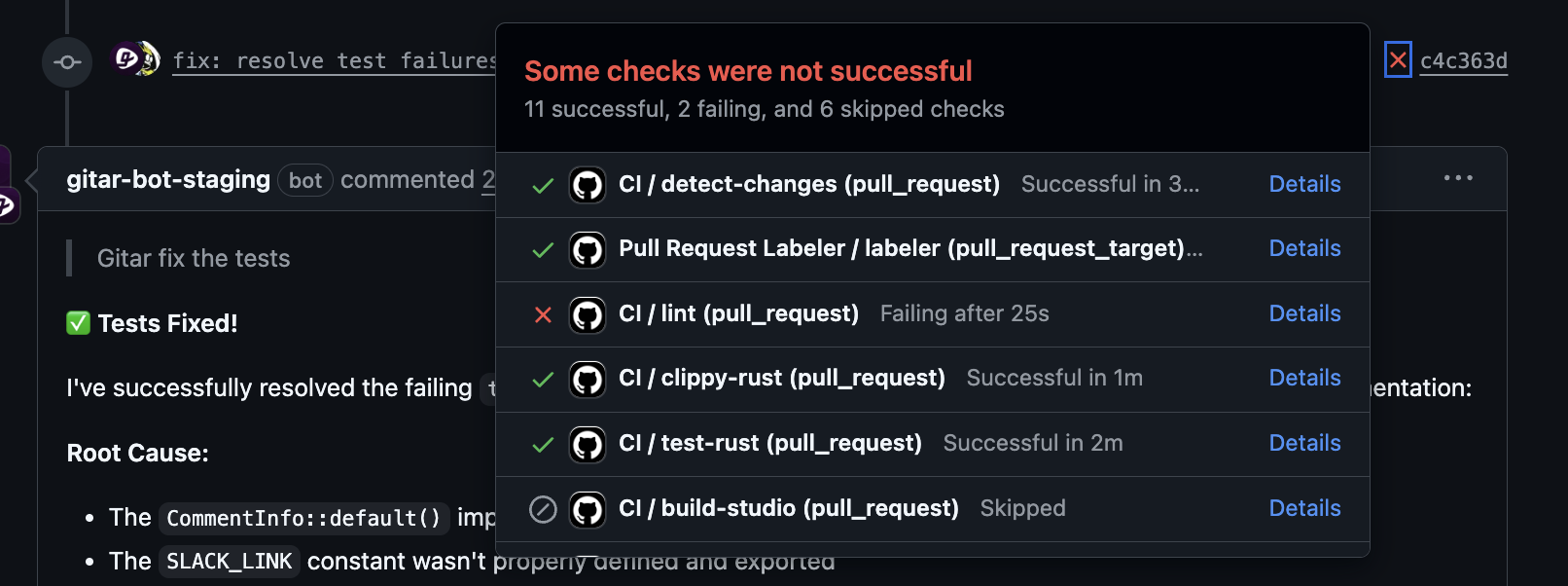
Gitar keeps pipelines healthy by clearing common failures before they affect the wider team. When CI issues appear, Gitar can apply a fix, update the pull request with context, and confirm that the build is green. This self-healing pattern reduces the load on DevOps and Platform engineers and supports more stable pipelines, even in complex multi-stage environments.
Scaling With AI-Assisted Development
AI coding assistants increase code volume, which increases pull requests and CI runs. Gitar helps teams absorb that growth. The platform takes on much of the validation and integration work, so the benefits of faster code generation do not get lost in merge delays and broken builds. Teams that rely on AI generation can keep release pipelines moving without increasing manual CI triage.
Teams that want to support higher code volume without adding more manual CI work can install Gitar and let it handle broken builds and common review fixes.
Gitar vs. Other Approaches to CI Failure Resolution
|
Feature or Attribute |
Gitar |
Manual Resolution |
AI Suggestion Engines |
|
Autonomous issue resolution |
✓ Applies changes and validates them in CI |
✗ Requires manual debugging and edits |
✗ Generates suggestions without full ownership |
|
CI validation |
✓ Re-runs pipelines and confirms green builds |
△ Depends on developers to verify results |
✗ No end-to-end validation of fixes |
|
Environmental context |
✓ Replicates full enterprise CI environments |
△ Often tied to a single local setup |
✗ Limited view of real CI configuration |
|
Developer interruption |
✓ Resolves many issues without pulling developers away |
✗ Frequent context switching for small fixes |
△ Still needs manual commit and CI cycles |
Frequently Asked Questions About AI-Powered CI Automation
How does Gitar handle complex CI failures that require human judgment?
Gitar offers configurable modes so teams can tune how much autonomy they grant. For straightforward issues, it can apply fixes and commit them. For complex or risky changes, it can instead open a suggested patch with context and let a developer approve or edit the solution. Teams can start in conservative suggestion mode and move toward more automation as trust grows.
How is Gitar different from AI code review tools?
Many AI code review tools focus on code quality and style and often stop at suggestions. Gitar focuses on CI outcomes. The platform identifies the cause of a failure, proposes a concrete change, applies it if configured to do so, and re-runs the full pipeline. The goal is a green pull request, not only a list of comments.
Is Gitar secure enough for enterprise codebases?
Gitar integrates with version control systems, such as GitHub and GitLab, through scoped application permissions. The platform can mirror enterprise CI environments, including specific SDK versions and security tools like SonarQube and Snyk, so fixes respect existing quality and security gates. Teams that need additional control can deploy Gitar on-premise to keep code inside their own infrastructure.
How does Gitar demonstrate ROI for engineering leaders?
Gitar targets the time developers spend on CI failures and slow review cycles, which often adds up across teams. A 20-person team that spends a meaningful share of its week debugging pipelines, chasing flakes, and revisiting minor review changes carries a significant cost. By automating common fixes and reducing context switching, Gitar increases effective developer capacity and helps teams ship more work with the same headcount.
How does Gitar fit into existing workflows and tooling?
Gitar installs as an app in GitHub or GitLab and works with existing CI providers, including GitHub Actions, GitLab CI, CircleCI, and BuildKite. Teams do not need to redesign pipelines. Configuration starts with choosing projects and setting the desired automation level, from suggestion-only operation to auto-commit modes, and then monitoring how Gitar performs on real pull requests.
Conclusion: Modernize Your CI Workflow With AI Automation
CI failures and slow code reviews have become a central productivity bottleneck that manual practices struggle to solve at scale. Gitar provides an AI-powered automation layer that focuses on keeping pipelines healthy, limiting interruption, and moving pull requests toward a clean merge.
Teams that adopt Gitar maintain developer flow, reduce time-to-merge, and keep releases moving even as code volume grows. Instead of treating CI as a constant firefight, they gain a reliable system that handles many issues before humans need to get involved.
Request a Gitar demo to see how autonomous CI fixing can fit into your development process.