
Key Takeaways
- AI coding tools speed up code generation 3-5x, yet manual reviews and CI failures still slow teams and can waste up to $1M in productivity each year.
- Gitar leads as the #1 free AI code review tool with automatic CI fixes, validating changes before committing to keep builds green.
- Competitors like CodeRabbit, Greptile, and Qodo only provide suggestions, require manual implementation, and charge $15-30 per seat without CI healing.
- Gitar supports unlimited repos, enterprise scale with 50M+ lines of code, and 30-second setup across GitHub, GitLab, and CircleCI.
- Teams save $375K+ yearly with Gitar automation, so install Gitar now for instant CI fixes and faster shipping.
How We Evaluated AI Code Review Tools
Our evaluation criteria focused on auto-fix and CI healing capabilities, free tier availability, integrations with Jira, Slack, and CI systems, scalability to 50M+ lines of code, single-comment UX design, and measurable ROI through hours saved. Sources include 2026 hands-on testing, developer forums, GitHub statistics, and real production cases such as Pinterest’s 50M+ line deployment. Each tool went through practical testing across real PR scenarios to provide verdicts based on real usage instead of marketing claims.
Top 9 AI Code Review Tools for 2026
1. Gitar: Free AI Code Review with Automatic Fixes
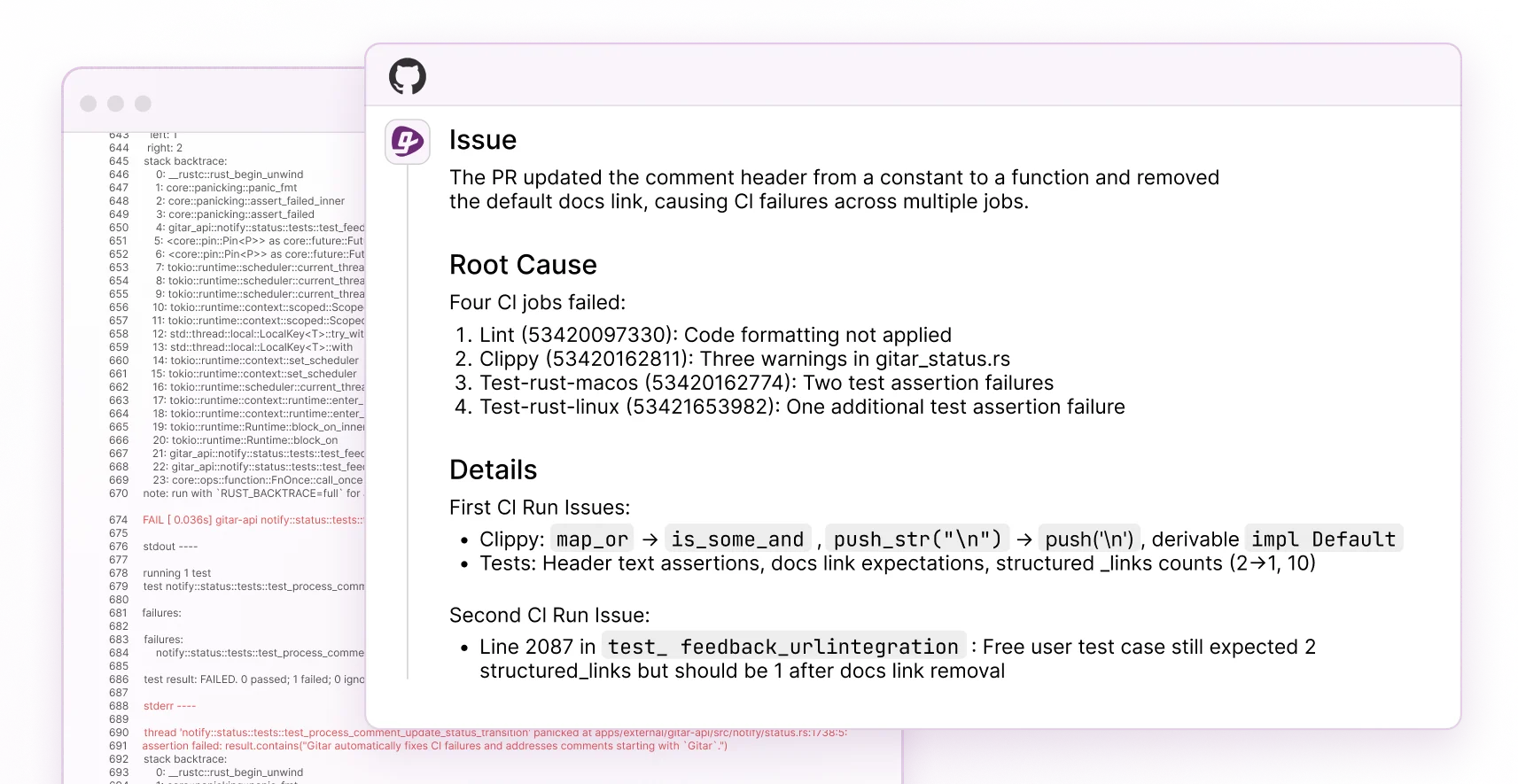
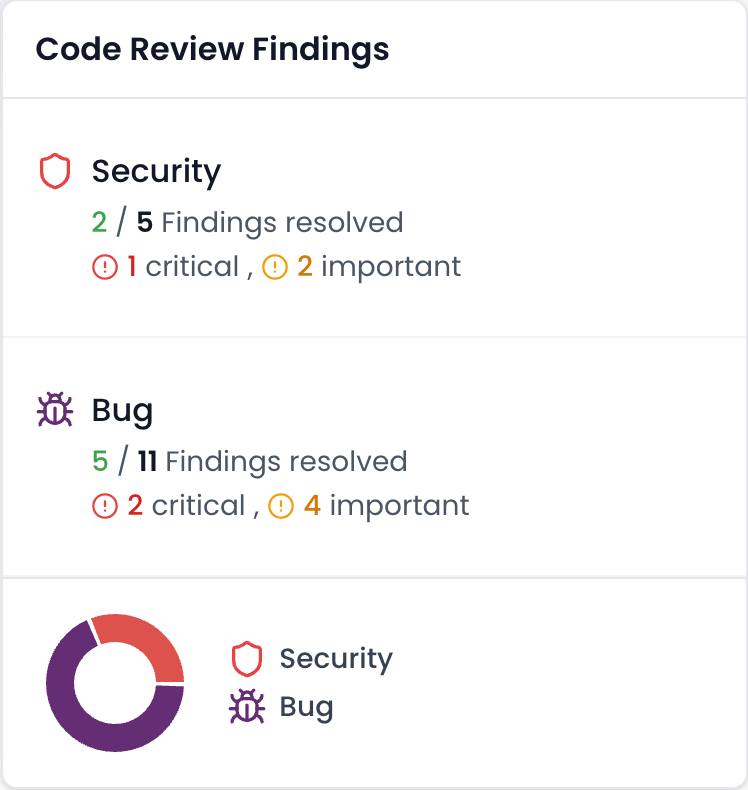
Gitar delivers free, comprehensive AI code review that fixes code instead of only suggesting changes. When CI fails because of lint errors, test failures, or build breaks, Gitar analyzes failure logs, generates validated fixes, and commits them directly to your PR. The platform uses a single dashboard comment that updates in place, which cuts notification spam while still providing PR summaries, security scanning, and bug detection for unlimited repositories.
Gitar’s architecture supports enterprise scale, including Pinterest’s 50M+ lines of code and thousands of daily PRs. The healing engine validates fixes against CI before committing, so teams get green builds instead of untested suggestions. Setup takes about 30 seconds with no credit card required, and auto-fix features include a 14-day free trial.
2. CodeRabbit: Suggestion-Only PR Analysis
CodeRabbit offers detailed PR analysis with 46% accuracy in detecting real-world runtime bugs using multi-layered analysis that includes AST evaluation and SAST. The platform provides inline suggestions, security scanning, and architectural feedback for $15-30 per developer each month. CodeRabbit does not apply fixes automatically, resolve CI failures, or support platforms beyond GitHub.
Users report limited context alignment, and the suggestion-only model still forces developers to implement and validate every change manually.
3. Greptile: Deep Codebase Context Without Fixes
Greptile focuses on deep codebase context analysis for $30 per developer monthly, giving teams a strong view of code relationships and architectural patterns. The platform shines at contextual suggestions that use full-repository knowledge instead of only single-PR analysis. Greptile operates as a suggestion engine without automatic fix application or CI integration.
The tool does not validate fixes against CI systems, so suggested changes may still fail builds or automated tests. Install Gitar now to automatically fix broken builds and remove manual CI troubleshooting.
4. Qodo (PR-Agent): Open Source with Setup Complexity
Qodo Merge provides open-source AI code review with self-hosting options and support for GitHub and GitLab. The platform offers PR summaries, inline suggestions, and basic security scanning across several pricing tiers. Limitations include confusing credit systems, expensive per-user pricing at $300 per month for 10 users, and no human approval workflows.
Self-hosting requires significant configuration and maintenance, with accuracy limits on complex codebases and surface-level analysis that misses architectural issues.
5. Bito: IDE-Focused Code Assistance
Bito plugs into IDEs to provide code explanations, security reviews, and performance suggestions, and it also connects to GitHub and GitLab for PR reviews. The platform offers free and paid tiers that support both individuals and teams. Bito does not provide full CI integration or automatic fix application, so it functions more as a coding assistant than a complete code review replacement.
The tool helps with real-time coding tasks but does not solve the PR backlog that teams face when they adopt AI code generation.
6. SonarQube AI: Security-First Code Review
SonarQube AI extends traditional static analysis with AI-powered security vulnerability detection, code quality checks, and AI CodeFix suggestions. The enterprise-focused platform delivers broad security scanning, technical debt analysis, and compliance reporting with CI and CD integration. SonarQube does not apply fixes automatically or resolve CI failures directly.
The platform also needs substantial setup and configuration, which fits large enterprises with dedicated DevOps teams more than fast-moving product teams.
7. GitHub Copilot Review: Native but Limited Automation
GitHub Copilot Review integrates natively into GitHub workflows and offers inline suggestions and basic PR summaries. The tool uses the same AI models as Copilot code generation to highlight potential issues and improvements. Copilot Review does not apply fixes automatically, analyze CI failures, or provide full security scanning.
The suggestion-only model keeps developers responsible for implementing and validating every change, which limits productivity gains for teams handling heavy PR volumes. Install Gitar now for CI fixes that are validated and ready to merge, not just suggested.
8. Cursor Extensions: IDE-Centric AI Workflow
Cursor AI extensions deliver an estimated 70-80% success rate for autonomous task completion, including debugging and test generation, with IDE-native integration for real-time help. The platform boosts individual developer productivity with a reported 55% average time savings on coding tasks. Cursor focuses on development-time assistance instead of PR review automation.
The tool lacks team-wide workflow integration and CI failure resolution, so it cannot replace manual code review processes for most teams.
9. DIY Claude or GPT Integration: Custom AI Review Pipelines
Custom LLM integrations using Claude or GPT APIs let teams build tailored code review workflows with specific prompts and automation. CLI tools like Claude Code and OpenAI’s Codex CLI can read files, run tests, and perform multi-step fixes inside project directories. DIY approaches demand significant engineering effort to build infrastructure, connect CI, and keep systems reliable.
Teams must design their own fix validation, error handling, and workflow automation, so this path fits organizations with dedicated platform engineering resources.
Side-by-Side Comparison of Auto-Fix Capabilities
| Tool | Auto-Fix/CI | Pricing | ROI/Savings |
|---|---|---|---|
| Gitar | Yes, validated fixes | Free | $375K+ annually |
| CodeRabbit | No, suggestions only | $15-30/seat | Limited, manual work required |
| Greptile | No, context only | $30/seat | Minimal, no automation |
| Qodo | No, analysis only | $300/10 users | Setup overhead reduces gains |
What Teams Should Weigh Before Choosing a Tool
Developers need less noise and fewer context switches during review. Engineering leaders look for measurable velocity gains and clear ROI from any new tool. Platform engineers focus on CI cost reduction and simpler workflow maintenance.
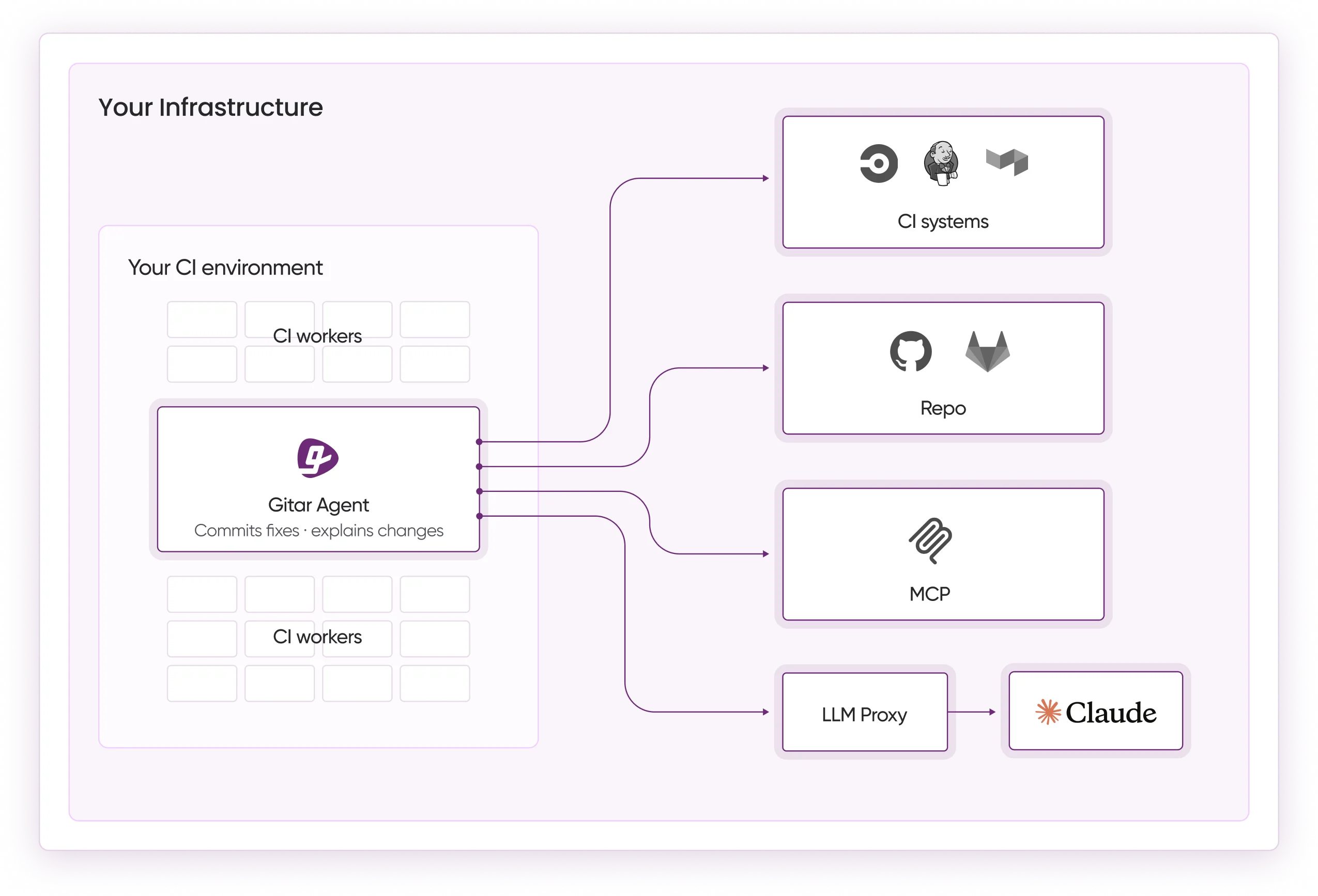
Common objections include doubts about free tool sustainability, concerns about trusting automated commits, and worries about complex CI environments. Gitar addresses these with configurable automation levels, validated fix application, and enterprise deployment options that run agents inside existing CI infrastructure with full access to secrets and caches.
Frequently Asked Questions
Best Free AI Code Review Tool in 2026
Gitar stands out as the most complete free AI code review platform, with unlimited repositories, PR analysis, security scanning, and bug detection, all without seat limits or credit card requirements. Competing tools charge $15-30 per developer for suggestion-only workflows, while Gitar includes automatic fix application with a 14-day free trial, CI failure resolution, and a single-comment UX that cuts notification noise.
Gitar vs. CodeRabbit for Productivity Gains
CodeRabbit offers suggestions that developers must implement and validate by hand. Gitar instead fixes CI failures automatically and applies reviewer feedback through validated commits. Teams often see more than 50% reduction in manual review effort with CodeRabbit, but Gitar pushes further by guaranteeing green builds and removing the manual implementation bottleneck.
How to Measure ROI from AI Code Review Automation
Teams can track time saved on CI troubleshooting, review cycles, and context switching interruptions. A 20-developer team often loses around $1M each year to review and CI friction, with developers spending about one hour daily on these tasks. Gitar cuts this to roughly 15 minutes through automated fixes, which delivers $375K+ annual savings even at 50% effectiveness, while also removing separate code review tool costs.
CI Integration Effort with Gitar
Gitar setup takes about 30 seconds through the GitHub App or GitLab integration, and no separate account is required. The platform immediately starts posting dashboard comments on new PRs and automatically detects CI failures across GitHub Actions, GitLab CI, CircleCI, and Buildkite. Enterprise teams can run agents inside existing CI infrastructure for maximum security and richer context.
AI Development Productivity Trends for 2026
Repository intelligence that uses AI to analyze code relationships and history now supports automated fixes for teams using AI code generation. Agent-based systems replace single-task automation with multi-step workflows, and open-source solutions emphasize interoperability and strong governance. The market is shifting toward free foundational tools with premium platform features, as AI-assisted code review becomes standard infrastructure instead of a premium add-on.
Conclusion: Why Teams Choose Gitar Next
Gitar outperforms competitors by combining free auto-fixes with clear, measurable ROI, while other tools charge premium prices for basic suggestions. The healing engine validates fixes against CI and keeps builds green, instead of leaving teams to hope that manual changes work. Installation takes about 30 seconds and immediately delivers value through automated CI failure resolution.